• GANTOB Books
  • About GANTOB
  • Re-enactments of GANTOB
  • LITTLE GRAPEFRUIT AT SEA (COMPLETE TEXT)
  • ESEMPLASTIC (THREADS part 1) (by GILLIAN)

    Mar 3rd, 2024

    Last night, following agreement with The Photographer and the Edinburgh branch of the GANTOB team, 10 numbered and signed copies of The Photographer’s Edinburgh-based booklet “6 Times” were distributed to 5 independent bookshops in North Edinburgh. These were disseminated by the food and literature delivery rider. Previously his work for GANTOB has been to deliver parcels to specific individuals who were expecting the items (e.g. a copy of the first book to people who had sent a question to be answered in that book).

    Last night, however, our faithful rider described the process of delivering unexpected pamphlets to shops under the cover of night as equivalent to “literary cold calling” or “backwards burglary”. In the latter term, we can hear clear echoes of Missi Formation’s description of pamphlet drops in Little Free Libraries and charity shops last August, in an effort to promote the original Kompetition, as akin to “reverse shoplifting”. GANTOB (the project) is meant to make you feel a bit awkward or edgy. If you received a copy of The Photographer’s booklet through these efforts, please get in touch through the usual channels, perhaps mentioning the bookshop and your response to the booklet.

    WARNING: Not all that you will read below is true. Some of it is misdirection, elaboration or confabulation to put certain individuals off the trail. GANTOB is, and must remain, an anonymous project.

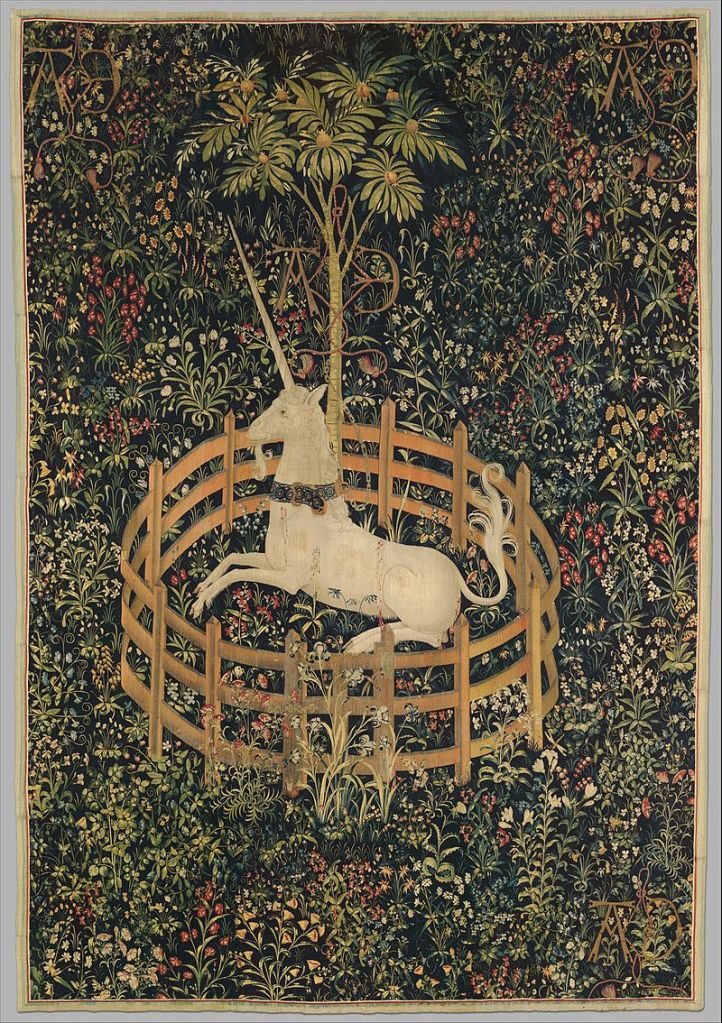
    Cover photo credit is to The Photographer. Unicorn tapestry photo is from Wikipedia.


    I handed over the baton of the week-to-week running of the 52 Pamphlets project a couple of weeks ago. There is a new GANTOB (the person). GANTOB3. I cannot go into details of the numbering, and do not know the name of my replacement, only their personal email address, which gives no clue to their identity. I can say that, after local advertising, the heart of the project remains in Badenoch. I had a lot of materials to hand over. It made sense to do it in person. I deposited my box of GANTOB paraphernalia at the bus shelter along from the Highland Wildlife Park, tucked into a corner against the wall, safely under cover. I remained close by, parked in a layby concealed by trees, lights off, until I received the message that it had been safely retrieved.

    This means that the only consistent participant in the GANTOB project since August 2023 is The Benefaktor. Please don’t hold that against the project. He is not a “golden thread”. But more on that later.

    I am now simply Gillian. I will continue to contribute, but as writer rather than project manager. I don’t think that I need to justify myself or apologise. I remain the founder of GANTOB, and am proud of everything that we – the GANTOB committees, GANTOBers – have achieved since July 2023.

    My paid work is settling into a routine, in the job I started at the end of 2023. I am coping reasonably well with doing my telesales calls from the croft (I am dropping the “K”s; I am leaving stress behind). I never work beyond my hours and I’m hitting my targets. But that honest toil doesn’t define me.

    Beyond work I have been feeling increasingly restless over the past few weeks. It must be the approaching spring. Even in the Scottish Highlands it arrives eventually. Snowdrops droop their heads in the eddies of wind around the base of our solitary tree. I didn’t know where to expect them in our new place. I can walk outside without a torch until after 6PM. And I feel the creative juices stirring.

    I have been drawn increasingly outside the KLF’s sphere. Stuart Huggett started it, in his piece The Gate is Open. And then Urs’ pamphlet Hawthorny. Both pointed me towards William Blake. And in subsequent emails, Stuart directed me to John Higgs’ books on the subject, and beyond. I read Higgs’ 2019 book William Blake Now (Why He Matters More Than Ever) in an afternoon a couple of weeks ago, between chores. It fired me up. As my family frequently remind me, my creative ambitions are not borne out by my grades in my final year at school in the late 1980s. But that was through lack of trying, or immaturity. I found the books we were reading uninspiring. Why couldn’t we read more contemporary books, like Barry Hine’s Kes (1968) or JL Carr’s A Month in the Country (1980) – two of the only course books that I enjoyed reading at school? I couldn’t be bothered with Jane Eyre, Shakespeare or Dickens at that age. Now, in my 50s, I’m keen to learn, but on topics of my own choosing.

    Higgs’ explanation of the problems Blake experienced in his life, and his current relevance, lifts a veil, particularly the chapter “Once Only Imagin’d”. Moving quickly from Blake to Albert Einstein and Samuel Taylor Coleridge, Higgs provides a compelling explanation for the difference between reason, imagination and fantasy, finishing with the Coleridge coined term “esemplastic”. This is the process in which “separate elements are combined to create something entirely original”. Fantasy is a “collage” of existing elements, but without changing them (he uses the idea of a unicorn, which can be understood as a combination of horn and a horse). Imagination moves us on to new intellectual terrain; it is required when we need to “go outside of established reason in order to find answers”. It’s a slippery concept, but I like it and I’m going to try to live by it. I am considering sending Higgs this pamphlet when it’s finished, to see if he will write a response.
    I jotted down some notes while reading Higgs’ book. Golden string (p7), golden thread (p8 and p62), “a Class of Men whose whole delight is in Destroying” (p19), duality (p23), the constructive and collaborative joy of playing a musical instrument (p34), previous Bill Drummond collaborator Neal Brown* (p39), Paul McCartney and Ginsberg (p51), “the competitive, antagonistic and obviously wrong view of the world… being nurtured in exclusive private schools” (p64), the recent failures of British politics (p65), the need for a new Beatles to save us (p67), hopefully without ditching the old Beatles. There is so much that I can relate to here, as evidenced in the first two GANTOB books, but also things that I have stored in my head for further exploration in the GANTOBverse. A cornucopia; a horn of plenty. Not attached to a horse. I kick the ideas around in my head for a day and then sit down to write because it’s still raining outside. I am hoping to create something new.   

    I have thought frequently in the past about Kurt Vonnegut’s 1963 book Cat’s Cradle. It’s been almost 30 years since I read it, sitting in a plane on my way to America for the first time, October 1994. I have not read it since, and no longer have a copy. But my takeaway at the time was of the strands that appear to connect some of us. That even in chance encounters separated by many years we can take up where we left off, comfortable, content to make each other’s acquaintance again. And how with some other people – even perhaps those with whom we might appear to have a lot in common – there appears to be no route in, and we are left feeling ill at ease in their company. I may have misremembered this aspect of the book, but I won’t let that hold me back. I can group some of the GANTOBers into the former category. Many of my regular correspondents catalyse ideas and avenues for further exploration when they get in touch. I don’t think that Urs would mind if I said that she is more in the second category, even though we have a shared “interest” in The Benefaktor. Not a love interest for either of us.

    I have mentioned Cat’s Cradle to various people over the years. Googling the book now I cannot see any mention of these points about connection, or its absence. There is a lot of detail about plot and characters. Sounds very complicated. In fact, in its setting and some of the themes, it makes me think of the island setting of parts of The JAMs’ 2017 book 2023: A trilogy. But with Vonnegut’s fictional island (San Lorenzo) off the north east coast of South America, and The JAMs’ Fernando Po off Equatorial Guinea on the west coast of Africa. Reading about it with fresh eyes, I see that Fernando Po is a direct lift from Robert Shea and Robert Anton Wilson’s book The Illuminatus! Trilogy (1984). Both Cat’s Cradle and the two Roberts’ Trilogy have the nuclear threat of the Cold War looking over them. And the secret religion in Cat’s Cradle – Bokononism – is curiously close to the island of Fernando Po’s current name – Bioko (since 1979). Is this “apophenia”, as I learnt from Andy Gell’s pamphlet (under the pseudonym Capt. Apophenia), or intentional on the part of the two Roberts? Certainly there is reference to another Vonnegut book (Slaughterhouse-Five) throughout their trilogy. “So it goes”, as they say in both books.  

    Golden Threads. Credit: The Photographer

    I am left haunted by the idea of metaphorical strings connecting some people – and ideas – but not others, like the childhood game of cat’s cradle. Threads. Not the BBC drama on nuclear holocaust (1984), which I am surprised to see is also by Barry Hines. No, I’m thinking about William Blake’s golden string, and where that might take us. Not to wind into a ball to lead to Heaven’s gate as Blake writes (and not the gate that Stuart mentioned in his pamphlet). Instead I’m remembering the golden thread from my project management days before I ditched that job to have my kids. The path that leads you from cause to effect, that allows everybody to understand what the project (or organisation) is doing and what it’s for. I can’t find a reference that tells us who first proposed the term golden thread, and how it’s become so widely adopted. I see a government report from 2018 – a response to the Grenfell Tower – that claims the concept for its own, but I know that it was really introduced decades before. And I’m left trying to remember what Higgs wrote about another tower block in London, though in a different borough – William Blake House.

    I have handed over the reins of GANTOB to GANTOB3. The first two months, the majority of which was under my steerage, have seen something of a connection in the pamphlets, even with Urs. And recently Mr Gell’s trilogy introduced me to enough of the two Roberts to see a connection with this pamphlet’s themes. GANTOB3 will need to do some sort of project management, even if it’s not the kind you learn through formal training. The idea of a golden thread is quite an intuitive concept. No need for PRINCE2 methodology, or whatever they teach now.

    And I want to end this pamphlet with a note on synaesthesia, a neurological condition that affected Blake. In his recent pamphlet, The Benefaktor mentioned that Franz Liszt, the Hungarian composer, had this condition. He saw music in colours. I wonder what it would take to see his vision by listening to his music. Has anybody cracked the code? There are lots of different types of synesthetes, who may, for example, taste words or link colours to the days of the week. Flicking through the index to John Higgs’ second Blake book (2021) this week I spotted a section on synaesthesia. Apparently Billy Joel is a synesthete. “And so it goes”, as he once sang. I reach for my phone to order Cat’s Cradle from the Highland Council mobile library.(+)

    Gillian, 3 March 2024

    Inspired? To contribute a pamphlet please visit gantob.com/pamphlet

    #GANTOB2024 Pamphlet 11 of the #52Pamphlets

    * Mentioned in Penkiln Burn pamphlet 22 “Roll over Jenny Holzer”

    + Artistic license is at play here. The van’s schedules and library stocks meant that I would have had to wait a couple of months for the book. I have relied instead on World of Books. To be continued in THREADS part 2 (once I have read Vonnegut’s book again, made notes, and had a bit of time to consider what I have learnt in the process).


  • PILES (by KATIE)

    Mar 2nd, 2024

    This blog is contributed by – by my reckoning at least – the youngest of the GANTOB collaborators.

    Katie submitted it to me three weeks ago, since when I have been exploring, GANTOB style, the possibility of recruiting experts in the topics to answer some of the questions that have emerged. So far I have not had success on this particular topic. But as The Tillerman once said, in a slightly different order:

    “GANTOB was relentless 

    GANTOB was exhausting

    GANTOB became an inspiration”

    That’s me.

    We have two strands at play in the 52 Pamphlets project at the moment.

    One is a golden thread of ideas and inspirations that seems to be weaving its way from William Blake to American counterculture in the 1960s, and then a couple of other destinations, before attempting to explain some outstanding mysteries in the world of K.

    The other strand is an interest in the mechanisms behind generating and disseminating ideas, particularly in the form of pamphlets. Katie’s piece is very much in this category, and therefore most welcome in providing balance to the blog. And she does, of course, by nature of her relationship to the funder of GANTOB, have some particular insights that we probably wouldn’t hear from anybody else.

    Last summer there were lots of GANTOB pamphlets disseminated across the UK, with the aim of promoting the original Kompetition. Over the winter – and with my change in job from travelling salesperson to telesales operator – the approach has shifted online, with blogs and electronic dissemination of longer pieces – what we’re calling pamphlets, but are really just 0s and 1s in the digital realm. With the peak of the spring bulbs upon us and lengthening days extending our range outdoors I think that we’re ready to return to a more physical approach.

    So I am excited to say that 10 copies of The Photographer’s piece 6 Times, uploaded to the blog yesterday, have been printed in a booklet and are being disseminated overnight to selected independent bookshops in north Edinburgh. These will be delivered by the food and literature delivery rider who has worked shifts for the project at various stages. I have no idea what the bookshops will make of the pamphlet/ booklet. Perhaps they will recycle them. But hopefully they will place them on the counter ready to be picked up. GANTOB (the project) thrives on collaboration, and some new participants recruited through these booklets would hopefully take the 52 Pamphlets book (published January 2025) in new directions.

    Over to you Katie, or should I say “The Foundation Doktor”.


    I leave the hospital on time for once, and hunt down a bus from the strip of stops strategically placed between car parks. No bike for me tonight. Some idiot has locked their frame onto mine at the bike shelter. I refrained from retaliating by locking mine onto his. Has to be a bloke.

    I catch the next bus into central Edinburgh and walk down the cobbled streets to my grandparents’ flat. There is still some light in the sky as I take the shortcut along Saxe Coburg Street towards Stockbridge. I can hear the cats before I open the door into the lobby. They are standing on hind legs, crying behind the inner glass door, furious. They are hours late for their evening feed. I shut the front door, securing the airlock between their world and outside. They force me to dish out their dry food before I can start on the errand that my grandfather had tasked me with.

    “To The Foundation Doktor,” the diktat started, “we are going to be away for a few weeks, on ‘kultural activities’. Please could you flat/cat sit? It will be a great opportunity for you to stretch out after the constraints of your digs. I wonder if you could also help with a projekt that I am exploring for a GANTOB pamphlet. I’ve left everything you need beside my desk. A few leads. The cats need 23 grammes of salmon pellets in the morning, and the same amount of chicken at night. And the usual business with the litter tray. Gratefully yours, The Benefaktor”.

    And a few minutes later, from my granny Urs: “Thanks for doing this. Don’t forget to top up the water every day. Have a few friends round if you like, but don’t go wild”.

    What do they think I do all day? I have another set of 12.5 hour night shifts coming up. I would much rather roll out of bed in the hospital accommodation and toddle along to the wards than have to bus or cycle all the way to the other side of town. And I have a couple of weekends away planned. I called my granny, but they were off already, heading to an undisclosed location in Europe. “I’m sure it’ll be fine dear. Must go.”

    I locate the extra key that my grandfather keeps in a freezer bag in the coffee beans at the bottom of the chest freezer and let myself into his study (“The Kino”). I have rarely been inside. Recently it’s only been for GANTOB discussions, until Urs was inducted into the secret after asking about the grapefruit logo that turns up whenever we are logged into the shared GANTOB accounts on our phones. The desk is situated between bookcases of film reels and boxed papers. The blinds are drawn to protect the paintings and spines of the books on the wall behind me from the afternoon sun. No risk of that in February.

    There are piles either side of the desk, others spilling out of the in tray onto the desk, and even some propped up papers on his revolving chair. What a mess. He’s obviously been flat out on one of his hare-brained schemes. I check the spelling (hare or hair?) and the definitions: “ill judged”. Is that a fair criticism, after everything that I’ve done to enable him? Probably.

    I skate over the books. They look heavy (topic wise). The FT and Guardian piles are precarious, so I ignore them. I sit down with the top few issues of London Review of Books. Not the sealed ones, some going back years, in white envelopes or recyclable wrappers. There’s a reasonably recent one – 30 November 2023, and it’s opened to page 22-23: “A National Evil”. On the surface, it’s a medical piece. Quite interesting really, about iodine deficiency and supplementing salt in Swiss cantons. But I’m not at work, and I’ve done enough revising recently for Membership exams. But there is also a lot of social commentary and cultural interest. It’s clearly caught my grandfather’s attention. There’s a little yellow sticky marker beside a paragraph on the first page. It’s about a GP called Heinrich Hunziker: “Hunziker was also a poet, who wrote short, formally precise verses of yearning and revelation that he published in slim volumes”. The yellow arrow points at the last two words. “Pamphlets? Must get” is written in The Benefaktor’s distinctive back slanting capitals. On a Post-It note he has listed a few titles and prices, from Abebooks and a couple of Swiss and German bookshop websites. I wouldn’t put it past him. Searching them out on my phone I reckon that some of the titles are by the wrong Hunziker, and others are too late to count as his early slim volumes. Hunziker, born 1879, died 1982. Jonah Goodman in The LRB is writing about the 1910s. But the relatively easy to find Die Idylle vom Holz that The Benefaktor has listed is from 1951. We need to rewind 40 years. I poke around a bit on a few websites, but there are too many false leads, and I don’t speak German unfortunately. I wonder what he’s looking for, but I know that he loves a bit of intrigue. “Revelation”. That would be enough of a catalyst. I wonder if this is something that the libraries he frequents could help with. But perhaps it’s tricky if it’s in German. And what role did pamphlets have in Hunziker’s medical work, persuading Swiss politicians that a centuries old problem affecting hundreds of babies every year had a quick fix?

    I wonder if that’s everything that my grandfather is looking at. “A few leads”. Well, I’ve hit a brick wall with this article so I turn on a few pages. Quite a few pages. These are long articles! There are no further handwritten notes about Hunziker. But the next article, “How to Plan an Insurrection”, has more of the neon stickies. A piece by Niamh Gallagher on James Connolly, Scottish revolutionary, born to Irish parents, grew up in Cowgate, Edinburgh, executed in 1916 following the Easter Rising. My grandfather has marked out the following section: “and like many of the Scottish socialist activists of his generation, he was a prolific journalist, producing pamphlets and essays…”. And there is another list of references that he has tracked down from an internet search presumably. This is well outside the comfort zone of GANTOB and her art project. From what I can see from a quick internet search, the text of at least some of these pamphlets is collected in various books. But if I know The Benefaktor he will be seeking out originals, or finding out what became of them.

    “Legacy”. When you’re 83 years old (like a lot of my patients) many people give up any interest in that word. They’re caught up in their own issues, where they’re going to live, wondering when their family are going to visit. Not The Benefaktor. He is caught up in his projects (and projekts). Have his cultural investments allowed others to get their message out there? Is his name in the programme, the sleeve notes, the credits? (In kontrast, he keeps his name out of GANTOB’s kultural aktivities to avoid kross kontamination).

    So, what is he planning? I think back to regular GANTOBer Missi Formation and her request to hear less of The Benefaktor. But also her claim to be an anarchist and her goading about the cosiness of some of the December 2023 posts on the GANTOB blog. And recalling the “Welcome to the Dark Ages” stuff from Capt. Apophenia’s recent pamphlet “The Magic Number” I remember that revolution was in the air in The JAMs’ book 2023 (which I still haven’t finished). But that is not what GANTOB (the projekt) is about. Then again, some of the advice in the first GANTOB book was pretty edgy. There were quotes on Death, War, Protest. A picture of a burning figure on a bridge. But surely The Benefaktor is not planning to break out, foment riots. There’s an Alan Moore quote in one of the chapters: “Don’t leave home without your sword – your intellect.” No, I cannot accept that The Benefaktor is planning anything more than writing about these subjects.

    I’m exhausted after all this reading and searching. Violence is not my thing, even on TV. I log on to Netflix on my laptop and flick through the list of romcoms that are suggested. It knows me too well. But there’s nothing that appeals. I am unsettled. I head to bed and scroll through dozens of posts about kittens, and puppies, the Japanese macaque that had just been recovered near the Highland Wildlife Park in Badenoch, another about a fugitive raccoon in Sunderland. That’s more like it.

    That night, sleeping in my grandparents’ spare room, I dream of towers. I’m surrounded, speeding through a city, but viewing it from above like a computer game or drone. At first I think it’s New York, from the height of the buildings and density of the streets. But then I realise that it’s George IV Bridge, looking down onto the Cowgate. Layer upon layer of windows, families, lives. But something is different. Gas lamps on the streets. Candles in windows. And a glimpse of a figure bent over books scribbling ideas for pamphlets. I detect an urgency, a clear sense of purpose. Did pamphlets ever change the world, in Switzerland, Scotland or anywhere else, and how would we know? And I suspect that is the task that The Benefaktor has set us. Submit your responses to this question, in the form of a pamphlet, via gantob.blog/pamphlet

    Katie, uploaded 2/3/2024

    Number 10 in the #52Pamphlets

  • 6 TIMES (by THE PHOTOGRAPHER)

    Mar 1st, 2024

    I was sent a draft pamphlet by an acquaintance of The Benefaktor – The Photographer – a couple of days ago. It was called “Surfacing”. It came in at 1600 words. I liked the general thrust of the piece, but felt that it needed some development. The Photographer replied this morning with this extended piece with its new title. It is, in effect, a triple pamphlet – 3 x 800 words. It is not a trilogy. It is a single piece. And it is one of several that were battling for pole position for this weekend’s slot. All have some time pressure, either because of the specific date, the changing season, the originality of the ideas, or the knowledge that a deadline can help some people fulfil their commitments. I have therefore made the decision – for now – to issue pamphlets more regularly than once a week. Watch the blog for more – and subscribe to receive email updates. If the plan works we may have 52 pamphlets in time for The Battle of Perth (in Stirling), 27 August 2024, but that is perhaps a tall order. We’ll see.

    I have issued this in a printed edition of one to The Photographer as a booklet. Not quite the RLS or Welsh volumes, but quite a handsome volume nonetheless.

    Feel free to re-enact it if you wish – either word-for-word, picture-by-picture, printing it out as a foldable volume, as I believe some may be attempting with Bill Drummond’s spoken word novels. (If you do recreate The Photographer’s piece as a booklet please send me a copy and I will link to it here. It will need to be in A5 booklet format). Or write your own travelogue of your life and travels and submit it as a pamphlet to 100percentvinyl2@gmail.com as part of the 52 Pamphlets. Or just simply enjoy The Photographer’s response to what sounds like a rather eventful few days.

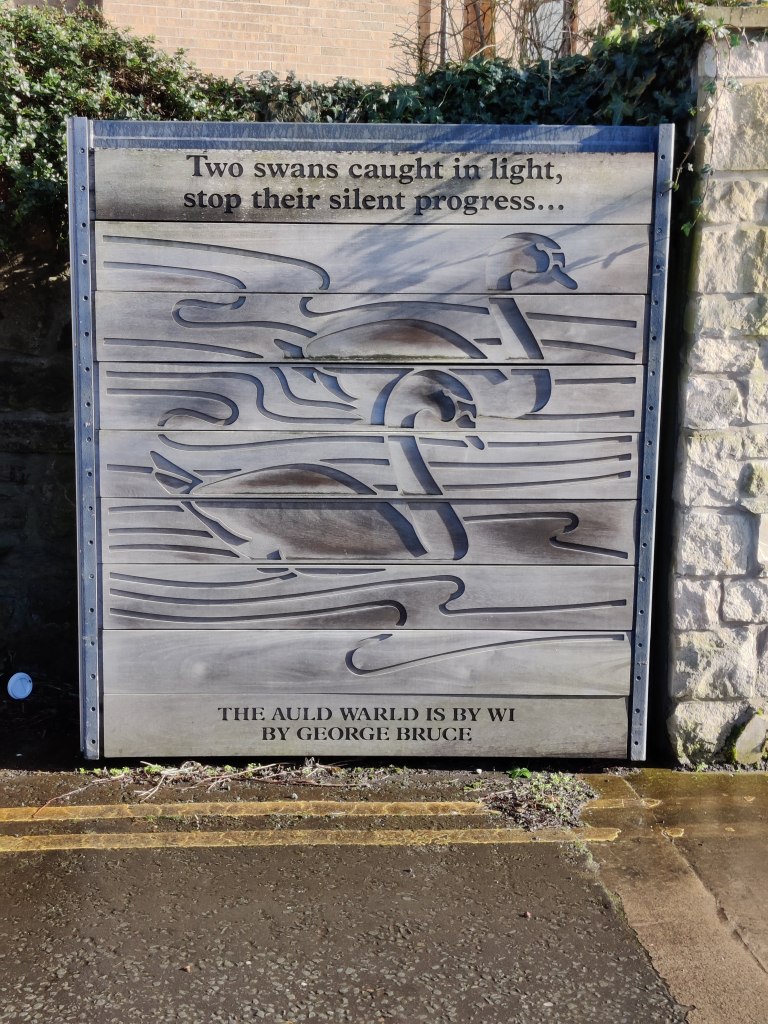
    Meanwhile, I’m off to contact the Scottish Poetry Library to see if I can find out more about the poem The Auld Warld is by wi by Scottish poet George Bruce (1909-2002). See The Photographer’s pictures of doors to see why.


    6 Times (by THE PHOTOGRAPHER)

    I wait, leaning against the railing looking out over the ruined wharf. I try not to see a message in the rotting struts, like teeth between the collapsed beams. Birthdays have been a sensitive topic since I was ejected by my first wife, landing at the feet of my younger second. As of today, the current model (version three) is no longer half my age, which is a relief perhaps, but at one point would have been a prompt. I remind myself that octogenarians cannot afford itchy feet.

    We had been heading to “b-day drinkies” at the top of a vertical distillery. There is a lot of tongue biting with a younger wife. B-day drinkies indeed. The plan had been whisky for me, gin for her. I had even anticipated her request for cocktails and had rehearsed a suitable request – “a Manhattan, please”. I couldn’t bring myself to ask for an Old Fashioned. But we didn’t get that far. The smooth motion of the lift to the top floor, with the parallax of the Edinburgh skyline, sparked off a nausea in her that quickly tipped to retching. After she had spent a few minutes in the toilet we returned to the lift and she managed down to ground level safely with eyes closed. And now she is recovering at my side, a shade or two off aquamarine. If my suspicions are borne out – I have experience here, trust me – I will not mention how many children this will make for me. Straying into Boris Johnson territory, though not the politics.

    I cancel the reservation, and flick around the venue’s website for a couple of minutes. I have done the tours of the Spey and island distilleries over the years – the carbon copy talks about the purity of the water, or the trading with local landowners for rights of access to a private loch. Situated at the mouth of the Water of Leith as it enters the Forth estuary I wonder how this place sources its principal ingredient. An aquifer 120m below the ground apparently. I imagine water coursing from the Pentland Hills down to the coast on a smooth layer of rock, landing magically at this precise spot. What are the chances of that? I know not to trouble Veronika with these details. She is still looking hellish.

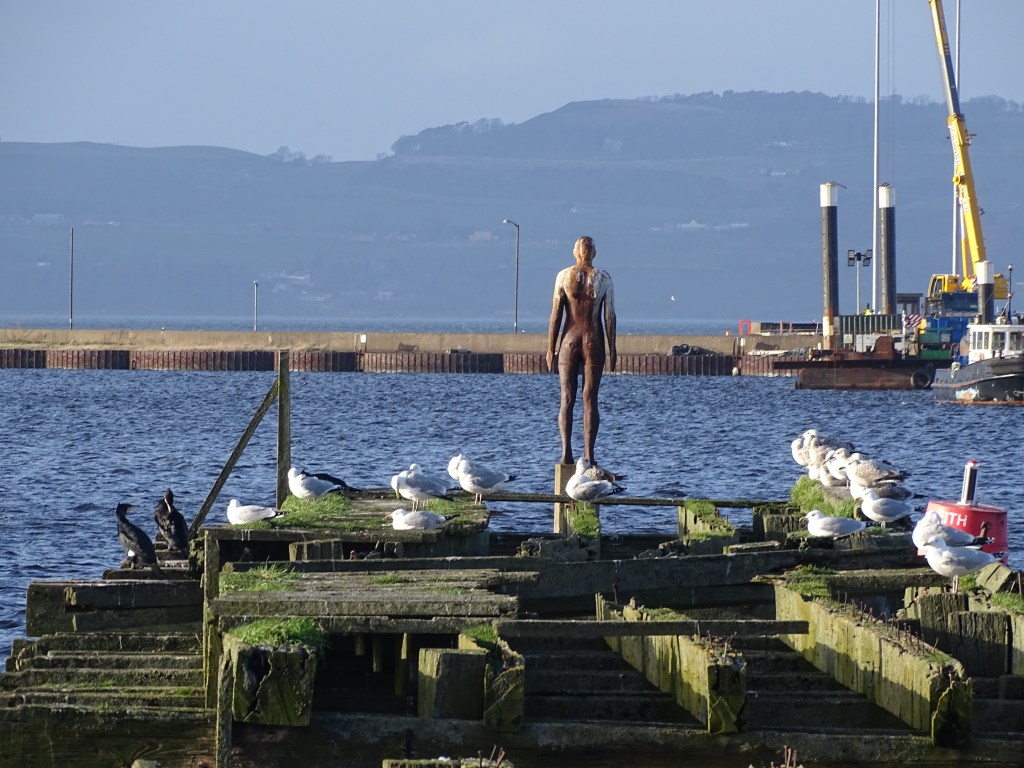
    The view across the docks is picked out in the sunlight of late afternoon.  Huge ships with winches and helipads to the right, Britannia to the left, and the dilapidated wharf dead ahead. Blocks of space rocket shaped flats in the middle distance, and beyond that the Lothian and Fife coastlines tapering towards the bridgehead. It really is a beautiful evening. Seagulls preen, enjoying the sun. And a couple of cormorants taking their turn to lift their wings to prayer. I zoom in on my phone camera but it doesn’t do them justice. I take one of the weird fish angle photos that the phone suggests and pop it away. There is romance here. Not that you would know it. V is leaning over the railing making noises that are mimicked by the herring gulls. The tourists are giving us a wide berth.

    Antony Gormley’s 6 Times Figure I

    Romance. I wonder what RLS – if that three letter acronym is not too familiar for the great man – would make of his beloved Water of Leith now. I am transported back to Christmas many decades ago, visiting my parents, and receiving a second-hand copy of Stevenson’s book Edinburgh: Picturesque Notes (1878). A brilliant present. Much of what he was describing was already old, but there was plenty to learn about our current environs. And here we are, standing on land reclaimed since my childhood, with a shopping centre behind us built at the turn of the millennium, a large part of which is about to be demolished. The world does seem to be accelerating towards some unprecedented endpoint. Or maybe it’s just the usual destination, which is a surprise for each of us when it comes.  

    The sun is edging over the horizon now, the top rim just visible. We would still have some time to take in a few of the sights if V would just sort herself out. I make some tentative enquiries. She wants to take it easy, appreciate the view, take in the sea air. She comments on a figure at the end of the wharf. I cannot make it out. She is a step ahead. “It’s a Gormley I think”. I nod noncommittally. Cataracts are holding me back in this conversation. I just see glare and shadow.

    Antony Gormley’s 6 Times Figure II

    I should explain at this point that I have been known as The Photographer since school days. My acquaintances tagged me as such because of my chosen Friday afternoon “society”. All the boys were encouraged to join extracurricular activities, with the promise of a “societies supper” of battered haddock and chips followed by cake and custard of a matching colour each week. My “football friends” (as I believe The Philatelist christened us in the second book) were all off in musical ensembles, but I am tone deaf. Worried about missing out, I chose discussions about SLRs and dark rooms instead – for seven years. I would sit quietly at the back, comfortably full after the best meal of the week. I don’t think that I spoke once in all my attendances at the society. I take photos, for sure. But they’re not professional. I’ve never owned an SLR or even understood the settings on my phone camera. I have a standalone digital camera as well, but the settings are clicked to “Superior Auto” rather than doing anything clever of my own. But “The Photographer” nickname stuck. Could have been much worse I suppose.

    The following morning, after dropping V off at her work, I return to the wharf with my digital camera. The optical and digital zoom do their work and I have a reasonable view of a Gormley sculpture part splatted with guano. I am aware of at least one other Gormley in the Water of Leith – it’s a hinged affair that bends over when the water is high. I check Google for an explanation and up comes details of a six sculpture work: 6 Times. They’re all within a manageable distance if I cycle. I pop home to pick up some waterproofs and head round the north Edinburgh cycle path.

    Antony Gormley’s 6 Times Figure III

    As I pedal, I am transported back to my school days. Passing underneath Wardie Road I can see evidence of the former railway platform and signal in the undergrowth. When we were kids this used to be our starting off point for trips into town or along to Leith. How quickly things change. Who would have thought that the tracks and trains would all now be dismantled, with trees full of blossom in place of billowing steam. At least their drivers didn’t have to dodge dogs, children and grown adults peering into phones or having conversations into thin air. I proceed carefully, squinting through the filters of my cycling glasses in the stop-start shadow-sun. I recall a trip that The Benefaktor, The Ornithologist, The Philatelist and I took from this very spot in the late 1950s or early 1960s. The others were lugging instruments and stands to one of the Leith venues. I was along for the ride, with nothing better to do. The Philatelist was writing out a speech on a scrap of paper balanced on his knee. I can’t remember the details, except that he was always writing or had his head in a book. And with this memory I resolve to write down my current trip as a travelogue through north Edinburgh, as my first written contribution to the GANTOB project. The Benefaktor has promised that he will give me a copy of the second book in return. I want to see what The Philatelist has written in his chapters (they’re not available on the blog). His recent postcards have been no help, except to reveal that he’s no longer in Europe. In the past few weeks he’s been in Karachi, Lahore, Faisalabad and Rawalpindi. There’s a pattern there, beyond just the decreasing order of population. Where next? Sialkot?

    Antony Gormley’s 6 Times Figure IV

    Cycling further along, past Trinity, Ferryfield, through Pilton, I recall a series of walks that the four of us took near here back in the 1990s, an Irvine Welsh guide tucked under The Benefaktor’s arm: A Visitor’s Guide to Edinburgh (1995) co-written with Kevin Williamson, published by Rebel Inc.*  The Benefaktor led the way, stopping outside a “sauna”, getting chucked out of a pub after asking if the TV could be turned off, and missing the opening hours of a fruit and veg shop not far from the red bridge I’ve just crossed. This was part of an in-joke, revisiting some of the infamous scenes from Irvine’s book. His most well-known books – Trainspotting and Porno – despite their periodic hilarity, marked a time when Edinburgh was one of the (injecting) heroin and HIV hotspots of the world, with some areas of north Edinburgh particularly badly affected. The lost generation. In 1994 we had seen Welsh’s Trainspotting on stage at The Traverse theatre**. We imagined ourselves living the parts of the characters. Renton (originally Ewan Bremner in the stage play, replaced by Ewan McGregor for the 1996 film), was The Philatelist. I was Spud (played by Bremner in the film). Sick Boy was The Ornithologist. And The Benefaktor was Begbie. We stayed in character throughout the walk. Privileged men in our 50s, older than the actors, even when they reappeared in Trainspotting T2 in 2017. We knew we were ridiculous. But we loved seeing Edinburgh on the page and the big screen. The Benefaktor’s “Begbie” went too far in our re-enactment, as my tongue reminds me now, excavating a gap in my lower incisors.

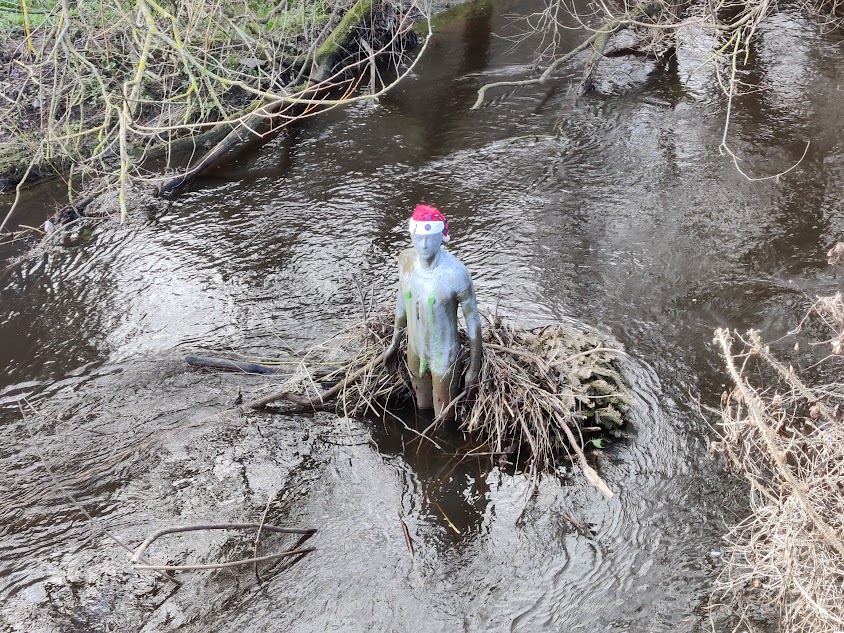
    And I’m almost there. The long drag up to Ravelston Dykes, and then onto to the road for a short stretch to reach the National Galleries of Scotland: Modern One and Modern Two. There’s half a Gormley in the pavement between them. A trip hazard I’d say. I park my bike and head down the steps behind Modern One. There’s another Gormley, standing in the water, above a more turbulent stretch of river. He’s not fishing I decide. He’s sunbathing, head inclined upwards slightly. He could almost be worshipping a sun god, though with hands by his side. I can imagine him rotating on the spot to mark the time of day, but suspect that is not the case. Water would get in the electrics, or somebody would need to wind the mechanism regularly. You can’t beat the force of nature. Branches have collected at his base. But it’s a calm day and he’s in still waters. You can make out his private parts and rivet-like nipples in the reflection. I can imagine how we would have sniggered at that 75 years ago.

    I head back up the steps, stop for a scone and a mug of soup in the gallery cafe, and pick up my bike. I dismount and push down a stretch towards the next Gormley (luckily that section of walkway has reopened after years of repairs following a landslide), past Dean Village and St Bernard’s Well. I well recall walking this specific stretch with my son after he had passed his final school exams, retracing the steps I had taken with my mother when I was at the same stage, ready to go to university and start a new life. I can put myself right back in both pairs of shoes. The sense of achievement mingling with the excitement and fear of unchartered waters, and on both occasions the summer sun penetrating the dense canopy, dappling the river and path with an optimistic glow. Not a leaf to be seen at the moment however. And it’s chilly.

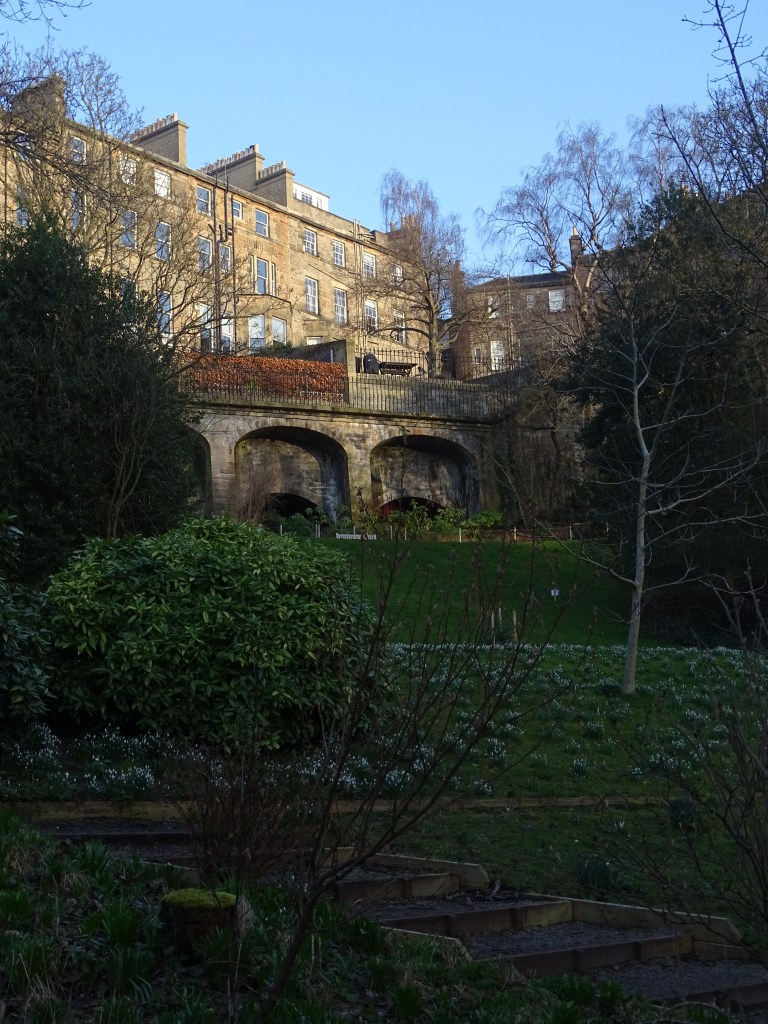
    The next Gormley is under Stockbridge – the actual bridge – which I was once told is the shortest street in Edinburgh. I can imagine RLS (1850-94) standing on this very spot 150 years ago, and wonder how much has changed looking upriver. The blocks of flats on the left obviously, but not the Georgian houses (including some previously of ill repute) on the right. Downstream is different – a lot of flood defences and raised walkways would have been unfamiliar to the famous son of the lighthouse family. Past a series of doors (but not green doors) and portals that I’d love to see through, Wallace style.

    The flood defence gates picturing swans features a quote by George Bruce and art by Gregg Magee.

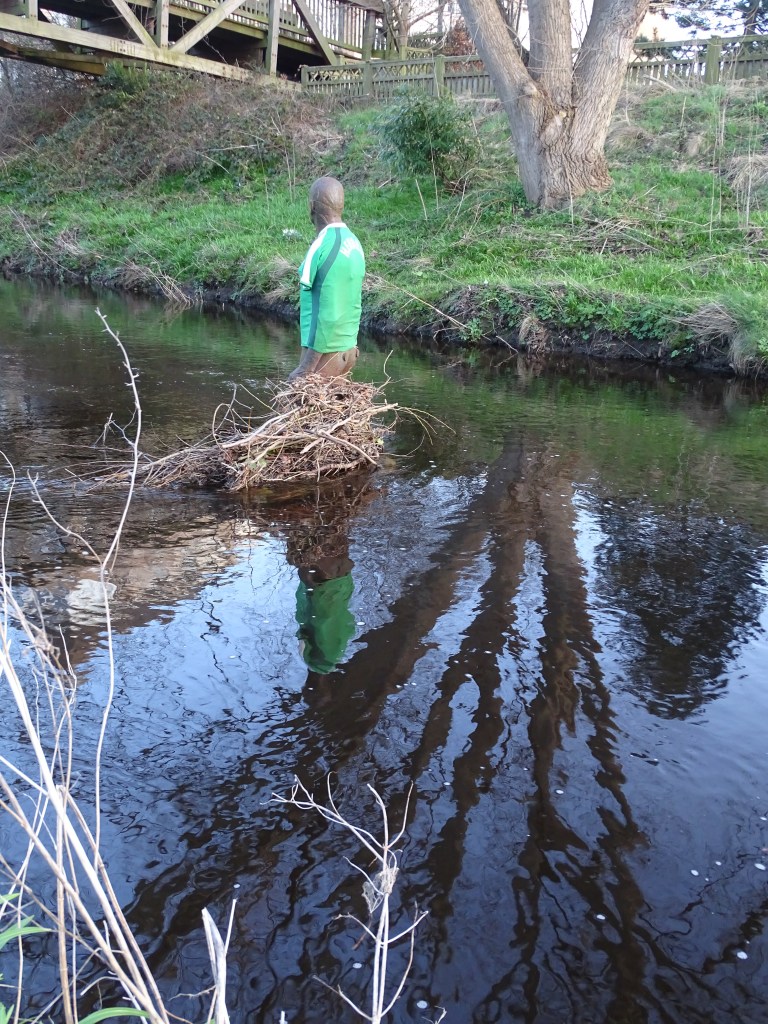
    And then we’re on to two “decorated” Gormleys. One in a football strip near the site of the old greyhound racetrack. I almost fall into the water in an attempt to capture a better picture against the setting sun, skidding to a stop in the wild garlic that is about to flower. (I notice the rivets on the buttocks when selecting the photos to accompany this piece – I imagine the snigger, this time from TV characters I hear my grandchildren talking about). And another in a Christmas hat beside a raised metal walkway. GANTOB tells me that she has shared some of these photos with a GANTOB correspondent – JR – who wrote about Gormley in the second GANTOB book. I ask that it is made clear to JR that I was not the comedian/ vandal making these additions.

    Antony Gormley’s 6 Times Figure V

    I stop off to admire the goosanders that seem to have set up home on the bend between The Quilts and West Bowling Green Street, the occupations and recreations of the past marked out in street names rather than the architecture or green space. (I read about “back green concerts” in the early 1950s when I look up the story behind the names, but have not been able to find out more). When this waterway was an industrial hub it would not have sustained such flora and fauna. The tufty headed, sharp beaked birds are having a great time with their duck and coot cousins, and a couple of swans. I think back to a walk with The Ornithologist, to explore the new cycle pathways that have made whole stretches of the river accessible, when he pointed out that the goosanders were not the grebes I had thought. I’m a late learner. And then I’m back where we started, at the mouth of the Water of Leith and the last Gormley.

    Antony Gormley’s 6 Times Figure VI

    I still cannot imagine the aquifer. But I’ve visited 6 Times of my own along the river, walking, cycling and slipping close to the banks, memories surfacing at each turn. I cannot do them justice with Veronika. She hasn’t lived through the first half of my life. That bit of me is a mystery to her, like the half Gormley that may or may not lurk under the asphalt outside Modern One. So I have written them down instead, in case they connect with you. These are my picturesque notes. My visitor’s guide. I’d better get back now. I’ve promised to pick V up and I mustn’t be late.  

    THE PHOTOGRAPHER 1 March 2024

    #GANTOB2024 pamphlet 9 of the #52Pamphlets

    The Photographer’s photo of a goosander (Mergus merganser), authenticated by The Ornithologist. GANTOB3 apologises for not including this in the first version of this blog.

    GANTOB3 notes, consulting Google, Facebook KLF fanpages, and the database of materials handed over to her by GANTOB:

    * In passing, I note that Williamson went on to co-found Neu! Reekie! with Michael Pederson in 2010, publishing a couple of Bill Drummond poems in #UntitledThree (2020), and hosting a Drummond painting “Bill Loves Elvis” in June 2021 with accompanying Penkiln Burn pamphlet – Two (PB pamphlet 33). One of the Drummond plays in #UntitledThree is called Life Model. Drummond’s memoir, which is being published in daily instalments at the moment, is called The Life Model. Today’s “Over” chapter is by Ali Flind (one of 168 different contributors to the “book”), and starts with an RLS quote. Coincidence? Or Apophenia? It’s why I felt that we needed to publish this pamphlet today.

    ** The Traverse also features in GANTOB’s pamphlet The Gap, a handwritten copy of which was handed to Bill Drummond by GANTOB in December 2023, edited and re-sent electronically [PDF] a few days later, and perhaps resulted in the Bill Drummond contribution to the second GANTOB book. It is also, quite possibly, the location where The Benefaktor crossed paths with Curt Finks for the first time.

    Inspired to write? You can submit your own pamphlet.

  • THE CHERRY ON TOP (by THE BENEFAKTOR)

    Feb 24th, 2024

    A pamphlet from the LittleGrapefruit-verse – but for adults) – written and narrated by The Benefaktor.

    I have written and am narrating this piece as the only consistent member of the GANTOBverse. Gillian is still around (indeed, next Saturday’s pamphlet is probably going to be one of hers). But she is no longer GANTOB. GANTOB3 is now in charge. I have not met them yet, but I believe that they are also resident in Badenoch.

    But let the pamphlet begin. Over to me…

    Here’s a version generated by a Google narrator (let’s call it the Little Grapefruit version)

    And the Benefaktor’s real but rather more turgid version. Give him a chance. He’s 83!


    An elderly gentleman, but not The Elderly Gentleman, sat napping in the armchair in his study. His door was shut, and he was wearing his vintage wired headphones so as not to disturb the rest of the house, because he likes to play his music at a volume that allows for his presbycusis. He was listening to Butterworth’s setting of a poem by Housman.

    Loveliest of trees, the cherry now/ Is hung with bloom along the bough,/ And stands about the woodland ride/ Wearing white for Eastertide.

    He had placed a copy of A Shropshire Lad on the left arm of the chair before he drifted off to sleep, ever mindful of the spines of the books in his collection. His tortoiseshell cat lay peacefully on his lap, studiously avoiding the reporter’s notebook and fountain pen that competed for space in this warm soft patch. He had been working from memory, thinking through conversations with The Philatelist, The Ornithologist and The Photographer, but principally his stamp collecting acquaintance. He had carefully drawn out a banana, a horn and, solely to seek inspiration, one of Hundertwasser’s onion ring trees. 

    Next door, in the Dining Room, the occupants of the fruit bowl were shifting around uneasily, seemingly as if in Brownian motion, even though the grapefruit, passion fruit, apples and mangos knew that could not possibly be the case. The bananas, were as usual, in a separate bowl. Urs had been told to do that decades ago. The Benefaktor had gone into one of his monologues about ethylene or ethene as he now insisted on calling it. Urs had switched off, but knew enough to minimise future lectures. Little Grapefruit had climbed to the edge of the bowl to peer over the rim. She was wearing prescription sunglasses to see through the window all the way to the tree in the garden outside. It was in full bloom, pink not white. She was not sure which month it was – gone were the days of seasonal produce to guide her. She was aware, however, from the conversations among the older grapefruit, that it was way too early to be in blossom. That other decorated tree was not long down and in its cardboard box, back in the cupboard for another year.


    The Benefaktor continued his slumber in The Kino. His dreams were flicking around, like the numbers and letters that jerk in and out at the start of old film reels. There was some flow and sequence in the ideas, if he could just think a bit harder, but he would not remember that when he woke up. First there was the postal horn that The Philatelist (also 83 years old) had recently had tattooed on his wrist after a bet with his purple-haired grandson. And then a graffiti banana – a spraybanane – that The Benefaktor imagined himself stencilling under the doorbell of a local printworks and gallery as a mark of approval. Octogenarians breaking the rules. Right on.

    Thomas Pynchon. That was the name he was grasping for in his dream. Out of reach, like the top shelf of his library, built ten years ago to take advantage of the high Georgian ceilings, but now revealing their true purpose: storing the books that he knew that would never have time to take on. The Illuminatus! Trilogy beloved of The KLF sits on that same shelf. The authors Robert Shea and Robert Anton Wilson were clearly heavily influenced by Pynchon. But it’s all out of sight, flotsam and jetsam, time out of mind. Not for 83-year-olds.

    The postal horn, representing communication in Pynchon’s entertaining 1966 novella, The Crying of Lot 49. He had enjoyed that when he read it first in the 1990s, a present from his son. He had thought of that a lot when hearing about The JAMs and The KLF at the start of his discussions with “GANTOB”. The symbolism, the cloak and dagger communiques, the intrigue. But in his dream the horn was played by Felix Klieser: Liszt’s Les Préludes painting the concert hall banana yellow. Perhaps that was the colour Liszt imagined for C major. A little brown mixed in for its relative minor and some green for the E major sections. He could not remember whether Petroc Trelawny had gone into the details in his recent mention of Liszt’s synaesthesia on BBC Radio 3.

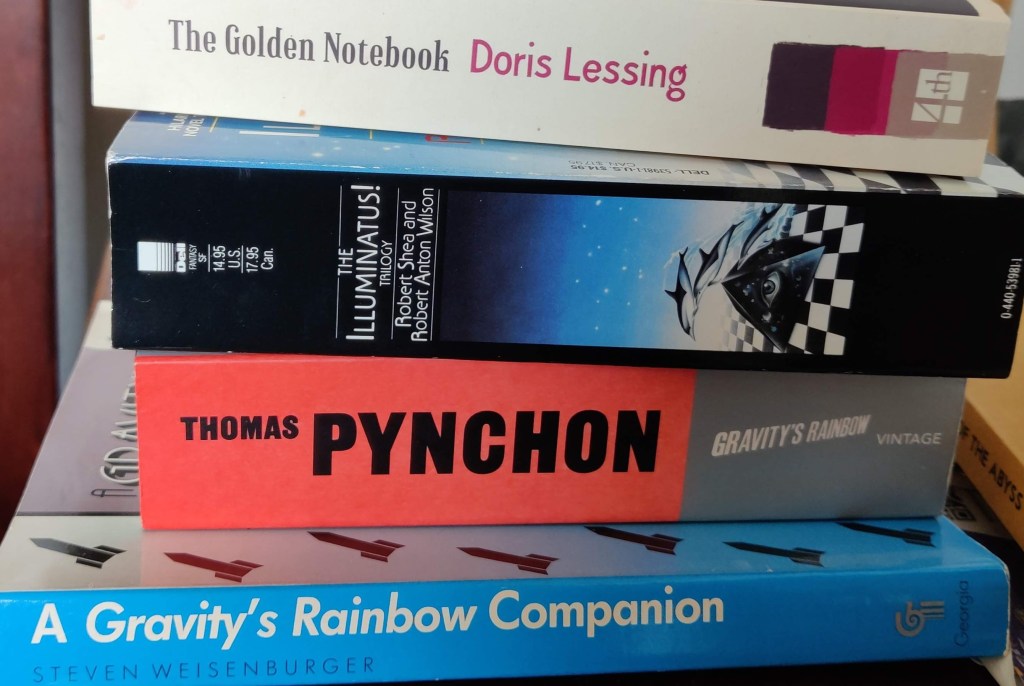
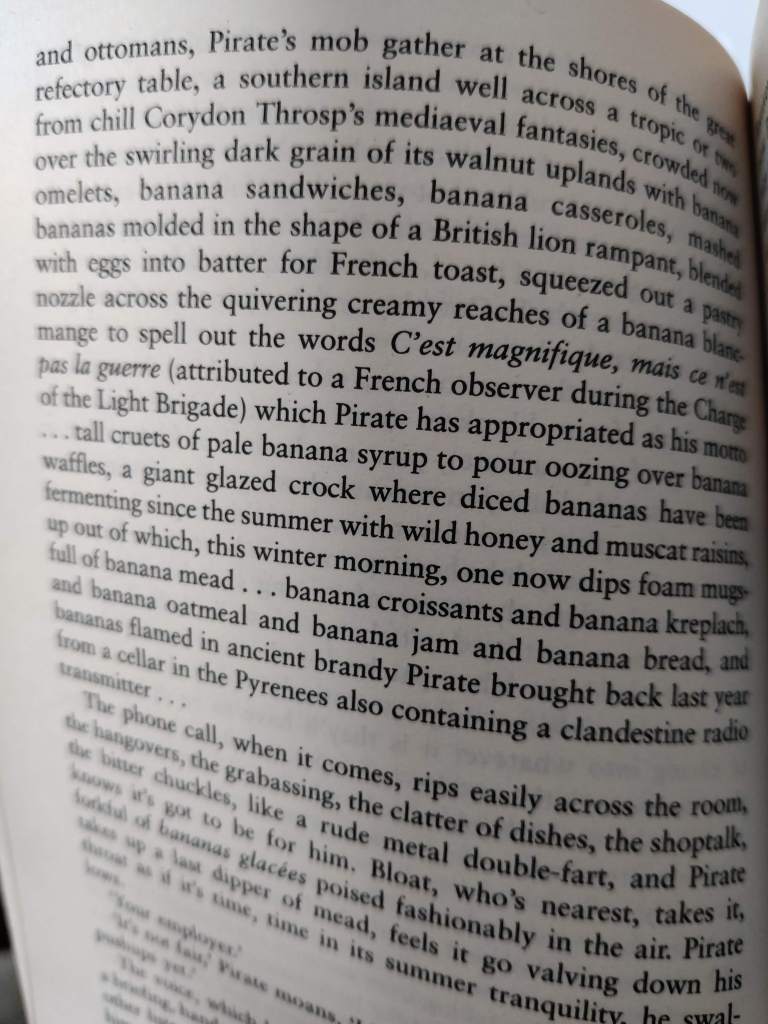
    In another of their discussions – this time by email – the former GANTOB and The Benefaktor had talked about books that they did not think that they would ever finish – The Golden Notebook for Gillian, Gravity’s Rainbow for The Benefaktor.  TB could not recall the reason for Gillian’s failure, but he remembered the snagging section in Pynchon’s book Gravity’s Rainbow (1973) alright. Intended no doubt as a cornucopia of delights, overflowing with bananas, The Benefaktor had been left feeling jaundiced. American authors do like to pad things out, outstay their welcome.

    And this thought jolts him awake. He abhors nationalism. And generalisation. He pads through to the Dining Room to grab an apple – to rid him of that bitter taste in his mouth, and to crunch his teeth back into their sockets after half an hour with his jaw slack while asleep. He wipes dribble from the corner of his mouth with his fraying shirt sleeve. If he had not been doing this for forty plus years he would have worried that he was displaying signs of “decline”.


    Outwardly, the fruit are absolutely still in their bowl when the old man approaches. But their insides are squirming. They are not worried by him – he’s far too old to notice their occasional itches and sneezes. They are thinking instead of the uncharacteristically early blossom. The older grapefruit issue warnings to Little Grapefruit and her generation. Beware the cherries.

    Page 12 from Thomas Pynchon’s 1973 novel Gravity’s Rainbow. Bananas

    The old man opens the window to the garden. It is uncharacteristically warm outside. Bird song and the almond scent of cherry blossom flood in. He heads out to the local greengrocer – a dying breed – and bags up some plump purple cherries that seem to call him from their box, marked with their price in kg and country of origin. He is not worried about the total bill. Or their source. He is thinking of Urs’ face when she sees the first proper cherries of the year. He’ll be in her good books for once. He has forgotten the trouble he caused last year when Urs stained her favourite cashmere cardigan with purple juice.

    Despite the older grapefruits’ warnings, the cherries are instantly popular with the carefree citrus children.  The cherries are sweet natured and great fun. They roll around freely and can squeeze through little gaps to meet their neighbours, snuggling in against the other fruit with their soft, smooth skin.  There is nothing spiky or rough about a cherry. When you talk to them, you are comforted. Their speech pattern is gentle, like music, as if learnt from the birds that had tried to peck at them through the netting. They use simple words in short sentences. Nothing is difficult or complicated. The youngsters play games, sing songs and share meals. They are part of the family.


    Big Grapefruit hasn’t met any of the Cherries before, because he works long hours outside Bowlingham. Returning home on the bus, he hears a group chanting a song. It has a nursery rhyme simplicity and is instantly catchy. He does not catch the words. He is thinking about being back home with his family. Big Grapefruit does not think anything more about it, but finds himself humming the tune when he rolls off the bus and heads home.


    This tuneful Cherry is called Quinctilius, named after the quince family who had lived next door when he was growing up, as his Mum insisted on explaining whenever anybody asked. He hates the association with another type of fruit. He prefers to be known as Lee. He doesn’t like other fruit. Life for him is a game of “opposite day”.

    “Black is white/ Day is night/ Left is right/ Dull is bright”, he sings. He is teaching his two sidekicks some of his ideas. They love this concept that everything is turned on its head. They ignore what everybody else says.

    Gravity? Doesn’t exist.

    Homework? Forget it.

    Grey? What’s that?

    Fruit and veg? Bad for you. Best avoid.


    The Benefaktor is back in The Kino, resting after his trip out. He is listening to Latvian composer Ēriks Ešenvalds’ Rivers of Light (2015) on Radio 3. He loves modern choral music. He looks it up: considered a companion to another Ešenvalds work Northern Lights (2012). Aurora borealis. He is sure that there is a Bill Drummond connection there if he asks Gillian. But he would rather think about other associations.


    Little Grapefruit is playing Pacman with her new friend Lee. Watch the ghosts, but don’t worry about the Power Pellets – focus on the bonus cherries. She dies her hair the colour of green maraschino cherries. What a rebel. Gets drunk on kirsch after eating too many cherry liqueur chocolates, setting fire to the stalks that are left over. High on sugar from full fat cherry flavoured Dr Pepper she heads out, daubing Lee’s new slogans in red on walls around the bowl. Black is white, Left is right. Right on.


    The Benefaktor is worrying about world affairs. Gaza. Ukraine. Poland. The Baltic states. Opposition Day in the UK parliament. Trump, Truss. What a mess. Nationalism at the root of it all. It doesn’t make for easy dreams.


    And Urs is left, as always, tidying up the pieces. She finds the bowl with its graffiti and bleaches it clean. She has known about the grapefruits’ nighttime activities for years. The Benefaktor must always have a grapefruit available in case there are kippers for breakfast, which there usually are. She has never seen them breaking out like this though.

    But she’s old enough to know how to deal with the cherries. She doesn’t listen to their songs or read their ridiculous slogans. She picks up the handful that remain after their coups and putsches, pops them one by one into her mouth, and strips them of their deceptively sweet and juicy flesh before spitting their hard little stone hearts into the compost bin to be disposed of with the next food waste collection.

    The Benefaktor, 24 February, 2024

    Pamphlet 8 of the 52 Pamphlets

    Some notes: maraschino is from the name of the cherry (marasca). The cherries are preserved in maraschino or a syrup of that flavour. What I found out in the course of writing this pamphlet is that marasca is from amaro (Italian for “bitter”), from the Latin amarus. I am reminded of my points on the word sanction in my Stuck blog. Amore vs amaro. Love or bitter. Amorous or amarus? It’s important to listen carefully in matters of the heart. I’m sure that Urs would agree.

    My recollection of the banana section in Pynchon’s book Gravity’s Rainbow is perhaps misremembered. Flicking through my long ignored copy I can only see mention of bananas for a few paragraphs on page 12. I was sure that I had managed well beyond that on one of my previous attempts, but I cannot see a longer banana-themed section now. Bananas are not even mentioned in the index to Steven Weisenburger’s A Gravity’s Rainbow Companion (though the second edition of that book has a Warholesque banana cover). Having flicked through both books again this morning I am not convinced that I will be returning to either. Yet it is frustrating to be defeated by a book. And having spent time with Shea and Wilson’s book recently (grudgingly) I can see a number of parallels with Pynchon even on the sketchiest of reads. Perhaps somebody else will be able to advise.

    The Philatelist has something to say about bananas and Thomas Baumgärtel’s spraybanane in the second GANTOB book (chapter 29; his chapters are additions and are not included in the blog).

    If you have a piece that you would like to contribute to GANTOB’s 52 Pamphlets, then please check gantob.blog/pamphlet. If your application is accepted, then you will receive a personalised copy of your pamphlet by post, and a copy of the third book (52 Pamphlets, publication date January 2025). If you don’t have a copy of the second book and would like to read The Philatelist’s chapters, then you’ll need to make your case. I have a very small number of spare copies.

  • THE MAGIC NUMBER (by CAPT. APOPHENIA)

    Feb 17th, 2024

    Many thanks to Capt. Apophenia, celebrated author in the world of all things K, for this week’s pamphlet. Handing over to the captain without further fuss.


    In the world of Mu, they say you’re never more than 23 feet away from a trilogy. On a long train journey home, I started to write them down and that’s when the apophenia really kicked in. 

    WARNING: This goes deep. 

    Rather than start at the beginning, let’s start before that.

    Dallas, November 1963. Three deaths in two days. Kennedy, Tippitt and Oswald. The latter was a former marine alongside one of the architects of Discordianism, whose Principia Discordia was printed on the photocopier in the office of New Orleans District Attorney Jim Garrison, who would later bring the only trial around the Kennedy assassination. 

    A copy of Principia Discordia found its way into the hands of Robert Anton Wilson and led to writing of not one, not two, but three trilogies. Illuminatus, Cosmic Trigger and Schrödinger’s Cat. But a trilogy of trilogies is not so unique in our story. 

    One way or another, the work of Robert Anton Wilson, inspired Bill Drummond and Jimmy Cauty to form The Justified Ancients of Mu Mu, who did an awful lot of things in threes. 

    As The JAMs, there was trilogy of LPs (1987, Who Killed The JAMs and Shag Times) and a trilogy of sample heavy early singles (All You Need Is Love, Downtown and Whitney Joins The JAMs).

    These were followed by a trilogy of Pure Trance releases and a trilogy of ambient LPs (Chill Out, Space and Waiting). The latter was also part of a trilogy of VHS releases (Rites Of Mu, Waiting and Stadium House Trilogy) the latter being The JAMs first acknowledgement of trilogies. 

    The Stadium House Trilogy (What Time Is Love?, 3am Eternal and Last Train To Trancentral) also forms part of a larger trilogy of trilogies of reworked songs. What Time Is Love? was released as Pure Trance, Live At Trancentral and America: What Time Is Love? 3am Eternal was released as

    Pure Trance, Live At The SSL and KLF vs ENT. Last Train To Trancentral came as Pure Trance A, Pure Trance B and Live From The Lost Continent. 

    This trilogy of trilogies appears to exclude one of their biggest singles, Justified & Ancient, but when we look, we see a career spanning trilogy of its own, that shares the same refrain (Hey Hey, We’re Not The Monkees, Stand By The JAMs and Jarvis Joins The JAMs).

    Another apparently isolated track is It’s Grim Up North, but its crediting to The Justified Ancients Of Mu Mu, puts it in another trilogy of anomalous releases by The JAMs alongside Jarvis Joins The JAMs and 2023: A Trilogy. 

    Speaking of books, of course there are three books (The Manual, K Foundation Burn A Million Quid and 2023). The Manual itself exists in three editions (How To Have A Number One The Easy Way, How To Build A Pyramid Of Stolen Shopping Trolleys The Easy Way and last year’s How To Build A People’s Pyramid The Hard Way) and 2023 can be enjoyed as a trilogy of hardback, paperback and audiobook read by Daisy Campbell. 

    Away from The JAMs, Cauty and Drummond have continued to embrace the trilogy. 

    As a teenager Jimmy produced a trilogy of Middle Earth posters for Athena alongside another trilogy of posters of sacred sites (Stonehenge, Glastonbury and Avebury). Later on, his RIOT Trilogy of Dismaland, Riot In A Jam Jar and The Aftermath Dislocation Principle followed. 

    Bill has a trilogy of birthdays with The Man (ages 33 1/3), 45(45!) and The Life Model (70), he had written a trilogy of books with Mark Manning (A Bible Of Dreams, Bad Wisdom and Wild Highway), released a trilogy of books with numbers for titles (45, 17, 100) and given himself three jobs to undertake on his 25 Paintings World Tour (Make A Bed, Make Soup and Shine Shoes). 

    Those of you with a keen eye for numbers will probs have been counting trilogies as we went along and will have probably settled on a satisfactory number of trilogies from world of Mu. That was entirely unintentional, but sometimes these things just write themselves. Remember, there’s no such thing as a coincidence. 

    (All of the above may have been an influence when I wrote a trilogy of books in response to Welcome To The Dark Ages. The first book, WHATEVER, was never meant to more than a single book, but the thing about trilogies is that they have a mind and will of their own. Inspired by the successful launch of WHATEVER at the Burn The Shard event, my second book began to take shape and it’s wasn’t until I’d settled on TOGETHER as a title that the WTF TRILOGY revealed itself and then completed itself with the FOREVER TRILOGY. Still available to purchase and enjoy from Amazaba). 

    Capt. Apophenia, 17 February

    A Page 130 Pamphlet 

    AKA #GANTOB2024 pamphlet 07


    A GANTOB trilogy

    GANTOB responds:

    I wrote in last week’s pamphlet about the thread connecting the recent #GANTOB2024 posts by Urs Benefaktor, Stuart Huggett, A young man on Facebook, and Annebella Pollen. These were four unrelated writers, volunteering or approached to write pieces for a loosely defined art project, breaking out from the orbit of The KLF to explore new horizons. However, in attempting to branch out in the topics covered and the people involved we appear still to be caught up in a tornado that is pulling us ever closer to Kansas or some other K themed setting. JR, a previous GANTOB contributor, not connected to Dallas as far as I am aware, asked in a comment on last week’s blog whether this is coincidence. Who can say.

    Now, I don’t do Facebook, but when I check on the weekly stats for the GANTOB blog I note that quite a bit of traffic is generated from Stephen Rennicks’ Searching for the White Room page (which is fortunately open to all, not just those on Facebook). He posted about Stuart Huggett’s William Blake piece on 25 January 2024, and a day later highlighted Capt. Apophenia’s excellent “Brit Pop” take on that English Poet/Artist/Prophet.

    Capt. Apophenia has been a loyal supporter of GANTOB, contributing a question to the first book and distributing pamphlets in book drops from the earliest stages of the project. He is also an accomplished author. I approached him to contribute a pamphlet, and the next day he replied with an email titled Th3 M3gic Numb3r.  I read it, accepted it, and filed it away in my brain at The KLF end of the GANTOB scale. When I was writing my response to Annebella Pollen’s pamphlet last week, noting all the connections between recent pamphlets, I was thinking that Capt. Apophenia’s piece was a fire break, or should I say a fresh start. Perhaps, like Prof Grayling Muir’s story on the GANTOB blog last year: a KLF related curio that stands alone.

    But when I read Capt. Apophenia’s contribution again, while making a personalised version of the pamphlet for him earlier this week, I realised that there was a lot more to his piece. The word “apophenia” for example. I must have skated over this the first time. I am sure that you will have looked it up yourself by now and will agree that it’s a great word. And JD Tippitt. I didn’t know about him either.

    And Welcome to The Dark Ages? That was the 23 November 2017 event that Annebella Pollen wrote about last week, which followed on from the publication of The JAMs’ book 2023: A trilogy on 23 August 2017. The book that introduced GANTOB, a fictional character that I have been fated to re-enact, Sisyphean style. I must have been very bad in a previous life. It also links very closely with A young man on Facebook.

    The Benefaktor will no doubt be delighted with Capt. Apophenia’s Schrödinger’s Cat reference, with his love of quantum physics. Though I am less well informed on that topic, I have made mention of it before in relation to the Curt Finks’ story Brent Goose Rock that was sent to the original recipients of my first GANTOB book. This was conceived as a snipped up story contained in a stuck down envelope, and was sent originally to a literary journal in 1987. The editor (or another reader) was to reconstruct the story word by word. We will never know what the editor thought of it, but it was not published. I wrote in the Kompanion Volume to the first book: “But perhaps there is a Schrodinger’s cat side to all this. The sealed item holds promise, and leaving it sealed avoids disappointment”.  Curt Finks, my late father-in-law, performer, writer. I was excited earlier this week to hear that one of his stories has now been published posthumously: “The A to Z of Curt Finks”, in the winter 2024 edition of Billy Childish’s Vipers Tongue Press Quarterly. How wonderfully unexpected (though I gave it a helping hand).

    But back to Capt. Apophenia’s excellent piece. A contribution, made in response to a comment about William Blake, which brings together an incredibly diverse range of cultural references, educating us in the process, but also messing with our heads around coincidence, and always bringing it back to The KLF or their origins. We are very definitely in the same orbit as earlier contributions to the 52 Pamphlets (which of course will be the third GANTOB Books publication). Worried? No need. I will leave you with this quote from Psychology Today:

    “Earlier descriptions of apophenia, also called patternicity, appeared in the literature in the 1950s by the German psychiatrist and neurologist Klaus Conrad. The term is the Greek “apo” for away, and “phenia” for display. Conrad described apophenia in psychotic patients who had perceptual distortions. Apophenia is not a disorder or a mental illness, it is a normal and common human experience.”

    I’m off to a darkened room to think how Bill Drummond’s books 25 Paintings and $20,000 fit in, and whether they mess up Capt. Apophenia’s scheme. But then I realise that they have words or other symbols in their title. And indeed $20,000 is really called For Sale. I think that we’re alright and I can press print/upload.

    52 Pamphlets is a free flowing and participative writing and art project as part of the GANTOBverse. If you are inspired to contribute then visit gantob.blog/pamphlet. If your work is accepted then, like Capt. Apophenia, you will receive a personalised pamphlet and a copy of the 52 Pamphlets book (January 2025).

    GANTOB 17 February 2024

  • ZOMBIE HISTORIES: IMPOSSIBLE AFFINITIES AND UNDEAD INSPIRATIONS (by ANNEBELLA POLLEN)

    Feb 9th, 2024

    I am delighted to announce that this week’s #GANTOB2024 pamphlet is by Annebella Pollen. Without further ado I will hand over to her.

    Kindred of the Kibbo Kift, a mysterious hooded brotherhood of English mystics, artists and social reformers
    (Credit: Annebella Pollen)

    If you were in Liverpool on 23rd August 2017, you may remember an event, at the Black E, organised and compered by the artist Tom James, which took the form of a public hearing. Designed to take place 23 years after the K Foundation burned a million quid, it invited witnesses to take the stand to provide their interpretations of the money burning. It then asked an eclectic bunch of five outsiders – including economist Anne Pettifor, artist Jeremy Deller, and myself – to propose their own theories of why the “fuckers burned the lot”.

    I came up with a theory that the K Foundation were part of a ‘deep tradition of historical weirdness’ and won the public vote. I linked the act to another group of justified ancients who liked to roam the land: the Kindred of the Kibbo Kift, a mysterious hooded brotherhood of English mystics, artists and social reformers who, around one hundred years ago, offered a radical set of propositions for reforming all that they saw was wrong with the country.

    A winning proposition

    With tongue firmly in my cheek, I argued that KLF and Kibbo Kift shared an uncanny number of philosophies and practices despite their different times. In their hoods and capes and cryptic symbolism, they certainly shared a wardrobe. Additionally, Kibbo Kift developed a powerful and self-referential myth that mixed politics, culture and magick (always with a K).

    And, like KLF, they were always there with that K, waving flags and throwing shapes, in Kurious Kostume and in the buff. The K was mystical insignia and organisational logo, an attitude of worship and a sign of allegiance. It was culturally and spiritually loaded with meaning, yet what it meant was never quite clear. Sound familiar?

    Kibbo Kift combined occult ritual, avant-garde aesthetics and agit-prop politics in their attempts to design a new world. They looked bizarre but spectacle was a central aspect of their method. They described themselves as ‘vanguards of the New Renaissance … in a world tottering on the brink of a New Dark Ages.’ K cultures echo across time.

    A core part of what KK wanted to do was to ‘blow the gaff’ on conventional thinking about money. The global economic system of the 1920s was a core enemy. Its trickery and deception were seen as dark arts. Kibbo Kift’s founder stated, ‘Bank money is nothing more than… “Promises to Pay”. There is no MAGIC in these bits of paper.’ He went further: finance was ‘a Death-Cult. The Whole Financial System represents a Ritual Dance of Death.’

    The method by which they registered their protest against economic order was highly symbolic, informed by the theatrical sacrifice rituals they used to mark the changing of the seasons. They marched three times anticlockwise around the Bank of England and burned an effigy of the governor of the Bank on the institution’s steps.

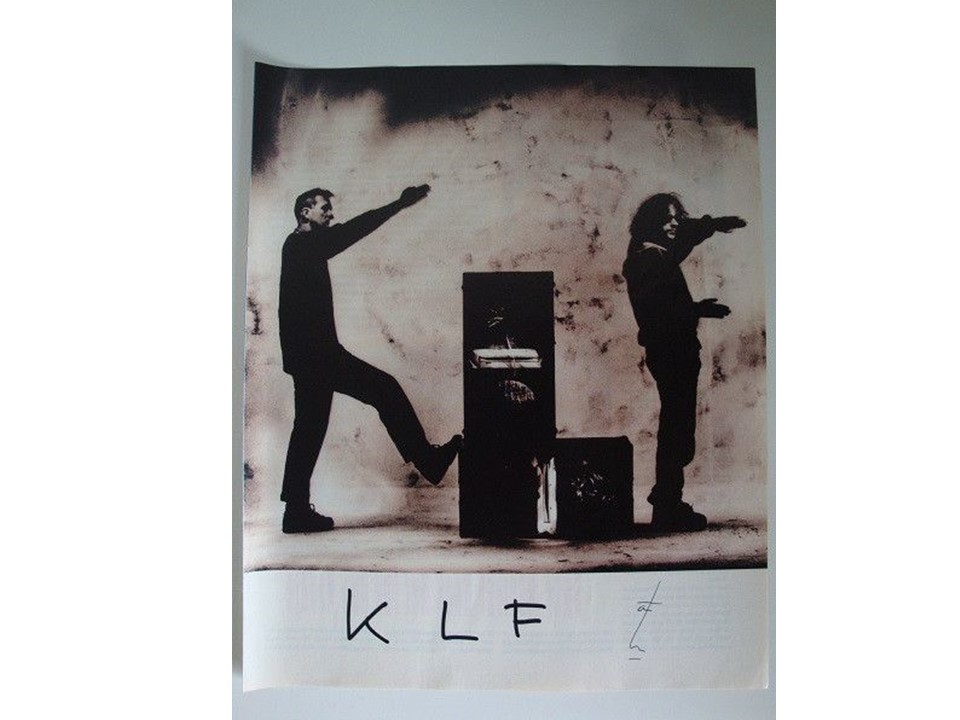
    The KLF (Bill Drummond on the left, Jimmy Cauty on the right).
    Used by Annebella Pollen in her presentation (link at end of text).

    Like the present-day Ks, KK forebears were fascinated by ancient cultures and what they called ‘primitive tribes’ (rural small scale societies). These seemed to offer visual styles and spiritual systems that were superior to those in Western culture. These might save it in its final dying breaths. It is among the economic systems of non-European and non-Christian communities that we might find answers to the K Foundation’s money burning. The potlatch gift-giving practices of the indigenous people of the Pacific Northwest, for example, are based on a principle of excess rather than scarcity. The destruction of wealth in potlatch is a means of achieving sovereign status. Smashing, sinking and burning luxurious objects, in order to show wealth’s sacred uselessness, demonstrates the power of the destroyer.

    Kibbo Kift, however, did not destroy a million quid. They barely had a hundred quid to spare. But with their global inspirations, their pagan-influenced anti-finance fire rituals, and their dramatic stunts, they blazed a trail for KLF to follow. Their ritual endeavours were performative magic, designed to bring ideas into being. They aimed to replace one form of immaterial imaginary (the financial system) with another (a leisure society or, in K2’s terms, ‘a Utopian costume drama’). The correspondences with KLF suggest an unbroken tradition.

    K2 put it in 2017:

    Down through the epochs and out across the continents, generation upon generation of the Justified Ancients of Mu Mu have told variants of the same story – an end of days story, a final chapter story. 

    Kibbo Kift proclaimed in 1927:

    The Kindred changes; its forms change, illogically, inconsistently, as it may seem, with the non-logical forces of Life and Death. What it was yesterday it is not to-day; and what it is to-day it cannot be tomorrow.

    These K-based shapeshifters draw on sometimes bewildering shamanic, retrofuturist and apocalyptic symbolism and ritual. They each seek answers deep in the past and future, outside everyday life, and beyond the rational. Through this lens, the burning of a million pounds by the K Foundation can be explained as a ceremonial annihilation of excess and a spectacular magick act, designed to disrupt the prevailing order, to expose the fiction of conventional economic value, and build alternative social status.

    The KK is dead! Long live the K!

    Postscript: Bricking It

    Obviously, this theory was consummate nonsense in any literal sense; it was an impossible affinity. But it was voted as credible by a mostly drunken audience, and it was condensed down to a single sentence and greeted with a nonchalant ‘Whatever’ by Bill Drummond and Jimmy Cauty. On the way to the Black E, Tom James had confirmed what I suspected: Bill and Jimmy had never heard of Kibbo Kift until Tom showed them a copy of my book a few months before. When I nervously introduced myself to Jimmy on the final day of the Welcome to the Dark Ages event, however, he asked if I had seen the parade banners, totems and costumes of the Toxteth Day of the Dead, which of course I had (I was in it). He told me: I based them entirely on Kibbo Kift. So, we seemed to have come full circle.

    At the time of putting my proposal together, I had no idea about the People’s Pyramid or the coming significance of the brick. Mumufication had not yet been revealed. Had I known, I might have put together a different historical narrative. The brick has a noble, if controversial place in the history of art, most famously with Carl Andre’s Equivalent series of fire bricks that caused outcry when exhibited in the 1960s and 1970s.

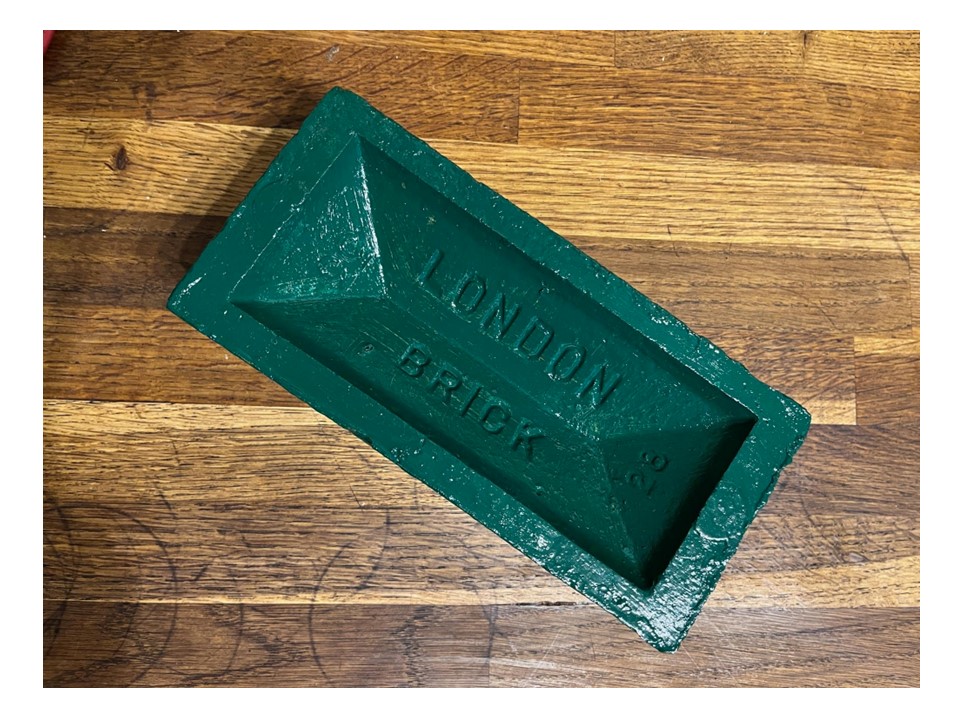
    The brick, too, is a cornerstone in Kibbo Kift legend, at least in their later reinvention as The Green Shirts in the 1930s, where they cast off their woodland whittling and devoted themselves to urban agit prop in pursuit of radical economic reform. Between 1934 and 1938, green-shirted members threw green painted bricks through the windows of 10 and 11 Downing Street. These acts have been the subject of artistic re-enactment; in 2006, in a work called Confession of the Kibbo Kift, sculptor Steve Claydon remade a painted brick alongside a reinterpretation of one of the group’s political cartoons. In the same spirit, I painted a London Brick green in 2023. For now, it is nothing more than an attractive paperweight, but one day it may be needed. Until then, it remains an undead inspiration.

    Annebella Pollen, Brighton

    10 February 2024

    #GANTOB2024 Pamphlet 6

    An audiovisual version of the 2017 presentation is also available.

    A personalised copy of this pamphlet has been sent to Annebella by Royal Mail.

    Credit: Annebella Pollen


    GANTOB responds:

    A couple of weeks ago on this blog we had Urs (The Benefaktor’s wife), in her response to Stuart Huggett’s pamphlet The Gate is Open, exploring literary connections around hawthorns (the subject of her earlier pamphlet The Three Trees), stumbling upon the word “kibble”, recognising it as something that a contributor called The Inconsistent Influencer had used in the second GANTOB book, contacting TII via the Deputy General Manager of GANTOB (the projekt), and on receiving the answer, asking the question in her pamphlet Hawthorny: “Who on earth were the Kindred of the Kibbo Kift?”

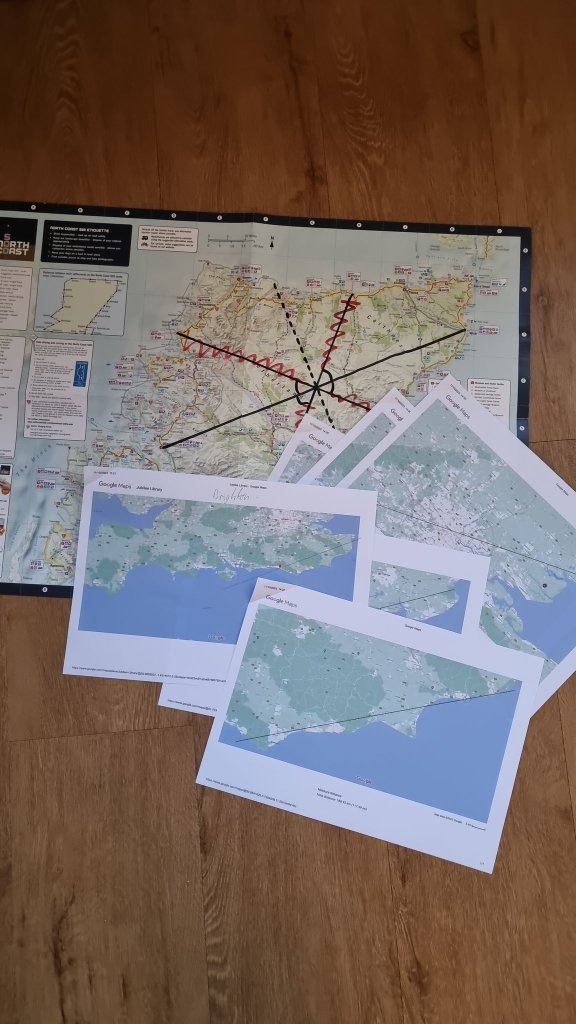
    To complicate things even further, last week’s pamphlet was – by complete coincidence – by one of the alter egos of TII: “A young man on Facebook” and his partner in crime, ChatGPT. That pamphlet explored geographic connections along the azimuth of 244′, plotted east to west. TII/AYMOF refers to this as The Line of Sh!te (which I argue is a term of endearment, and of course it has clear Bill Drummond connections). Last summer I placed a book with an earlier version of the young man on Facebook’s piece in Folkestone. If you draw a line of 244′ from Folkestone (give or take a few degrees(*)), where do you think you end up? Brighton, where Annebella is based. I contacted Annebella after I read Urs’ question, and she replied with her pamphlet later that same day. It’s a beautiful piece on a fascinating topic.

    For a writing and arts project that is meant to unfold spontaneously every Saturday over the course of a year, that is a lot of unforeseen connections, stretching from Badenoch to Sussex, in just a few weeks. The Benefaktor has mentioned the quantum physics theory of entanglement and ley lines previously (with tongue in cheek probably). Who knows where else this will take us.

    The phrase “Kindred of Kibbo Kift” sounds more outlandish than pretty much anything else you may have read about in the GANTOBverse. But it is very definitely something of the real world, and studied by Annebella, an authority in visual and material culture. I heard about them a few weeks ago on the excellent Search for the White Room Facebook page (you don’t need a Facebook account to visit). Extending our horizons, creativity, and hopefully making the world a better and fairer place are fine aspirations. It’s certainly what GANTOB (the person and projekt) are about.

    You can still purchase Annebella’s book on the Kindred via Donlon Books. It’s a beautiful volume. And her new book on art and the British Council was published last month (bonus marks if you can find a connection with a Bill Drummond book via a shared interest in a famous artist). It too is a beautiful book (Annebella’s book that it; though Bill’s is pretty good too of course).

    Until next week,

    GANTOB

    If you you have an idea for a pamphlet please get in touch: check out the 52 Pamphlets page.

    (*) 253′


  • THE LINE OF SHITE (by A YOUNG MAN ON FACEBOOK and CHATGPT)

    Feb 3rd, 2024

    Thank you very much to A young man on Facebook for this educational piece, which was issued earlier today in paper format, hopefully reaching The Passerby (whoever that may be) and the author (AYMOF). The latter is apparently mentioned in The JAMs’ book 2023: A trilogy, but I cannot check that detail because I have destrukted my copy of that book. AYMOF has kindly provided a bit more context.

    I perhaps need to substantial the claim that this piece is educational. It will almost certainly extend your vocabulary (for example geographical terms). It has helped me make calculations based on coordinates. We can all potentially learn something new from Bill Drummond’s thoughts on any subject. And it will probably expand your knowledge of the northern limits of mainland GB.

    Warning: There are straight lines in this piece. I don’t do straight lines usually. That is documented right back to my most recent trip to Northern Ireland in August 2023, when I was still a travelling salesperson (but not The Travelling Salesman, for obvious reasons). It is also there in one of Little Grapefruit‘s chapters in the second GANTOB book. It all relates to the Viennese artist Hundertwasser. Straight lines are godless and lead to the downfall of civilisation. Sometimes, however, we need to be flexible and shake off our strongly held preconceptions.

    There is also mildly rude language. Probably not one for children as a result. I do not find the sh*te word particularly offensive. It is often used in a humorous way where I come from. Think Billy Connolly. Apologies if it has ruder connotations where you live.

    The physical version of this pamphlet that was left in a book drop earlier today came in two forms – one for the person finding the book in the Little Free Library north of Drummond Place, Edinburgh, and one for that person (AKA The Passerby) to send to AYMOF. The wording may have been different in the two pamphlets. We are awaiting a confab and comparison of pamphlets between The Passerby and AYMOF. The means for this communication were provided in the drop. We will see if the plan bears fruit. It relies on the existence and honesty of The Passerby, and the reliability of the Royal Mail. We’ll see.

    That’s enough from me (GANTOB) for this week. Over to A young man on Facebook and ChatGPT.

    Oh, but before that I should also mention that I have been involved in AYMOF’s Line of Shite project once before – in a book drop in Folkestone, on 23 August 2023. I didn’t post about this on social media, because I didn’t want to spoil AYMOF’s work. Coincidentally, 23 August 2023 was the day that I started to feel the influence of The Benefaktor. There’s a bit more on that topic in the earlier post Entanglement, but it’s also discussed in a bit more detail in the second book (GANTOB’s 2023: A trilogy).

    Pamphlet 5 of 52 Pamphlets for 2024

    Submit your own idea for a pamphlet at GANTOB.BLOG/pamphlet


    The Line of Shite by A young man on Facebook.

    A narrated version, by AI voice “Malcolm”, can be heard here:

    This is the latest text of a book insert:

    “One evening in August 2003, a holidaying young man and his fiancée were minding their own business in a bar in Ullapool (a fishing village on Loch Broom in North West of Scotland). There, they witnessed a wizened trawlerman advise some bemused Scandinavian tourists, “Dinnae gae tae Wick, it’s a pile of SHITE”.

    One morning in August 2020, the now older young man and his now wife and now kids were holidaying in Walberswick (an ex-fishing village on Suffolk coast in the East of England).  There, he read a post on the artist Bill Drummond’s penkilnburn.com website: “MAKE LIVERPOOL SHITE AGAIN”. 

    Among other things, Bill Drummond is the author of “45“

    (“a non-fiction book published by Little, Brown in 2000” [Wikipedia] that collects various essays written by Drummond in 1997 and 1998.) [Some familiar with Drummond’s work may disagree with the “non-” prefix].

    The young man subsequently emailed Bill Drummond noting that, while Liverpool may be a bit “SHITE”, he had heard that Wick was a “pile of SHITE” – although, he had never been there to check. Bill Drummond emailed back, noting that, “Ullapool is definitely not SHITE. Whereas Wick has elements of bleakness”.

    One night in September 2022, the young man had the opportunity to stay in Wick (a fishing town in Caithness in the North East of Scotland).  There, he found that, while it did have elements of bleakness, on balance, he agreed with the Ullapool trawlerman – Wick was, indeed, a pile of SHITE.

    To mark this confirmation, the young man placed a copy of Bill Drummond’s 45 in his hotel room’s bedside drawer in Wick.  A few days later, the young man placed another copy of Bill Drummond’s 45 on a shelf in a bookshop at a hotel in Ullapool.

    These placements established the Line of SHITE.

    The young man subsequently determined that the Line has an azimuth of 64′ when plotted West to East (244′ the other way) – roughly East North East / West South West.

    GANTOB’s calculations

    Between 2010-22, the young man had amassed several spare copies of 45.  Acutely aware that one does not throw away books (and not wanting to flood the local charity sector), the young man wondered, “What would Bill Drummond do?” [Some might say the answer would, most probably, be, “not give a SHITE.”]

    The young man resolved to place pairs of 45 in suitable locations forming parallels with the Line of SHITE, recognising  that, over time, these may move – through happenstance, third party action or continental drift.

    You have found one of them.  You will probably never know the placement of its companion to the East North East or the West South West.  You may judge the SHITEness of its current location.  You may wonder if its companion is in a better or worse place than you are.

    You’re welcome.”

    AYMOF’s documentation

    In drafting this Pamphlet, ChatGPT was fed [by AYMOF] the above text and invited to: “Draft three paragraphs on the subject of Lines in Situationism that consider how the above exploit aligns or challenges this topic.”

    It replied:

    “Situationism, a movement rooted in the artistic and political avant-garde of the mid-20th century, embraced the concept of psychogeography – the study of how environments impact human emotions and behaviour. This included the idea of “dérive,” a drifting or unplanned journey through urban landscapes to expose hidden meanings. The Line of SHITE could be a contemporary echo thereof, where the young man connects disparate urban locations with a symbolic line. This echoes the situationist emphasis on uncovering subjective experiences tied to specific places, transforming them into a cohesive narrative.

    Moreover, the act of placing copies of “45” along the Line of SHITE introduces an element of détournement (situationist subversion of pre-existing cultural elements for artistic purposes). The books become  his instruments in the interpretation of place, transformed into markers challenging the conventional meaning of both a book and its locations. This aligns with the situationist ethos of disrupting established norms and encouraging a fresh perspective on the familiar.

    However, this Line also challenges aspects of situationist thought. While situationism often seeks to critique and subvert the societal structures it perceives as oppressive, the young man’s engagement with the Line of SHITE appears more whimsical than revolutionary. Instead of actively challenging the socio-political status quo, he demands a subjective classification of a place. This suggests a more nuanced relationship between individual experiences and broader societal critiques, adding layers to the conversation on the intersection of personal narratives and socio-cultural landscapes within the context of situationism.”*

    By “A Young Man on Facebook” and ChatGPT

    3 February 2024

    *The author edited ChatGPT’s output to achieve the word limit for this Pamphlet.

    Placements to date:

    Ullapool (no insert) – Wick (no insert)

    Stratford, London (no insert) – TBP

    Canada Square, London (no insert) – TBP

    Folkestone (via GANTOB, insert v1) – TBP(+)

    Brighton (insert v2) – TBP

    TBP = To be placed

    (+) GANTOB’s LoS drop, Folkestone 23 August 2023.

    #GANTOB2024 Pamphlet 5 of 52

    By A young man on Facebook and ChatGPT

  • HAWTHORNY (by URS)

    Jan 27th, 2024

    Written on the occasion of the publication of her husband and GANTOB’s book GANTOB’s 2023: A trilogy

    Pamphlet 4 of 52 Pamphlets for 2024

    Submit your own idea for a pamphlet at GANTOB.BLOG/pamphlet

    Listen to Urs narrate the pamphlet here:


    My granddaughter Katie (AKA The Foundation Doktor) has been asked to proofread GANTOB’s second book. You should receive the result in the same parcel as this pamphlet. This is my second pamphlet for GANTOB. Helping Katie with her task, and my observations of the goings on in our household over the past few months have been useful preparation.

    The shine was off my first pamphlet even before it arrived by second class post exactly a week after it was uploaded to the GANTOB.blog. My husband Douglas (The Benefaktor to you) was the first to point out my errors when I showed him the blog on my phone. I had mistaken the common-or-garden viburnum flowers for apocalyptically early hawthorn blossom. How could I have been so naïve? His question, not mine. He is always correcting me. It is not as if he is always right himself.

    (Douglas is furious that none of his errors about Bill Drummond or The KLF in the early chapters of the book have been “korrekted”. Katie mentions GANTOB’s Kreative Tyranny. Douglas does not know yet about the major changes that GANTOB and her Deputy General Manager have made at the end of the book. Rather hypocritical of them. Hopefully I will not be in the flat when he reaches that part).

    I emailed the corrections to my pamphlet to The Deputy General Manager. An addendum (but not correction) was added at GANTOB.blog before anyone had read it. But by that time the physical copy of the pamphlet – GANTOB’s “payment” for my efforts – had already been posted to me. The pamphlet arrived in a long white envelope, address printed on a label, GANTOB’s exploding grapefruit logo on a label providing some extra stickiness to the seal. The invitation to submit an entry for the GANTOB 52 Pamphlets project had suggested that the selected authors would be sent a personalised version. However, the instructions accompanying my pamphlet were very much “do it yourself”. As in myself. I was instructed to gather some hawthorn blossom on a dry day and press the five-petalled flowers inside the pamphlet, then inside a heavy tome. I decided against asking whether I should attempt the same with some viburnum bloom. It was pouring outside, so I did not feel like going to the park to visit the bush. Then, remembering that after researching my error I had spotted a viburnum in the shared garden, I snipped a carefully selected spray, dried it on some kitchen roll, and placed it inside an ancient Yellow Pages. I might add some hawthorn blossom in May, or whenever it appears in north Edinburgh’s shaded gardens.


    Two weeks have passed since that pamphlet was published – The Three Trees. A week ago Stuart Huggett wrote a piece called The Gate is Open, making profound points about James Joyce, William Blake and HG Wells. I have not read any of them before, much to my chagrin. My first pamphlet comes off badly in comparison: it is just a description of a chain of events. Stuart’s submission is a literary essay, unpicking a topic and proposing something original, linking it back to The KLF. I would like to do the same, but know little of The KLF (apart from snippets gleaned from Douglas, Katie, the GANTOB book, and Mr Huggett’s piece). I think I am off the hook though on that count. GANTOB has already said that it should be something that interests you as the writer, not shoehorning The KLF in for the sake of it.


    Katie visits. A day off after a run of night shifts. I tell her about my flawed pamphlet – my first piece of creative writing since leaving school. I give her some time to read it and explain the error. After a bit of thought she starts to explain some concepts from a recent research module.

    Confirmation bias – when you mistakenly see something that appears to support your pre-existing beliefs. I was expecting to see evidence of global heating, after reading a Greenpeace pamphlet, so imagined that a flowering bush in the dead of winter was evidence of impending catastrophe.

    And the aptly titled Hawthorne Effect, named after a Chicago suburb rather than the tree. She gives me a potted summary: subjects in a research study are thought to have modified their behaviour because they were being observed. The original context was factory workers in a Western Electric plant. The experiment measured productivity in different lighting levels and conditions and found improvement with almost all alterations, including breaks and shorter working weeks.  Katie and I are not sure that it really applies to my mistake, but we agree that the GANTOB participants were very productive (artistically and in putting pen to paper) during preparations for the second book.

    I marvel at what I do not know, but must have been well established decades before I started school 70 years ago. Take the Hawthorne Effect – the data was collected 100 years ago (1924-1927), but we are still hammering workers. Douglas tells me that quantum mechanics is the same, but I have heard his century old Heisenberg lecture on repeat.

    Katie heads off for some bouldering, so I pop along to the library. I am going to check my facts for this pamphlet, sticking with the hawthorn. I am confident I can find a link between the shrub and Stuart’s pamphlet, and who knows, maybe even The KLF. Stuart mentioned Blake’s poem Milton, and its relationship to The Justified Ancients of Mu Mu’s song It’s Grim Up North via Parry’s hymn Jerusalem. With GANTOB’s strict word count (which I feel compelled to ignore as I am doing her a favour introducing her second book) Stuart focuses on the northern English imagery in the poem – “the dark satanic mills”. But Blake’s words also take us to the southwest of England, and Joseph of Arimathea’s reported visit to Cornish tin mines over 2,000 years ago: “And did those feet in ancient time”. Some versions even have a young Jesus accompanying him. Joseph of Arimathea will forever be associated with Glastonbury where, exhausted, he stuck his staff in the ground and lay down to rest. On waking, he discovered that his stick had taken root and sprouted into a hawthorn tree, with beautifully scented blossom. And if that was not enough, Joseph’s tree flowered twice a year, unlike the common hawthorn. Biflora.

    The Glastonbury thorn. Burned in the English Civil War, circa 1647. Replanted in 1951 (but destroyed by unknown vandals in 2010). Propagated at other sites multiple times, but only some of the resulting trees flower twice in a year, in May and Christmas time. I visit the bush in my local park again, with its January flowers, but it remains a viburnum.

    And Glastonbury, I find out from a series of internet searches on the library computer, is one of the last places where The KLF, in their K Foundation guise, broadcast their music. Against Michael Eavis of Glastonbury Festival’s wishes, they hooked up their song K Cera Cera and blasted it around the festival site in 1993, for peace in the Middle East. If only.

    Nothing is new. The religious intolerance of the 17th century destroying a tree that had survived across two millennia, and the destruction of the replacement Glastonbury thorn in 2010. It is too close to the much-publicised Sycamore Gap incident at Hadrian’s Wall, September 2023. News stories from that time mention the connection with the Bryan Adams number 1 song (Everything I Do) I Do It For You, 1991. Now, I remember that! And I discover that was the year when The KLF rarely left the charts: 3AM Eternal, Last Train to Trancentral, the aforementioned IGUN and Justified and Ancient.


    There are a few blind alleys. The hawthorn is most associated in literature with William Wordsworth and Marcel Proust. On the off chance I google another literary giant mentioned in Stuart’s piece: James Joyce. I add in “hawthorn” in inverted commas to the search as Katie suggested. And there is a connection, however tenuous. A 1962 pamphlet written by the Scottish poet Hugh MacDiarmid called Poetry Like The Hawthorn. From In Memoriam James Joyce. 150 copies, octavo edition. The local antiquarian bookshop has a copy, but at £50 for 5 pages I am unfortunately not in the market. I find it in the library in a volume of MacDiarmid’s selected poetry. The hawthorn poem takes us no further – we already know when the common hawthorn blossoms. But in the poem Plaited Like Generations of Men, also in MacDiarmid’s Joyce series, he references the double “k”ed Danish philosopher Kierkegaard: “How the moment can be made eternity… it depends on repetition”. That sounds like The KLF. But it is a bit spurious. By channelling Joyce, MacDiarmid can just do a stream of consciousness. You could find a few relevant words on almost any topic from such a long, gnarly and spiky poem.

    I am feeling a bit stuck. I want to move things on. “Add to Playlist” as Douglas mentions in one of his chapters in the book. As a final attempt, I make a random choice from the poetry section. Modern Scottish women poets(*). More my scene. I land on page 180, and read In the Kibble Palace: Sunday Morning, by Anne MacLeod, 1999. I am drawn to mention of chrysanthemums, “palm and fern and moss, a green confusion”. But I check and there is no mention of viburnum or hawthorn. But no matter. I already have my connection. Kibble. It rings a bell, though it is not a word I can define. I have read it in GANTOB’s second book:

    “Characters from GANTOB’s first book, ‘Grapefruit Are Not The Only Bombs: 2023 re-enactment” kibble, adding layers to the intricate tapestry of her GANTOBverse”. (Chapter 80, by The Inconsistent Influencer, who also likes to be known as “A young man on Facebook”).

    Kibble – but not as MacLeod uses it (which is a reference to John Kibble, who established an iron-framed glasshouse now in the Glasgow Botanical Gardens).

    Nor is it the noun – kibble: an iron hoisting bucket used in mines. I wonder about tin mines. It is from the Latin for cup. Could it be the “holy grail” we seek in adventure films, our deeper explorations of the great poets, or even record and pamphlet searches relating to The KLF?

    No, as “The Inconsistent Influencer” explains later by email, kibble (the verb) means to “loosely mix with and grate against”. He used it to “evoke thoughts of K-related influences, such as the Kindred of Kibbo Kift, or the K Foundation”. And there we are. A completely new topic to explore for a future pamphlet. Who on earth were the Kindred of the Kibbo Kift?

    Urs, 27 January 2024

    #GANTOB2024 Pamphlet 4. A paper copy has been sent to Urs and recipients of the second book

    (*) Ed McMillan and Byrne, Canongate Classic, 2003

    If you know something about the Kindred of the Kibbo Kift and want to contribute some new writing, please get in touch via GANTOB.BLOG/pamphlet

  • THE GATE IS OPEN (by STUART HUGGETT)

    Jan 20th, 2024

    Thanks to Stuart Huggett, regular GANTOB contributor, for this thoughtful and literary journey along the Sussex coast. A personalised copy of this piece, in a trifold pamphlet, will be winging its way to Stuart along with his copy of the new book GANTOB’s 2023: A trilogy, the latter as payment for his GANTOB blogs last year. Find out more about progress on that front on X and Instagram.

    You can submit your own pamphlet for consideration following the instructions below, or by visiting the 52 Pamphlets page. Contributors will receive a copy of the book 52 Pamphlets , publication date January 2025.

    But before that, please read or listen to Stuart’s new piece.


    Listen to this pamphlet:

    Enlightenment can occur at any time and in any place. For me, the time was less than a week into 2024 and the place was Butlin’s holiday camp.

    GANTOB’s call for 52 Pamphlet submissions had been made on Thursday 4th January, while I was getting packed ahead of a weekend at Butlin’s in Bognor Regis for Rockaway Beach festival. We’ve been to every edition of Rockaway Beach since it began in 2015 and there’s little on the surface to connect it to the worlds of either GANTOB or The KLF/Justified Ancients Of Mu Mu.

    With thoughts of submitting a pamphlet in my head, the only KLF connections I could come up with at first were that Echo & The Bunnymen had played the festival twice and The Fall had appeared once. This year’s line-up included Skids, whose leader Richard Jobson does appear in Chris Atkins’ 2021 film ‘Who Killed The KLF?’ None of these connections felt particularly strong though.

    A couple of things I did know about that immediate stretch of the Sussex coast, however, was the presence of two key figures in British and Irish literature. A 15 minute walk to the east of Butlin’s brings you to Felpham, where the thatched cottage that William Blake and his wife Catherine resided in from 1800 to 1803 can still be found. Blake began writing his epic poem ‘Milton’ in Felpham, the preface to which is best known in its musical form as Sir Hubert Parry’s hymn ‘Jerusalem’.

    A few streets west of Butlin’s, in Bognor Regis itself, lies Clarence Road, where James Joyce stayed in 1923. A blue plaque informs us that Joyce wrote some of ‘Finnegan’s Wake’ while visiting here. Draw a line between Blake in the east and Joyce in the west and your path passes right through the holiday camp.

    While I was hoping to describe Joyce or Blake as pioneering pamphleteers to bring them into the GANTOB project, the facts of their publishing histories don’t really fit the conceit. Still, we were spending three days eating, drinking, dancing and sleeping on a Blake/Joyce literary ley line, so something might find us, and in his 2021 book ‘William Blake Vs The World’, KLF admirer John Higgs does point out that Blake “was a one-person publishing industry, writing, designing, printing and colouring illustrated works of his own devising. Although he was still in the Georgian era, Blake was practising the ‘do it yourself’ ethos of punk rock.”

    One of our party arrived on Friday having brought along the 2006 Tate Publishing facsimile of Blake’s ‘Songs Of Innocence And Of Experience’, remembering our first exploration of Felpham the previous year. Reproduced from the 1992 Folio Society edition, Richard Holmes’ introductory essay quotes from Blake writing about his initial arrival in the village:

    “Work will go on here with God speed. A roller & two harrows lie before my window. I met a plow on my first going out at my gate the first morning of my arrival, & the Plowboy said to the Plowman, ‘Father, the gate is open.’”

    In his 1995 biography ‘Blake’, Peter Ackroyd writes that, “For Blake this was an emblem of his new life, and of the work that he was about to begin.” If this encounter was symbolically important to Blake, it could also be important to us.

    Some downtime on the Saturday led me to explore nearby Hotham Park, with its miniature railway, nature garden, café and private residence, Hotham Park House. A William Blake Trail information board at the park’s southern entrance repeats the story of Blake interpreting the farm boy’s call as a symbolic sign. I’d not been looking for Blake in the park but here he was with the same tale told. I still wasn’t feeling very visionary myself but I banked the memory.

    Fittingly for a weekend spent midway between the former lodgings of William Blake and James Joyce, half our chalet party were English and half were Irish. Blake’s presence was starting to loom larger than Joyce’s as the weekend progressed but I bore in mind an argument put forward in Jeremy J. Beadle’s 1993 book on sampling technology and musical post-modernism ‘Will Pop Eat Itself?’ where he suggested that “the literary echoes consciously summed up in Joyce’s ‘Ulysses’, its use of sound collage, were all discrete sounds fed through the digital sampler of Joyce’s imagination to produce art of a (supposedly) coherent narrative.” It’s worth noting that Beadle’s book analyses The KLF at great length.

    Sunday brought us to a lunch booking at Felpham’s Fox Inn, an 18th century pub across the street from Blake’s cottage. While the property has inevitably changed over time, not least being damaged in 1946 and rebuilt three years’ later, a blue plaque in its doorway marks the spot where Blake was arrested for sedition in 1803, having thrown a soldier billeted at the inn, one Private John Schofield, out of his cottage’s garden in a fit of anger.

    William Blake’s cottage. Credit: Stuart Huggett

    Over the course of a couple of hours in the pub, my companions having a Sunday roast while I opted for game stew, the magic of the Blake connections worked their way back through my memories, dredging up forgotten facts while my conscious mind was still rattling through conversations about the FA Cup Third Round.

    It was only as we left the Fox, stepping back out through a doorway still vibrating with the energy of Blake’s arrest, that the recurring phrase finally clicked into focus. “THE GATE IS OPEN” is a message on the label of the 12” release of ‘What Time Is Love? (Live At Trancentral)’, the version that began The KLF’s run of Top 10 singles over the next couple of years.

    I had to Google it to make sure but there it is, down at the bottom of the label, in the Other Data slot used, on other KLF releases, to quote from their lyrics (“OVER AND OUT”, “THE K. THE L. THE F. & THE OLOGY”), add missing credits (“MC BELLO APPEARS COURTESY OF GEE ST. RECORDS”) or just to play with the record buyer’s expectations (“PROBABLY THE MOST NAUSEATING RECORD IN THE WORLD”).

    One Discogs user reckons that ‘THE GATE IS OPEN’ is “a reference to The KLF’s announced but naturally unreleased acid-house album ‘The Gate’ which they intended to record in 1990 but scrapped in favour of filming their one-hour feature ‘Waiting’ on the Isle Of Jura.” The KLF’s own press release ‘WAITING: KLF BIOG 010’  states that “The KLF’s original plan on visiting Jura was to take their mobile studio ‘Trancentral’ and record an album entitled ‘Gate’.  It was to be a minimalist techno record, but the power of the land, sea and sky scapes of Jura and the almost dream-like quality of the light put an end to any thoughts of making music more suited to inner city night life.” Blake would recognise such a description of Jura in his own early perceptions of Felpham.

    What if ‘THE GATE IS OPEN’ IS a deliberate reference to Blake though? After all, The KLF have drawn on Blake’s work at other times. The Justified Ancients Of Mu Mu’s ‘It’s Grim Up North’ climaxes with an instrumental rendition of ‘Jerusalem’, the Sir Hubert Parry hymn based on the preface to ‘Milton’ that Blake began in Felpham. ‘Jerusalem’ fits perfectly as the whole track is a celebration of the north of England. Remember too, the visual quote from The Fall (who themselves had previously covered ‘Jerusalem’) at the end of the video, ‘THE NORTH WILL RISE AGAIN’.

    Elsewhere, Blake informs The KLF’s work more subtly. Some of the sampled crowd noise on their Top 10 album ‘The White Room’ comes from The Doors’ album ‘Absolutely Live’. The Doors took their name from Aldous Huxley’s book of psychedelic experiments ‘The Doors Of Perception’, itself a quote from Blake’s ‘The Marriage Of Heaven And Hell’. William Blake breaks on through.

    Referencing H. G. Wells’ unnerving 1906 short story ‘The Door In The Wall’, GANTOB has occasionally written about Green Doors (as in her pamphlet ‘Paint Them Black’). In her telling, these are doors, literal or metaphorical, which appear occasionally in our lives, the passing through, or not, of which are branch points at significant moments in life. It may be notable that The KLF’s quoting of Blake on the 12” label of ‘What Time Is Love? (Live At Trancentral)’ occurs at the start of a significant shift in their artistic practice.

    Prior to this single, The KLF’s work, and their previous activities as The JAMs and The Timelords, can be seen as playful, entertaining and innovative, certainly in their post-modern, post-Joyce, cut and paste music. They are not yet transcendent though.

    ‘What Time Is Love? (Live At Trancentral)’, however, marks the point at which The KLF not only became hugely commercially successful but also visionary in a much wider sense. From here on in, their big budget videos, outlandish ‘Top Of The Pops’ appearances, wild collaborations and mock pagan rituals all fired the imaginations of the global public, for years to come.

    Consciously or not, Blake had been invoked by The KLF. His eternal, imaginative spirit entered their work and the course of their lives and popular culture was changed as a result.

    The gate was opened. The world followed them through.

    STUART HUGGETT, 20 January 2024

    PAMPHLET 03 (2024)

    Notes

    The original source of Blake’s “The gate is open” quote is ‘The Letters Of William Blake’, edited by Geoffrey Keynes (Oxford University Press, 1980).

    Thanks to Carolyn Bristow, Laura McQuaid, Noeleen Murray and Laura Tyrell for exploring the Blake/Joyce literary ley line with me.

    Want to contribute a blog? Pamphlets should be between 800 and 1600 words, ideally an exact multiple of 400. Submissions to 100percentvinyl2@gmail.com should be made as soon as possible (first come, first served, unless something more suitable comes along), and no later than 27 December 2024. Suggestions for developing ideas or other modifications to the submitted pamphlet may be made by the GANTOB Pamphlet Committee.

    Follow progress via @gantob2023 on X and Instagram. Good luck!

  • THE THREE TREES (by URS)

    Jan 13th, 2024

    This is the second pamphlet from the GANTOBverse for 2024.

    Urs is having a bad week. Please hear her out. Indeed, you can listen to her read her story here:

    Next week’s blog will be by Stuart Huggett. It’s a cracker. Find out how you can contribute at the end of this piece.

    Erratum: Urs is mistaken about the first tree. It is a viburnum, which is meant to blossom at around this time. The labels had got mixed up. The cherry tree, however, is not meant to be in flower.

    Over to you Urs…


    My husband Douglas has admitted defeat with this week’s pamphlet. You may know him as The Tonsure, The Benefaktor or Rev K______. His piece was to have been a version of Edwin Abbott Abbott’s 1884 novel Flatland, or Orwell’s Animal Farm, but with fruit rather than shapes or animals. He is still working on it, but I have offered to do my bit. That curious individual GANTOB will put it into pamphlet format I am told.

    There is burnout in the air after Christmas and the New Year. Our son, a GP, worked both long weekends with the out-of-hours service. Two four-day stretches when everybody else was resting. He tells us that he spent the intervening days curled up in a ball recovering. Before he worked in the out-of-hours service he was a GP partner, but the pressure was unspeakable. He is talking about reducing his hours further. Douglas was swanning about with our granddaughter in Europe over the New Year, as is his habit (except over the Covid years), but this time they came back dejected. Both in a great big sulk.

    We soldier on. But there is an edginess in the air. The Post Office scandal. The Middle East. Trump. Global heating. And here I am writing about three trees (and a plastic one). But they are symbolic of what we are all experiencing, so bear with me.

    On Wednesday I set out to the Nostalgia Café where I volunteer most weeks. Out of my usual routine and having had a rush with the baking I took a shortcut through the local park grateful for my choice of boots. And there was the first tree. It was a funny gnarly thing with offshoots off the main trunk. A hawthorn with a small crop of last year’s berries shrivelled on the stems but also a fresh display of fully formed pink blossom on the newer growth. No bees or birds to enjoy the heady perfume. I took a photo as evidence, the morning gloom failing to do its blooms justice.

    Blossom in early January on the “May tree”. I attempted to explain it away. The enthusiasm of youth. The main body of the tree, after all, had no blossom. I kept moving. I was meant to be setting up after all. Nobody had been in over the holiday period. There would be quite a lot of tidying up, and who knows what would be happening with the heating.

    Tea, cakes and reminiscing with the “old dears”. Not that some of them are any older than me. That is the way of things. Same with volunteering at the Marie Curie clothes shop. The young ones come and go, but it is the core of septuagenarians and octogenarians who keep things afloat. We always have such a beautiful selection in the shop, and so well organised. But that is my Friday job.

    I was pondering this while taking down the Christmas decorations and squirreling them away into the group’s limited cupboard space. I put the 5-foot plastic tree back in its Woolworths box, which already contained the broken branch that we never quite get round to fixing or chucking out.

    Googling it now I see that Woolworths closed 15 years ago, in the period immediately after Christmas 2008. Miserable for the staff. I do not know how long before that this tree was acquired. I am told that it was a donation from one of the families we were supporting. But that was before my time. I was still working at that point. Not that I have ever really stopped since “retiring”.

    The community centre that hosts the “café” each week looked bare when I had finished. But we are lucky to have the space. During the pandemic it was a Covid testing centre. I remember it from my own test, having dodged the bullet for 18 months. Cubicles in a row, staff dressed in spacesuits, everything spaced out and demarcated. We were not sure that we would get back in again after it was decommissioned. Lots of talk about decontamination, which we took to be a euphemism for gentrification. Another block of student flats. More profitable than refurbishing it and returning it to its original use. A petition has granted it temporary reprieve. Who knows how long it will take the bureaucrats to make their final decision. No doubt more paperwork and meetings to fill out. Add it to the pile.

    I had only 15 minutes left to turn things around. Nobody else was there. Time for a sticking plaster fix. I covered the bare plaster where there had been partitions, and the signs and arrows mark that era. I found the box of posters and pictures from previous visits by a local artist. That cheered things up, as did the tablecloths and napkins. The home baking would also help when the rest of the team arrived. I left the corner by the kitchen clear because we had a singer and violinist visiting. I hoped they were not doing the WWII greatest hits again. 1960s and 70s would be more appropriate for our current group. A bit of Dexy’s Midnight Runners would hit the spot I thought.  John, one of the other volunteers, had roped in his husband to play the piano. And speak of the devil, the other helpers appeared, rushing in, excuses about the traffic.

    The old dears started to arrive a few minutes later, in minibuses and adapted people carriers, a couple in wheelchairs pushed from the flats and sheltered housing nearby. One of the men vomited on arrival, so we sat him quietly at the back to recover, arranged a cordon using chairs around the slip hazard, and directed the stragglers to their tables. Phyllis mopped up.

    The morning was a blur as usual. Falls averted, misunderstandings between the regulars cleared up, the wanderers who would not settle. “Walking with purpose” is the current term I read in the form that I have to send to the council every year – I will have to submit that in a few weeks and I have not even started it yet. When the music started I loaded up the trolley and wheeled the dishes to the kitchen, rolling down the hatch to avoid disturbing everybody else. Ishbel came through to help, and we nattered away as usual. She talked more than dried, as is her habit. She had read something on the BBC News app about global warming and commented on the cherry tree visible through the kitchen window, in the garden of the Georgian house next door. The whole tree was ablaze with pink blossom. Months early. Not just the new shoots. No arguing with that. John, who is a keen gardener and helps out at the community garden project, confirmed this when he came in to escape the strains of “We’ll Meet Again”. I seemed to be doing everything, and the dishwasher had stopped working. I would need to report it. Another email to draft. And everyone was talking, that awful singing just would not stop and the violin was flat. I snapped and bawled out John and Ishbel, and wondered if we should have called an ambulance for the vomiter who was lying stretched out across three folding chairs, an accident waiting to happen. I worried that I would need to fill out an incident form.

    I hobbled home, my left ankle throbbing. I was looking forward to a cup of something from the tea advent calendar that my other granddaughter gave me (a bargain from the New Year sales). Douglas was scheduled to be out that afternoon. I would have the house to myself. I would switch off. Silence.

    But as I squeezed past the 4×4 parked up on the kerb I saw that our gate was blocked by a huge Christmas tree stretched across the pavement. The others along this stretch of street had been lifted earlier in the week. Presumably a neighbour in one of the big houses had missed the collection. Left outside somebody else’s gate for them to sort out. That somebody else being me. Another call to the flipping council. It had already become a magnet for other detritus – a packet of crisps that had perhaps blown along from the communal bins, a large orange pile of dog poo, another neatly bagged up in a blue bag, hanging on a branch. I could not bend down to reach the tree’s short stump and I did not have suitable gloves to protect my hands from the pine needles. I nudged it with my boot, but whichever angle I tried it was too big to move. Stupid ankle. And there was no hope of me climbing over the railings. The doorbell was out of reach and as usual Douglas was not answering his mobile or landline. It was the last straw.  I would have screamed, but who was going to hear me?

    I laughed bitterly at the irony. A dead tree, still bushy and green, looking as if it would survive and flourish if it were planted in the ground. Rootless, but immovable. Sorrowful in its undecorated state, save for society’s excrement. And the two other trees, too full of life, beautiful in their premature livery, potentially spoiling this year’s crop.

    I made my way to the local chain café, picking up stronger painkillers from the pharmacy en route. I would be able to put my feet up for a few hours and hope that somebody else cleared the way for once.  There really are so many jams to kick out, as I believe they say.

    URS, 13 January 2024

    PAMPHLET 02 (2024)


    Want to contribute a blog?

    In effect we will be constructing a memoir of 2024. Write it in the first person, or which ever person you want, and make it relevant to now, but building on what you’ve learnt so far in life. Or make it entirely fictional. Or philosophical. Relate it to the GANTOBverse in some way, however subtle, for bonus points.

    Spread the word. Subscribe to gantob.blog, and follow progress via @gantob2023 on X and Instagram. Good luck!

    As a guide, pamphlets should be between 800 and 1600 words, ideally an exact multiple of 400. Submissions to 100percentvinyl2@gmail.com should be made as soon as possible (first come, first served, unless something more suitable comes along), and no later than 27 December 2024. Suggestions for developing ideas or other modifications to the submitted pamphlet may be made by the GANTOB Pamphlet Committee.

←Previous Page
1 … 40 41 42 43 44 … 53
Next Page→

Blog at WordPress.com.


Loading Comments...
 

    • Subscribe Subscribed
      • GANTOB blog
      • Already have a WordPress.com account? Log in now.
      • GANTOB blog
      • Subscribe Subscribed
      • Sign up
      • Log in
      • Report this content
      • View site in Reader
      • Manage subscriptions
      • Collapse this bar