November’s pamphlet (GP006) is available to preorder on our Buymeacoffee page
Yet to be written, it is inspired by looking at Gaynor’s painting on a very stormy day
To be enjoyed with ELO’s Summer and Lightning, one of The Benefaktor’s favourites from his Pop Music 101 with Gillian Finks, Autumn 2023
Final copy of GP001, and a few more copies of GP002-005 are still available on the site. All come with various extras
If you miss the coloured card copy of any of the pamphlets (they come in editions of only 20) you can request a paper copy with any other order, so you can keep up with the evolving story
The GANTOB team are currently doing some research on islands for the forthcoming pack (GP005).
In addition to the pamphlet that continues the Doris Wolff story (this month’s instalment is called The Opponent), there will be a Little Grapefruit pamphlet. The GANTOB editor thinks that Big Grapefruit in the Big Apple requires a bit more work, so the author is currently doing some further research on that story, on an island. There may therefore be a slight delay in printing and posting GP005 (a week or two).
The forthcoming GANTOB package, The Opponent (GP005), will include a new story from the Little Grapefruit verse. It will be in a pamphlet of its own called Big Grapefruit in the Big Apple.
In August, Edinburgh is all about the crowds. It’s much busier than Curt Finks’ era, though there are no doubt shows with as few audience members as his “fringe of The Fringe of the Edinburgh International Festival” performances.
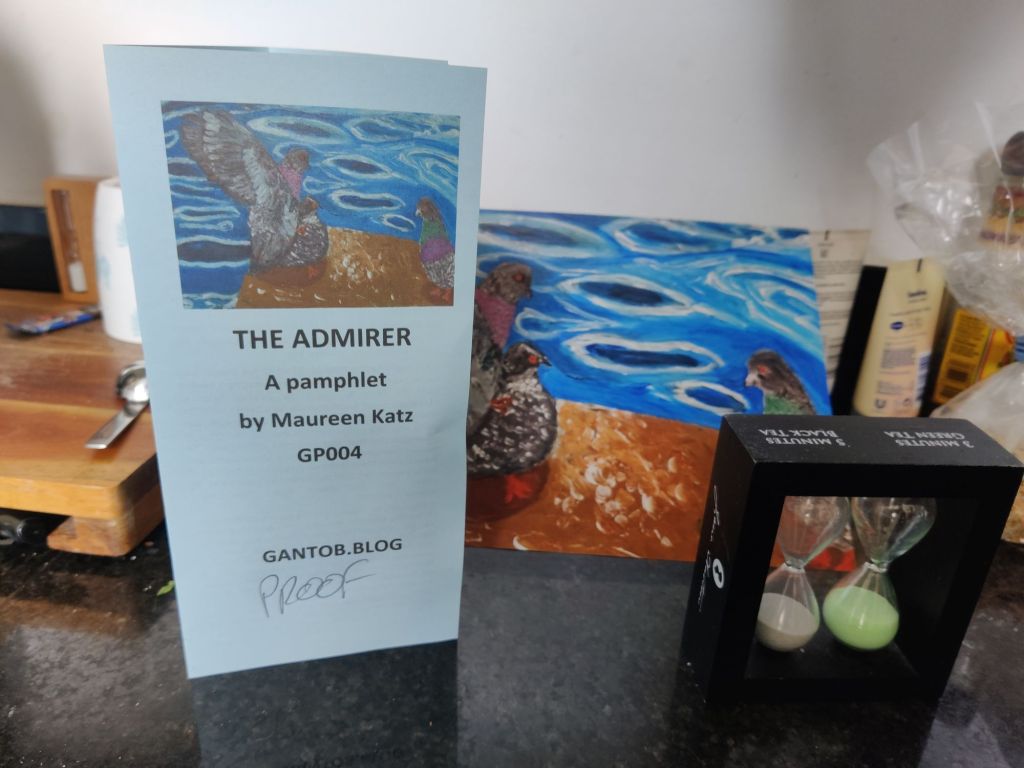
There are crowds in this month’s pamphlet, The Admirer (GP004), but not in Edinburgh. Buy it here. The final version will be printed on card. It comes with an A4 print (numbered and signed), a handwritten green tea slip from the drafting of the story, and a contribution from somebody we haven’t heard from for months, returning to a previous preoccupation. Only available by snail mail.
Next month’s pamphlet is also ready to preorder at the same link.
The current management of GANTOB (yours truly) does not drink green tea, despite trying to like it over a period of many months. I’m more like Doris Wolff in this year’s pamphlet series, who gravitates towards coffee, for her daytime hot drink at least.
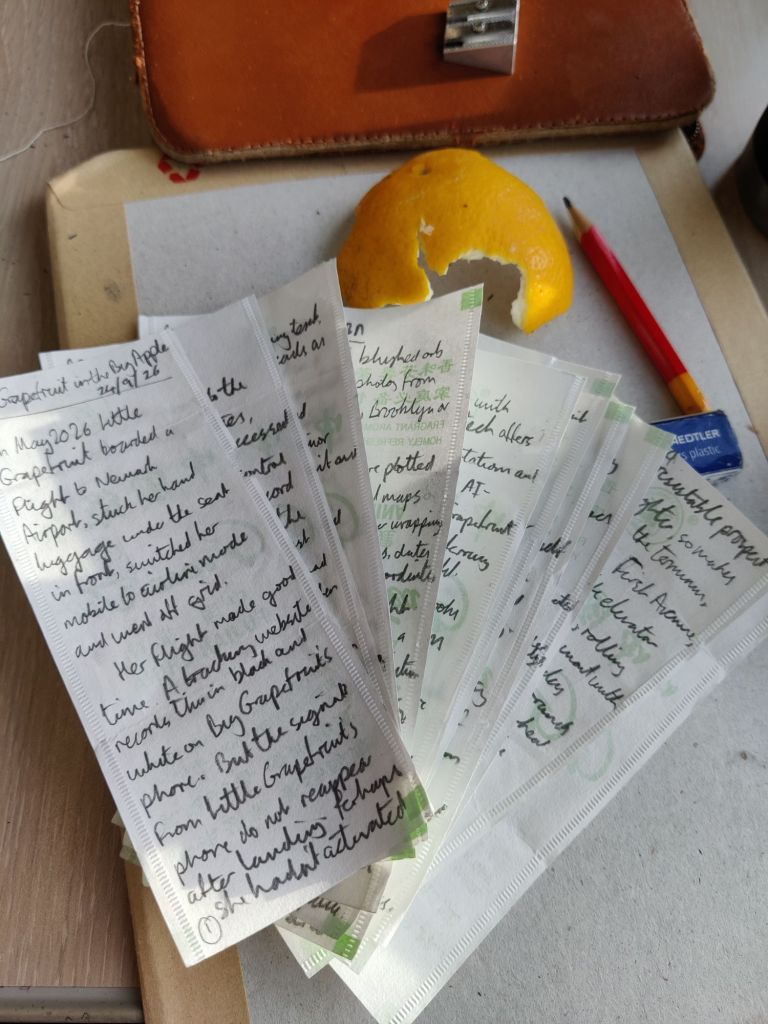
GANTOB tradition dictates, however (and Urs Kanning, wife of The (late) Benefaktor, insists) that I continue to write on green teabag envelopes/ slips. That leaves me every month with spare unwrapped green teabags.
If you would like to receive some green teabags with your next pamphlet delivery please let me know.
MAUREEN KATZ, 14 August 2026
A used green teabag from yesterday’s lunch. All teabags distributed to GANTOB customers will be in date and unused.
It’s proofing, printing and quality assurance day at GANTOB HQ. The first copies of GP003 will be posted this afternoon. Buy yours, or subscribe to the series, at buymeacoffee.
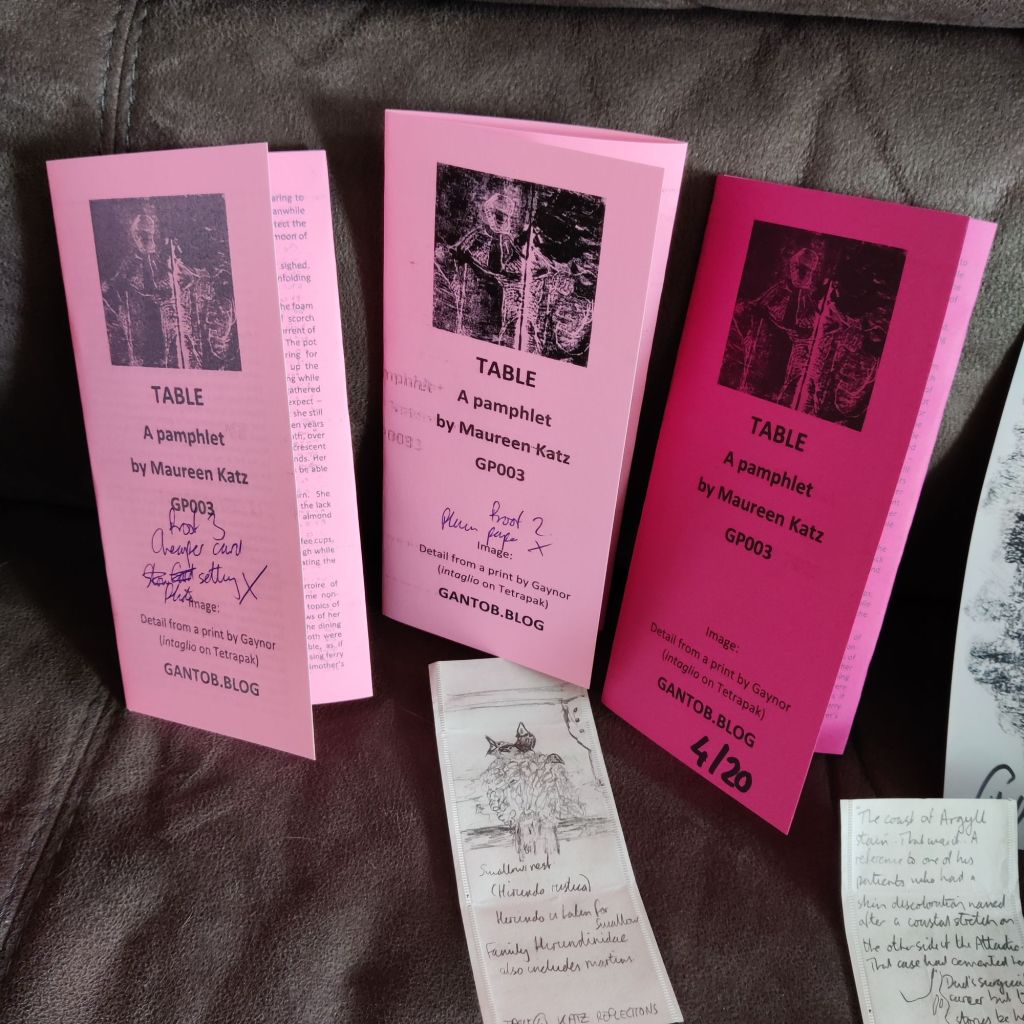
On the perils of trying to save money with cheaper card. Pastel variants of this pamphlet will not be issued
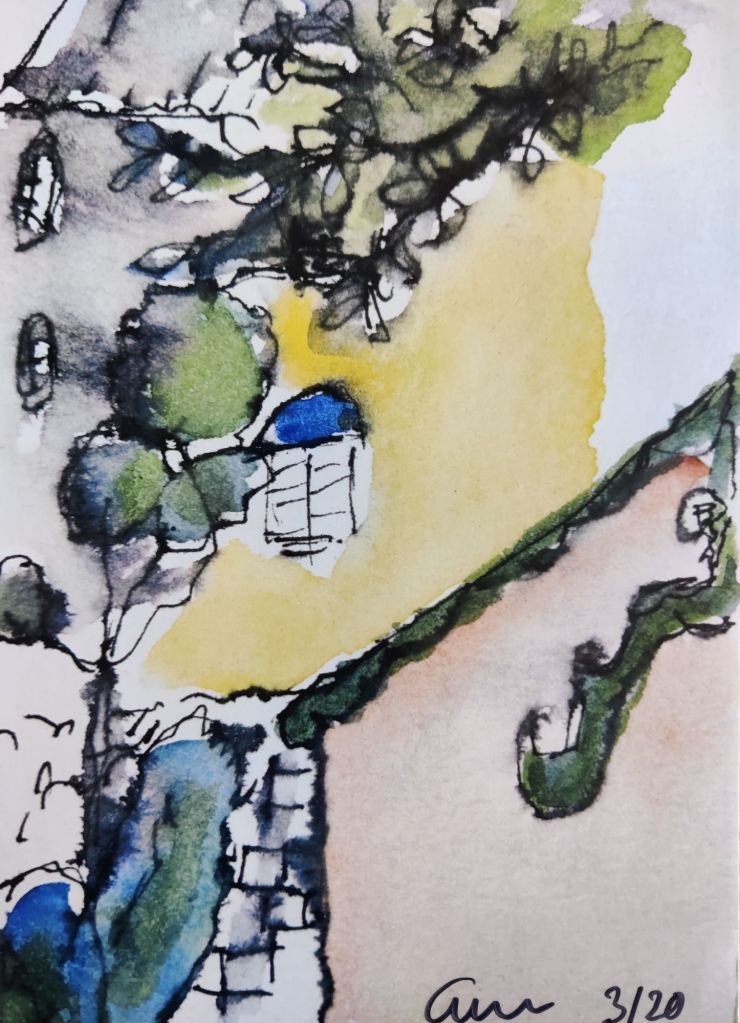
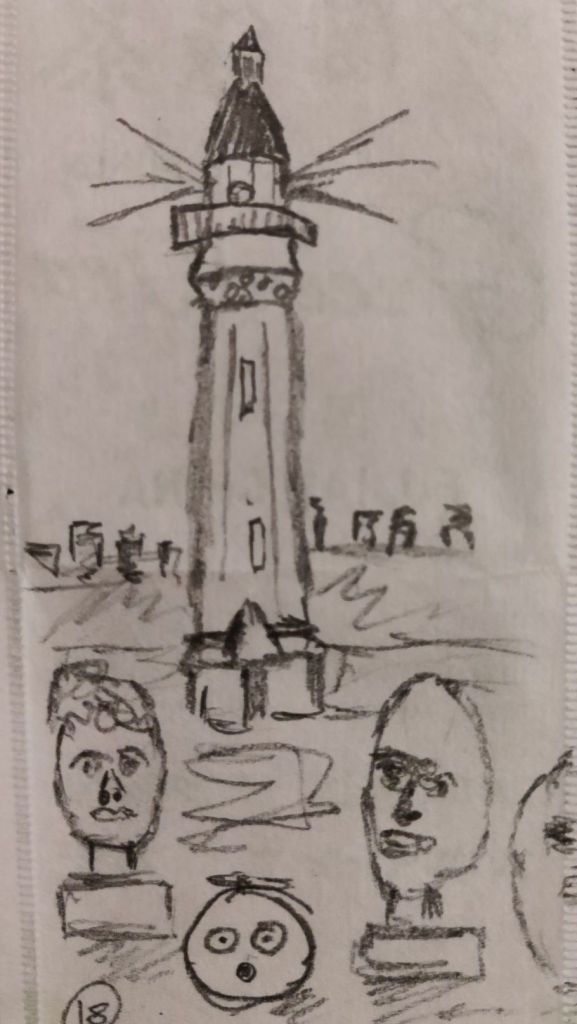
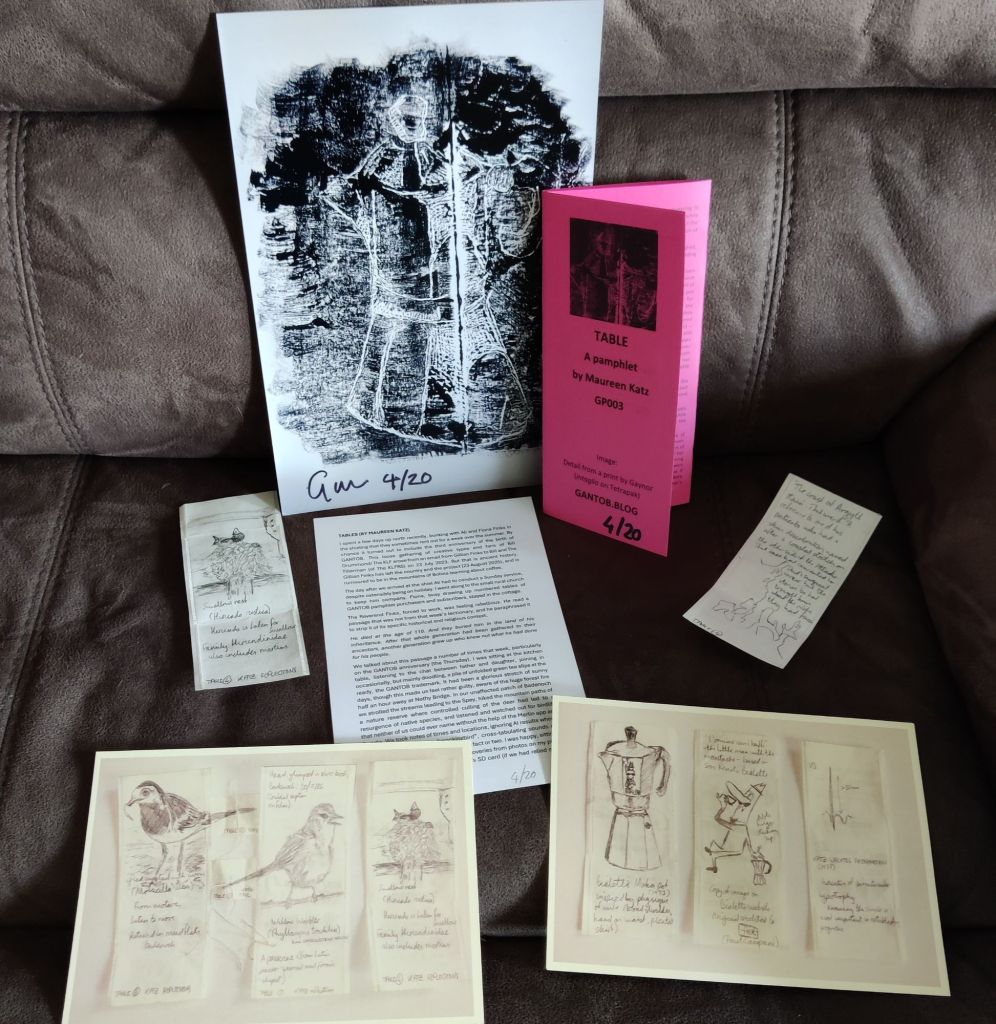
GP003 (TABLES) is in production. It includes a pamphlet called Table that will be printed on card, a green tea slip with the initial notes for the story in pencil, an A4 signed and numbered print of the picture by Gaynor that inspired the writing, an A5 insert (in preparation) that provides some reflections from a trip to visit Ali and Fiona Finks in the Highlands last weeks, and another hand drawn green tea slip with a picture drawn during that trip. All for £3 to cover costs and postage and packaging, anywhere in the world. Shipping next Saturday. Buy it here.
Today, 23 July 2026, is the third anniversary of GANTOB. It is when Gillian Finks first wrote to Bill Drummond and The KLFRS’s The Tillerman to ask for permission to reenact the book Grapefruit Are Not The Only Bombs.
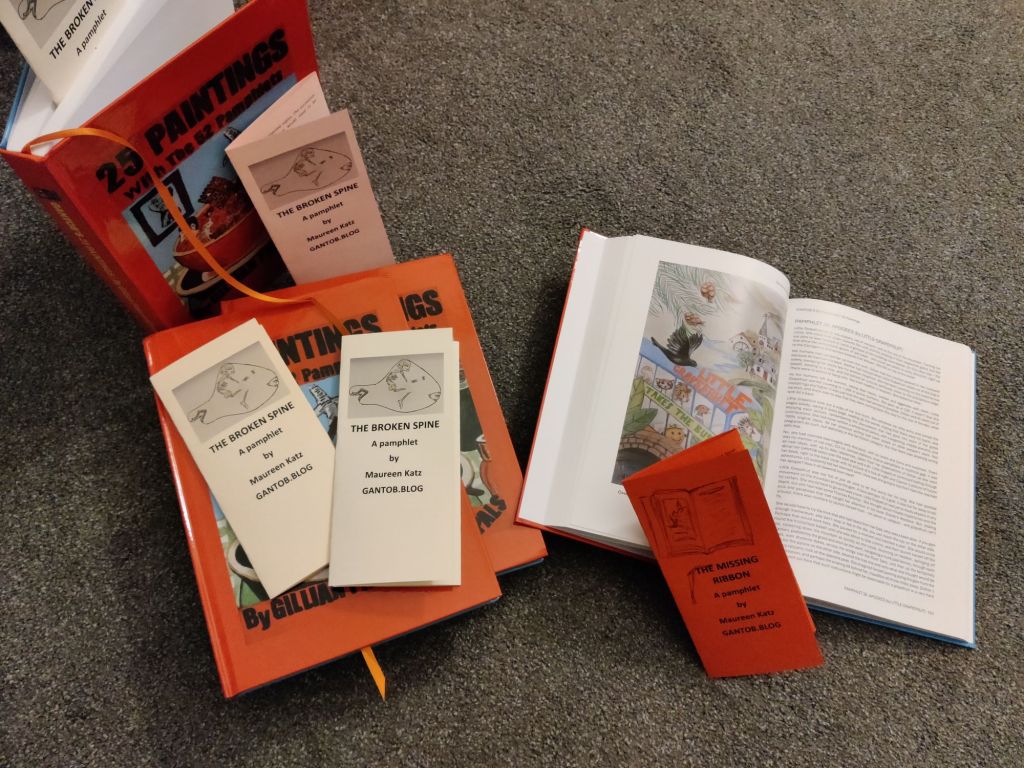
So it was fitting that I took a trip to the Agency for Legal Deposit Libraries to deposit five copies of GANTOB’s 25 Paintings, having received their request a few days ago. Copies will be with the National Library of Scotland, The Bodleian Library Oxford, University National Library of Wales, Cambridge University Library, and The Library of Trinity College Dublin in due course.
I thought I had five copies reserved for this purpose, but I had forgotten I had sent copies to Bill Drummond (receipt acknowledged) and John Higgs (no response as yet). I therefore had to send my own personal copy. That felt like a rather Bill Drummond thing to do.
The four reserved copies had been bashed before I had even received them, so were accompanied with a copy of The Broken Spine pamphlet (April 2026). My pristine copy of the book, from the first print run, was sent with a newly drafted pamphlet, The Missing Ribbon, named after the defining feature of that issue. The new pamphlet updates some points, including the new series of pamphlets for 2026/27.
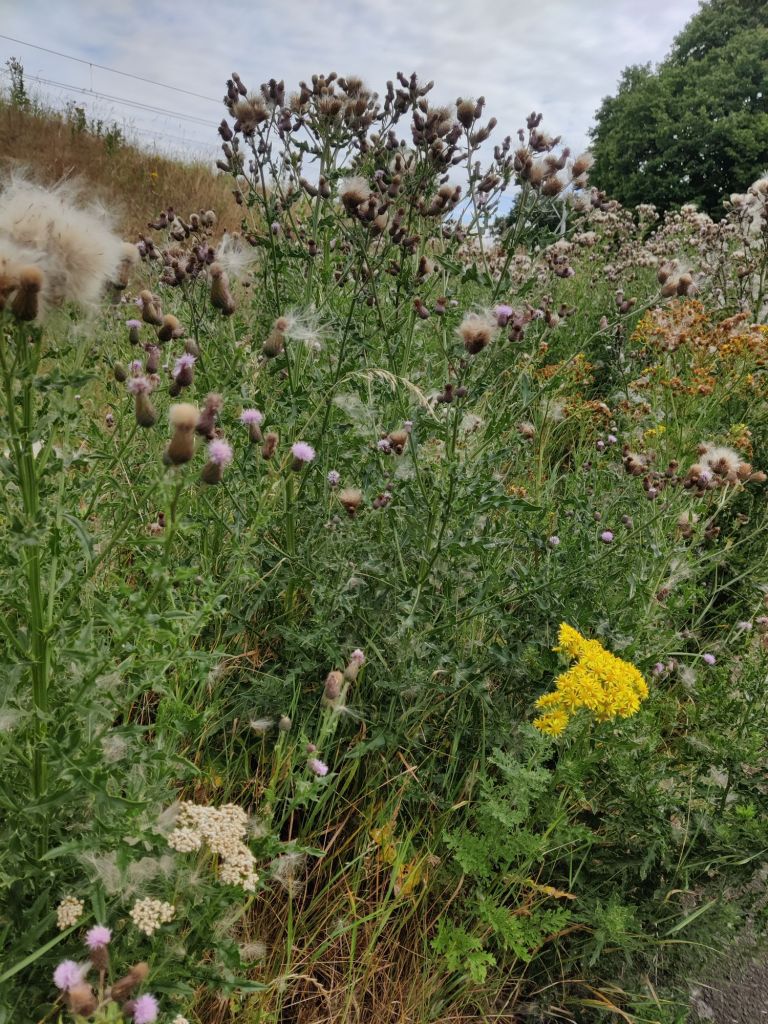
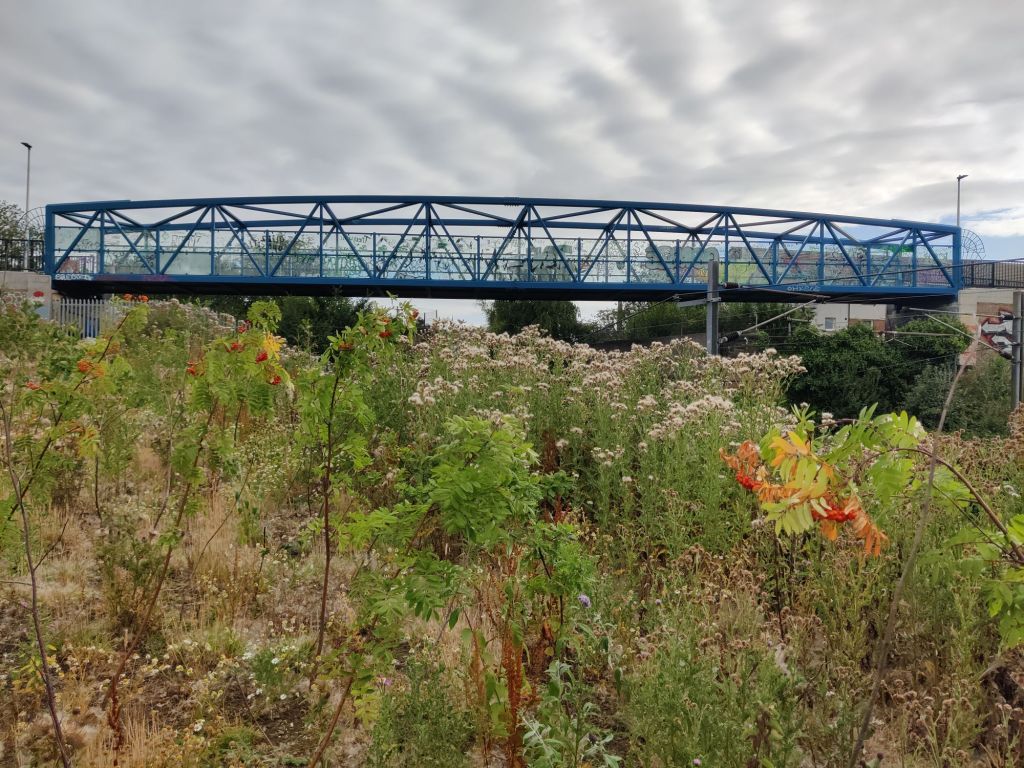
The ALDL warehouse is in a drab industrial estate on the other side of Edinburgh from my home. I cycled there with 8.5kg of books attached to my handlebars and in my rucksack, appreciating the thistles and ragwort in the sidings. Who would have thought that such a pivotal cultural institution would be situated in such a hinterland.
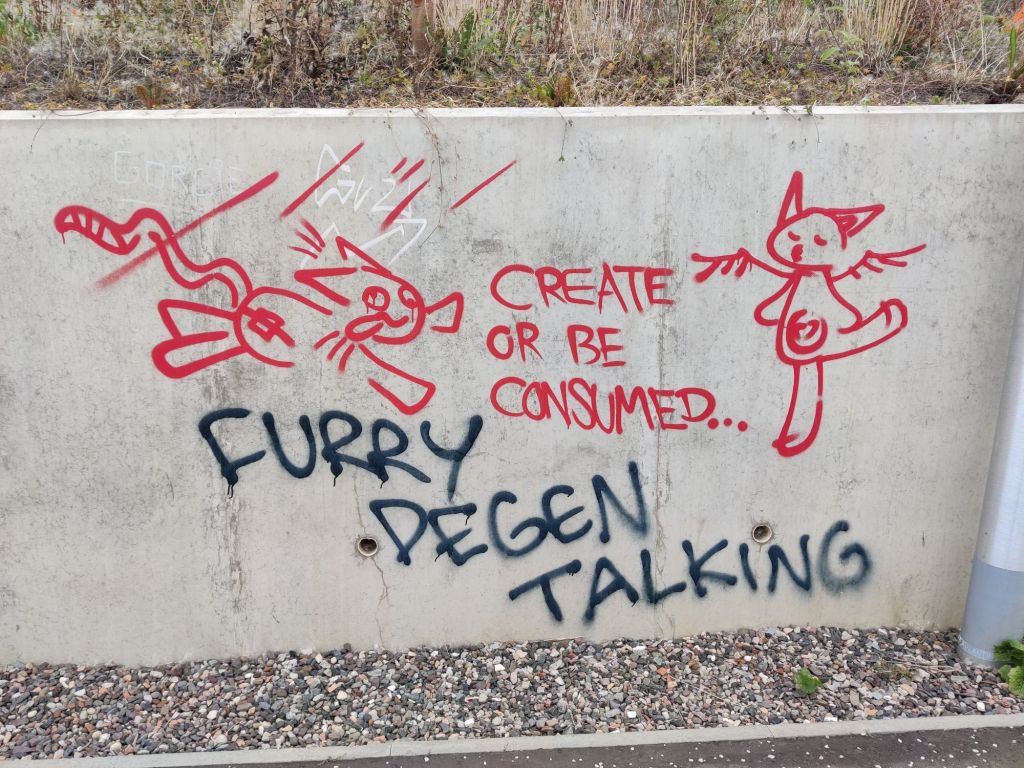
On the way back I took photos of graffiti. A thoroughly enjoyable way to start our third birthday.
A message from Gaynor marks the day well:
‘Wow really!!
This is the longest iv ever been interested in “stuff”
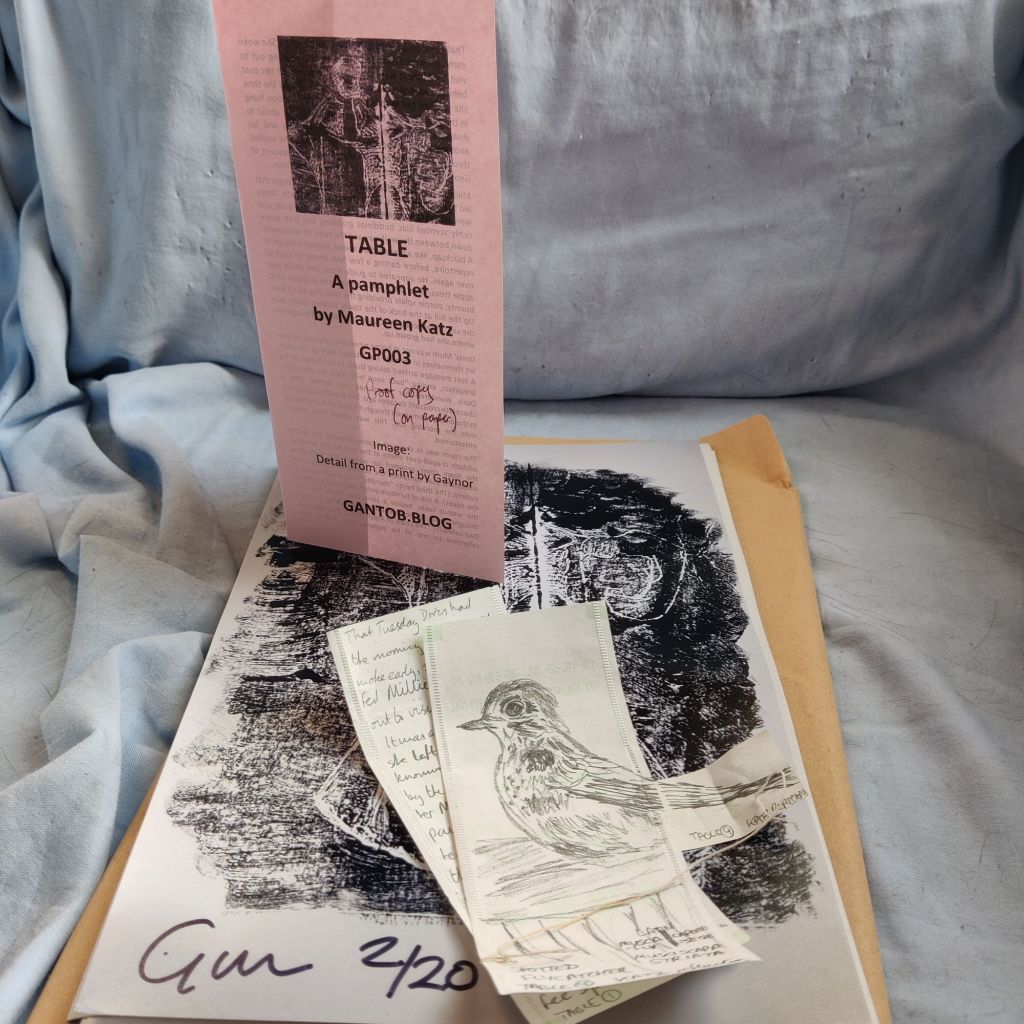
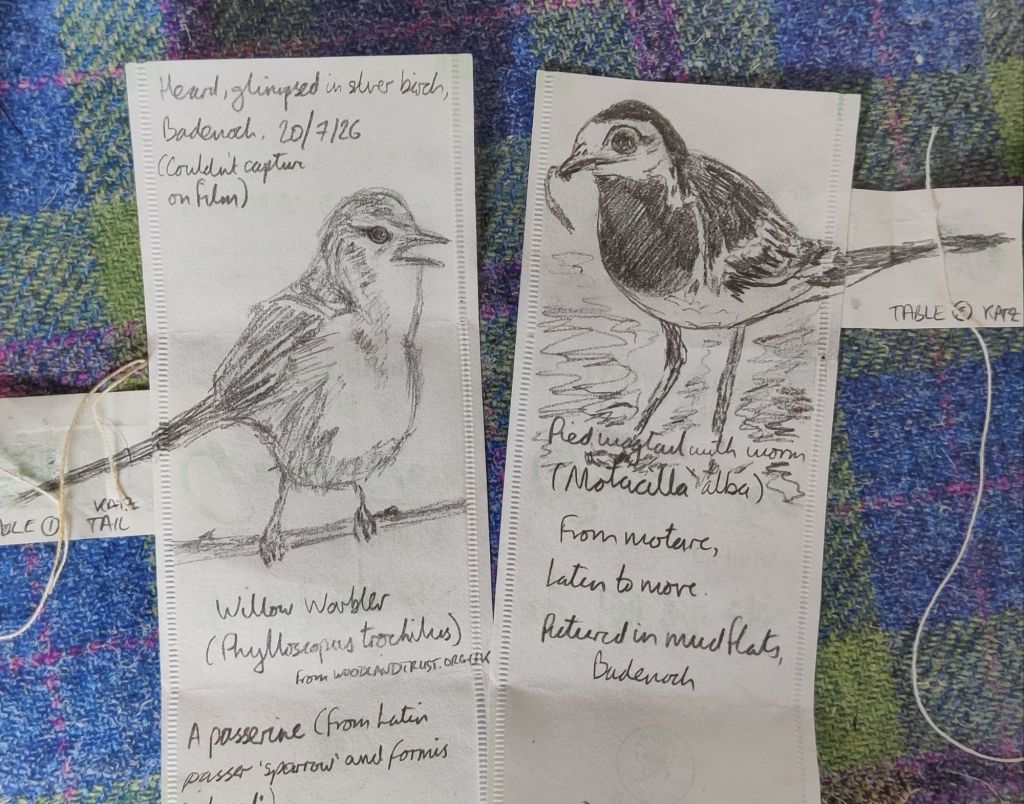
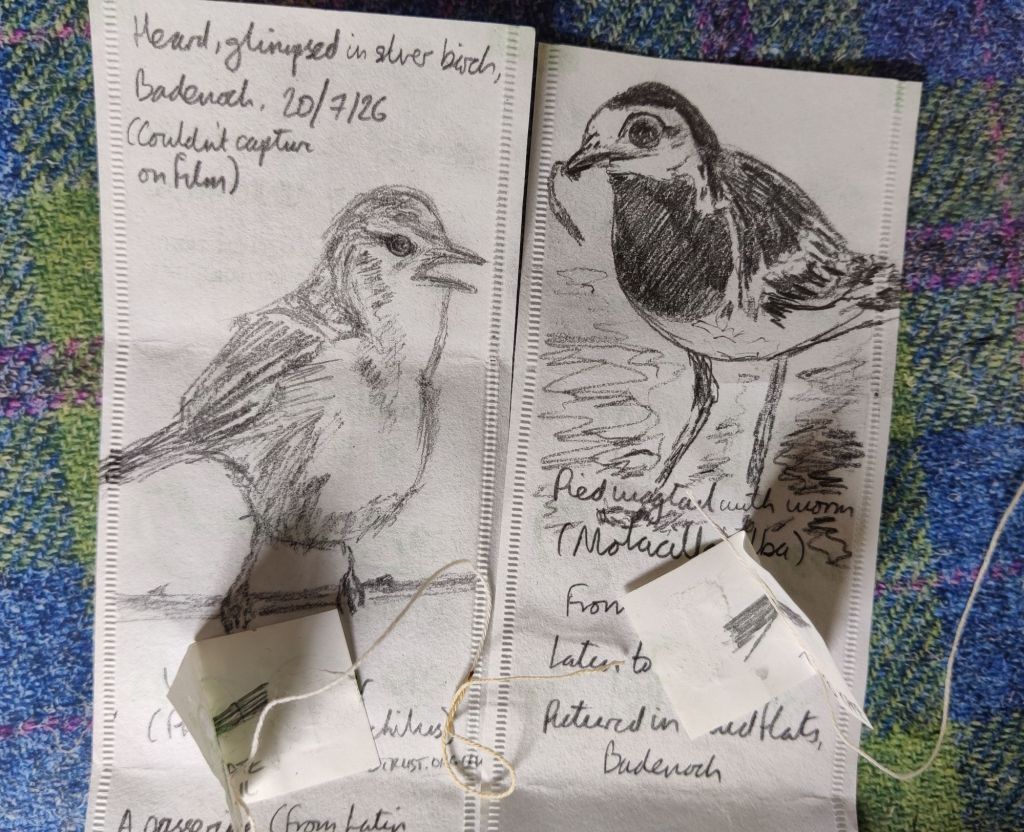
Each GANTOB pamphlet order for the 2026/27 series (12 titles planned) comes with at least one hand written or drawn green tea slip. The precise number depends on the number of stories in the pamphlet or booklet that month. These are the originals produced in drafting the content, not copies. Each green tea slip comes with a sticker on the back giving a bit more context. GANTOB HQ has a photo of each green tea slip for authentication if required at a future date. This month (Tables, GP003, July 2026) comes with pencil drawings of creatures in Badenoch, from photos I took this week while visiting Ali and Fiona Finks. The two pictured here are works in progress. Some of the drawings have detachable tails on green tea labels. These will be taped to the back of the green tea slip so that the recipient can choose the placement of the tail themself.
Ali Finks and his daughter Fiona are up in the glens at the moment, in the shiel where Gillian Finks (current whereabouts unknown) wrote the book Little Grapefruit Takes The Bus back in 2024. I have popped up to see them, taking the opportunity for a weekend in the Scottish Highlands. It is a relief to be out of Edinburgh for a bit.
I have my laptop, an envelope packed with blank unfolded green tea slips, a pencil and a sharpener. The first draft of my new story The Table (for GP003 pamphlet Tables) is complete, with the green tea slips on which it is drafted carefully numbered 1-20 for inclusion as part of the GP003 package. The final version of the story will take some editing. I wrote it in response to a picture produced by Gaynor. It has taken me in an unexpected direction. There will be a separate essay in Tables, about the subject of Gaynor’s picture for GP003, so it may become a booklet rather than a pamphlet.
Before I left Edinburgh yesterday I posted off the A4 prints of Gaynor’s picture so that she can sign and number them (an edition of 20, as is the case for each of the 2026/27 GANTOB Pamphlet series), and send them back to me so that I can distribute them by the end of July.
I had quite a lot of time to think on the journey up. The process of arranging printing of high resolution photos, keeping track of green tea slips, drafting, editing and collating the stories in a pamphlet or booklet, and producing an insert takes quite a lot of planning. I noticed when posting off a GP002 package to Gaynor this week that there was a whole phrase missing from the original insert to GP002. So there are now two versions of the insert – the original and the corrected version. Add to this the need to budget and keep records of purchases so that I can demonstrate that we are either breaking even or running at a slight loss, to keep the HMRC happy.
To add to the complexity, I needed to decide how to choose which number of package to send to each purchaser. There is no GANTOB Committee anymore with which I can discuss such important matters. Ali and Fiona have not been involved much in GANTOB politics. Urs (wife of The (late) Benefaktor) is no longer interested. So I have to make the decisions myself. (I consider myself the Rick Astley of GANTOB – employed initially as general dogsbody, now the top dog).
I wondered about keeping the numbering of packages, and the individual items within each package, by order of purchase. But then I realised that collectors probably quite like to have consistency with numbering. So I have opted to allocate a number to individual purchasers, based on their first contact with the GP00x series. I have everybody listed in an Excel table, recording purchases and blanking out cells where an individual has not yet made a purchase, to keep that number spare just in case they come back and purchase the item in the future. GP001-002 can be purchased and GP003-004 can be pre-ordered from the GANTOB BuyMeACoffee shop. So far 14 individuals have purchased at least one pamphlet/ booklet. For the completists therefore, there are only 6 more opportunities to buy the full set of 12 pamphlets/ booklets in the 2026/2027 series. There may come a time when there are numbers allocated above 20, for example if GP001 has sold out but there are still copies of GP002 or subsequent packages available to purchase.
I mentioned the whole process of the 2026/27 GANTOB pamphlets when preparing tea last night for Ali and Fiona, as a thank you for putting me up in the but and ben they are renting for their summer break. I took the room originally intended for their son (the blue and pink mulleted one, who is busy with hospitality work in Edinburgh).
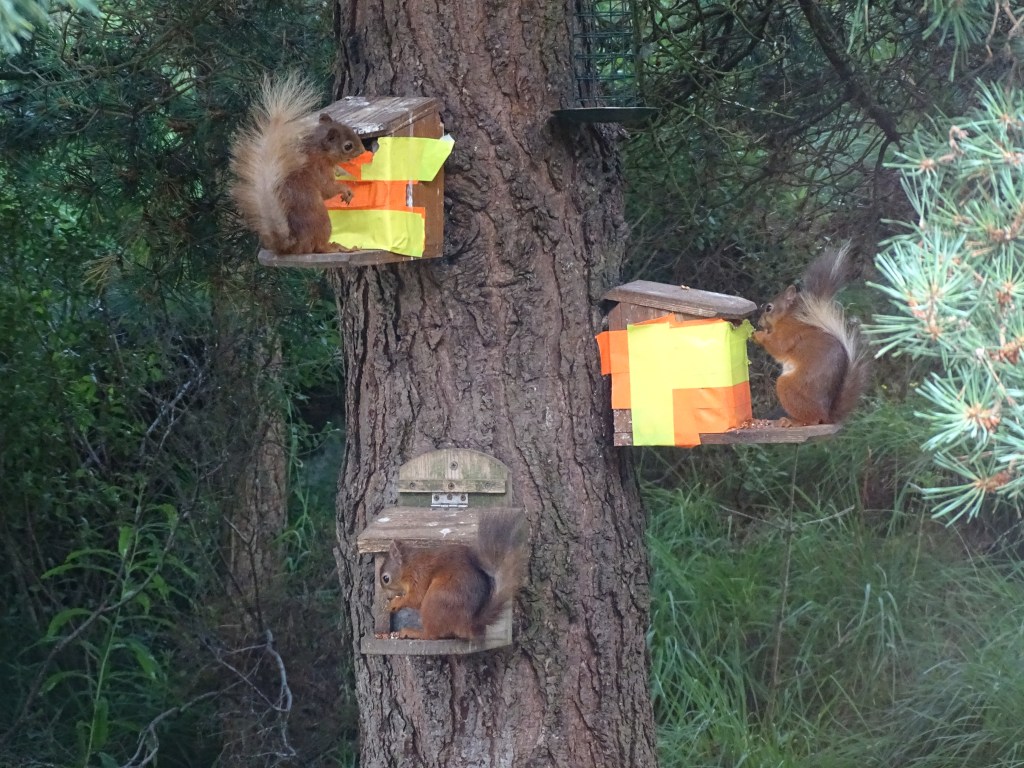
We talked about tables in their various senses, including the bird/ squirrel table that we can see from the kitchen sink (Ali did the dishes). Fiona, who is entering her final year studying part time for a Masters in archiving, noted that tabulation means “to arrange information, facts, or numbers into an organized table (rows and columns)”, which is what I am doing with the list of GANTOB GP00x purchases. But she also noted that “In a historical Scottish legal context, [tabulation] specifically meant to enter a document (like a summons) into an official court roll or register”. Which is arguably what we have been doing with GANTOB books when we send them off to the legal deposit libraries.
In contrast, the GP00x series is going to individuals, hopefully for their enjoyment, without being held anywhere centrally. They are like the finches and sparrows that I can see from the kitchen window currently as I drink a glass of water before going for a walk with Ali and Fiona up a forestry trail. Once these tiny birds have flown away they are completely out of sight and beyond our control.
There is another column in my spreadsheet of customers. Three people so far have become GANTOB “supporters”. That means that they have clicked the GANTOB BuyMeACoffee main page and pledged a sum (£3 x remaining number of pamphlets for that individual). They do not need to keep checking in on the shop to make a monthly purchase. They will receive the remaining GP00x pamphlets in the 2026/27 series each month.
If you would like to enter a similar arrangement, make your calculations and enter the amount in the “Support GANTOB2023” section of the site. If you are completely new to the series you would pay 12x £3, subtracting £2 for excess P&P for the first two packages because the first three packages will be sent together = £36-£2 = £34. If you have already purchased pamphlets you can pay ahead for future pamphlets in the 12 part series, £3 each. If you are an international customer you may wish to make an additional contribution, because postage and packing is rather steep for A4 (21 x 29.7 cm or 8.27 x 11.69 inches) bundles, particularly when we are doing it 12 times over. I will leave that to your discretion.
Meanwhile, I’m off to watch the hares and swifts as they play their separate games in the fields beyond the honeysuckle hedge.