
TEETERING is the imagined perspective of Bill Drummond in 2024. It is not by Bill Drummond and is not part of his memoir The Life Model (2024).
I wrote these 1,000 words on the day that “I am thirty-two” was published in The Life Model for the first time in its repeating 71-day cycle. The “conscious” section of the chapter was blank. That “text” – TWO BLANK PAGES – remains the official version.
29th of April 1985 to 28th of April 1986
I – the imagined Bill Drummond – have to accept that this particular year involved letting a lot of people down. Perhaps it is therefore not a surprise that my memoir – The Life Model (2024) – ended up with two blank pages for the period in question. I was stuck in the middle with me, between artists and management, family and friends, expectations and deliverables.
The year started with a long and boring meeting at WEA HQ in central London. In A&R I spent a lot of time in committee rooms listening to new management theories from gurus fuelled by the attitudes of Thatcher and Reagan. People with names that I could imagine were directly lifted from The Illuminatus! Trilogy were teaching us to relearn our jobs. Filibuster Monteith from Tucson telling us how to leverage value from our portfolio of artists. Sky Cresthawk from Montana giving a lecture with flipcharts on quality and cost being two sides of the same coin. That, I think, was the proverbial straw. Were you meant to toss the coin to see on which side it landed? Or did she really think that one side of a coin influenced the other? I didn’t get it. I tried to relate it to myself, as is anybody’s wont I suppose. My two faces – the genial one smiling encouragement down on wannabe starlings who had to believe they were going somewhere; and the closed one, a portcullis ready to slam down on the same band’s hopes and dreams.
I was ranting on about Ms Cresthawk while playing a game of shove ha’penny with Martin Glover from Brilliant later that same day. His penny – chosen either in rebellion against the name of the game, or as a marker of the inflation of that year – was dangling precariously on the edge of a table beside a mixing desk. Martin – AKA Youth – was explaining a version of the game that incorporated the rules of rugby, flipping the teetering coin and “converting” it over makeshift goalposts fashioned out of my fingers. I did not hold his public school boy ways against him. I was fascinated by a game that seemed to reward players for taking their money to the absolute brink. I could connect with that.

June, Jimmy and Cressida were sitting smoking on amps in the studio next door. Martin, catching snippets of their conversation, realised that he was potentially missing out on a party and ambled off in their direction, flicking his hair. I leafed through my Filofax trying to look busy and, glimpsing diary pages for that week, I realised that that was not far from the truth. I was meant to be up in Glasgow meeting Jill and Rose from Strawberry Switchblade that very afternoon. I rushed out to catch the tube home, debating whether to drive or catch the train. Inevitably I misjudged, caught for hours in a tailback on the M6 after a major accident. Nul points. I managed to let down both Brilliant and Strawberry Switchblade in a single day, leaving both thinking that I was favouriting the other band.
I had intended to avoid naming people in my memories of that year. Instead, I had planned to capture the proverbial gut punches that I dished out and received in almost equal measure in broad categories of failure. I could not work hard, and be in two places at once, and balance figures, and be a husband and parent all at once. But I cannot recall a period in my life when I failed to achieve this seemingly impossible trick quite so catastrophically. The bands that I had spotted, nurtured, and promised success, did not quite meet my predictions. But I kept pushing, and spending. Invest to save. Gambling with that coin about to plummet from the ledge, falling as heavily as any portcullis on a 1p coin. I have estimated that the losses that I racked up for WEA for Brilliant alone at £500,000. Plugging that figure into an inflation calculator puts it at almost £1,500,000 in today’s money.
But you can’t think that way. A subtly different spin and either band could have gone stratospheric. Pet Shop Boys failed to light up the dance floors with their first version of West End Girls in 1984, but they came back in 1985 with an all new version and in January 1986 they were Number One. Another push, and I could have converted my bands into the success they deserved.
Nonetheless, I feel guilty about Strawberry Switchblade’s chart trajectory. If my subconscious ended the previous year hankering after my own Number Ones, my fully surfaced consciousness in 1985 plotted the decline in chart positions of my erstwhile wards, peaking at numbers 59, 84 and 53 for their three singles that year. If they feel that I deserted them, then they’re probably right.
But I am not going to apologise. The management culture of the time did not allow for contrition. Two-faced Janus looked forwards and backwards. I took a determinedly prospective stance. If a band’s songs all sounded the same, well I had invented a new scene. Push that to the NME. I was like a used car salesman talking up a car’s trickier aspects – an overly enthusiastic brake? Great safety feature. In fact, why talk about failure at all? Just take the money that you would have spent on a band and chuck it to landfill, tip it over a cliff in the boot of a car, burn it all. Cut out the middle eight, whoever – or whatever – they may be.
4 March 2024
I would like to pretend that the rest of this pamphlet was written under GANTOB’s conditions of Kreative Tyranny. I wrote the main bit above after a busy shift, on the evening of publication of the TWO BLANK PAGES for “I am thirty-two” (4 March 2024). I have given myself the duration of Arvo Pärt’s album Te Deum (1993, 66 minutes) to complete this second part(*). I am sticking to a total of 2,200 words with GANTOB’s agreement, to account for the 1,000 already contributed above.
I wrote the subconscious chapter for “I am thirty-one”, and posted about it in the pamphlet CYCLING in the #GANTOB2024 #52Pamphlets series. I wrote my bit for Bill Drummond’s memoir in the third person by mistake. I made sure that I did not repeat that same mistake for this unofficial re-enactment of “I am thirty-two”.
I made another mistake in my contribution to “I am thirty-one”. I wrote the following words: “Sunday 3 March 1985, The Man is making soup, trying not to think about work tomorrow. He is listening to BBC Radio 3, which is playing choral music by an ensemble called The Sixteen. He is not in the mood for their carefully rehearsed polyphony. He switches station, adjusting the aerial.”
I wrote this as a bit of a joke, thinking that I had been original. But the real Bill Drummond had already covered this topic in his book 17 (2008). He wrote (my highlights):
“For many years, decades in fact, I have been drawn to choral music. Any sort, from anywhere in the world, from Bach’s St Matthew’s Passion to those women in Bulgaria… Before my voice broke I was in the school and church choirs” (p25).
And in 2004: “I discovered the Estonian composer [Arvo] Pärt. I fell in love with what he did, especially his choral stuff” (p25).
And “There is a choir from Oxford, England, that specialises in singing what is now called early music, which is music from the 18th century or earlier. I’m a big fan of this choir. They are called The Sixteen. So maybe I was just subconsciously wanting to be like The Sixteen but trying to go one better” (p27).
And to rub salt into the wound he mentions “Finland’s Shouting Men or the Polyphonic Spree or any other vocal ensemble that might exist in the modern world” (p29), to tick off another word that I used in my piece.
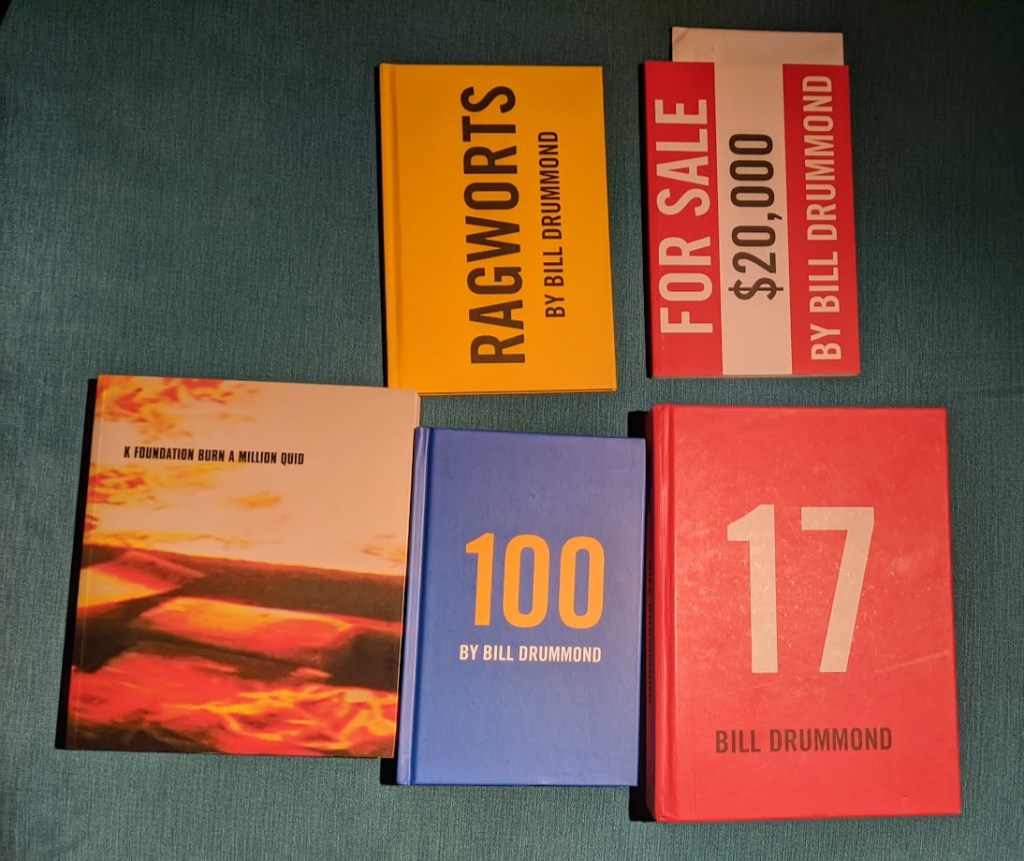
I heard Bill Drummond talk about his book 17 at Waterstone’s, Princes Street, Edinburgh in 2008. Perhaps he read this section, and my subconscious had stored it up to regurgitate it slightly shuffled around in late 2022, in my attempt at imagining his reactions in 1985. I was almost certainly incorrect when I predicted that The Iconoclast or any other part of The Man would have lashed out against polished choral music. But the “years, decades in fact” makes it seem likely that even at 31 years old Drummond was a fan of choral music. At least I had done some research – The Sixteen were formed in 1979, with regular releases and performances, so were quite likely played on the radio. Sounds as if our imagined Bill Drummond would have left it playing though. Hopefully by writing this down in black and white it corrects my inaccurate predictions. Before I move on to my next point, I should highlight that Polyphonic Spree are not a classical choral act. Try The Sixteen or Arvo Pärt’s music instead. I can recommend Te Deum.
Drummond also noted his love of choral music by William Byrd (1543-1623) and Thomas Tallis (1505-85) in a 2012 piece for The Quietus. Steve Reich (b1936) and Henryk Górecki (1933-2010) also got a mention. Going by their ages it looks as if choral arranging is good for your health. Like Drummond, I sang in school and church choirs as a child. Dunfermline Abbey had a very active choir, led by a choir master raised in the Anglican tradition. As a result we did a lot of Byrd and psalms, the final chord of each piece floating around the abbey’s nave for seconds after we stopped singing, highlighting our successes or flaws. Luckily for everyone else, I no longer sing.
Before we move off the topic of music in Drummond’s books, I want to mention another 2012 book – Ragworts. This is set in Forgemasters, Sheffield, in a connection to Drummond’s teenage years in another steel town – Corby. Towards the end of Ragworts he mentions inviting Forgemasters’ boss Graham Honeyman to play his saxophone alongside the industrial noises of the plant. In Sheffield Score Five (Seventeen Deep Breaths) Drummond writes: “Take a deep breath/ Blow a long low note on your horn/ A note you imagine to be in harmony/ With the noises around you”. The saxophone. A connection back to Gillian’s Reeds and Rushes in her Threads series. Drummond also reminds us of “a tradition in previous times for composers to compromise their craft by creating works that would include the musical aspirations of their patrons”. I would not attempt to direct that at The Benefaktor – the patron of GANTOB (the project). I do not know enough about his intentions, but it is an important warning about vested interests in general.
In my piece TEETERING, Sky Cresthawk argues that quality and cost are two sides of the same coin. This was intended as a reference to business management practices. But it could equally apply to quality of life and public investment in the arts. I should say at this point that, as a father of three, I have seen the powerful effects of universally-accessible, publicly-funded music programmes first hand. They foster cooperation, collaboration and socialising between schools across the region, and often provide children with their first opportunity to hear and perform a wide range of music to an audience of family, friends and peers.
In his book 100 (2012) Bill Drummond writes: “I am fundamentally opposed to funded art. That said, I have been funded to do certain things in the past by funded organisations, and I am sure I will again in the future”) (p71). It scarcely needs said that Drummond has a slippery relationship with cash, from the K Foundation with their £1m, to his $20,000 Richard Long photo. I wonder what his position on public funding of the arts would be now, after 12 further years of austerity and worsening inequalities across the UK. The devastating cuts being implemented to arts programmes, libraries and other essential services across the UK – for example those announced recently in Birmingham – will have a very major impact on life and opportunities in these areas for many years to come. We just have to look at the impact of removing culture, socialising and learning over the period of the pandemic lockdowns to find evidence of that.
We need a flourishing creative arts sector for people of all ages. Children are arguably the most vulnerable to cuts though. Article 31 of the UN Convention on the Rights of the Child supports the right “to rest and leisure, to engage in play and recreational activities appropriate to the age of the child and to participate freely in cultural life and the arts”. We can see the clear benefits on child development and future prospects with programmes such as Sistema Big Noise. Without ready access to orchestras, choirs, theatres, and the visual arts our communities are incomplete. Creative arts make a huge positive contribution to the country’s economy, and also on health and wellbeing at an individual and community level.
The next generation of musicians, performers and artists will not just appear. It will need nurturing. Secure funding is an important part of that. Not a toss of a coin.
Graham
10 March 2024
Pamphlet 15 of the #52Pamphlets
A contribution to the 9 Missing Years project
#GANTOB2024
Send in your idea for a pamphlet here.
(*) In reality it took two spins of that album.
 GANTOB blog
One response to “TEETERING (by GRAHAM)”
[…] to Bill Drummond on 10 March about one of the missing years in his memoir The Life Model, with a piece that led on from my official contribution for that same book. GANTOB has subsequently sourced […]
LikeLike