
Graham has been in episodic correspondence throughout the GANTOB project and has made contributions to all but the first book. Here he shares insights from a recent trip to a Bill Drummond event in Coventry, and much more along the way.
I have written previously about my (sometimes) unhealthy tendency to collect, study and write about the works of Bill Drummond, and before that The KLF. I am filing this piece as a progress report.
THE PAST: I have doomscrolled through various sources over the past 35 years, looking for gaps in my kollektion – the NME, fanzines, copies of Record Collector, eBay, Facebook pages, Bill’s Penkiln Burn website and Abebooks. I have chased after what might have been single screenings of films in London (The KLF’s Rites of Mu in 1994, in a triple bill with The Beatles’ Magical Mystery Tour and Echo and the Bunnymen’s Shine So Hard) and Cushendall on the Antrim Coast, Northern Ireland (Bill Drummond’s STAY, 30 August 2025). I have already written quite enough about that.
In the intervening years there have been trips to Corby (June 2022 for the 25 Paintings’ Tea Rooms), London (December 2023 for an E17 Book Club event with Bill interviewing Paul Simpson of The Wild Swans), and Glasgow (to listen to Bill and Tam Dean Burn play the Voices from the Galloverse LP at a Hear Hard event, Deep End, 16 June 2024). The most elaborate event that I have participated in, however, was at CatStrand, New Galloway when my wife Liz and I went to watch Bill, Tam and The Penkiln Burn Players perform Voices from the Galloverse live, directed by Leo Condie, 10 May 2025. The high street of New Galloway was shuttered up by the time we arrived. We had taken the long way round from Drumlanrig after the sat nav dropped out and we ended up on forestry trails and farm tracks. There was nowhere to eat for miles around.
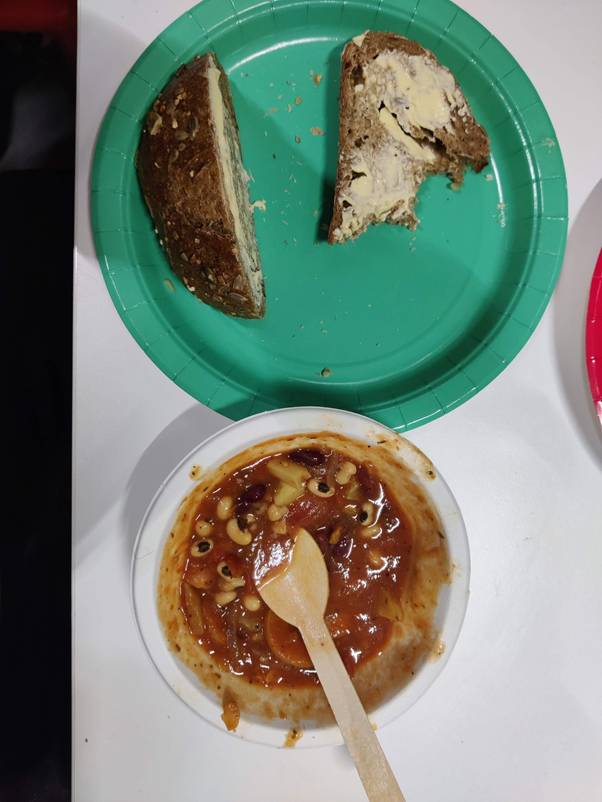
CatStrand was the only place open in the village, and we were the only customers in the café. The performance was scheduled to start in just over an hour. Everything was in limbo. We wondered if they had stopped serving. The cake display had been cleared away. Encouragingly, our order of cups of tea was not rebuffed. When that had arrived we asked about options for food and ended up getting offered the leftovers from the performers’ tea – veggie chilli and rice. The manager apologised for the presentation. We were just delighted to be fed. The plates were cleared away before other audience members started to arrive. There was a buzz of generosity and excitement.
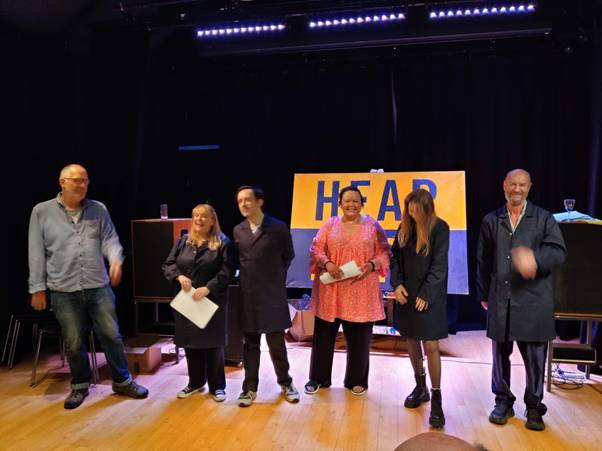
The Players performed songs by bands inextricably linked to Bill from the late 1970s to the mid-1980s, including Teardrop Explodes, Echo and the Bunnymen, The Wild Swans, Strawberry Switchblade and Bill’s own solo album The Man. They performed the majority of these familiar songs with a twist: in the style of Gaelic psalms.(+) Though most pieces involved audience participation, the final song was a duet – two selkies (Suzanne Bonnar and Angie Darcy) singing the Bunnymen’s The Killing Moon. It was a particularly haunting rendition.
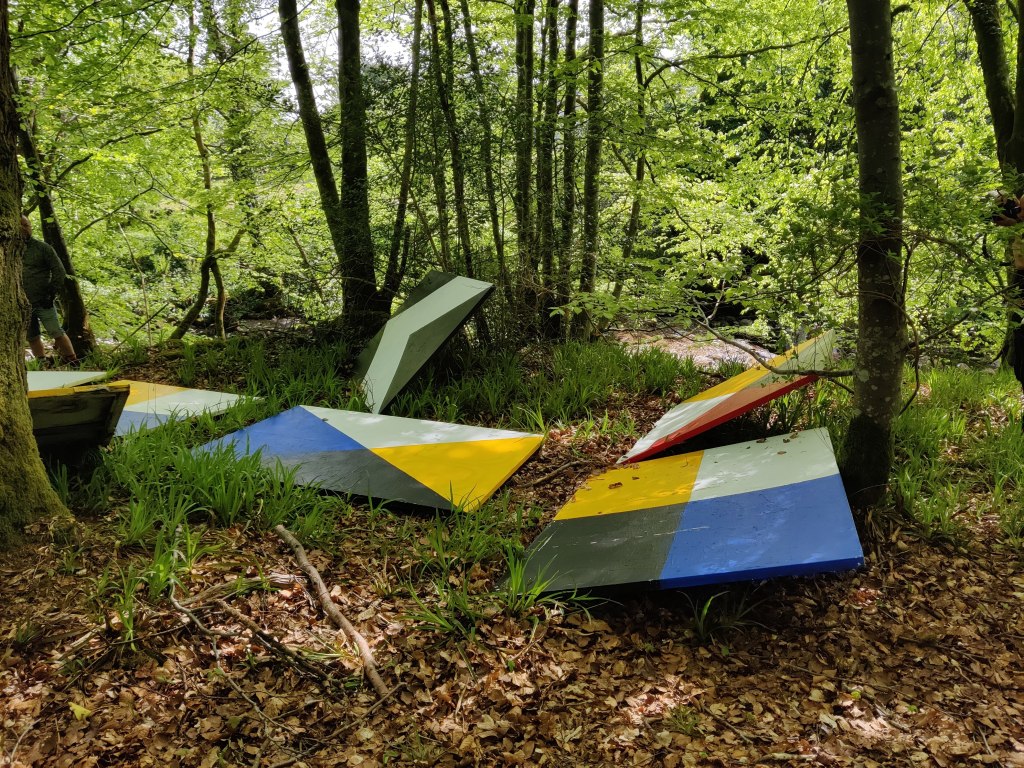
The next day Liz and I skirted the north side of the Cairnsmore of Fleet mountain(*) to visit Newton Stewart, the town where Bill Drummond spent almost a decade as a child. A team of volunteers helped carry Bill’s 25 Paintings across a stream to an island and back, in return for a pebble from Penkiln Burn. Liz and I had a tour of the area afterwards with Jethro Binks, expert archiver of all things KLF and Drummond. He showed us the church where Bill’s dad worked as minister, the manse where the family lived, and Sparling Bridge, named after a rare species of fish that Bill has written about, which returns to the river ever year.
Before you worry about carbon emissions from all these journeys, I must highlight that all but that journey to Galloway have been by public transport. There were even journeys by foot in Edinburgh: up to Waterstone’s bookshop on Princes Street, Edinburgh in 2008 for a 17 book signing; the Filmhouse Cinema on Lothian Road to see Bill and Tam perform the play White Saviour Complex before the premier of Paul Duane’s film Best Before Death at an Edinburgh International Film Festival event in 2019; and a visit with my daughter Kirsty to see Bill’s contribution to a Neu! Reekie! exhibition on Leith Walk, June 2021.
If all that indicates an unhealthy obsession, or a profound “special interest”, then I would argue that I have made considerable progress in my rekovery. While my earliest activities were focused on purchasing and accruing, avidly reading the details in inserts and early fan-made websites, my journeys over the past three years have been about participating, with occasional byproducts – his book The Pied Wagtail (2022), the Voices from the Galloverse LP (2024), the STAY LP (2025).
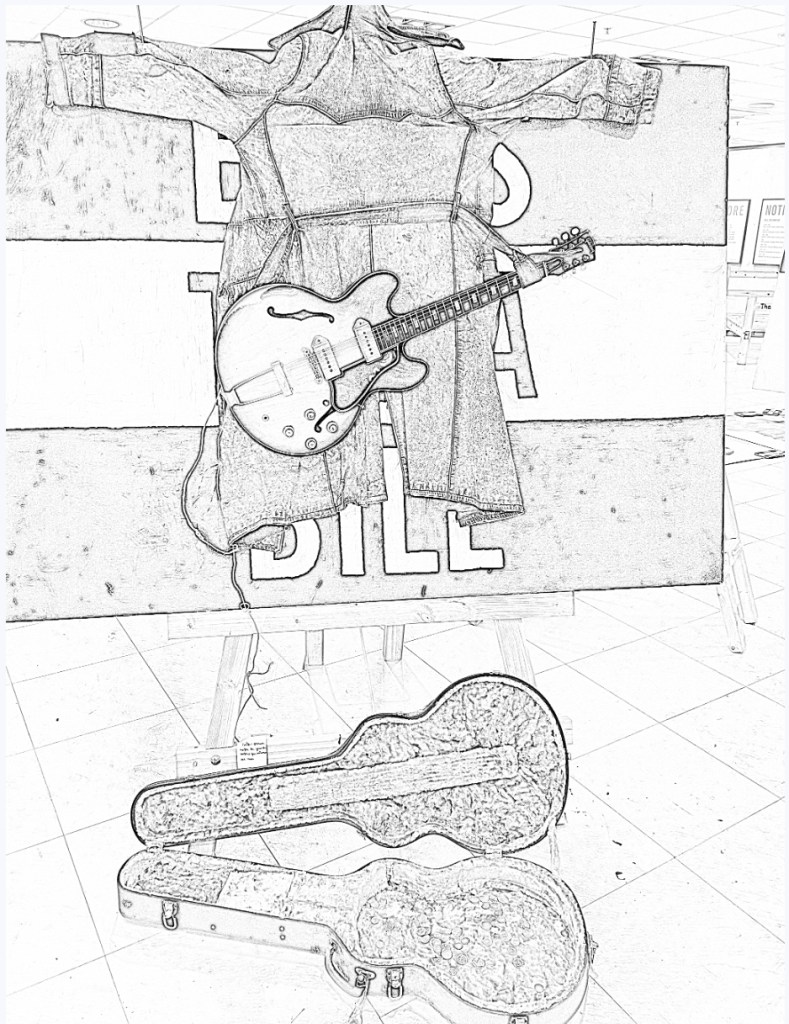
As I flick through my photos from these events, including these photos from the 25 Paintings’ Café of 2022, Bill’s work might seem monochrome and self-referential. The experience of his work, however, is very different. There is intelligence, warmth, collaboration and purpose. There are twists and turns that point towards a bigger plan, or at least take you to facts that would otherwise have been missed along the way. [Ed: See also yesterday’s Killing Moon post by Maureen for more on dates and Bill’s careful planning]. It is also striking how loyal his co-performers and collaborators have been over the years. Tam of course. And Tracey Moberly, recording Bill’s activities under Spaghetti Junction, making films, and documenting his events. Leo for the past couple of years. There is also a fair helping of uncertainty, risk and vulnerability, both for Bill, the performers, and participants.
Bill has said previously that he wants his work to be experienced in the moment and often deletes or otherwise destroys products of his work. Over the past 30-plus years he has not typically recorded or broadcast his work. Bill’s longest period of creativity on a single theme is arguably The 17, which is also one of the few websites that he has left intact and unchanged over the years. It was clearly stated throughout that project that performances by the various configurations of The 17 were for participants. They can be re-enacted, for example by following instructions in posters published in Scores 18-76 (2006) or Slice through Derby (2008), but they will never be the same twice. If you want to experience his work as intended, you need to be present.
THE PRESENT: Friday 14 November 2025. I am travelling down to Coventry by train. Bill Drummond is going to be serving soup. Then there will be a performance/ recording with audience participation. There is an evolving plan, elaborately described on the Penkiln Burn website. I have cut my toenails in anticipation, in case the warning about tied toes and red nail varnish on the website applies to the audience.
| Bill has history with Coventry as well. I found that out when I was researching a chapter for his book The Life Model (2024 – web publication). My contribution was for the “I am 31” chapter (subconscious side), in a piece that he named Third Culture Kid. I wrote about Bill’s desire to have a number one, only to see his rivals and contemporaries from his Liverpool days reach the top spot first, including Pete Burns. Bill wrote this in his tribute to Pete Burns in 2016, building in a mention of another Pete – the record producer who helped Burns along the way: “The conversation took twists and turns and provocations were leapt over and we were talking about Betty Wright playing the Locarno in Coventry, circa early 1975, where I was in the audience and this Pete Waterman was the DJ.” Bill returns to this specific moment in his sleeve notes for the Emotions LP (2025), shared on his website. Waterman played The Shangri-La’s song Past, Present and Future that same night in 1975. This was the first time that Bill remembers hearing the track. It was written by Jerry Leiber, Artie Butler and George Morton. The latter also produced the record, under the name Shadow Morton. Over fifty years later, Bill clearly thinks about this song a lot. The song was written by three men. However, that most intriguing girl band of the 1960s, The Shangri-Las, very much made it their own. |
On 21 October 2025 Bill wrote: “The Tied Hands are to mark the completion of their 480-day tour of the World Wide Web (17th of May 2024 and the 8th of September 2025) on the 14th of November 2025, at the Delia Derbyshire Building in Coventry, England”.
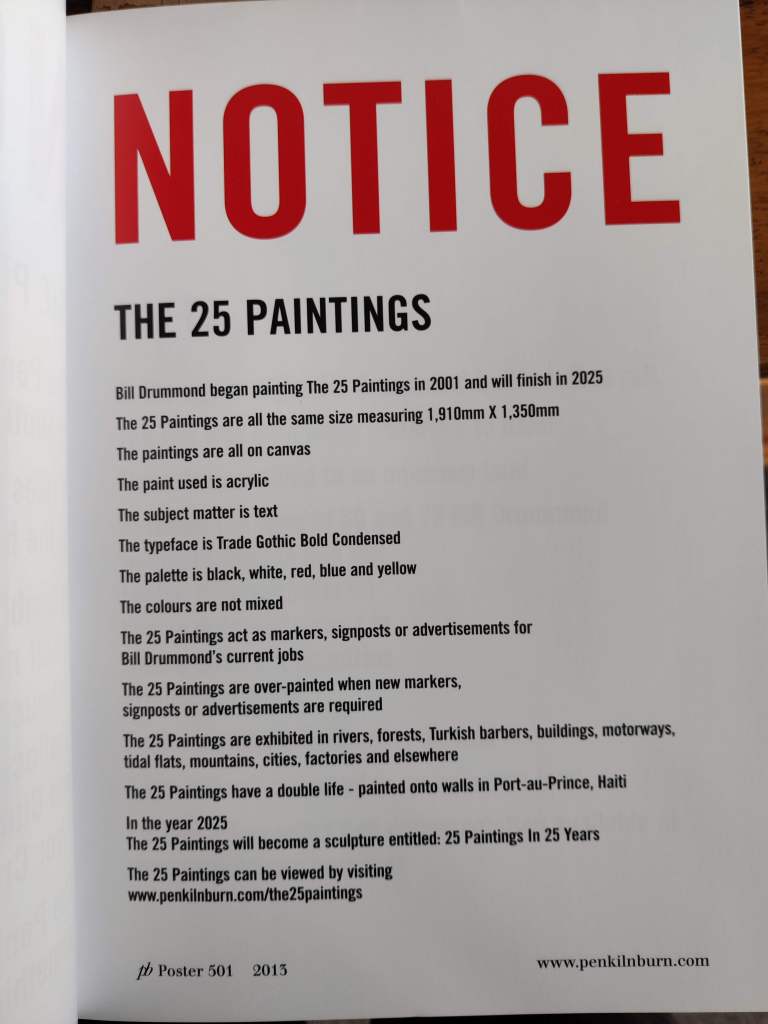
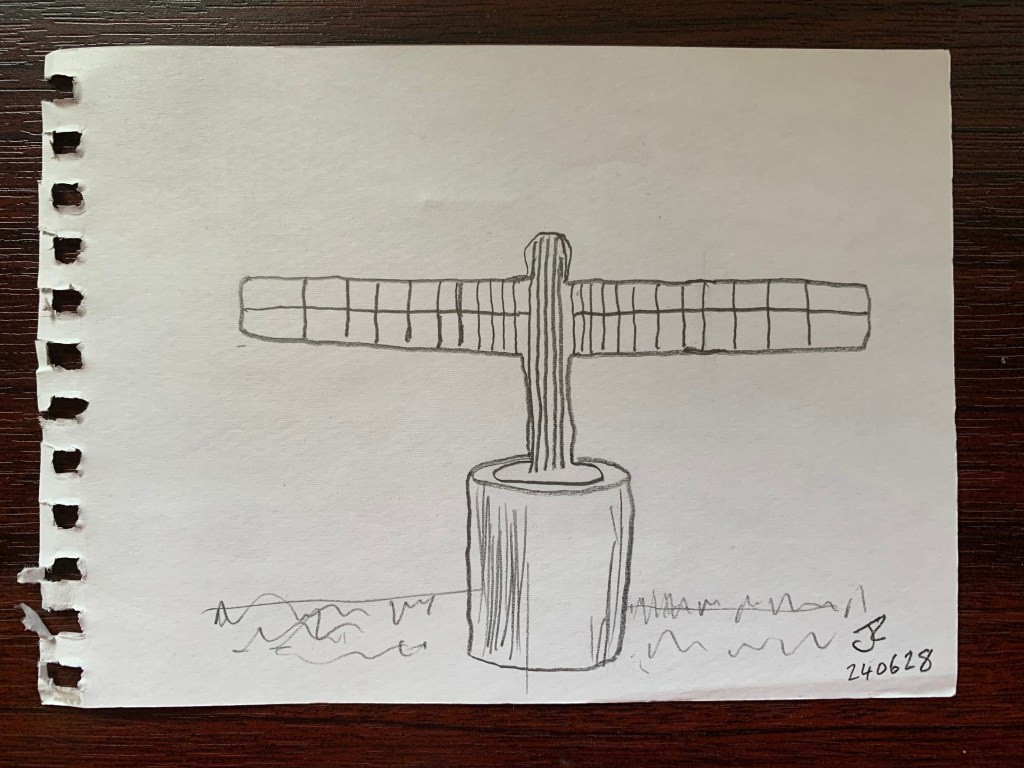
I know of The Tied Hands from Bill’s previous posts. I read about them with passing interest, when in the middle of other things. Something about displaying a poster of tied hands on a website for 40 days(^), in a 12-step tour of the world. Forty is a significant number for Bill, frequently appearing in his work. The idea of a 12-step tour is also familiar from early mentions of The 25 Paintings (e.g. see BILL DRUMMOND WORLD TOUR 2014-2025, pb poster 300, 2013). In another poster he talks of the paintings becoming a sculpture. Or perhaps he means the tour will be the sculpture, like his famous rabbit map of Echo and the Bunnymen’s tour. Or like Antony Gormley’s 6 Times work stretching for miles along the Water of Leith, which I walked last year after reading about it on the Gantob blog.
I was aware over the past year and a half, from my daily check of the Penkiln Burn website, of Bill’s plan to pass on the baton of these tied hands, website to website, country by country, simultaneously displaying the posters in the real world. Then I noticed that contributors had recorded tracks to mark the occasion. It seemed like a peripheral activity from Bill’s other activities in Galloway and Cushendall – a distraction. I had not expected the tied hands or tied toes to be the centre of a completed piece of work with a performance and a new LP called Emotions. Bill has a history of unfinished work. Perhaps his proposed “Graffic Model”, announced 2024, featuring woodcuts of scenes drawn in pencil from his biography The Life Model, will fall into that category. He is also known for his projects which were completed but never released, which might include his book Cairnsmore of Fleet (written 2015).
I do my homework for the trip from the Penkiln Burn website, reading the Moonlight Sonata page about the event and listening to all the tracks from the Emotions page. I dial up Beethoven’s Moonlight Sonata and The Shangri-La’s song Past, Present and Future, which I do not recall having heard previously. It’s a powerful piece.
I contact people I have met over the years through events run by Bill to find out if they are also going to Coventry, or if they would like me to procure a copy of the new LP. They decline the offer, having heard excerpts from the website. My cats agreed, fleeing the room when I played a ZX Spectrum inspired version of The Shangri-La’s song on my cheap speakers a few days earlier.
A train cancelation announced the night before, presumably due to the miserable weather, means that I am taking the East Coast route to Coventry, a couple hours earlier than planned. I leave the house at 6:40. The journey passes through Newcastle, York, Sheffield and Derby before arriving in Birmingham. I think, inevitably, of Bill’s exploits in some of these cities. I have mentioned the Derby connection already. I remember reading about Bill’s spell as artist in residence at Forgemasters, Sheffield in his book Ragworts (2012), with boss Graham Honeyman playing his saxophone against the hum of machinery (Score 390, SEVENTEEN DEEP BREATHS, pb Poster 318, 2011).

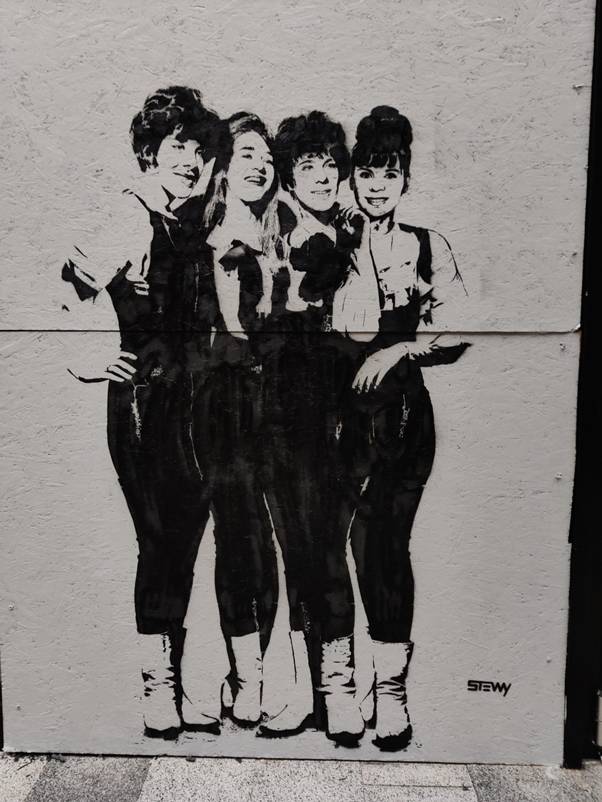
I have to run through the busy corridors of New Street Station for the Coventry train. I am meeting my daughter Kirsty late afternoon. Arriving in Coventry I have time to grab a cup of tea and check out the Delia Derbyshire building, where street artist Stewy is spraying a painting of The Shangri Las beside the front door, Tracy Moberly documenting the process on camera. It is pouring outside. I visit the Herbert Museum, where I learn that Coventry is the birthplace of twinning cities, a topic close to Bill’s heart. There are displays about Lady Godiva and Peeping Tom, Two Tone records and experience of life in the city by different communities.
There is an exhibit on the bombing of Coventry in 1940. It is only at that point that it dawns on me that today – 14 November 2025 – is the 85th anniversary. It is all there of course on Bill’s Moonlight Sonata webpage, but mentioned only in passing in an entry on 2 November 2025. The scan of the record sleeve just mentions November 1940. The date is no accident. As we know, Bill plans meticulously.
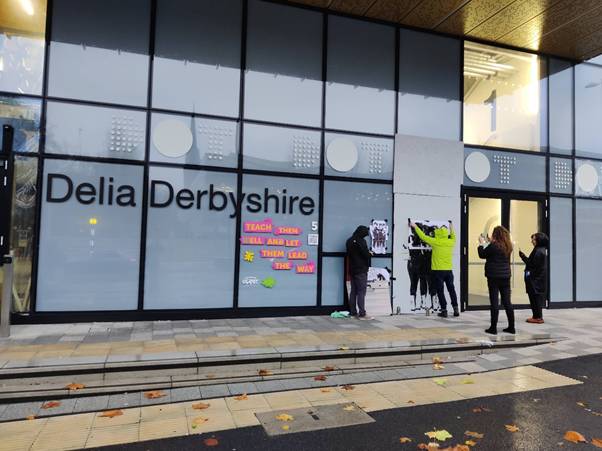
It is even wetter now. I squelch my way back to the station to pick up Kirsty. We visit the famous cathedral ruins at dusk, spotting the gathering crowds outside the gloriously restored section. We have time for a cup of tea. We head back to Shortland Coffee, where the drinks were served to a standard that I am sure would meet Bill’s approval – loose leaf tea, a proper cup and clear advice about brew time. Back across town again on foot we are thoroughly soaked by the time we arrive at the Delia Derbyshire building of Coventry University. Stewy’s painting of the four members of The Shangri Las is finished at the front. There is another of his stencilled paintings – this time of Delia Derbyshire – standing inside on the stairs. The large room where the two events are held – soup counter 5-7PM and the recording 8-9PM – is buzzing. The building is for Arts and Society studies, well chosen with its flexible spaces for different groups and activities.
Bill is serving soup in the centre of the room. The 12 posters of the different stages of The Tied Hands are displayed on corrugated iron behind the counter. There are some students sketching the scene, and others inspecting Bill’s A0 posters listing his new questions (over 100) towards a forthcoming novella which will be called Why is Andy Warhol Shite? There are whole families painting two huge canvases on easels – the classic size and set up of Bill’s 25 Paintings. They are painted in monochrome – black and white. The Penkiln Burn website advertises red and yellow paint as well, but the prime colours have been omitted tonight, which is probably just as well given the mess that people are getting into. Good to avoid a brown sludgy mess on the canvases themselves.
I say hello to Bill and introduce my daughter Kirsty. She has seen him in action previously, when she was volunteering at the Edinburgh International Film Festival in 2019, and at the E17 book club. Tam, Leo and Tracey are nearby. It is like a time warp back to New Galloway in May 2025 when we were given the Players’ leftovers. Usually I am tongue tied when I meet Bill Drummond. Kirsty commented on it at the book club. Tonight however I feel emboldened to ask what we have in store. The words of the friend who had refused the offer of the new LP, and the protests of the cats who had fled when I played the Jet Set Willy track, are fresh in my mind. I give an abbreviated version of both experiences. How could the performance by a random group of amateurs possibly be of the quality we heard at CatStrand, with a band of professional musicians captivating the audience? Bill pulls a face combining amusement and mock offense. He serves someone soup. We go and put our soaking coats and bags down.
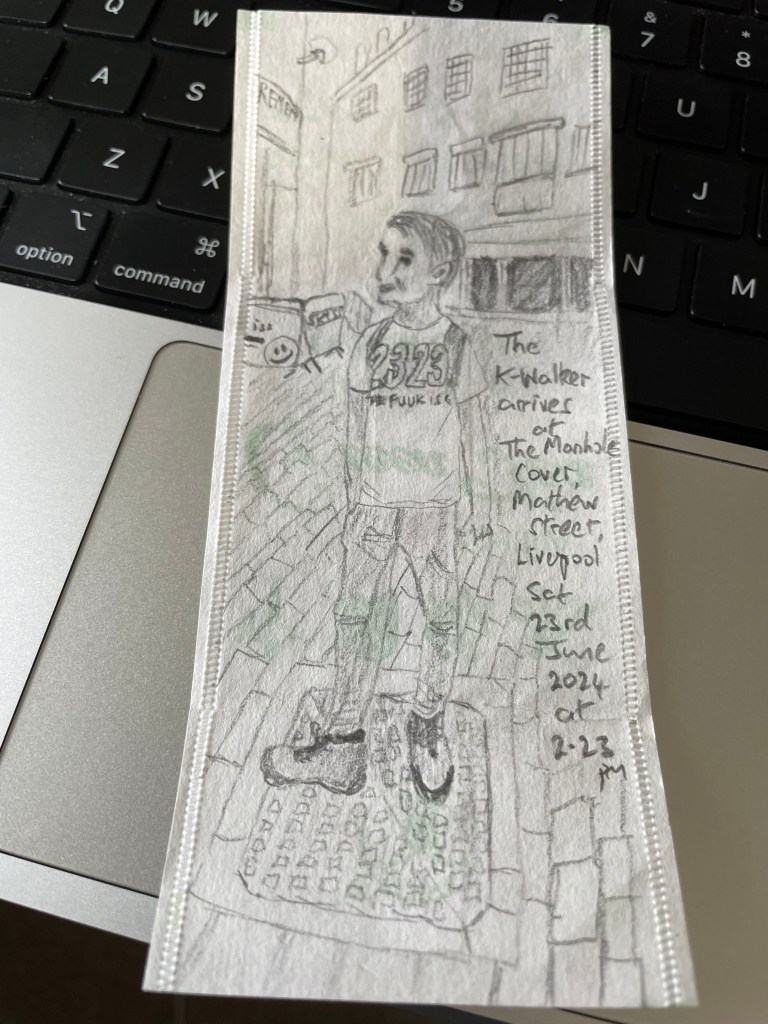
On the long tables between the serving area and the walls of activities, dozens of people are enjoying their soup. Many have already completed the answers to questions required as payment for the soup. I recognise Stu Huggett, Andy Gell and Stephen Dorphin from walking the K-Line into Liverpool on two glorious days, June 2024 (see also the KLFRS’s book The Manual (How To Make A Leyline The Easy Way) (2024)). There are lots of other people we chat to along the way. Everyone is very friendly.
Kirsty and I collect our bowl of soup and hunk of sourdough bread. The portions are generous and there are seconds. There will be no need for anything else to eat tonight. The recipe and an explanation of Bill’s soup line are displayed on framed A0 posters beside the serving area. Kirsty and I have brought a gift – a present (or “small treasures and trinkets”) – as an entry requirement for painting the canvases, as instructed on the website. I have brought George Toe-Well socks from the museum. They seemed rather apt, with Orwell’s Jura connection. They are damp and stained after our soaking. I apologise to Bill as I hand them over. Kirsty has brought an orange bucket hat from the junior doctors’ strike. We are told that only one other person has brought a gift. Tim from Glasgow – who I do not know – has already given Bill a length of pristine bike chain. Bill is clearly delighted that a few of us have followed his request from the website. Everyone else paints on regardless.
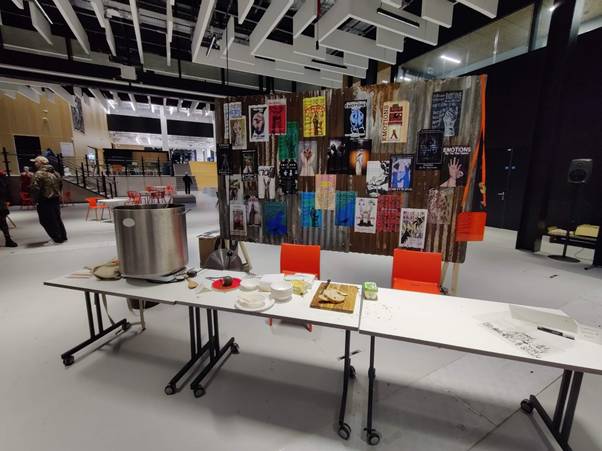
A short while later, when Kirsty and I are reading some of the 100 questions, adding some comments about “profiles”, Bill calls for everyone’s attention. There are loaves left over –expensive ones – free to a good home. He talks about the Soup Line (of which this event is not part, because it is too far south to be on a straight line drawn from Belfast to Felixstowe). He shares some examples of encounters from the actual Soup Line, where he visited people to make a vat of soup. There is some personal material in here too – the perils and opportunities of being invited to make a vat of soup, only to discover that there is just one person to share it with. He moves on to talk about the generosity of Scottish people, highlighting the contrast with expected stereotypes. The three people who brought gifts are asked to identify themselves. We discover that, completely by chance, we are standing beside Tim from Glasgow. We make our introductions.
Tim, it turns out, is a fellow contributor to the GANTOB project. He posed a question about cycling for the first book. My question (about electric cars) did not reach the final cut for that publication. After some further painting of the TIED TOES and SOUP LINE canvases, Kirsty, Tim and I are summoned up to meet Tam and Leo, as fellow Scots. Bill dots in and out. We sit with them for about 15 minutes, talking about music: choral singing, Gaelic psalms, Pibroch; the event in New Galloway and Newton Stewart. We contrast the precise timing and delivery required in classical music, and the shepherded approach of Gaelic psalms, the precentor leading, the congregation joining in at their own pace, leading to a wave of sound, with built in lag and drone. That’s what the audience had to do at CatStrand. Leo talks about the inclusivity of Gaelic psalmody, bringing together congregation members, many of whom would have been illiterate 400 years ago. It is fascinating to hear about the creative process. Leo describes the uncertainty and thrill of unchartered territories – will tonight’s recording work, has there been enough time to prepare, to translate Bill’s initial ideas to achieve the desired outcomes? Then it is time to leave so that they can set up for the event at 8PM.
About fifteen of us head to Phoenix pub. Others gather outside the Delia Derbyshire building, admiring Stewy’s work. It is still bucketing it down. We chat about recent Bill Drummond events. I meet a guy who attended a 5-day workshop run by Bill in the Pyrenees a few years ago (I think that this must have been Let Your Lone Ranger Ride, 2019). He describes soup making, bed construction and many other classic Bill Drummond activities. A website describing the workshop puts it like this: “Working in the classroom, outdoors in the landscape, in the studio, through group and individual guidance, this session will embrace the principles of free thought, metacritical assessment of art and music, and avoidance (and simultaneous generation) of absurdity”. Sounds excellent. There is always something new and unexpected to learn about Bill.
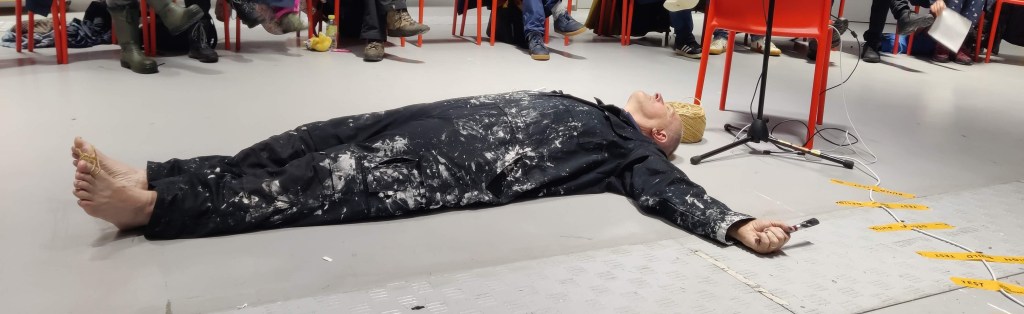
And then we are heading back to the Delia Derbyshire Building. The room is now set up with a circle of chairs, Bill supine in the middle, eyes shut, feet bare. He is the audience. We all don dark overalls. We are technicians. Tam, dressed as a minister, takes us through the order of service. You can read the plan from the 2 November 2025 entry on the Moonlight Sonata webpage. Tam’s delivery is as engaging as ever, with equal doses of humour and menace. We really do not know what is in store, despite the pre-reading. There is relief as the threat of red nail varnish mentioned on the website does not come to pass. We keep our shoes on, so there is no question of exposing damp socks, flat feet and bruised nails.
It is interesting to think about how a story develops and changes in our brains. I can describe my experience of the event. I do not take notes during the performance and we are instructed to put our phones off. We have Bill’s plan from the 2 November 2025 entry on the Penkiln Burn website:
| The Minister will tell The Congregation that in 1801, Ludwig Van Beethoven composed his Piano Sonata Number 14, which was later anointed the title Moonlight Sonata. And… It was on this evening 85 years ago that Luftwaffe, under strict instruction from Adolf Hitler, carpet bombed the City of Coventry. And… That Adolf Hitler decided to call this carpet bombing of Coventry his Moonlight Sonata. And… That in the early months of 1966, Shadow Morton used the Beethoven’s Moonlight Sonata to be the backing track of The Shangri-Las record Past, Present & Future. And… The Minister may play the original version of Past, Present & Future by The Shangri-Las and one or two of the other versions recorded by The Tied Hands during their tour of the World Wide Web. This will be done to give context to whatever may happen next. |
I interpreted this as follows, elaborating the ideas when explaining the trip beforehand to family, friends and colleagues: Hitler considered Moonlight Sonata Beethoven’s great masterpiece. Hearing reports of the devastation of the city, Hitler decided to apply the same name to his carpet bombing. Tonight’s event is Bill’s attempt to reclaim Moonlight Sonata from this savage cruelty. That is not, as you can see from the quote above, what Bill wrote. It is how I interpreted it.
During the event I learn that 14 November 1940 was a beautiful clear night over Coventry, just a day off a full moon. A killing moon. Even with everyone observing the blackout, the city would have been visible to the bombers overhead. Did they know this in advance? I read on the GCHQ website that the first recorded mention of Moonlight Sonata in a coded message was 11 November 1940. So the name was coined before the scale of destruction was known. Did they have accurate long distance weather forecasts in those days, and realise that conditions would be optimal for their mission of destruction? Or maybe it was an even simpler reason than that, with the number of the piano sonata pointing to the date – 14 November 1940.
Bill weaves his personal reasons for choosing The Shangri-La’s song Past, Present and Future for this event into a dream sequence on the sleeve of the Emotions LP. You can read that on the Moonlight Sonata webpage.
The Shangri-La’s song Past, Present and Future describes an incredibly complex set of emotions in a state of flux. Nothing is quite as it seems. It initially sounds innocent but drips with ambiguity: “silent joys and broken toys/ Laughing girls and teasing boys”. Unfinished or perhaps unfinishable thoughts: “there were moments when”. Apparent simplicity in the present – “Go out with you? Why not” is put into context by the devastating lyric: “Don’t try to touch me”, repeated, then “Cause that will never happen, again”. Imagining the future, she is back to thinking about the innocence of childhood games: “A tisket, a tasket”, sung while children dance in a circle. That appears to be an unretrievable state. The song appears to be about a desperate trauma that the narrator wonders if she will ever escape, with the final lines of the “future” verse delivered in the present tense: “at the moment it doesn’t look good”. The late Mary Weiss, lead singer of The Shangri-Las denied that the song was about rape or trauma. They were simply a band singing songs of teenage melodrama. It is difficult to believe that interpretation in modern context.
Sitting in our circle, with Bill Drummond lying at the centre beside a laptop and microphone, Leo and Tam sitting in striking distance of the technical guys behind the scenes, we have a task to perform. There are lyric sheets on pieces of white A4 paper. Leo leads us straight into the recording process. No time to listen to Past, Present and Future by The Shangri-Las or anybody else. We are going to record layers of the track, following Leo. He has the track beamed into his headphones after he counts the recording engineer in. We record the bassline – long sustained notes, initially a beat behind Leo, and then closer to his rendition as we learn the piece. I think of the singing making up the pentatonic chords in Bill’s recording with The Harmonics.
Leo gives us encouragement with each layer we record – smiles and thumbs up. He was not sure how the arpeggios of Moonlight Sonata will go, but he seems happy with the result. There is a swirling kaleidoscopic recording of the middle eight, in free form. We do the spoken lines a few times – in normal voice twice, then whispered and finally shouted. Tam’s voice is often heard above the crowd. A pause to mix the track, and then we are listening to the first complete rendition of Past, Present and Future of the night – our own recording. It is a bit rough around the edges, but discernibly the same song. It’s a wrap. We do not have the opportunity to play it to Stewy’s version of The Shangri-Las outside the building. It’s either too wet or too late. The canvases are too big to carry home. The university accepts them as a gift. We are each given a copy of the LP. We write out date of birth on the inside of the record cover, as requested by Bill, and put them carefully in a plastic bag that I packed specially.
Some farewells, and then we are out into the night. It strikes me how unusual it is for Bill to record the output of such a group activity. I wonder if he has a plan for this recording.
THE FUTURE:
We walk back to the station, dropping Tim off at an underpass that leads to his hotel. On the train we sit with people we recognise from the performance. A brother and sister. She had seen Bill’s graffiti under Spaghetti Junction. He is along for the ride. They have enjoyed the evening, but it was not as polished as the Hear Hard event she attended in London. Kirsty and I have had a whale of a time. There is nothing quite like communal singing and finding your way with others.
Bill writes further posts, on his imagined reception to the album:
I mean they might even get into how unlistenable a record it is…”
“What do you mean. How do you know it is “unlistenable”?”
“You can tell by the pretentious cover.”
He gives away copies to charity shops in London, rather like GANTOB’s book and record drops in the summer of 2023. I worry that my comments on the night of the recording have offended him, or cast a shadow over the project. But then I recall some of his first words about the LP: “Do not buy a copy of this album, if you consider music as something to be enjoyed / emotionally moving or appreciated. Or even an investment.” Perhaps it’s been part of his plan all along. We have played a part, scripted in advance by Bill Drummond.
On the train back to Edinburgh I read the backstory of the different contributors. I particularly relate to The Thinker Hub track. I also had a ZX Spectrum when I was a kid, waiting seemingly inordinate lengths of time for games like Manic Miner and Jet Set Willy to load. I also recall the simple versions of Grieg and Beethoven for the Matthew Smith penned games. And Bach (The Well-Tempered Clavier) on Saber Wulf. Those were proper games. I hadn’t thought about them for decades.
Bill posts a video of Concrete and Rain, recording flyposting in the downpour. He also provides uploads a version of the novella Why Is Andy Warhol Shite to embroider and embellish?
I play the Emotions LP a couple of nights later with Kirsty, after a busy weekend. We sit in a quiet room, HiFi turned up, listening hard. There are several versions of Past, Present and Future, and some original tracks inspired by the concept. Bill’s version starts the record. The tracks cover a wide range of genres. I enjoy them all, including the varied covers from ZX Spectrum bleeps to the powerful build of Noisesurfer. They are all clever renditions, drawing out different aspects of the song. The songs written specifically for the record, from Seinnidh Sinn’s Gaelic composition to the rap of DLX ADV and the other tracks on the second side are excellent too, drawing on the themes from the Shangri-La’s song. I write to Bill to take back my throwaway comment. It is a cracking record. He does not reply, but I feel better having made my apology.
A few days later, on my third listen, this time with Liz (minus the cats who flee yet again with the computer music), I start to draft this piece. We put on Voices from the Galloverse too, enjoying the memories of spring 2025. I read some of Bill’s books and posters, checking points. I google a phrase or two. I learn that Bill and Jimmy Cauty, when they were The JAMs, sampled The Shangri-Las – a snippet of Leader of the Pack on Candystore (from the Who Killed The Jams? LP 1988). That same year The KLF wrote their MANUAL (HOW TO HAVE A NUMBER 1 THE EASY WAY), which includes this postscript to anybody disappointed about the ending of the book:
| All the lies and logic, morals and myths and the difference between “yes” and “no”… To quote the most heart shuddering moment in teenage pop, the closing line in “Past Present and Future” performed by the Shangri Las, written and produced by Shadow Morton, “It will never never happen again.” |
We are the sum of our past influences, shaping our present and future. I slot the Emotions LP back inside its sleeve, and pop it back on the shelf beside the speakers. I wonder which of Bill Drummond’s projects will bear fruit next. Perhaps his film about poppies in Galloway. Or the proposed “graffic” novel: that could be in Nottingham, which is on the soup line, and has a pencil factory.
I will make sure that I choose my words carefully if I can arrange time off work to attend, and permission from my family. If it is a musical event I will listen to the record – on my HiFi, without distractions or cats – before I pass comment. I will check the date and try to piece together the clues and references that have brought Bill to this particular point, with this specific project.
There will no doubt be others like me in the audience, prepared to travel a considerable distance for such activities. We will head out on a miserable cold night to let Bill draw us into his knotty relationship with the past, shaping all our presents. Toes will probably not be involved. There might be a connection to some of his more obscure books or pamphlets, or one of his records, or perhaps it will relate to something he has written about many times before, without us realising the specific significance to him. He will introduce us to songs or ideas that have troubled or entertained him for most of his life. He will dress the event up in familiar activities – monochrome word paintings and soup – to distract us from our emotional response. That will come later, when we sit back and play it all back in our heads.
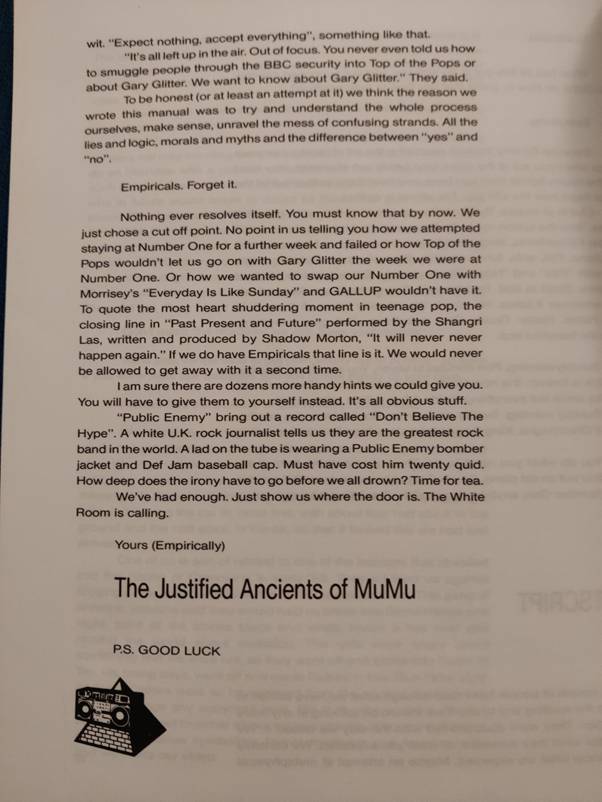
[Editor: the page before this in The KLF’s manual, in the last paragraph before the postscript, is the following line – “You do what you need to do. There was nothing behind the green door but an old piano”. Now, if you know the works of GANTOB, which I do, as I have had to edit four of their books, you will know that the “green door” idea features prominently, inspired by an HG Wells story). It is first mentioned in GANTOB in a Little Grapefruit story which is built around the name of the character in the Wells story. It receives a full pamphlet treatment by The Study Master, in answer to one of the “23 Questions” used to prompt submissions for the fourth book. A green door appears in numerous pictures and other GANTOB writings. Gillian Finks, the founder of this GANTOB project, is no longer here to ask why she featured green doors so prominently in her oeuvre. She was last seen beside a chalk door outside Waverley Station on 23 August 2025. Perhaps this key line in The KLF’s book was the inspiration, and perhaps HG Wells was Bill and Jimmy’s influence for this particular point. Or maybe it was all just coincidence or subliminal. We will probably never know. Meanwhile, the search for Gillian Finks continues].
GRAHAM, 25/11/2025
(+) A Cube Cinema webpage promoting one of the Hear Hard events where the Voices LP was played, prices the record at £19.78 to mark the “re-imagining of the Post-Punk years in Liverpool”
(*) Cairnsmore of Fleet, at 2333 feet, is classified as a “Graham” (after Fiona Torbet (née Graham)).
(^) I try to dig back to the first mention of these ideas and see how much was laid out in plain sight. There was a Penkiln Burn email about “The Garden Shed” on 17 May 2024. It says: “The Garden Shed is somewhere in Suburban North London. Most mornings King Boy D locks himself in The Garden Shed so he can converse with The Spiders. To know more click here”. The link has long gone. Perhaps somebody has the detail.









 GANTOB blog