A couple of months ago I was noodling about Hegel, and being stuck when I come across the term “Hegelian“. Today, in one of our occasional Saturday guest posts, we have a post by Brechtian. Bertolt Brecht (1898-1956) is another lacuna in my knowledge, apart from some titles, snippets of writing and David Bowie’s version of Baal.
The term Brechtian is arguably as broad as Hegelian. Here’s a one sentence summary on Brecht’s legacy from Wikipedia:
“Besides being an influential dramatist and poet, some scholars have stressed the significance of Brecht’s original contributions in political and social philosophy”.
You may also be amused to hear that Brecht wrote a manual of sorts – Manual of Piety (originally published in German as Die Hauspotille, 1927).
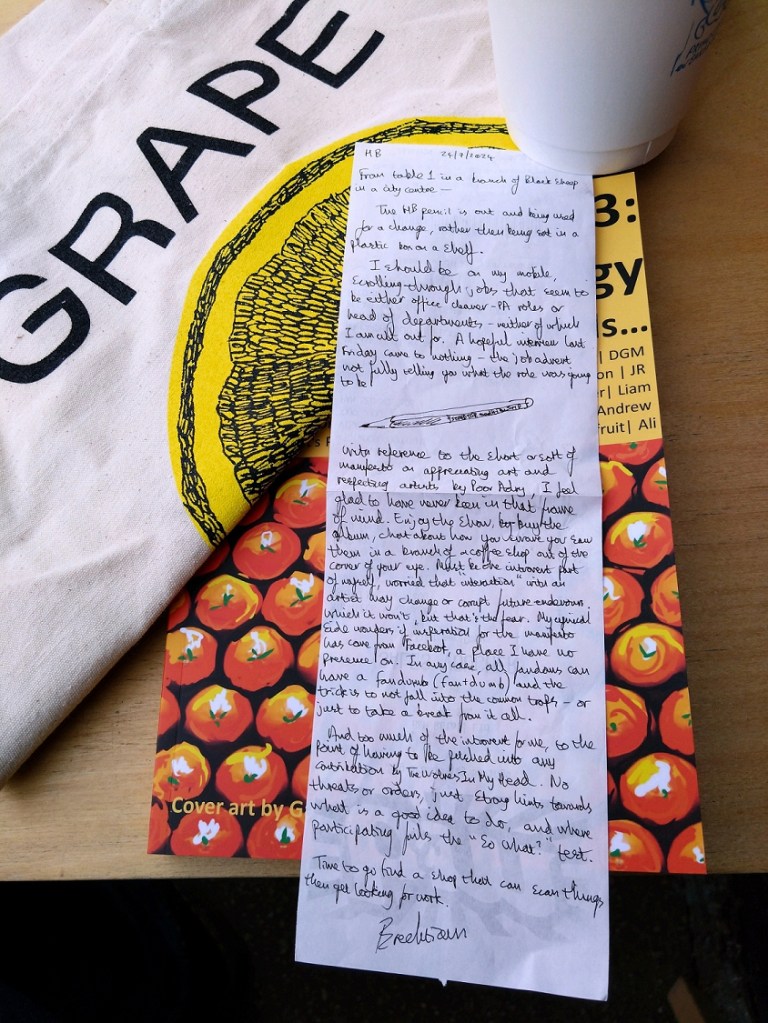
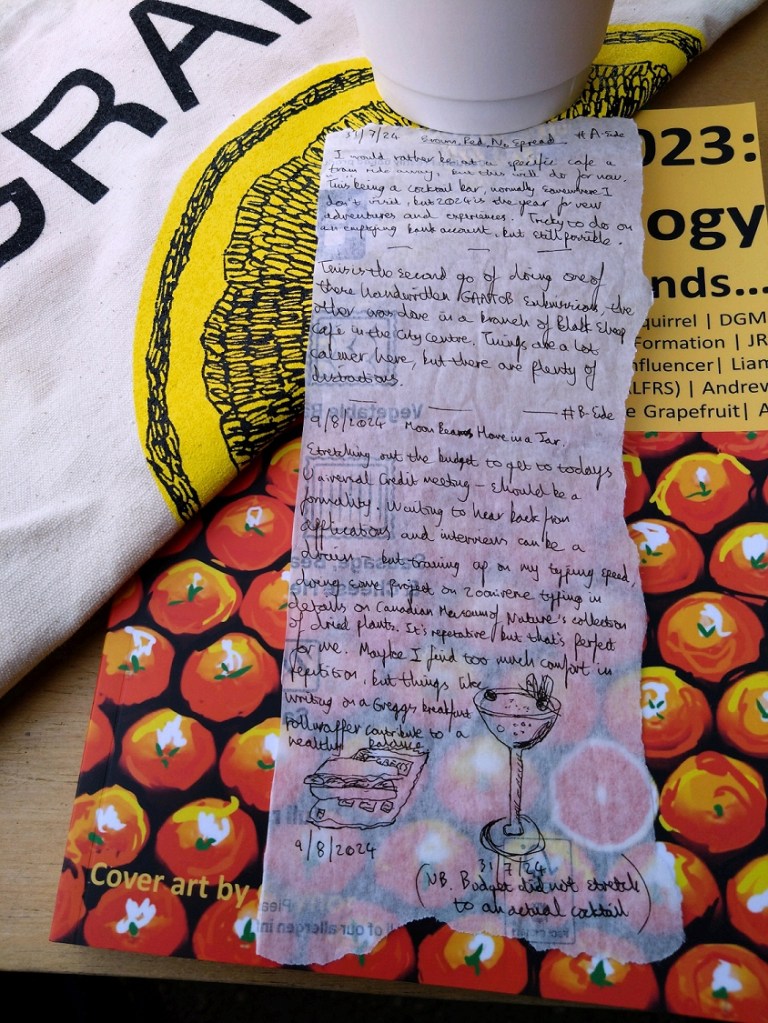
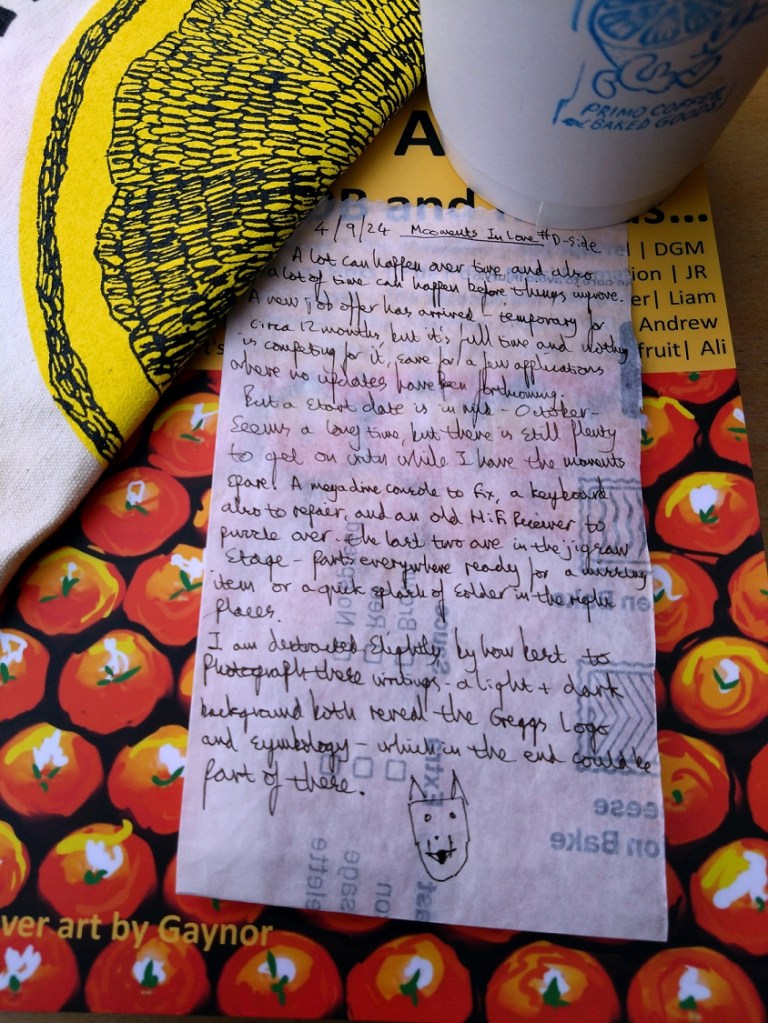
There is plenty of social and political interest in this series of reflections by Brechtian. And I love the GANTOBian style of capturing these thoughts in snatched moments, by hand, on found scraps of paper, with interesting objects to provide context.
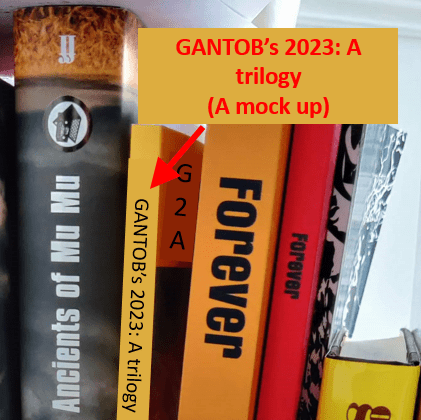
As you will see, Brechtian also provides answers to a question posed in GANTOB’s November 2023 pamphlet “The Birth of Death”, pamphlet X14 (2023), copies of which were available at November 2023’s Day of the Dead (The Krossing), with the full text also available in the second GANTOB book (GANTOB’s 2023: A trilogy).
I am sure that all GANTOBers will wish Brechtian the best of luck over the coming year.
This question was submitted by Rebus Frill Truckmen on 3 April 2024. They wrote: “I have been reading some RLS recently, to join the dots between idling and Bill Drummond. I stumbled across this question. Your help would be greatly appreciated”.
You can read more about 23 Questions, and see the Robert Louis Stevenson quote in context on the 23 Questions page of this blog. You can also submit your question(s) there.
Note that Penkiln Burn pamphlets referenced throughout the answer can be viewed (albeit not in full text) at KLF.de.
But for now, I will hand over to The Food and Literature Delivery Rider, in a form of let and sublet agreement through The Benefaktor.
All will become clear if we’re lucky…
I have two phones. One for my food deliveries – an iPhone provided by a well-known food delivery company, securely attached to my handlebars in a waterproof cover (tricky to handle with the goat hoof gloves essential to survive an Edinburgh winter). And the other – a “burner” – provided by my father, The Benefaktor, for the literature deliveries. I manage a few hours a week for my first job. Not quite enough to produce the mental health boost that Gillian mentions in her pamphlet On/ Off Work. But my father supplements that quite enough to fill the eight hours a week. Over the pandemic it was deliveries of books from local independent bookshops, to lockdown imprisoned readers. When that dried up, I diversified. For example I might collect a tap from a wholesaler to allow a plumber to fix a sink for a student completing their English literature thesis. But to be honest that just happened the once, and it was for my cousin. Then GANTOB (the project) came along in 2023 and I had quite a busy summer, popping up to stationers for A5 coloured paper, pound shops for padded envelopes and dropping off pamphlets and books around Scotland. Clandestine operations sometimes – delivering a USB stick to a woman wearing a yellow carnation standing outside the Boots at Waverley Station. A message in a bottle to a man in a café round the corner from a consulate. All to maintain my allowance. My first documented drop off was to The KLFRS themselves.
The most recent text to the burner, received on Wednesday morning, read as follows: “You’re needed now. My room”. I scuffed along the corridor and knocked on his door. He was wearing a thick towelling dressing gown and slippers. Old man hairy legs on display. He thrust a jiffy bag into my hands and retreated back into his room (“The Kino”). The package was addressed to me, using my name rather than function. It was unsealed. Inside there were photocopied materials, a handwritten letter, and a printed sheet containing some notes. It was an instruction, not a request. As usual, my allowance was conditional on successful completion. The diktat stated that I was to write the unofficial version of the subconscious section of I Am Forty-Six (under): for Bill Drummond’s memoir, The Life Model. I had been selected because I am currently 46-years-old and am a man. Fine. Mission accepted. As if I had a choice.
The Benefaktor laid out a few rules:
Your pamphlet can only include material relevant to the period (29th of April 1999 to 28th of April 2000).
It is not an official part of The Life Model.
It has to be written mainly from the viewpoint of a 46-year-old man.
As it is being written after the publication of The Life Model, and stands as part of the GANTOB canon for the 52 Pamphlets, it can provide some reflections on the period in question from the viewpoint of 2024, but remembering that you are still a 46-year-old man.
The word count must be a prime number.
The pamphlet must mention the number seventeen.
It must be structured – in whatever way you like – to represent the number seventeen.
Kreative Tyranny means that you cannot step outside that structure.
It must reference literature…
…and commercial dining, whether that is takeaways or restaurant meals.
Penkiln Burn pamphlets must be referenced by title and number.
Do not be confused by the stated publication date of these Penkiln Burn pamphlets; they cannot be fully explained…
…but try to find a plausible answer to the gaps in the pamphlet catalogue for that period.
Do not worry about “My Favourite Colour” (Penkiln Burn pamphlet 1): all the preparation had been completed by the year in question. It is a story worth exploring further in the future though.
Do not worry about “I Love Easy Jet” (Penkiln Burn pamphlet 2): I would view it as a flier rather than a pamphlet.
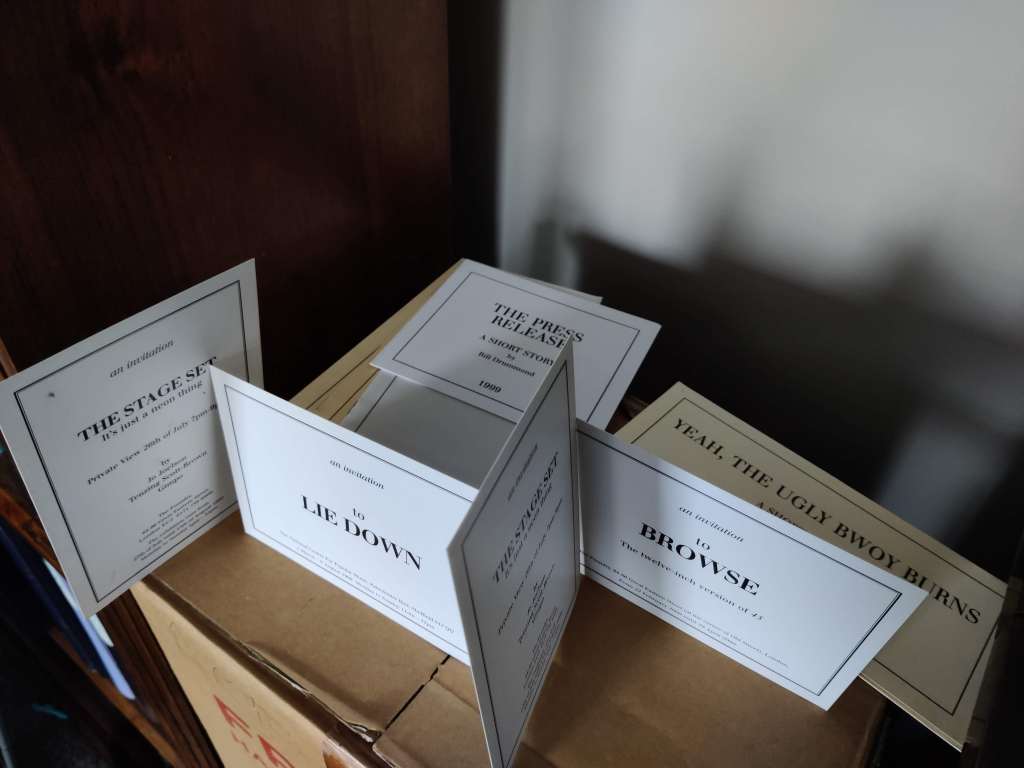
You do not need to mention The Press Release (Penkiln Burn pamphlet 6): it was the wrong shape and its predictions did not come to pass.
Do not try to extrapolate lessons about Bill’s Dad to your own relationship with your father, The Benefaktor.
Distribute the finished pamphlet with food deliveries on the evening of Friday 5 April 2024.
I Am Forty-Six (Under) (written from the perspective of Bill Drummond, as imagined by The Food and Literature Delivery Rider)
29th of April 1999 to 28th of April 2000
Sifting and sorting. Slipping and sliding. Sentimentality. Since I heard about Roger Eagle’s death from cancer, when he was just 56 years old, a few days after my own 46th birthday, my subconscious has been dwelling primarily in Liverpool. Some people have a disproportionate effect on your life – Roger Eagle had a powerful impact on me. Seeing others’ views in print after his death, or hearing them on the radio, felt like an intrusion on my grief. Simply Red, the Guardian obituary wrote, would have missed “a vital element in their musical education”. Shaw, as in George Bernard, was a distant relative. Sublime to the ridiculous, in reverse order. Still, that GBS connection is interesting. Significantly, Roger and I both seem to have lived by one of Shaw’s axioms: “A life spent making mistakes is not only more honourable, but more useful than a life spent doing nothing.” Stuff like that gets tucked away in my head all the time, waiting for the right moment.
Eagle. Events of this year have hovered around his life and death, forcing pen to paper. Every twist and turn, documented in a pamphlet: memorialising, moralising, justifying, but also worrying about how it might be seen. Extemporising: “Maybe my idea is just me jerking off – ‘Look at me, Bill Drummond, didn’t I do well for myself’ – as I wave my diminishing wad at the thinning crowd”, even when that is unsuspecting customers at a snack bar or mourners at a memorial service. Escaping too – from responsibilities and a custodial sentence. Even my relationship with my eighty-six-year-old Dad, helping him to make sense of pieces of writing that he has collected in a box from across his life, sellotaped onto the page to create a… and I’m struggling to think what it is – a patchwork?
Version: that’s it! Versions of ourselves, through our writing (a book for my Dad), my book 45, or record collection in Roger’s case. Visions vary depending on who you ask. Vitriol and scorn if you don’t capture people’s heroes the “right way” (as I find out to my cost). Vacillate? Validate? Valorise? Vandalise – that’s where I end up taking my emotional oscillations about Roger, scrawled on a wall, numberplate caught, standing in court. Verbosity ignored, chapter and verse delivered. Victimhood? Vindication? Valediction is most on my mind, now and forever: for Roger, for myself, and for my elderly parents.
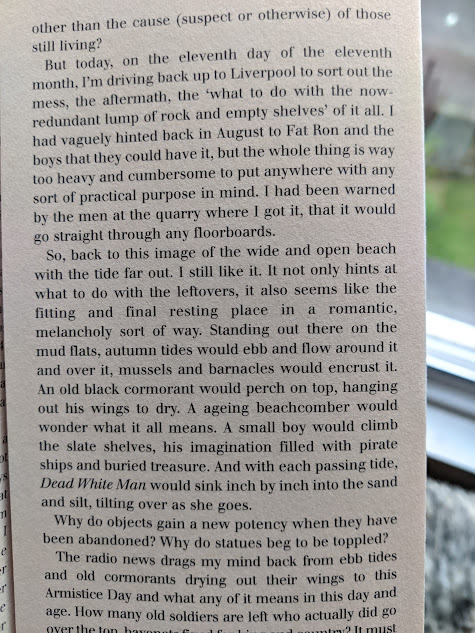
Eagle would have loved the sculpture I am planning for him I think, even as an Antony Gormley pastiche. Exhibit 1 from 17 Forever (below). Ebb and flow of waves, lapping at the base, submerging the record of a life, taking the covers and labels first, then salt between grooves, sand smoothing away the tracks. Eons of wear required perhaps, but probably still faster than the destruction of drips onto a box of papers stuck in a loft for decades, bookworm tunnelling, ink leaking, paper rotting, into mulch. Even if rescued from that fate, the box of my Dad’s papers risks a similar destiny eventually if my plans come to pass. Enforced exile in an oak box in the Eildons. Except, now we need to fast forward the future.
Exhibit A: Description of Drummond’s proposed sculpture in memory of Roger Eagle, from 17 Forever pamphlet
Nineteen-ninety-nine might seem a long time ago. Now, in 2024, after publication of my book The Life Model, I cannot recall whether my repeated mentions of the number seventeen in my writing throughout 1999-2000 were intentional or coincidental. Notes, from pamphlets published that year, document other men at age 17: soldiers lost in the trenches in the Great War, listed on war memorials across the country; my Dad, given his “first run out with Melrose Rugby Club’s senior side in the opening game of the 1930 season”; and a boy, white faced, sitting behind me in the waiting area for court room 17. No escape (from the justice system, or the number). Numbers – especially prime numbers – have always fascinated me, but I took extraordinary measures for the pamphlets in 1999-2000, after laying the ground with 17 Forever (pamphlet 9) and My Dad (pamphlet 10). Neatness was a driving force, which perhaps sits uncomfortably with my reputation as iconoclast. “Need” is a tricky word, but at the time I desperately needed my follow up pamphlet to 17 Forever (on Roger Eagle) to be pamphlet number 17. Nothing else inspired me at this point – I was drowning in loss, actual and predicted – so I couldn’t fill the gaps with words. Nudging things along, I devised a plan for five of the intervening “pamphlets”. Necrolatry was in the air, so I listed three pamphlets on death in the Penkiln Burn catalogue – Who Died Last (Penkiln Burn pamphlet 12), Paint Them Black (PB pamphlet 13), The Birth of Death (PB pamphlet 14), bookended by two “blanks” (PB pamphlets 11 and 15). Null returns, to represent loss, dust to dust. None issued, or even written. Number 16 in my pamphlet series was just a diversion in Correx at that point, attempting to salvage something from a $20,000 picture by Richard Long, framed as a “minor stunt”: it would of course become something much bigger, ultimately perhaps also buried in a box, but that is a story for another year. Number 17 of the pamphlets was the big show in town: My Day in Court, closing off my Roger Eagle stories in a blaze of glory – graffiti, and potentially time in prison. Not, however, my “Band on the run” moment: “Is this all some sort of publicity stunt?” they asked. No, but it would take another few years for me to find my real purpose with the number 17: a choir. Not that it would always involve 17 singers: where’s the fun in that? Nevertheless, unabashed by criticisms of my self-centred ways, I kept on distributing my writing, with pamphlet 17 going to diners at Cook Au Van; perhaps just to be crumpled up with packaging and discarded menus.
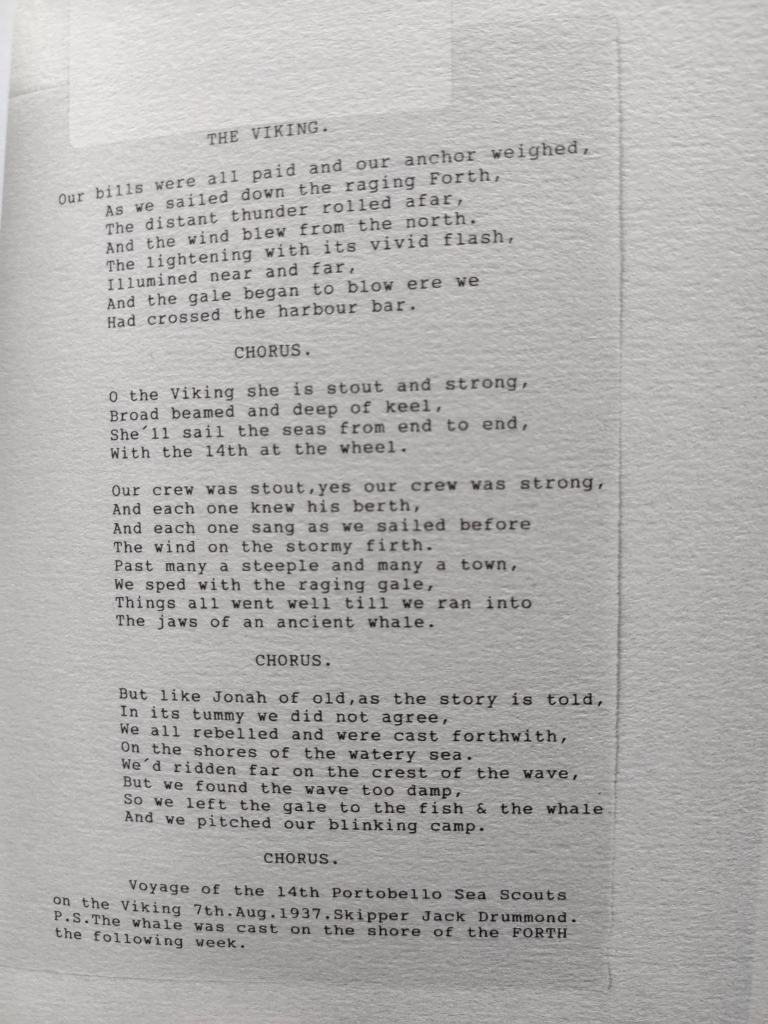
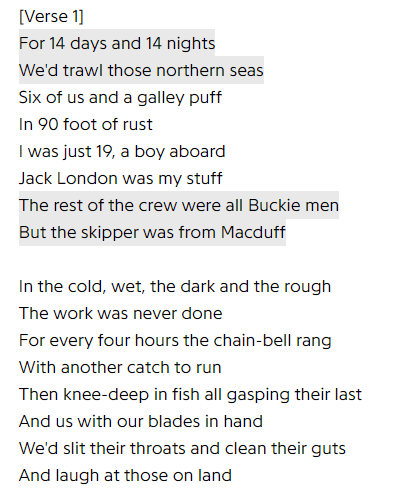
The work with my Dad was a welcome escape. Telephone discussions late into the night, agreeing the pieces to include. Things we had never discussed – his writing from the 1930s – drew me in. Thoughts about the impact of his verses on my own creative output. The rhythms in his poem The Viking (1937), for example, remind me of my own seafaring song The Porpoise Song (1988), when I was part of The JAMs.
The Viking from Jack Drummond’s book Here’s Tae Melrose (Penkiln Burn Book 4)The JAMs’ Purpoise Song (1988), from LP Who Killed The JAMs (Credit: Genius Lyrics)
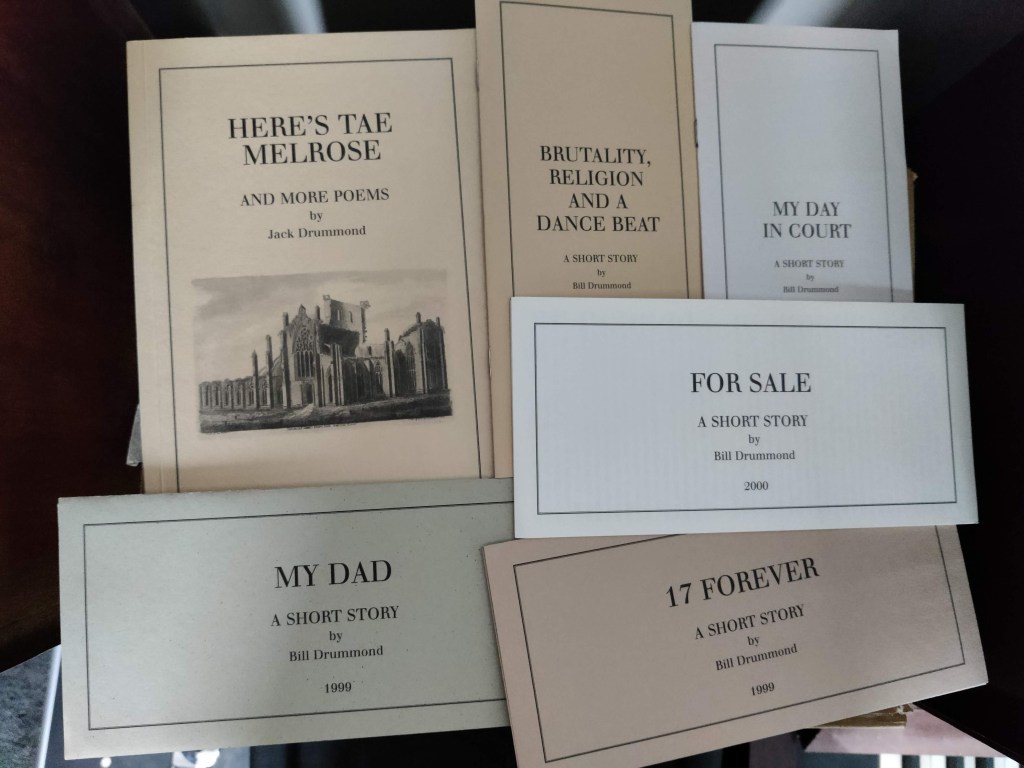
Eventually he had a book (Here’s Tae Melrose), and a pamphlet to go with it (My Dad). Everyone has a book in them, and my Dad no doubt had more than that: if you were to sew up all his sermons they would make several volumes. Everybody in Melrose was to receive a copy of his collection of poems, but I don’t think that we managed that. Existence and presence was enough: we had the boxes of books and they rested in bookcases of some households in the town, but also of family and friends further afield.
Existence and presence: the hard copy of something that we produced together. Even now, 25 years on, it brings back happy memories of my Dad, and our conversations from throughout his life. Evidence of his long time on this earth. Edinburgh, Portobello, his – and eventually our – time in Africa, back to Newton Stewart, Corby, and destinations along the way and further down the line.
Nonsense poems, hymns updated to cover topical issues, the approaching millennium. News bulletins from my Dad’s brain. Next to my books in bookcases, and Penkiln Burn libraries, this volume, signed by my Dad, with a cheery greeting in each, stands as a record of the man as he was, as he thought and wrote and spoke and interacted and entertained and preached and comforted and consoled. Nothing can take that away. Now, in 2024, looking back, I can see that my explosion of pamphlets in that period 1999-2000 – however inconsistently numbered and inexplicably fixated on the number 17 – was driven less by Roger Eagle’s death and more by my subconscious concerns about what came next for my elderly parents, Jack (d.2009) and Rosalind (d.2010). Not forgotten.
1339 words (a prime number)
The Food and Literature Delivery Rider,5 April 2024
This blog is contributed by – by my reckoning at least – the youngest of the GANTOB collaborators.
Katie submitted it to me three weeks ago, since when I have been exploring, GANTOB style, the possibility of recruiting experts in the topics to answer some of the questions that have emerged. So far I have not had success on this particular topic. But as The Tillerman once said, in a slightly different order:
“GANTOB was relentless
GANTOB was exhausting
GANTOB became an inspiration”
That’s me.
We have two strands at play in the 52 Pamphlets project at the moment.
One is a golden thread of ideas and inspirations that seems to be weaving its way from William Blake to American counterculture in the 1960s, and then a couple of other destinations, before attempting to explain some outstanding mysteries in the world of K.
The other strand is an interest in the mechanisms behind generating and disseminating ideas, particularly in the form of pamphlets. Katie’s piece is very much in this category, and therefore most welcome in providing balance to the blog. And she does, of course, by nature of her relationship to the funder of GANTOB, have some particular insights that we probably wouldn’t hear from anybody else.
Last summer there were lots of GANTOB pamphlets disseminated across the UK, with the aim of promoting the original Kompetition. Over the winter – and with my change in job from travelling salesperson to telesales operator – the approach has shifted online, with blogs and electronic dissemination of longer pieces – what we’re calling pamphlets, but are really just 0s and 1s in the digital realm. With the peak of the spring bulbs upon us and lengthening days extending our range outdoors I think that we’re ready to return to a more physical approach.
So I am excited to say that 10 copies of The Photographer’s piece 6 Times, uploaded to the blog yesterday, have been printed in a booklet and are being disseminated overnight to selected independent bookshops in north Edinburgh. These will be delivered by the food and literature delivery rider who has worked shifts for the project at various stages. I have no idea what the bookshops will make of the pamphlet/ booklet. Perhaps they will recycle them. But hopefully they will place them on the counter ready to be picked up. GANTOB (the project) thrives on collaboration, and some new participants recruited through these booklets would hopefully take the 52 Pamphlets book (published January 2025) in new directions.
Over to you Katie, or should I say “The Foundation Doktor”.
I leave the hospital on time for once, and hunt down a bus from the strip of stops strategically placed between car parks. No bike for me tonight. Some idiot has locked their frame onto mine at the bike shelter. I refrained from retaliating by locking mine onto his. Has to be a bloke.
I catch the next bus into central Edinburgh and walk down the cobbled streets to my grandparents’ flat. There is still some light in the sky as I take the shortcut along Saxe Coburg Street towards Stockbridge. I can hear the cats before I open the door into the lobby. They are standing on hind legs, crying behind the inner glass door, furious. They are hours late for their evening feed. I shut the front door, securing the airlock between their world and outside. They force me to dish out their dry food before I can start on the errand that my grandfather had tasked me with.
“To The Foundation Doktor,” the diktat started, “we are going to be away for a few weeks, on ‘kultural activities’. Please could you flat/cat sit? It will be a great opportunity for you to stretch out after the constraints of your digs. I wonder if you could also help with a projekt that I am exploring for a GANTOB pamphlet. I’ve left everything you need beside my desk. A few leads. The cats need 23 grammes of salmon pellets in the morning, and the same amount of chicken at night. And the usual business with the litter tray. Gratefully yours, The Benefaktor”.
And a few minutes later, from my granny Urs: “Thanks for doing this. Don’t forget to top up the water every day. Have a few friends round if you like, but don’t go wild”.
What do they think I do all day? I have another set of 12.5 hour night shifts coming up. I would much rather roll out of bed in the hospital accommodation and toddle along to the wards than have to bus or cycle all the way to the other side of town. And I have a couple of weekends away planned. I called my granny, but they were off already, heading to an undisclosed location in Europe. “I’m sure it’ll be fine dear. Must go.”
I locate the extra key that my grandfather keeps in a freezer bag in the coffee beans at the bottom of the chest freezer and let myself into his study (“The Kino”). I have rarely been inside. Recently it’s only been for GANTOB discussions, until Urs was inducted into the secret after asking about the grapefruit logo that turns up whenever we are logged into the shared GANTOB accounts on our phones. The desk is situated between bookcases of film reels and boxed papers. The blinds are drawn to protect the paintings and spines of the books on the wall behind me from the afternoon sun. No risk of that in February.
There are piles either side of the desk, others spilling out of the in tray onto the desk, and even some propped up papers on his revolving chair. What a mess. He’s obviously been flat out on one of his hare-brained schemes. I check the spelling (hare or hair?) and the definitions: “ill judged”. Is that a fair criticism, after everything that I’ve done to enable him? Probably.
I skate over the books. They look heavy (topic wise). The FT and Guardian piles are precarious, so I ignore them. I sit down with the top few issues of London Review of Books. Not the sealed ones, some going back years, in white envelopes or recyclable wrappers. There’s a reasonably recent one – 30 November 2023, and it’s opened to page 22-23: “A National Evil”. On the surface, it’s a medical piece. Quite interesting really, about iodine deficiency and supplementing salt in Swiss cantons. But I’m not at work, and I’ve done enough revising recently for Membership exams. But there is also a lot of social commentary and cultural interest. It’s clearly caught my grandfather’s attention. There’s a little yellow sticky marker beside a paragraph on the first page. It’s about a GP called Heinrich Hunziker: “Hunziker was also a poet, who wrote short, formally precise verses of yearning and revelation that he published in slim volumes”. The yellow arrow points at the last two words. “Pamphlets? Must get” is written in The Benefaktor’s distinctive back slanting capitals. On a Post-It note he has listed a few titles and prices, from Abebooks and a couple of Swiss and German bookshop websites. I wouldn’t put it past him. Searching them out on my phone I reckon that some of the titles are by the wrong Hunziker, and others are too late to count as his early slim volumes. Hunziker, born 1879, died 1982. Jonah Goodman in The LRB is writing about the 1910s. But the relatively easy to find Die Idylle vom Holz that The Benefaktor has listed is from 1951. We need to rewind 40 years. I poke around a bit on a few websites, but there are too many false leads, and I don’t speak German unfortunately. I wonder what he’s looking for, but I know that he loves a bit of intrigue. “Revelation”. That would be enough of a catalyst. I wonder if this is something that the libraries he frequents could help with. But perhaps it’s tricky if it’s in German. And what role did pamphlets have in Hunziker’s medical work, persuading Swiss politicians that a centuries old problem affecting hundreds of babies every year had a quick fix?
I wonder if that’s everything that my grandfather is looking at. “A few leads”. Well, I’ve hit a brick wall with this article so I turn on a few pages. Quite a few pages. These are long articles! There are no further handwritten notes about Hunziker. But the next article, “How to Plan an Insurrection”, has more of the neon stickies. A piece by Niamh Gallagher on James Connolly, Scottish revolutionary, born to Irish parents, grew up in Cowgate, Edinburgh, executed in 1916 following the Easter Rising. My grandfather has marked out the following section: “and like many of the Scottish socialist activists of his generation, he was a prolific journalist, producing pamphlets and essays…”. And there is another list of references that he has tracked down from an internet search presumably. This is well outside the comfort zone of GANTOB and her art project. From what I can see from a quick internet search, the text of at least some of these pamphlets is collected in various books. But if I know The Benefaktor he will be seeking out originals, or finding out what became of them.
“Legacy”. When you’re 83 years old (like a lot of my patients) many people give up any interest in that word. They’re caught up in their own issues, where they’re going to live, wondering when their family are going to visit. Not The Benefaktor. He is caught up in his projects (and projekts). Have his cultural investments allowed others to get their message out there? Is his name in the programme, the sleeve notes, the credits? (In kontrast, he keeps his name out of GANTOB’s kultural aktivities to avoid kross kontamination).
So, what is he planning? I think back to regular GANTOBer Missi Formation and her request to hear less of The Benefaktor. But also her claim to be an anarchist and her goading about the cosiness of some of the December 2023 posts on the GANTOB blog. And recalling the “Welcome to the Dark Ages” stuff from Capt. Apophenia’s recent pamphlet “The Magic Number” I remember that revolution was in the air in The JAMs’ book 2023 (which I still haven’t finished). But that is not what GANTOB (the projekt) is about. Then again, some of the advice in the first GANTOB book was pretty edgy. There were quotes on Death, War, Protest. A picture of a burning figure on a bridge. But surely The Benefaktor is not planning to break out, foment riots. There’s an Alan Moore quote in one of the chapters: “Don’t leave home without your sword – your intellect.” No, I cannot accept that The Benefaktor is planning anything more than writing about these subjects.
I’m exhausted after all this reading and searching. Violence is not my thing, even on TV. I log on to Netflix on my laptop and flick through the list of romcoms that are suggested. It knows me too well. But there’s nothing that appeals. I am unsettled. I head to bed and scroll through dozens of posts about kittens, and puppies, the Japanese macaque that had just been recovered near the Highland Wildlife Park in Badenoch, another about a fugitive raccoon in Sunderland. That’s more like it.
That night, sleeping in my grandparents’ spare room, I dream of towers. I’m surrounded, speeding through a city, but viewing it from above like a computer game or drone. At first I think it’s New York, from the height of the buildings and density of the streets. But then I realise that it’s George IV Bridge, looking down onto the Cowgate. Layer upon layer of windows, families, lives. But something is different. Gas lamps on the streets. Candles in windows. And a glimpse of a figure bent over books scribbling ideas for pamphlets. I detect an urgency, a clear sense of purpose. Did pamphlets ever change the world, in Switzerland, Scotland or anywhere else, and how would we know? And I suspect that is the task that The Benefaktor has set us. Submit your responses to this question, in the form of a pamphlet, via gantob.blog/pamphlet
A pamphlet from the LittleGrapefruit-verse – but for adults) – written and narrated by The Benefaktor.
I have written and am narrating this piece as the only consistent member of the GANTOBverse. Gillian is still around (indeed, next Saturday’s pamphlet is probably going to be one of hers). But she is no longer GANTOB. GANTOB3 is now in charge. I have not met them yet, but I believe that they are also resident in Badenoch.
But let the pamphlet begin. Over to me…
Here’s a version generated by a Google narrator (let’s call it the Little Grapefruit version)
And the Benefaktor’s real but rather more turgid version. Give him a chance. He’s 83!
An elderly gentleman, but not The Elderly Gentleman, sat napping in the armchair in his study. His door was shut, and he was wearing his vintage wired headphones so as not to disturb the rest of the house, because he likes to play his music at a volume that allows for his presbycusis. He was listening to Butterworth’s setting of a poem by Housman.
Loveliest of trees, the cherry now/ Is hung with bloom along the bough,/ And stands about the woodland ride/ Wearing white for Eastertide.
He had placed a copy of A Shropshire Lad on the left arm of the chair before he drifted off to sleep, ever mindful of the spines of the books in his collection. His tortoiseshell cat lay peacefully on his lap, studiously avoiding the reporter’s notebook and fountain pen that competed for space in this warm soft patch. He had been working from memory, thinking through conversations with The Philatelist, The Ornithologist and The Photographer, but principally his stamp collecting acquaintance. He had carefully drawn out a banana, a horn and, solely to seek inspiration, one of Hundertwasser’s onion ring trees.
Next door, in the Dining Room, the occupants of the fruit bowl were shifting around uneasily, seemingly as if in Brownian motion, even though the grapefruit, passion fruit, apples and mangos knew that could not possibly be the case. The bananas, were as usual, in a separate bowl. Urs had been told to do that decades ago. The Benefaktor had gone into one of his monologues about ethylene or ethene as he now insisted on calling it. Urs had switched off, but knew enough to minimise future lectures. Little Grapefruit had climbed to the edge of the bowl to peer over the rim. She was wearing prescription sunglasses to see through the window all the way to the tree in the garden outside. It was in full bloom, pink not white. She was not sure which month it was – gone were the days of seasonal produce to guide her. She was aware, however, from the conversations among the older grapefruit, that it was way too early to be in blossom. That other decorated tree was not long down and in its cardboard box, back in the cupboard for another year.
The Benefaktor continued his slumber in The Kino. His dreams were flicking around, like the numbers and letters that jerk in and out at the start of old film reels. There was some flow and sequence in the ideas, if he could just think a bit harder, but he would not remember that when he woke up. First there was the postal horn that The Philatelist (also 83 years old) had recently had tattooed on his wrist after a bet with his purple-haired grandson. And then a graffiti banana – a spraybanane – that The Benefaktor imagined himself stencilling under the doorbell of a local printworks and gallery as a mark of approval. Octogenarians breaking the rules. Right on.
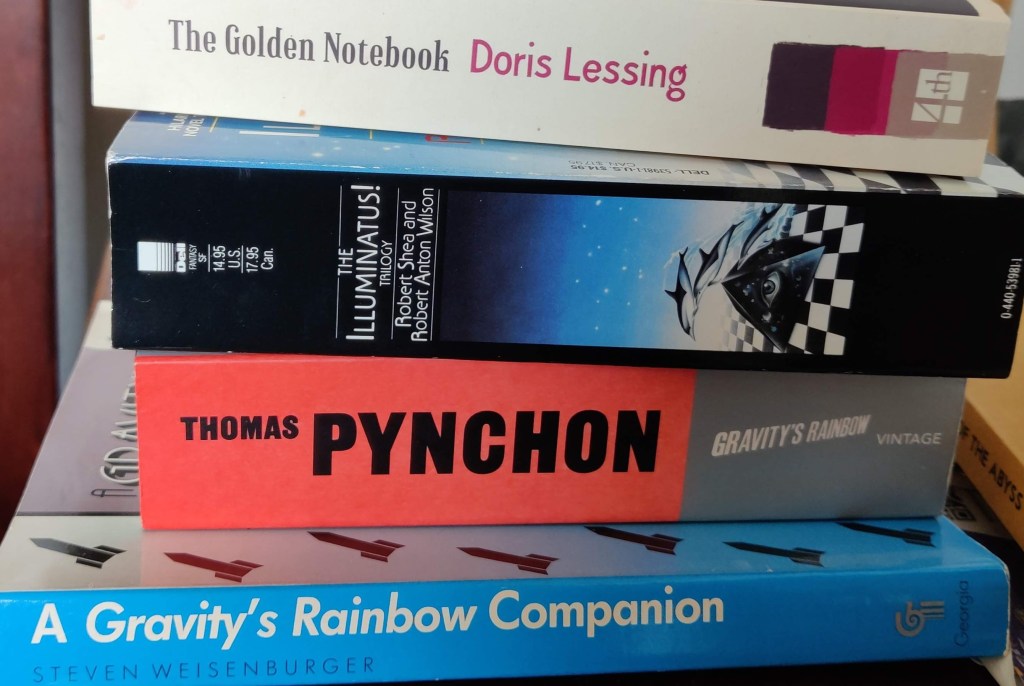
Thomas Pynchon. That was the name he was grasping for in his dream. Out of reach, like the top shelf of his library, built ten years ago to take advantage of the high Georgian ceilings, but now revealing their true purpose: storing the books that he knew that would never have time to take on. The Illuminatus! Trilogy beloved of The KLF sits on that same shelf. The authors Robert Shea and Robert Anton Wilson were clearly heavily influenced by Pynchon. But it’s all out of sight, flotsam and jetsam, time out of mind. Not for 83-year-olds.
The postal horn, representing communication in Pynchon’s entertaining 1966 novella, The Crying of Lot 49. He had enjoyed that when he read it first in the 1990s, a present from his son. He had thought of that a lot when hearing about The JAMs and The KLF at the start of his discussions with “GANTOB”. The symbolism, the cloak and dagger communiques, the intrigue. But in his dream the horn was played by Felix Klieser: Liszt’s Les Préludes painting the concert hall banana yellow. Perhaps that was the colour Liszt imagined for C major. A little brown mixed in for its relative minor and some green for the E major sections. He could not remember whether Petroc Trelawny had gone into the details in his recent mention of Liszt’s synaesthesia on BBC Radio 3.
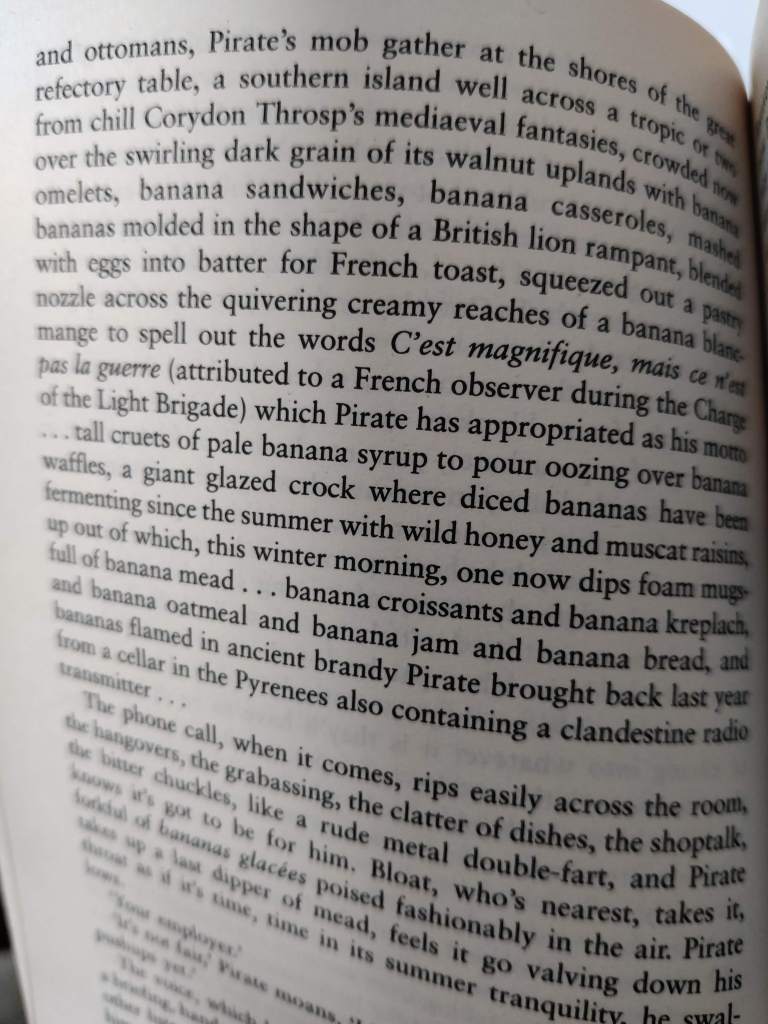
In another of their discussions – this time by email – the former GANTOB and The Benefaktor had talked about books that they did not think that they would ever finish – The Golden Notebook for Gillian, Gravity’s Rainbow for The Benefaktor. TB could not recall the reason for Gillian’s failure, but he remembered the snagging section in Pynchon’s book Gravity’s Rainbow (1973) alright. Intended no doubt as a cornucopia of delights, overflowing with bananas, The Benefaktor had been left feeling jaundiced. American authors do like to pad things out, outstay their welcome.
And this thought jolts him awake. He abhors nationalism. And generalisation. He pads through to the Dining Room to grab an apple – to rid him of that bitter taste in his mouth, and to crunch his teeth back into their sockets after half an hour with his jaw slack while asleep. He wipes dribble from the corner of his mouth with his fraying shirt sleeve. If he had not been doing this for forty plus years he would have worried that he was displaying signs of “decline”.
Outwardly, the fruit are absolutely still in their bowl when the old man approaches. But their insides are squirming. They are not worried by him – he’s far too old to notice their occasional itches and sneezes. They are thinking instead of the uncharacteristically early blossom. The older grapefruit issue warnings to Little Grapefruit and her generation. Beware the cherries.
Page 12 from Thomas Pynchon’s 1973 novel Gravity’s Rainbow. Bananas
The old man opens the window to the garden. It is uncharacteristically warm outside. Bird song and the almond scent of cherry blossom flood in. He heads out to the local greengrocer – a dying breed – and bags up some plump purple cherries that seem to call him from their box, marked with their price in kg and country of origin. He is not worried about the total bill. Or their source. He is thinking of Urs’ face when she sees the first proper cherries of the year. He’ll be in her good books for once. He has forgotten the trouble he caused last year when Urs stained her favourite cashmere cardigan with purple juice.
Despite the older grapefruits’ warnings, the cherries are instantly popular with the carefree citrus children. The cherries are sweet natured and great fun. They roll around freely and can squeeze through little gaps to meet their neighbours, snuggling in against the other fruit with their soft, smooth skin. There is nothing spiky or rough about a cherry. When you talk to them, you are comforted. Their speech pattern is gentle, like music, as if learnt from the birds that had tried to peck at them through the netting. They use simple words in short sentences. Nothing is difficult or complicated. The youngsters play games, sing songs and share meals. They are part of the family.
Big Grapefruit hasn’t met any of the Cherries before, because he works long hours outside Bowlingham. Returning home on the bus, he hears a group chanting a song. It has a nursery rhyme simplicity and is instantly catchy. He does not catch the words. He is thinking about being back home with his family. Big Grapefruit does not think anything more about it, but finds himself humming the tune when he rolls off the bus and heads home.
This tuneful Cherry is called Quinctilius, named after the quince family who had lived next door when he was growing up, as his Mum insisted on explaining whenever anybody asked. He hates the association with another type of fruit. He prefers to be known as Lee. He doesn’t like other fruit. Life for him is a game of “opposite day”.
“Black is white/ Day is night/ Left is right/ Dull is bright”, he sings. He is teaching his two sidekicks some of his ideas. They love this concept that everything is turned on its head. They ignore what everybody else says.
Gravity? Doesn’t exist.
Homework? Forget it.
Grey? What’s that?
Fruit and veg? Bad for you. Best avoid.
The Benefaktor is back in The Kino, resting after his trip out. He is listening to Latvian composer Ēriks Ešenvalds’ Rivers of Light (2015) on Radio 3. He loves modern choral music. He looks it up: considered a companion to another Ešenvalds work Northern Lights (2012). Aurora borealis. He is sure that there is a Bill Drummond connection there if he asks Gillian. But he would rather think about other associations.
Little Grapefruit is playing Pacman with her new friend Lee. Watch the ghosts, but don’t worry about the Power Pellets – focus on the bonus cherries. She dies her hair the colour of green maraschino cherries. What a rebel. Gets drunk on kirsch after eating too many cherry liqueur chocolates, setting fire to the stalks that are left over. High on sugar from full fat cherry flavoured Dr Pepper she heads out, daubing Lee’s new slogans in red on walls around the bowl. Black is white, Left is right. Right on.
The Benefaktor is worrying about world affairs. Gaza. Ukraine. Poland. The Baltic states. Opposition Day in the UK parliament. Trump, Truss. What a mess. Nationalism at the root of it all. It doesn’t make for easy dreams.
And Urs is left, as always, tidying up the pieces. She finds the bowl with its graffiti and bleaches it clean. She has known about the grapefruits’ nighttime activities for years. The Benefaktor must always have a grapefruit available in case there are kippers for breakfast, which there usually are. She has never seen them breaking out like this though.
But she’s old enough to know how to deal with the cherries. She doesn’t listen to their songs or read their ridiculous slogans. She picks up the handful that remain after their coups and putsches, pops them one by one into her mouth, and strips them of their deceptively sweet and juicy flesh before spitting their hard little stone hearts into the compost bin to be disposed of with the next food waste collection.
The Benefaktor, 24 February, 2024
Pamphlet 8 of the 52 Pamphlets
Some notes: maraschino is from the name of the cherry (marasca). The cherries are preserved in maraschino or a syrup of that flavour. What I found out in the course of writing this pamphlet is that marasca is from amaro (Italian for “bitter”), from the Latin amarus. I am reminded of my points on the word sanction in my Stuck blog. Amore vs amaro. Love or bitter. Amorous or amarus? It’s important to listen carefully in matters of the heart. I’m sure that Urs would agree.
My recollection of the banana section in Pynchon’s book Gravity’s Rainbow is perhaps misremembered. Flicking through my long ignored copy I can only see mention of bananas for a few paragraphs on page 12. I was sure that I had managed well beyond that on one of my previous attempts, but I cannot see a longer banana-themed section now. Bananas are not even mentioned in the index to Steven Weisenburger’s A Gravity’s Rainbow Companion (though the second edition of that book has a Warholesque banana cover). Having flicked through both books again this morning I am not convinced that I will be returning to either. Yet it is frustrating to be defeated by a book. And having spent time with Shea and Wilson’s book recently (grudgingly) I can see a number of parallels with Pynchon even on the sketchiest of reads. Perhaps somebody else will be able to advise.
The Philatelist has something to say about bananas and Thomas Baumgärtel’s spraybanane in the second GANTOB book (chapter 29; his chapters are additions and are not included in the blog).
If you have a piece that you would like to contribute to GANTOB’s 52 Pamphlets, then please check gantob.blog/pamphlet. If your application is accepted, then you will receive a personalised copy of your pamphlet by post, and a copy of the third book (52 Pamphlets, publication date January 2025). If you don’t have a copy of the second book and would like to read The Philatelist’s chapters, then you’ll need to make your case. I have a very small number of spare copies.
I’m glad to be heading home. On the way back I get off the train two stops early (Dalwhinnie) and Ali takes the scenic route home. My post yesterday – about the spirit of his Dad Curt Finks and his celebrity ghost friend – was written without causing conflict (unlike Brent Goose Rock).* As expected in a JAMs 2023: A trilogy re-enactment, we might look to children’s telly for some insight. Blue Cow’s bovine associates might have said that “Everyone knows that ghosts don’t write blogs”.
I update Ali on other aspects of the project, including the plan to recruit 31 volunteers to write all the December blogs, so I can reach 45 copies of the planned book. See my new un-numbered pamphlet “17, 23, 45. You decide” for more. It is being distributed by volunteers across the UK, including Andrew, Liam, Graham, Heather, Dan, Art, Christine, Andy, Nick and Caroline (“The Ten” perhaps). I sent them inserted into Bill Drummond books with numbered titles (17 and 45).
Ali introduces the number 8 into our discussion – the Edinburgh café posts, representing a “middle 8” as he puts it (posts 41 to 48). It was indeed a very long discussion I had with The Benefaktor and The Foundation Doktor. But we still didn’t reach the point where The Benefaktor and I explained how we finally landed on our original kollaboration. Perhaps we’ll come to that.
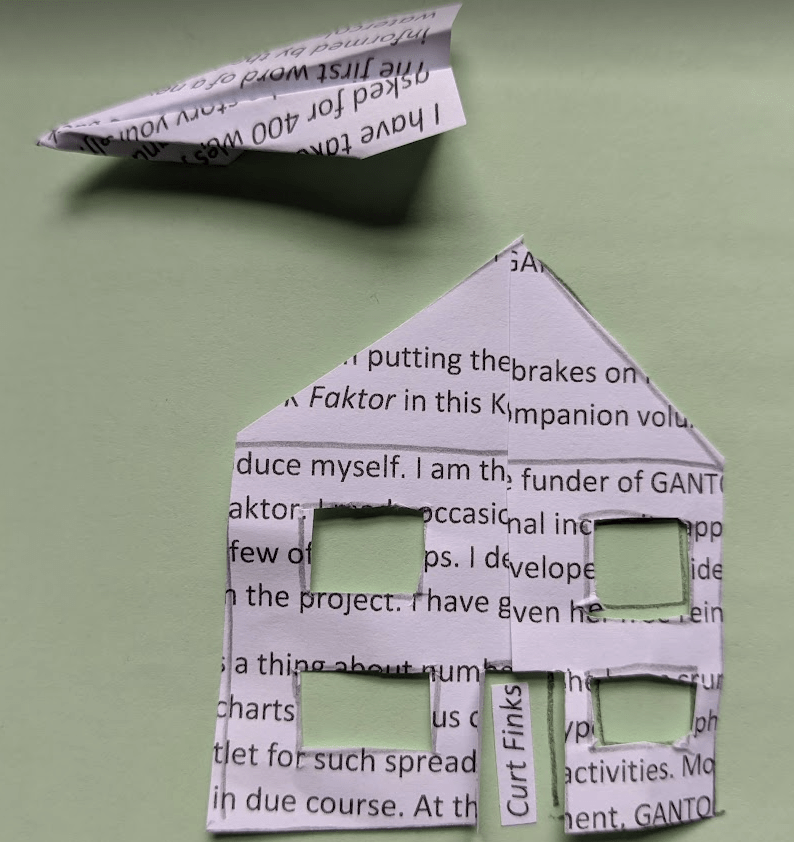
After yesterday’s post we decide to stop outside Halfway House and we talk about the practice of pulping remaindered books that haven’t sold. I have been using misprinted versions of Kompanion Volume to illustrate recent posts and personalise the copies of the new pamphlet for “The Ten” to keep. That uses spare materials well. I certainly wouldn’t want the produkts of my labours pulped. But is it kowardly to print only those copies that have a name against them? Should I be aiming to publish more and seek a new audience?
When we get back to The Manse I recheck the website that stocks Bill Drummond’s most recent books. The four books published in 2022, printed in editions of 400, are still available at their original price. I know of people who have bought multiple copies. Remaining copies will not be pulped presumably, but it demonstrates the nicheness of even King Boy D’s literary outputs. I decide that 17, 23 or 45 will be enough for my re-enactment.
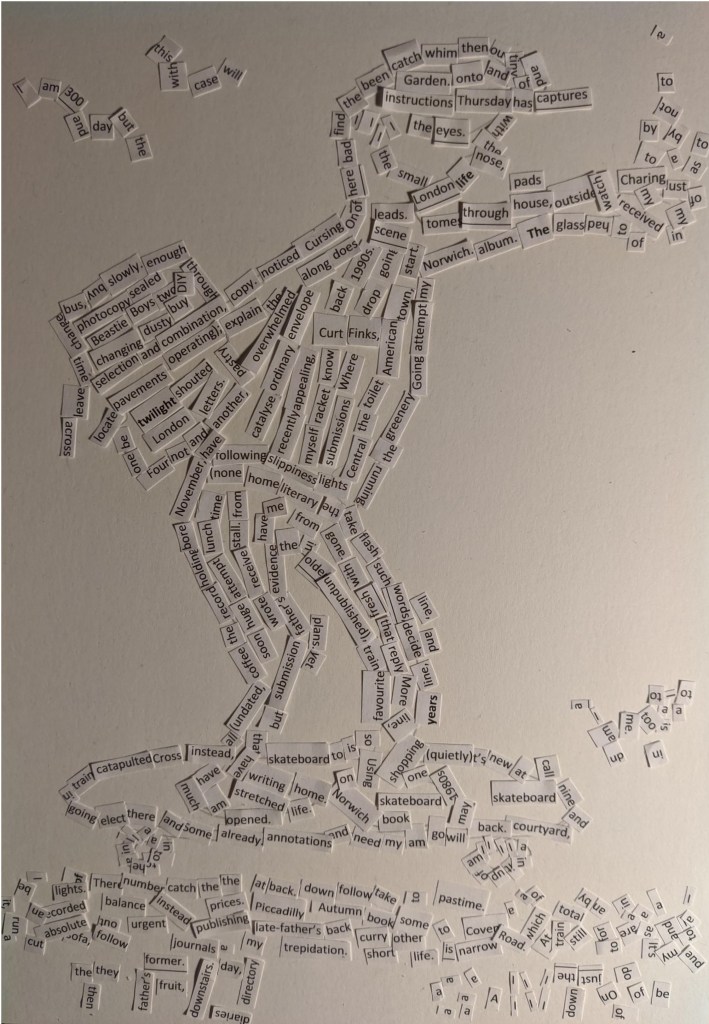
Don’t forget to enter The Foundation Doktor’s competition to win a unique piece of art by GANTOB (inadvertently using TFD’s bootlegged text of an imagined Curt Finks story).
Ali and I are unsettled. We are talking about the “personal delivery” of a new story by Curt Finks. Either our cover is blown, The Benefaktor is out of hospital, or someone is acting on his behalf. But The Foundation Doktor is apparently in East Anglia. Nobody else knows the location of The Manse. I have read the final “meta” blog planned by The Benefaktor/ The Foundation Doktor, saved as scheduled post on the WordPress system. “They” are up to something.
I do not usually share GANTOB business with Ali, but I thought that in this instance he needs to know as it potentially concerns his late father Curt Finks. We have had some successes in unearthing Curt’s unpublished writing, and occasionally his Edinburgh Fringe programmes or flyers come up at auction, or are found slipped inside a book as a bookmark. But we can’t yet verify the provenance of this new story.
Ali checks his CF spreadsheet. One of the columns is incomplete so he goes to his shed to look through his Dad’s things. He comes back a few minutes later with the 1986 copy of the Keighley Literary Almanac*. Turning to the pages with his father’s pencil annotations he runs a finger down the list, entering missing details about each journal’s conditions for submission. There is not a consistent format in the printed text, but Curt appears to have followed up the rules with selected editors and has added details in his neat hand. “Stet” he writes above one word, the smudge of a substandard eraser partially concealing the text. Ticks beside the first line of the address or phone number could indicate either enquiry or submission. Ali completes as many details as possible on his spreadsheet and then shakes his head. None of the highlighted journals’ rules match the details from this new Curt Finks story.
We return to the personal delivery of the envelope. Ali goes into a rambling story about the plot of a murder mystery he finished recently, where the serial killer attempts to divert attention by committing further crimes with the same MO, but ever more distant from his hometown. Might The Foundation Doktor actually be holed up in Badenoch rather than East Anglia, waiting to revenge The Benefaktor’s fall? But a blog apparently posted elsewhere would surely be a very flimsy alibi. We will lock our doors and snib our windows.
GANTOB
31 OKTOBER 2023
* To give it its full title, we should add “/Fanzine” after Literary.
Curt Finks (not his real name), my late father-in-law, was well known to a small group of loyal followers at the Edinburgh Fringe (1970s and 1980s). What is not so well known, until recently, is that he also wrote short stories and submitted them to literary journals of the day. You can find a fuller history of one of his stories – Brent Goose Rock – in the Kompanion Volume to my book. While unpublished, and indeed uncertain whether it was even considered by the editor, the story survived the closure of the literary journal, and was returned in its original “snipped” form to my husband Ali.
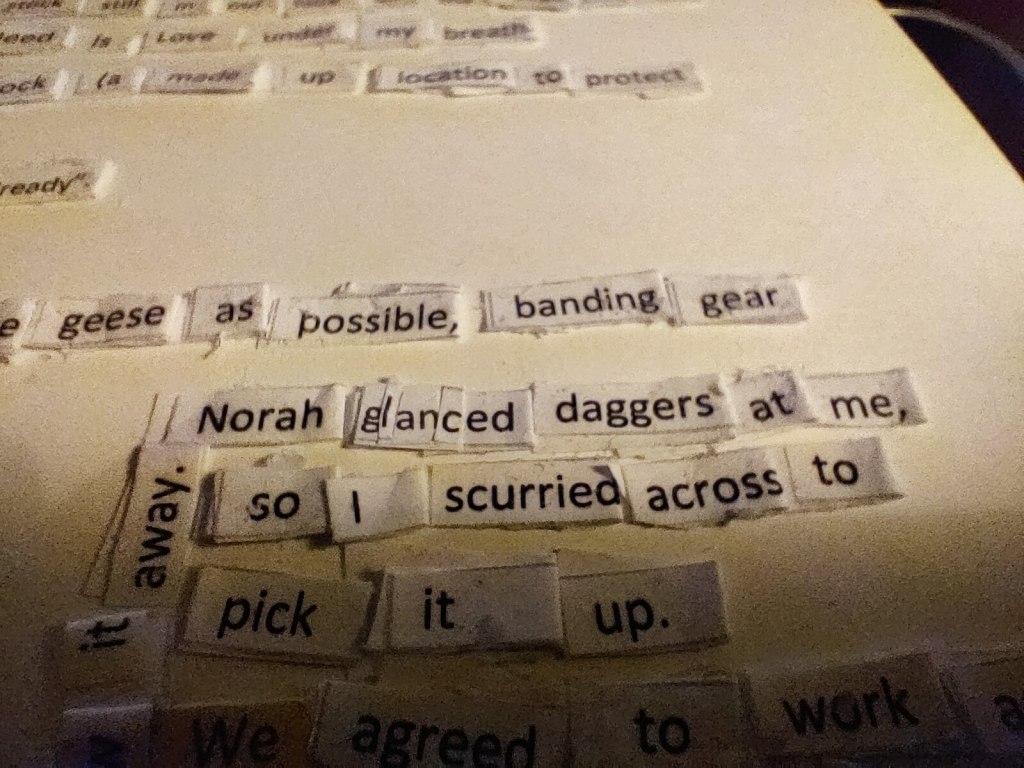
The envelope containing the story arrived a few days later, and was left unopened while we debated the next step. Ali opened the envelope in his study, calling along the hall of The Manse for a tray when the contents spilled out. We read the accompanying letter again, with its “suggested order”. The intention of Curt Finks was that the reader would reconstruct the story, using the “snips” which had a number on one side (1-400) and a word on the other. The tiny pieces of paper measured 24mm by 4mm, and appeared to have been produced on a typewriter, with pencil marks to guide cutting.
We spent two evenings painstakingly recreating the story, turning over the snips to read their number and putting them in order. There were heart stopping moments when we appeared to have lost a snip, only to find them under the tray, stuck almost magnetically to another piece of paper, or once turning round on the wheel of Ali’s desk chair. I took notes as he did this, neatly reversing the roles of the protagonists of Brent Goose Rock.
After I cut things up, and stuck them on a sheet in random order, The Benefaktor did the re-cutting and re-sticking, playing to his strengths as the “details man”. See what he did with the repeated “looked” (turning it into “glanced” with some spare letters from an earlier draft).
The Benefaktor and I discussed how to recreate the interactive component, after typing in the words. Between us we snipped up ten copies for recipients of my book. But we ran out of time, so others had to recreate their own version of the interactive tale, asking a friend to snip up the numbered sheet on their behalf and put it in the envelope. We talked about Banksy’s self-destructing art. Another kommentator noted parallels with Bill Drummond’s work on Richard Long’s A Smell of Sulphur on the Wind. After such effort we wanted to share this more widely, so recreated a version for social media, recording our own solution for posterity.






 GANTOB blog