
30 August 2025. It is due to rain most of the day.
When I received my package with two copies of the proof of GANTOB’s 25 Paintings (plus What Is Proof? pamphlets), in neatly secured bubble wrap, there was a handwritten note inside. It read, in a left leaning italic script, written with a blue fountain pen:
| Graham, I thought that the enclosed might appeal. Please read the pamphlet and do the needful. If time, when you are in Cushendall, would you mind taking a photograph of Ossian’s grave? Many thanks, The Benefaktor |
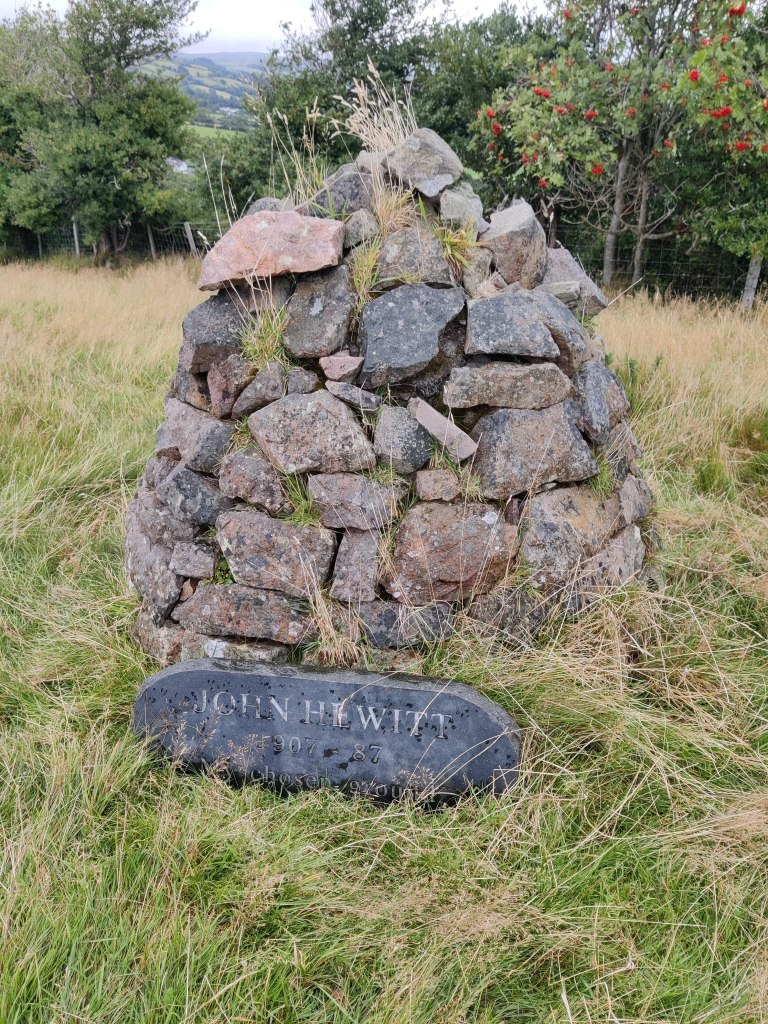
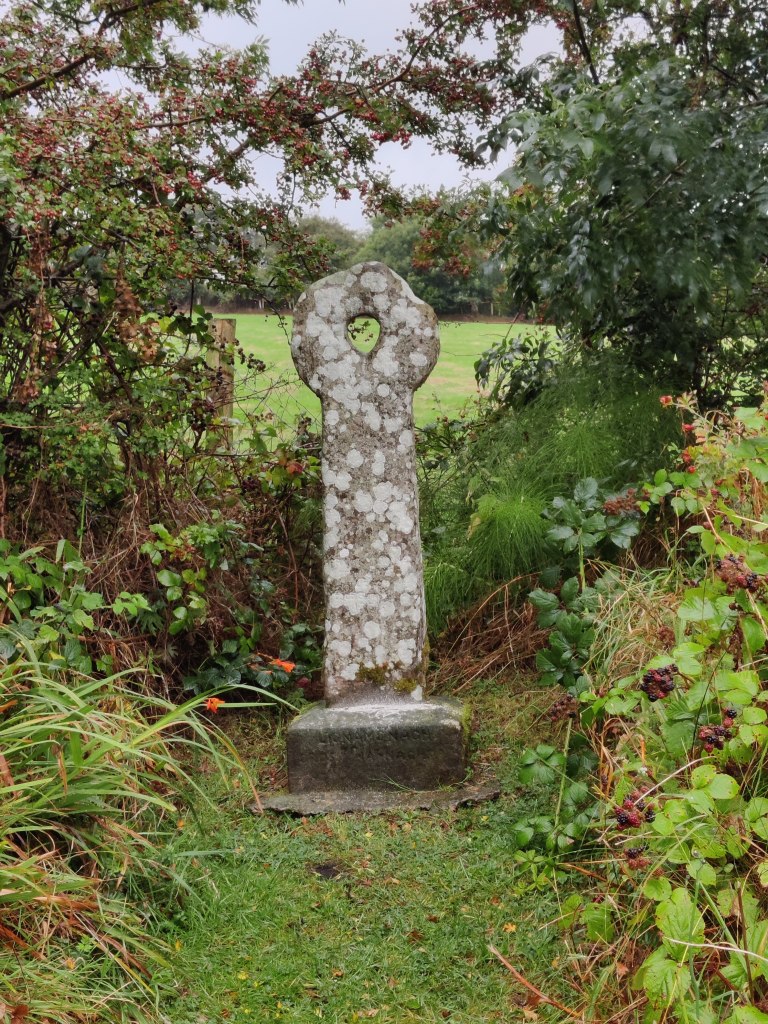
Stephen, Michelle, Liz and I take a trip early on to Ossian’s grave, on the hill behind the B&B. I know some of Ossian’s story from trips to the National Trust’s Hermitage in Perthshire, but learnt more when reading The Benefactor’s piece “Mountebanks”, as featured in the proof for the new GANTOB book. It is a submission for a missing year in Bill Drummond’s biography The Life Model (2023). The grave is also mentioned in local tourist literature. We walk up from the carpark, past some other hikers. In a field near the top, with views over the rolling hills, nestled in among rowan trees, we come across a cairn dedicated to John Hewitt (1907-1987) and his “chosen ground”. Not Bill’s collaborator. This John Hewitt was a celebrated Northern Irish poet. Coincidences and connections in Bill’s web of ley lines.(#) In a dip in the field, stones mark the site reported to be Ossian’s burial site. There are orphan stones of the same type lying elsewhere in the field. It is starting to rain. We head back, past others coming up to visit, trying to beat the rain.
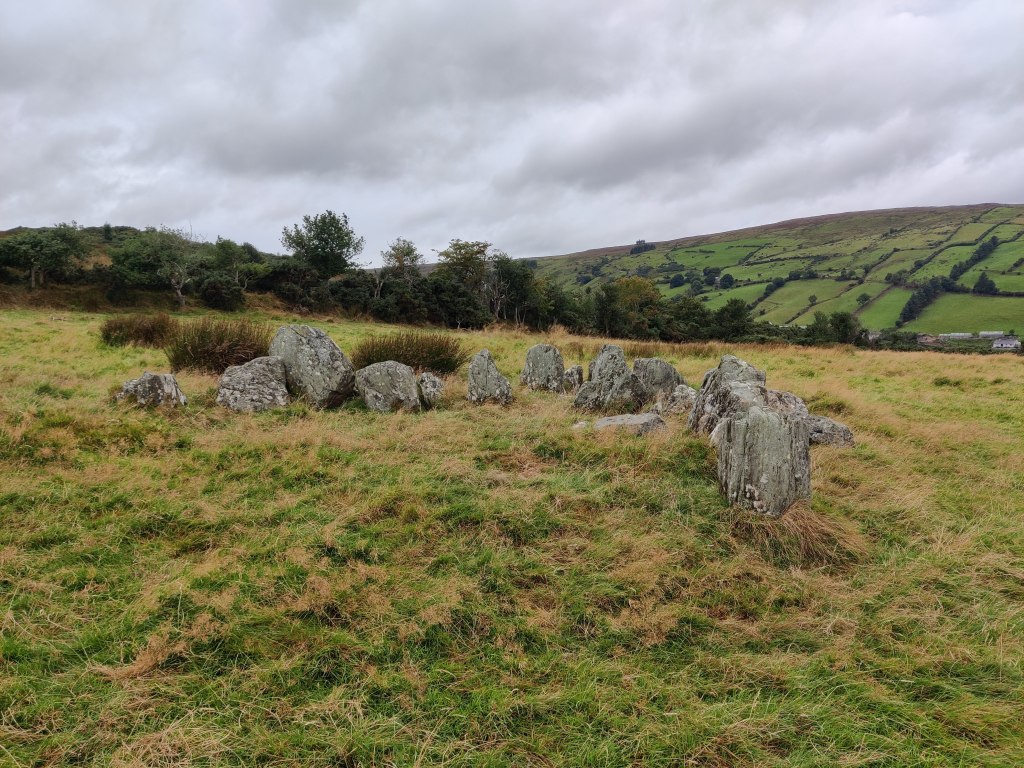
| I note that Emma Must’s piece for The Curfew Tower is Many Things mentions both Ossian’s grave and the John Hewitt cairn. As a Northern Irish poet, Emma would know who that John Hewitt was, but presumably not Bill Drummond’s former associate of the same name. Also, on looking through After Curfew again, I spot that Ossian’s grave is mentioned in Skye McDade-Burn’s chapter. Beyond that, I cannot see any particular reason why The Benefaktor would be interested in Ossian. I haven’t found Bill referencing the grave, but it may well be tucked away in a corner of his writing, and I imagine that he would have explored it, even if just as a tourist visiting the area for the first time. |
(#) I spotted a pub named after the poet when I was in Belfast in 2023, staying in a Premier Inn in the Cathedral Quarter. Looking it up now I see that Bill was artist-in-residence at the Cathedral Quarter Arts Festival, 2004, making soup. The John Hewitt pub is mentioned in a Belfast Telegraph article featuring Bill Drummond from that period.
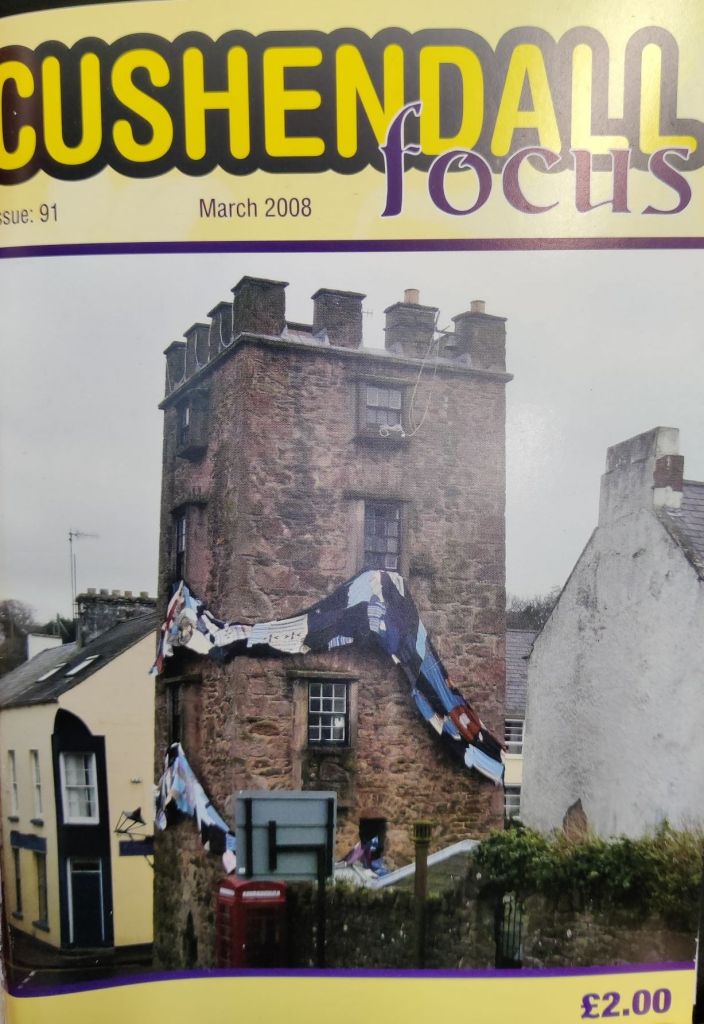
We spend the rest of the day dodging the rain. In the library we find rows of history books about the Glens of Antrim, including standalone books and bound volumes of the journal Cushendall Focus. Curfew Tower features prominently. We find a feature in Cushendall Focus on The Big Scarf by artists in residence Jane Twigg and Astrid Bin (16-24 February 2008). In the Cushendall Local Information Office, which doubles up as the Glens of Antrim Historical Society, there is even more information about the town and area. Volume 29 of The Glynns (2001), Journal of the society, has a picture of Curfew Tower on the front. There is not an article about the tower inside, but I spot an obituary for a James McCambridge, and wonder if he was a relation of Mark, AKA Arborist. I flick through an article on postcards (sometime medium of Bill Drummond), and learn from an article by Robert M Bonar, that postcard collectors are called deltiologists, from the Greek word deltion, meaning a small writing tablet. Volume 44 of The Glens (2016) has a feature on fifty years of archaeology by Cormac McSparron, mentioning Ossian’s grave in a section on the earliest farming communities. It is a passing reference. Volume 49 (2022) has an article by Fr Kevin McHugh on the literary hoax around Ossian’s poems, which takes us full circle to The Benefaktor’s Mountebanks chapter. Cushendall is an area so steeped in history, real and imagined, with so much documentation.
| I wonder what Robert M Bonar would make of Bill Drummond’s twinning project: see city 1, Belfast, 2000: “Twinned with your wildest dreams”. The photo is taken underneath a motorway sign dividing the road into lanes – Belfast, Belfast East, Bangor. I should note in passing that I have history with Bangor, involving a painfully on-off relationship in my late teens and early twenties. The less said about that the better. |
We bump into Zippy, out with his family. He tells us that tonight’s gig is sold out. Two hundred tickets were available and he has sold 50 to locals, but likely more have bought tickets online. We have lunch in North Coffee. There is a counter for John Healy Photography which sells, among other things, Curfew Tower fridge magnets.
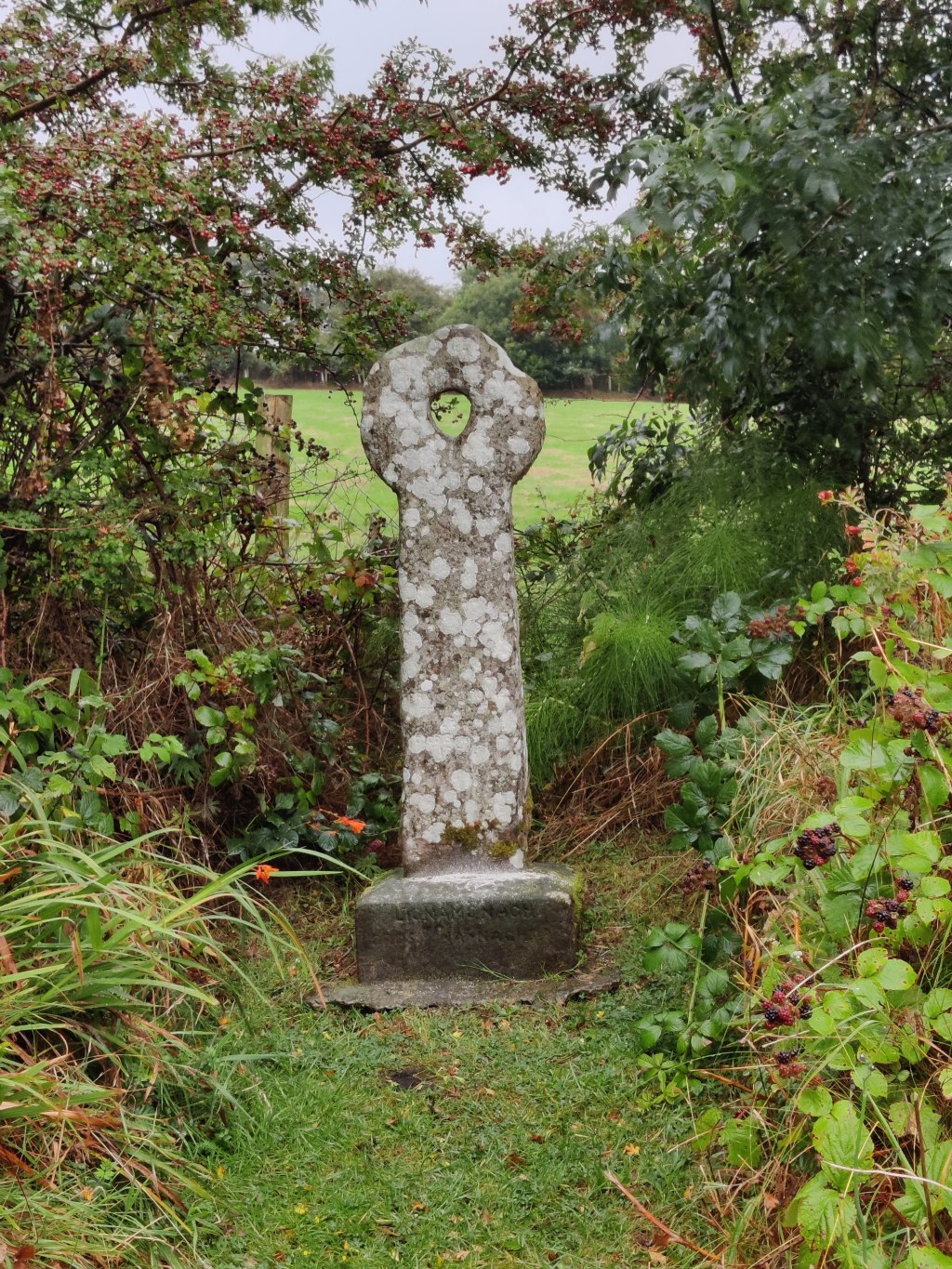
Eventually we brave a walk through the mizzle up the road towards the ruins of Layd Church. The tiny church packs a punch – the hole stone, with its connections to the (“infamous”) MacDonnell family, and perhaps a much longer (even pre-Christian) history; and the burial site of James McDonnell (1798-1845, with a grave marked by a more traditional Celtic cross) a physician with a social conscience. We don’t hang around. It’s pouring. Indeed, it’s too wet and slippery for the cliff path. We head back to the B&B for a short break from the elements. And then it’s time for the 25 Comeback Special.
Doors open at 18:00. There is a strong sense of anticipation. I spot Duke Special (AKA Peter Wilson) setting up at the side. I introduce myself and tell him that my kids, particularly our second daughter, loved his album Songs from the Deep Forest, particularly the song Last Night I nearly Died (But I Woke Up Just in Time). When Iona was 4 years old, October 2006, I was heading off to see Duke Special and Divine Comedy at Liquid Rooms, central Edinburgh. Iona asked for a story before I headed out. And in the process I missed Duke Special’s set completely. I’m looking forward to seeing him play tonight. We take our seats. But the show does not begin until 18:45.

Bill comes on and talks about negativity. He would rather that 40 people saw the film rather than 200. He is on good form. The audience, which seems to be made up mainly of locals, laps it up. He tells us that the film will be seen by no more than 1000 pairs of eyes.
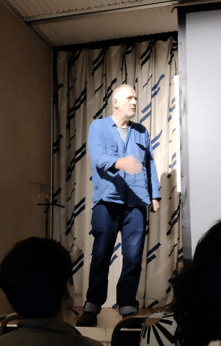
And then we are some of these lucky few pairs of eyes. The film, script by Bill Drummond (which is made available for a couple of days on the Penkiln Burn website after the performance), can be viewed in a number of different ways. An early scene in the film has a long shot of musician and actor Tony Wright cycling down the hill into Cushendall, but not the coastal road that Liz and I took on the bus. They take the inland route. Tony is talking to the puppet Elvis, who is in the basket at the front of the bike. I had read about Tony on the Penkiln Burn website. Bill had written: “My former colleague alerted me to the fact that this unemployable musician was a complicated person. That he had is [sic] issues.” These were, of course, selling points for Bill: “he was the right man for the job. Choice was not an option”. So, when I watch the film, I imagine that the words I am hearing, between Irish and American accents, are not just spoken by Tony, but originally conceived by Tony. It is all very deadpan but endearing. Tony’s facial expressions are extremely well acted.
| Puppet Elvis: What are They The Artist: Lambs Puppet Elvis: What are Lambs for? The Artist: For eating, we eat Lambs, or at least humans eat Lambs, puppets don’t have to eat. Puppet Elvis: What eats humans? The Artist: Time and mosquitoes. |
Later there is a lamb skull. Life is a cycle.
There are yellow flowers. I think of ragworts. There is no doubt a lot of symbolism that would not be spotted the first time watching. There are stickers on back of the picture frames. I noticed them in May when a group of volunteers, recruited from the audience at the Voices from the Galloverse events, helped Bill and Tracey move the 25 Paintings across Penkiln Burn onto an island. I recognise a Great Yarmouth sticker on one of the picture frames in the film.
The script mentions imagery that might only be detected subliminally, at the very start. Perhaps it is just as well we can’t buy the DVD and rewatch the film, driving friends and family mad with our finger on the freeze button.
Tony and Elvis discuss photos of Elvis and Bob Dylan. One is deified, the other vilified. Bill has complicated relationships with past heroes.
Watching Tony go through the stages of a residency in Curfew Tower, reinforces this feeling that the film is about him, with Tracey Moberly invisibly on hand to capture the key moments.
He bakes a cake. Elvis compliments his one-handed technique for breaking eggs.
He makes a bed, as detailed in Penkiln Burn Poster 283 (2024), shown and read out in full in the film. He destroys another bed. Life is a cycle.
There is a house spider in the bath called Priscilla, Queen of The Glens.
There is knitting required, to keep Elvis comfortable. I think of the scarf I learnt about earlier in the library, keeping the tower warm.
He burns the ruined frame of the bed, like the cake, in the small walled garden behind the tower. The grass does not appear burnt in the next scene from the garden. Life is a cycle. Or there is something positively Lynchian going on with time, like Mulholland Drive.
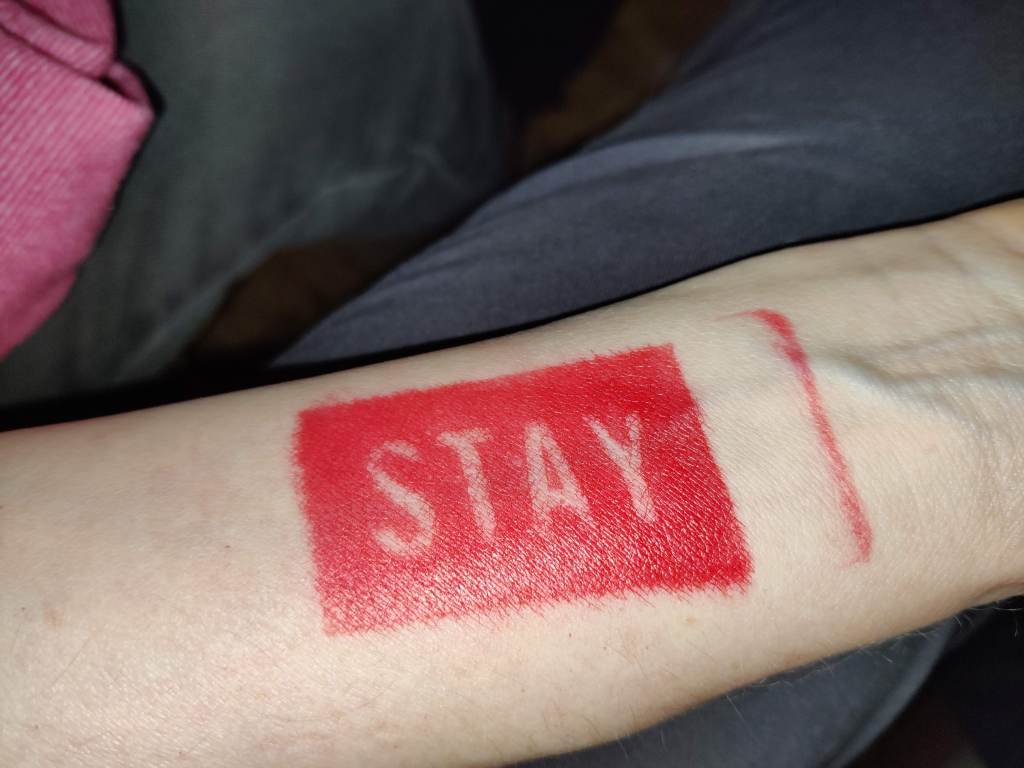
He has a contretemps with a huge painting of scissors. He paints over it with the word Stay. He doesn’t shine shoes. He doesn’t make soup. He doesn’t mention rookeries (though there is a dead crow). But otherwise, the activities are straight out of Bill’s book 25 Paintings and other writing.
How could I be so stupid. Stephen realises that the film represents Bill’s life from the start I think – the cake is destroyed on the bonfire, representing the family birthdays missed by his madcap activities. The distressing phone call to family from the public phone box outside the tower. The tortured, twisted painting of the tower. Having Tony paint the inside of Curfew Tower a visceral red, with a narrow brush, can no doubt be linked with another aspect of Bill’s life.
But then there is the song – 40 Hours to Memphis. This is clearly Tony’s work. He wrote it, and recorded it, first in The Cell at the bottom of the tower, on a basic tape recorder, and then in the studio with The Gold Tips. There is a blurring of lines between Tony and Bill. And there is uncertainty about the terms of the residency. Did Tony really live in the tower during filming? Would there not have been rather strong paint fumes? Would this not have damaged his health and voice? Did any of the artists on the STAY LP that we are about to hear performed live, stay, write and record their song in the tower? It doesn’t really matter of course. Nothing is what it seems.
At times the imagery is Sisyphean (carting a large canvas up a hill or a long road), or biblical (the frame of the picture that Tony carries is like a crucifix; he walks past a cross on a hill). The script in scene 23 states: “inserted dialogue forty… CROSS”. The puppet is instructed to stop asking questions at this point (though he doesn’t comply).
There is a sign by the road, on that final walk, apparently marking the spot of an execution. There was a rifle earlier in the film, but unlike the rule named after Chekhov (somebody who is referenced several times in the new GANTOB book), it doesn’t have to get used.
Things get darker in the film, in a different way. Try to watch it if you can.
There are points that only people viewing the whole process, from Bill’s first blog posts on the 25 Comeback Special in early June, to the screening of the film at the end of August would spot. In the very first of the blog posts, 3 August 2025, Bill writes: “these artists will perform live their second-best song ever written”. When Tony reads out Penkiln Burn Poster 282 during the film he states: “You are an artist in residence here in Graceland in The Glens. It is your duty to write a song for The Ghost Of Elvis/ This song must be the best song you have ever written”.
Bill has asked for questions about the film. Mine would be:
- Is it the best song or the second-best song that he wants the artists to record?
- Why not use a bigger brush or even a roller to apply the paint? There’s a hardware shop diagonally opposite the tower for goodness sake.
I might email them to him. I might add in a question about the timing of the event and Dallywood earlier in the month.
There is a break after the 90-minute film. We move our chairs, clearing space so that the Ariffe Dancers, a local dance troop, can perform Into The Graceland, accompanied by sounds and songs from the film. It’s an engaging set. I take some footage, as instructed, to send to Tracey Moberly.
There is a lot of local involvement in the evening’s activities, in addition to the Ariffe Dancers. The lighted and open window facing Curfew Tower is a character in the film. The background music in the film is, as Bill writes on his blog: “any number of the community groups and local work colleagues in Cushendall, each singing their single note drone to create the pentatonic scale to lift Duck’s pigeons to the Sky above Cushendall, at the same time be used in the musical score of the film STAY”. The notes of the C major pentatonic scale – C, D, E, G and A. It’s like The Harmonics, but with an extra note and with representation from a whole community rather than just a bunch of middle-aged white male artists. More like The17 then. We also hear that Arborist, Mark McCambridge, spent his summers in Cushendall as a child. Perhaps that was a relative I spotted in the library earlier.
| I check my phone, and there is a reply from the GANTOB email account: The Benefaktor thanks you for your earlier photo of Ossian’s grave, and additional information about John Hewitt. He replies with a poem: The watchers We crouched and waited as the day ebbed off and the close birdsong dwindled point by point, nor daring the indulgence of a cough or the jerked protest of a weary joint; and when our sixty minutes had run by and lost themselves in the declining light we heard the warning snuffle and the sly scuffle of mould, and, instantly, the white long head thrust through the sighing undergrowth, and the grey badger scrambled into view, eager to frolic carelessly, yet loth to trust the air his greedy nostrils drew. John Hewitt, 1950 I trust you enjoyed the film. Yours, DGMoG (tp) ——————————- There is a cough behind me. I turn. Is The Benefaktor observing (or perhaps GANTOB’s albatross)? I recall that a badger featured in The KLF’s return after their 23-year moratorium. And there are several mentions of badgers in GANTOB’s 25 Paintings. What is going on? Luckily, I don’t have time to think any more about this. The rest of the show is about to begin. |
To be continued


2 responses to “STAY (Part 3, by GRAHAM)”
And thAT we are some of these luckY few pairs of eyes. Sorry.
LikeLiked by 1 person
Thanks JR. I’ll certainly take the lucky amendment. I hope the trip is going well and that doors are still being opened by the T-shirt. A final big piece on the 25 Comeback Special is being uploaded as I type. Yours DGMoG
LikeLike