
The question I would like to answer is question 20 – ‘Where is your green door?’
I remember once hearing someone say words to the effect that “anything asserted without evidence, can also be dismissed without evidence.” Well, by similar reasoning I believe it is fair to say that any question posed cryptically or ambiguously, can also be answered cryptically and ambiguously.
I think I know what this question is getting at. I suspect the mind behind this question had their own ‘green door’. It sounds like a gateway to another world – a place of safety to retreat to in childhood. The green door led to that special place that was just yours – seemingly unnoticed and unclaimed by any other.
This seems a more plausible and more fruitful interpretation than to suppose that the green door the questioner had in mind was the same one Shakin’ Steven’s sang about.
At the funeral of an old school friend, his best mate spoke movingly about the garden shed the two of them shared as kids making model aeroplanes in the summer holidays. They’d grown up together, started careers and families and remained close. He said whenever the two of them got drunk and sentimental, it was always that garden shed they both wished they could return to. Whatever the actual colour of their shed door was, it was their green door, in this sense.
But I’m just unpacking the question here – interpreting it and not answering it.
Where is it? Well, unsurprisingly, it was close to my childhood home.
I come from a fairly religious background, although I didn’t realise it at the time. I just thought everyone went to church, because everybody did (or seemed to) in our town when I was growing up. It was the sort of place where, on Monday mornings, the teachers would ask the children to raise their hands if they had been to mass the day before, and most of us did. Then they would start with the questions. “What time? Was it Fr. Tarrant or Fr O’Kelly who said mass? What was the Gospel reading? What was the Psalm?”
My dad, who’d been to the same school years before, told me that in his day, those who didn’t raise their hands to confirm their attendance at mass received six of the best. That practice had stopped by the time I started secondary school, but the stern, disapproving looks were still ongoing. A friend whose father was a local councillor once told me that our hometown had the highest concentration of Catholic churches per 100,000 of the population anywhere in the UK, but I don’t know if that’s still the case.
My parents were perfectly normal, ordinary working-class people. My father was a carpenter, and my mother was a secretary. I was neither privileged nor deprived, although our house was lacking in some of the mod-cons that I could see in the homes of my school friends, not because we couldn’t afford them, but rather because my parents had that frugal, ‘waste-not-want-not’ dislike of consumer goods you sometimes find in religious people.
At mass on Sundays, I’d see most of the other kids from my class with their families. My mum seemed to know lots of their mums from “The Mothers” – that is, the Union of Catholic Mothers, or U.C.M. These were the ladies who really ran the parish. They organised all the jumble sales and other fundraisers.
Every year, we’d send a small group of sick and elderly folk on pilgrimage to Lourdes, with a group of volunteers from the ranks of ‘the Mothers’, who would push the wheelchairs and care for their charges. My mum and my aunt were especially active in all that. Growing up around all this, I had a real sense of a close-knit and functioning community. By face if not by name, I knew most people from my school, parish or estate – a Venn diagram of those 3 categories would almost be a circle.
Despite my flippant joke a few paragraphs back, ‘the green door’ I first thought of when pondering this question was not Shakin’ Stevens’, it was the green door of “the green hut”, which served as the community centre for Our Lady’s parish. It was here that parish jumble sales would take place if it was raining, or where I would sit with my classmates to eat sandwiches, jelly and cake after we’d made our first confession, first Holy Communion, been confirmed etc.
While writing the above, I’ve just had a flashback to a time when our family arrived at the church on a winter evening after dark because Fr O’Callaghan had asked my dad to help with some carpentry, and my brother and I were drafted in to help him. The admirably named ‘green hut’ was the place where my dad set up his makeshift workshop to repair the Stations of the Cross.
But although the green door of the green hut was the first thing to occur to me, it is not the answer I choose to give. I’m just setting the scene.
It’s not an original observation to note that we tend to look back at the past through rose-tinted spectacles, and maybe that’s what I’m doing here. Perhaps all was not really well for everyone once they were behind closed doors, even green ones. My adult cynicism tells me that that golden age is really a myth borne of childhood naivety. Doubtless there were those in my hometown who must have suffered, who were forced to hide some core aspect of themselves from their socially conservative neighbours.
Again, as I write this I’m having another flashback to a time when my brother and I had to share a bedroom for the night (with me on the floor, since it was his room and he was the oldest) because my mother had taken in one of the other U.C.M. ladies who arrived at our door in tears, and whose husband was a heavy drinker. Their son was in my class, and I also remember a conversation with my mum, the gist of which was ‘don’t talk to him or anyone else about this matter’.
Years later, home from university and visiting my parents, I glanced at a copy of their free, local newspaper and saw that this same lad had died from complications arising from a heroin addiction. He’d always been a troubled lad. Our headmaster had once arranged for him to ‘shadow’ me for a whole term in our final year at school. I was supposed to be a good influence on him. After a couple of days, he confided that this whole arrangement was made because he’d attacked his father with a knife. But I digress.
So, there may have been a hidden darkness in my hometown, but it was well-hidden and relatively rare. This is the context. This is where I found my green door – that place I want to return to when I’m indulging my sentimental and nostalgic side. It was in my aunt and uncle’s back garden. They lived a few minutes away, in the biggest and most expensive house in the area. Its previous occupants had been the Kumars -“Dr Kumar” and “Dr (Mrs) Kumar” was how their names appeared on their respective doors at the local GP’s surgery. I mention this because my late aunt, bless her, was enormously proud to live in a house that was previously owned by Drs, and was sure to tell any visitors. My uncle, I was told, was “very clever” and “had a very good job working for I.C.I.”
As befits the status of a house once owned by two doctors (can you imagine?!), it had an exceptionally large garden, like no other I had ever seen. My aunt and uncle would never have designed a garden like the one left behind by the Kumars. Often, if I was bored or at a loose end, I’d wander off down the road and ask to play in their garden. They never said no, and I was usually offered a glass of cordial and a biscuit. My cousins were older than me and had flown the nest, so I had the garden all to myself.
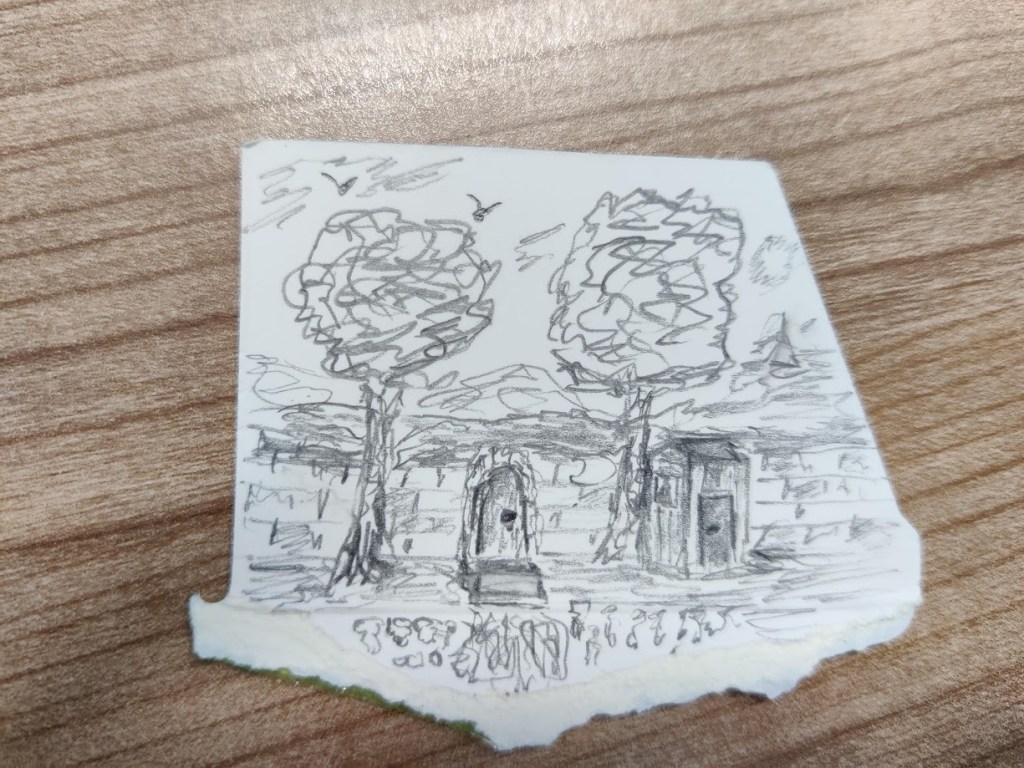
There were two trees at the end of garden (I should say, there still ARE two trees at the end of the garden, but I haven’t visited them in many years). On the left and to the fore was a well-established weeping willow. Set further back behind the willow, and a few shrubs and bushes, was an apple tree. The overhanging branches and long leaves of the willow formed a canopy, beneath and behind which I could disappear completely.
The apple tree was my favourite thing, though not because of its bounty. These were “cooking apples” and “not for eating,” I was told, which never made any sense to me, and still doesn’t, but I accepted it. The appeal of the apple tree was the ease with which it could be climbed. It had the most convenient arrangement of sturdy branches. I could reach almost to the very top with little effort or risk. I never once lost my footing.
The tree’s summit gave me a magnificent view of the neighbourhood, but also a magnificent feeling. Not a gloating or superior, ‘king-of-the-castle’ sort of feeling though. Now that I come to describe it, I realise it’s hard to put it into words. Partly it was the fun of being able to watch people passing by, unaware that they were being observed. No one ever thought to look up. I remained unnoticed.
But it was also the joy of feeling that I’d discovered a secret place that only I knew of or how to reach. It gave me a unique perspective on things, literally and metaphorically.
To the west, I could see the spire of St Michael’s church, poking out above the houses just down the road. Sometimes the parishioners of St Michaels would process to our church (I think on a particular holy day, but I don’t recall which one) and both parishes would have a shared mass celebrated by both priests. And sometimes the parishioners of Our Lady’s would process to St Michael’s church. I was always amused on these occasions to note that “we” would all sit on one side of the church, and “they” would all sit on the other.

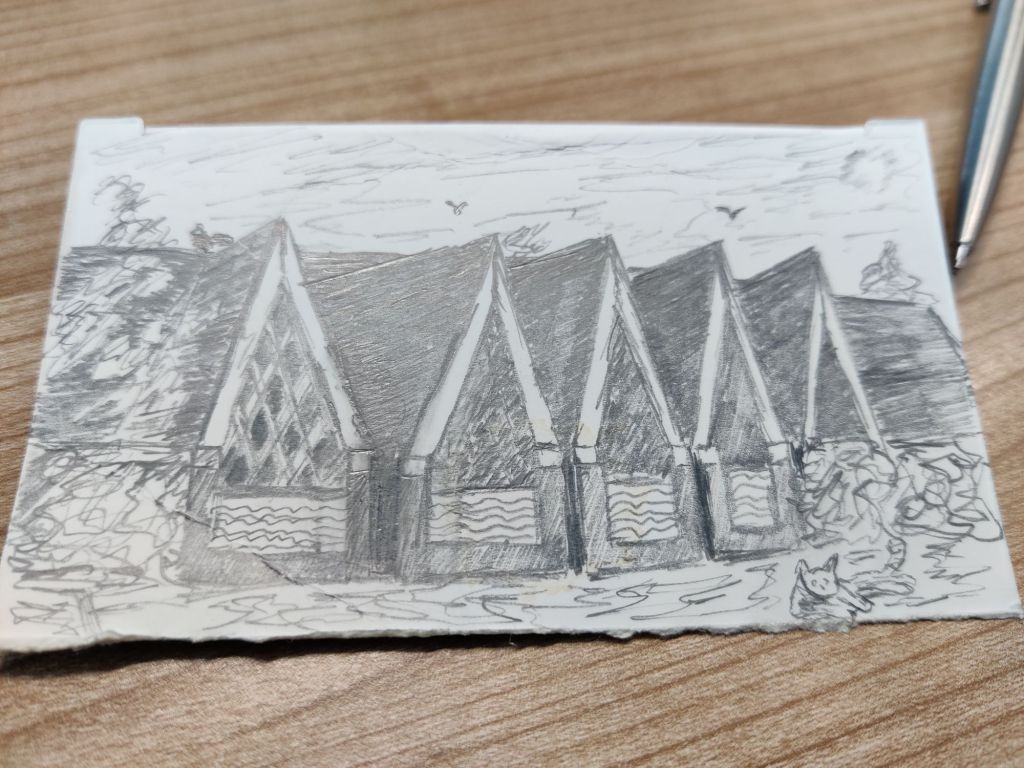
Over to the north, Our Lady’s Church had no spire. It was a modern rather than traditional design, but its tall, pointed roof was just about visible, beyond the park and the rows of semi-detached houses. Experience had taught me that I wouldn’t need to wait long before something interesting happened down below. I could stare and eavesdrop to my heart’s content, and no one would tell me stop.
On one occasion, up in the apple tree when I must have been about 10, I saw the familiar figure of Father O’Callaghan arrive at our gate, and knock on our door. My dad answered and invited him inside. Now, I wanted to avoid Fr O’Callaghan because the last time I was in his company he tried to persuade me to become an altar boy, which I really didn’t want to do.
But it was getting close to dinner time and I had to go home soon. So I kept watch hoping that he’d leave before I really had to go, but he didn’t. I walked in to find him and dad creased up laughing, almost uncontrollably. I’d never seen the old priest like that before and it was a bit of shock. My dad refused to tell me what they were laughing about.
A few years later I asked him about it and he explained that it was soon after Pope John Paul II’s visit to the UK, including a trip to Liverpool, where the Reverend Ian Paisley and company had set up amongst the crowds of well-wishers, essentially to shout abuse. Apparently Fr O’Callaghan had been telling my dad the content of some of the football-chant replies to Reverend Paisley.
For a few years before puberty struck and everything changed, the garden with its apple tree and vantage point was my green door – a safe space that was mine alone, where I could play as I wanted to without any fear of mockery. With a pair of binoculars and two small pocket guidebooks obtained for a few pence at a parish jumble sale, I taught myself the names of common British birds and trees. Sometimes I would fashion a makeshift den beneath the willow tree and spend all afternoon reading there.
Where is your green door? My answer to this could not be given by GPS coordinates; it could not be found on an OS map. It is not really a location. My green door lives in my mind. It is a state of mind. It is a feeling, an emotion or sensation. It is the sense of freedom that comes from the absence of any anxieties. It is a fond memory.
THE STUDY MASTER
26 JUNE 2024
Number 49 of the #52Pamphlets
An answer to question 20
If you would like to answer one of the 23 Questions, there’s still time. Answers must be received by 23:23 on 30 June 2024.


One response to “WHERE IS YOUR GREEN DOOR? (by THE STUDY MASTER)”
[…] The GANTOB Pamphlet Committee was delighted to receive a submission from The Study Master this week. We very much enjoyed their previous piece. […]
LikeLike