Hi GANTOB, (or is it Gillian now?)
I have been playing catch up with the blog again, I got a bit behind.
I’d like to submit a question: “Is modern art just bits I could knock up in my shed or does it have deeper meaning?”. If you accept it I hope there might be a humorous response or two.
Anyhow, I spotted Question 9 – What are the 2 sides of the same coin? Continuing on the modern art thread I’d like to suggest an answer.
The 2 sides of the same coin are traditionally heads & tails, and coin tossing is a frequent decision maker; win or lose, do or don’t.
The British artist Ryan Gander explored this concept last year with “The Find” in the Manchester International Festival. Thousands of specially minted coins were hidden in public spaces around the city for folk to find, keep, give away or use as talismans and decision makers as they went about their days. They appeared overnight in flowerbeds, tucked into statues, on benches, in fountains, on trams and buses, in selected shops. Random drops just like those GANTOB has made.

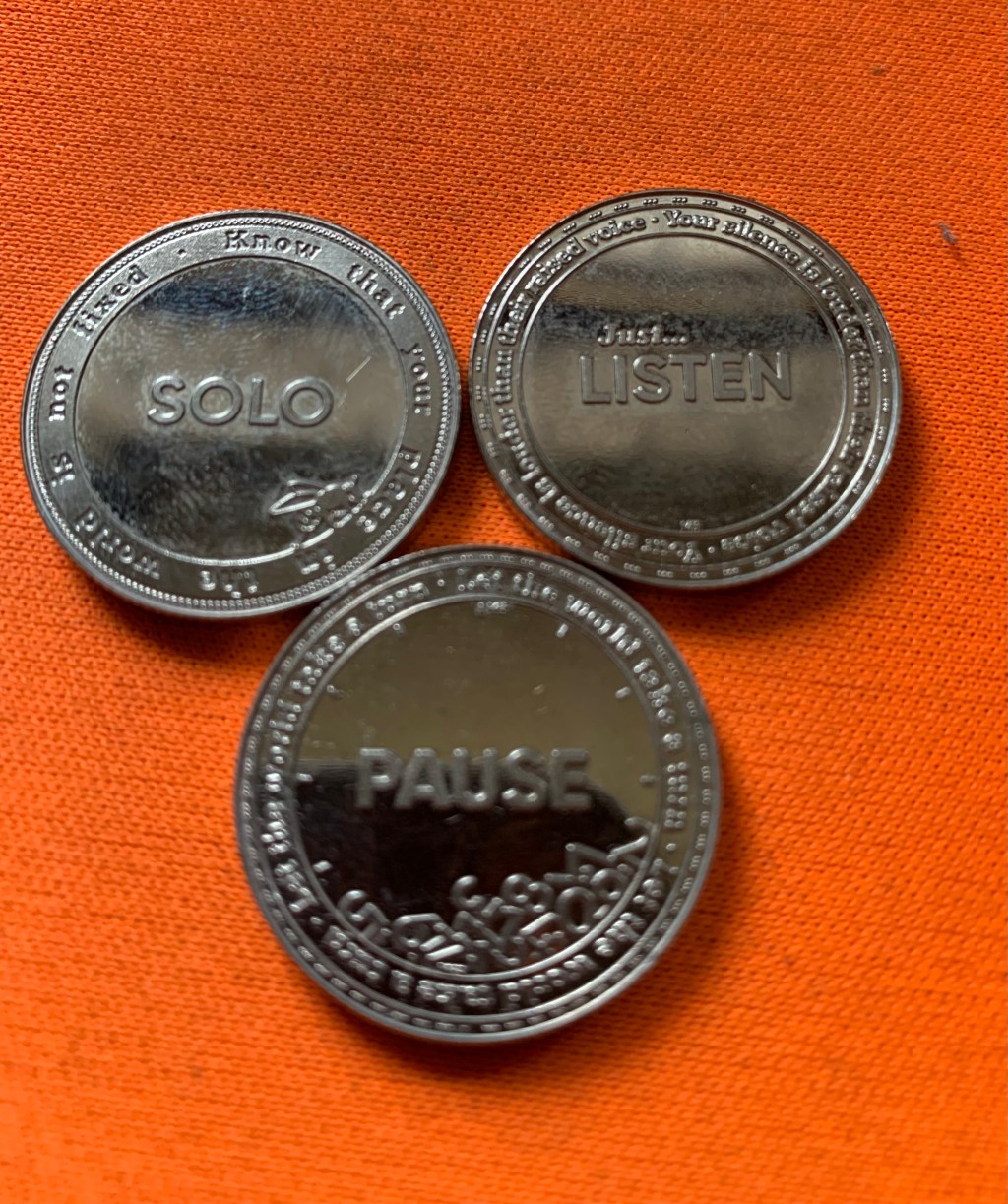
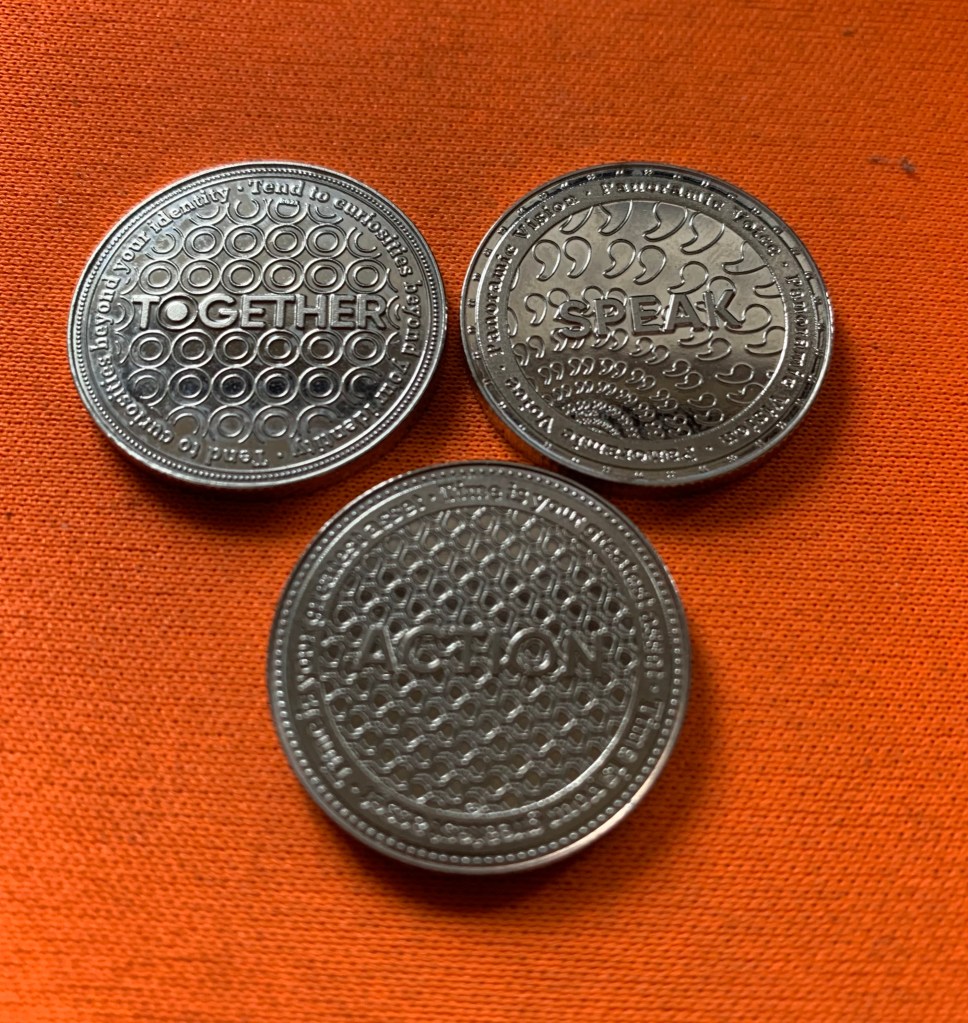
There were three types of coin, each with different words and phrases or quotations on either side.
One was “SOLO / TOGETHER” with the phrase “Know that your place in the world is not fixed” on the Solo side and a quote from another artist, Carmen Herrera, on the other. “Tend to curiosities beyond your identity”.
The second was “LISTEN / SPEAK” having “Your silence is louder than their raised voice” on the Listen side and “Panoramic vision. Panoramic voice” on the Speak side.
The third was “PAUSE / ACTION” with “Let the world take a turn” on the Pause side and “Time is your greatest asset” on the Action side, both quotes from Gander’s father.
I don’t know whether many of the good people of Manchester actually tossed these coins to help them decide whether to act, speak or seek out a friend. I hope so. I’m sure Ryan Gander and the festival organisers would be very pleased if they did.
Photos of my own found set attached. Feel free to use them if you wish.
All the best
JR 10 April 2024
There have been two contributions to question 9 already: Bronwyn and The Two Ghosts gave different accounts of the same year of Bill Drummond’s biography. And Graham imagined Bill Drummond wallowing in music industry jargon. None of these replies are entirely satisfactory. JR’s response takes us much further.
It would be great to have impression alongside intention.
So, after hearing JR’s recollection of Ryan Gander’s exhibition, who better to ask than the artist himself?
A coin should having opposing sides of agency, as a decision making tool. Sides that we should not ‘tolerate’ but embrace as catalysts of difference. It makes me think of part of a speech by Bernie Sanders that starts ‘Feel it in your guts’…
I believe from the bottom of my heart
That it is vitally important
For those of us who hold different views
To be able to engage in a civil discourse
It is easy to go out and talk to people who agree with you
But it is harder but not less important
For us to try and communicate
With those who do not agree with us on every issue
Ryan Gander 14 April 2024
So that’s Question 9 covered, straight from the artist and an enthusiastic participant.
And now onto Question 14. Over to you Gaynor
IS MODERN ART JUST BITS I COULD KNOCK UP IN MY SHED OR DOES IT HAVE A DEEPER MEANING?
I want to avoid claiming art is subjective. There’s no feeling to that.
You can definitely create in your shed or under the stairs or in the back room. Wherever takes your fancy.
* What is modern art?
Why’s it modern art? I mean is it something done yesterday because it’s new? Or is it something that’s out of the norm because it’s new? Or something that’s out of the traditional and never seen a paint brush?
* Isn’t all art modern at one point, or a new genre?
What about Picasso with his glued on newspaper or bits of chair, or Marcel Duchamp with his bicycle wheel and urinal. They were created in 1912 and 1917. Is that still modern art now? Wasn’t all art new at some point simply because it was newly created?
The twentieth century saw a new era of artists all forming new modern art movements such as expressionism, cubism, Dadaism. These where controversial in their own right.
Let me take you back to my favourite decade: the nineties and cool Britannia. Art, fashion, music, film. Britain could do no wrong. It was a movement.
Bill Drummond and Jimmy Cauty left a dead sheep outside the 1992 Brit Awards with the message “I died for ewe – bon appetit” tied round its waist, two years before Damien Hirst created “Away from the Flock”, which was a dead sheep in a tank of formaldehyde.
The K Foundation also offered a cash prize for the worst artist of the year, much like an anti-Turner Prize. Turns out the winner of the K Foundation worst artist of the year WAS the Turner Prize winner of 1994.
Although visually many people would write this all off as nonsense and cobbled together – made somewhere dark by someone wearing a blind fold – there was such emotion, hope and excitement and political change coming. Music and art were beginning to explode. Britain was going off like a firework worldwide with culture and coolness. There seemed to be extravagance everywhere. Suddenly billboards and TV advertisements were mini works of art shot beautifully by Saatchi and Saatchi advertising agency.
Charles Saatchi is known for his collection of art, housed in a gallery named after himself, and for his sponsorship of the Young British artists (YBA) including Tracey Emin and Damien Hirst. Saatchi was as huge in the nineties as the modern artists of Britannia.
One such exhibition bankrolled by Saatchi was Sensation which ran from September 1997 to December 1997 at the Royal Academy of Arts in London. Saatchi owned all the artwork on display. The BBC said it featured “gory images of dismembered bodies and explicit pornography”.
It featured the work of forty-two artist who staged one-hundred-and-ten pieces of work and came with this warning:
“There will be works of art on display in the sensation exhibition which some people may find distasteful.
Parents should exercise their judgment in bringing their children to the exhibition, one gallery will not be open to those under the age of 18”.
I was twenty-three (23)
I was studying art and knew this was something BIG. it was causing a massive stir in the media. Most of the artists where already infamous and I was excited to see their work. It was almost like going to see a massive band – it was that kind of trepidation. Even getting the tube there I had a sense that I’d remember this journey – it felt like the moon landing. In my head my internal monologue was chatting, incessantly taking notes of what I saw and my thoughts. This was like a big night out; the tingle before a rave.
I might have made this up, but I’m sure while I was queuing in the courtyard to go in there was a car hand-painted by David Hockney, just parked. I remember the colours. Was it some piece of Saatchi’s advertisements for a car brand? I don’t know. It was a long-gone thought for years.
Anyway, I was in! And I wasn’t allowed to touch stuff. I’m not a toucher of stuff that’s not my own, let alone artworks worth billions. But then I set eyes on Marc Quinn’s self-portrait, which was a cast of his own head frozen in silicone from ten pints of his own blood. It was titled Self.
I stood in front of it. It had a noise – a hum almost. It stood on shiny chrome plinth – this life-sized head encased in a clear Perspex (I imagine) box.
I realised it was making a noise because it was a refrigeration unit. Oh my god it WAS blood man…
I got closer. I wondered if someone was going to grab me by the back of my head and drag me out. You could see the ripples of dried blood, like little floating bits that must have been frozen drips from the mould like a crown around his head. I swear to god I could smell the iron: the earthy smell of blood. I couldn’t have – it was encased – but I did dare myself to touch the cold plinth. It was freezing. I quickly walked on by.
I was really excited to see an actual piece of work by Tracey Emin, because I really didn’t rate any of her work at the time and I wanted to see it to understand it.
And I saw her piece called Everyone I Have Ever Slept With 1963-1965. It was a blue tent, not even that big, is what struck me. She hadn’t even made it. It was a shop bought tent. I thought I’d have at least made it, to look like I’m taking part. Inside she had stuck or embroidered names of everyone she had ever shared a bed with. There were a fair few I thought! It was causing a stir because of some of the names embroidered in there, like Billy Childish; and a female being so open about sexuality and sex. It was on the wave of girl power pop which the media seemed to champion, but not this honest approach. The media was wild, vilifying Emin.
She had included some of her family’s names and two foetuses, which illustrated the names were not all people she had had a sexual relationship with, just shared a bed. Yet all the media clung to was how many sexual partners a woman had.
It just didn’t excite me at the time. I mean it was burnt into my head, but I thought it was a bit obvious. Being 23, maybe I didn’t yet have the life experience? I didn’t even want to champion her being a female and being open about sex and I should have been, in this Britannia revolution. I couldn’t get over the fact she had just bought a tent.
Years later I think I have an understanding: maybe it was too new and modern then? Maybe I was too new and modern, but I’m not now. And I’ve experienced life and grown. I love Tracey Emin and that blue tent makes me smile and I appreciate her cathartic self portrait.
Almost everything exhibited in Sensation was modern art. It’s been over twenty years now. Is it even sensational let alone modern any more? But it did and does stir, it’s emotive and defiantly cuts deep, differently for everyone. It is cult. It is culture. And it stirs up some deep reminiscence. Any art that can do that – is requisite. Make art wherever you choose.
GAYNOR 24 April 2024
Pamphlet 34 of the 52 Pamphlets.
Answers to questions 9 and 14 of the 23 Questions.
Profound thanks to JR, Ryan and Gaynor for your insightful responses. This is what GANTOB (the project) is about. Lots more reflections to come, and plenty of slots for you to contribute, with a pamphlet or answer. The question slots are, however, fully subscribed.
 GANTOB blog
One response to “ON MODERN ART (by JR, Ryan Gander and Gaynor)”
Gaynor is of course correct. All art that does not follow an established trend is “modern” at its inception. I should have omitted the word from the question. But the responses are great, and have given me a push to go and get busy in the shed. Maybe something will emerge that both pleases me and touches another. Time will tell.
LikeLiked by 1 person