
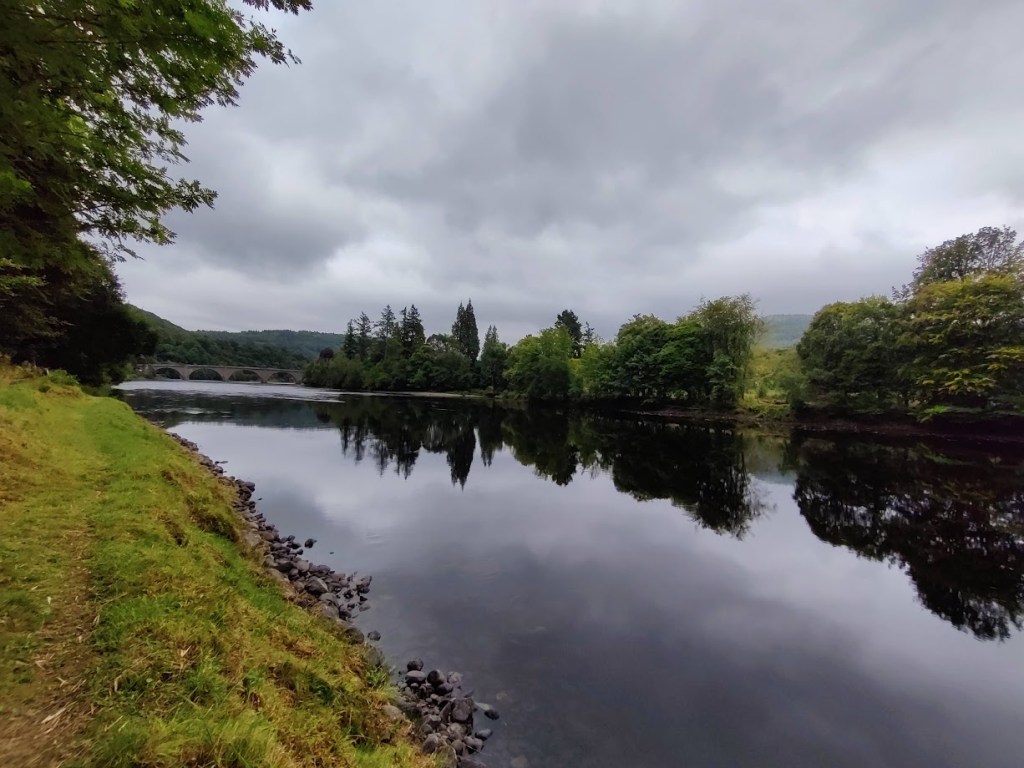
Unofficially filling a gap in “I Am Sixty”. AKA the answer to Question 3. Photo is of the River Tay at Dunkeld and was provided by The Benefaktor.
I, The Benefaktor, have been mobilised into action. Urs, my wife, has her three pamphlets. Even that dead albatross has one. As do its fellow spirits, the ghosts of author Ian Macpherson and GANTOB’s father-in-law Curt Finks. I do not like lagging behind.
Yesterday’s year in Bill Drummond’s memoir, The Life Model, had two blank pages. It was the subconscious section of “I Am Sixty”, covering the period 29th of April 2013 to 28th of April 2014. It was meant to have been contributed by “Smiley”, of “unknown”. Cauty perhaps?
I set myself the task of filling the gap. I missed the day itself. I do not like rushing.
As GANTOB’s legal team insists on me writing, this is part of the 52 Pamphlets, not Drummond’s The Life Model. There is nothing official about what I am writing here.
There is work going on downstairs, and my youngest grandchild is in the room next door whooping away. She is on antibiotics. I put on some Mendelssohn to drown out the racket. His first two piano concertos and the Hebrides Overture (“Fingal’s Cave”), recorded by the Scottish Chamber Orchestra. What is it that Florence Nightingale said about the piano? Ah yes: “The finest piano-forte playing will damage the sick”. Never mind.
I need to find out what Bill Drummond was doing 2013-14. As I go across to the HiFi to turn up the volume, I peruse my shelves. I work along the Penkiln Burn section, and the miscellaneous compendiums with Drummond contributions. The Observer, filling a gap from 2011-12, used material from The 25 Paintings, which was published in 2014. And the Penkiln Burn book The Curfew Tower is Many Things (various authors), though published in 2015, documents artist residencies in Drummond’s tower in Cushendall in 2014. I pull both volumes out.
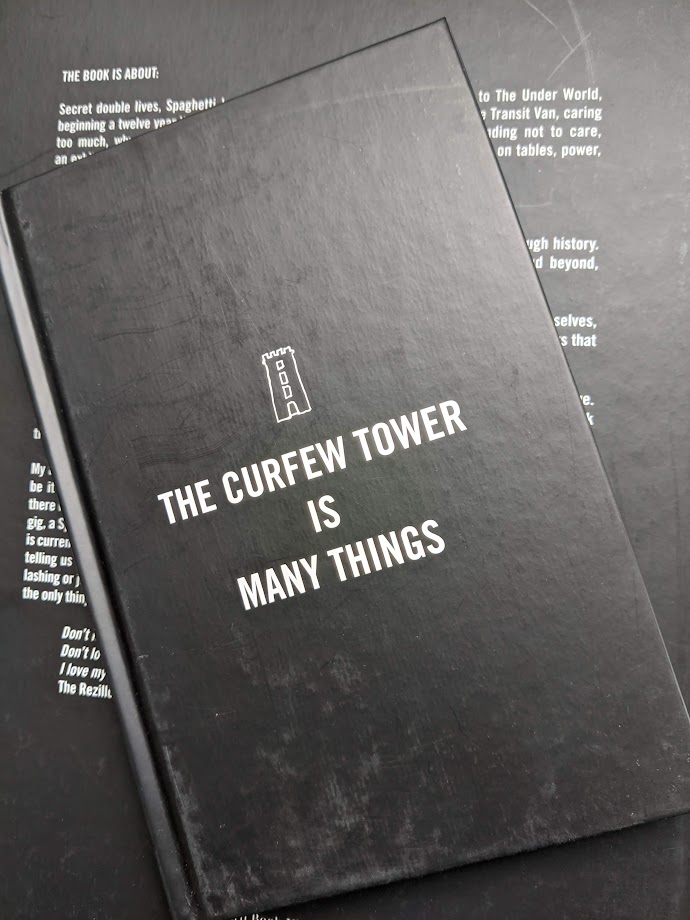
I turn to page 23 of the smaller volume, by chance rather than design. It is a poem called “The Tower and The Book”, by Emma Must. I establish that it was written in the period we need. Must writes: “The most suitable thing of mine to include is probably the longish poem I started while I was supposed to be at the Tower in January [2014], then finished writing while there in March. It’s the one I copied out into the large book in the Tower dungeon…. I did also write something called Thirteen Tips for Writers Staying at the Curfew Tower, which I emailed to my colleagues on my return… (I think Glenn might have emailed this to you a while ago?)”. These two pieces may well have been poking away at Drummond’s subconscious in the period leading up to his 61st birthday.
Number 7 of Must’s list is “Pay homage at Ossian’s Grave (Celtic warrior-poet)”. I know about him – the subject of a great literary fraud by another Macpherson (no relation as far as I can see)(*). And Must’s poem refers to the Thomas Kemp Tower at the Royal Sussex Hospital. Looking up Thomas Read Kemp I see that he designed the equivalent of Edinburgh’s New Town in Brighton, and spent his final years in exile from debt, in Paris. Mountebanks both. [GANTOB: A “strong sense of self-esteem and self-importance”. And with that dictionary definition of ego, these two men could be viewed as good examples of the “male ego” that Ariadne asked about in question 3 of the 23 Questions].
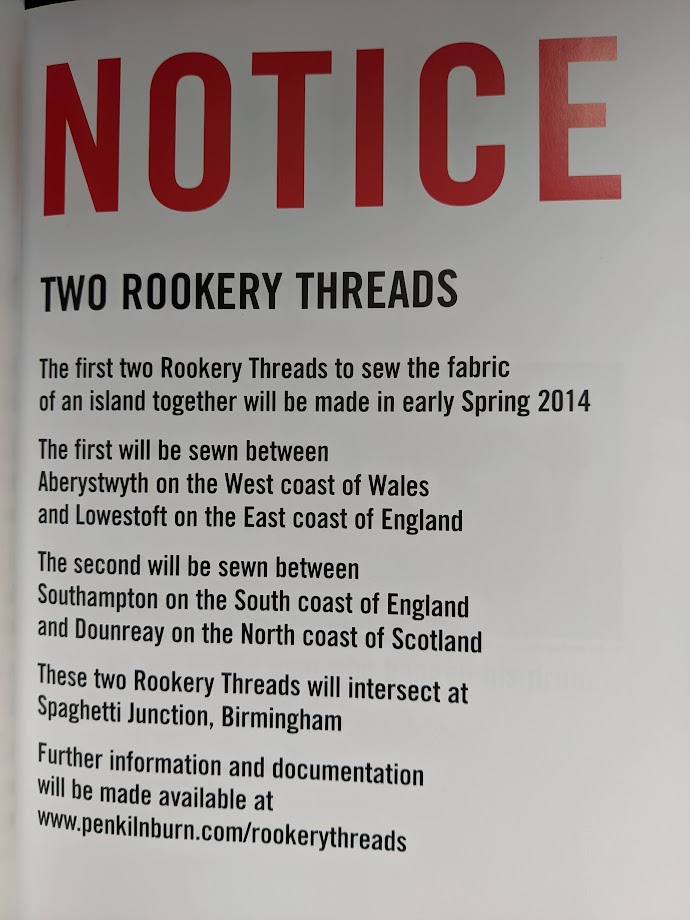
I imagine Drummond – or at least the maverick/ iconoclast part of his subconscious [GANTOB: surely the ego, rather than the superego, which is the “self-critical conscience, reflecting social standards learned from parents and teachers”]. He is mulling over Macpherson and Kemp on a trip from Southampton on the South coast of England to Dounreay on the North coast of Scotland, sewing the second of his Rookery Threads.


The imagined Drummond, March 2014:
Past Perth, tractor holding up a couple of dozen cars, I count down the signs to villages off the A9: Luncarty, Stanley, West Tofts, Bankfoot. Black tarmac, white dotted lines, like stitches, but too fine to be seen on any map. Textured to wake you up if you’re drifting off course. I’m fine, listening attentively to the drone of the Land Rover’s engine. Sometimes I hum along.
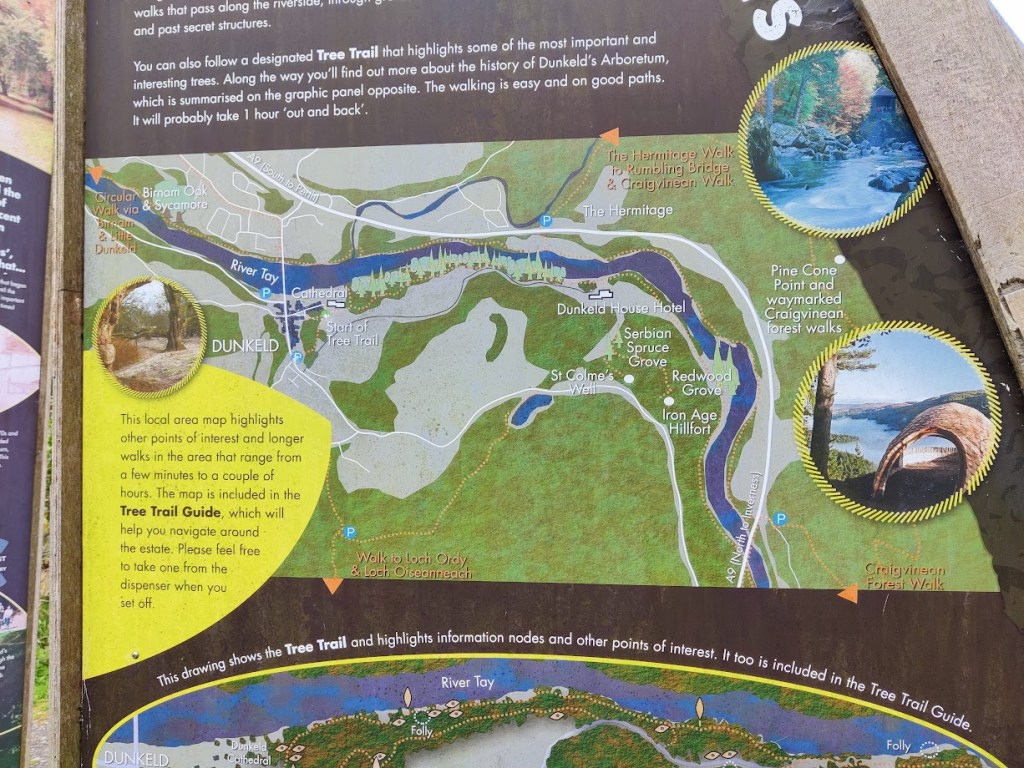
I decide to keep going to Dunkeld. I am not going to make it to Dounreay tonight. Perhaps that large white B&B just before the Dalwhinnie turnoff will have a bed. I’ll give them a ring from Dunkeld. I stretch my legs, climb the mound behind the carpark, and decide to keep walking, up along the Tay.
It’s a beautiful afternoon. I follow the signs to The Hermitage, up through the towering Douglas fir trees and narrow, knotted paths, down across a stream and then up again from Ossian’s “Hall of Mirrors”, following the signs to Ossian’s “Cave”. I am dimly aware of the story of James Macpherson (1736-96), who in the 1760s claimed to have discovered the text of a centuries old epic written and narrated by Ossian (originally in two parts – Fingal and Temora). This was a literary sensation at the time, drawing many famous figures into the conceit, but was subsequently demonstrated to have been fabricated by Macpherson, stitched together from his own work and ancient Scottish and Irish sources. The third Earl of Breadalbane appears to have bought into the myth, incorporating Ossian themed follies into his landscaping in the following decades – the carefully planned wilderness with its paths, water features and exotic plants imported thousands of miles by land and sea. I love the idea of an invented world that is now so well established that it appears to be the most authentic part of rural Perthshire, with the National Trust of Scotland stamp of approval. A known fake, but part of the establishment. I vow to visit the real Ossian next time I’m in Cushendall. He must be turning in his grave.
“Control your own myths”. I have been working with Gavin Wade, artist, curator, director. He quotes these four words in the introduction to my new book: The 25 Paintings. He also writes the following on mythmaking: “if it is understood, it no longer contains any power”. The modern Ossian’s power was lost when Macpherson’s identity was revealed. I try to ward off such disclosure.
Gavin and I have been talking about funds. He is worried about keeping his public gallery afloat. I have been thinking how I can help. But I have bills of my own. Money, money, money. Bills, bills, bills. “Bill, you’re ‘one of THE British artists of the last three decades’ – surely you can sell some books/ canvases/ music/ films/ tickets”. I wish people would stop asking me that. Perhaps I’ll sleep in the Land Rover tonight. Man avoids bed. Maps the points. Sells the book.
Another quote from Gavin: “[Bill’s] art offers a double life to the art world, a super symmetry even”. Who knows.
The following day, passing through the Black Isle, and then up to Thurso, I am thinking about lines, mirrors and reflections. I can picture my last destination before Dounreay – Thurso. It has the usual seemingly temporary trappings of a modern commercial port (Scrabster, for Stromness, Orkney). But just inland, firmly anchored, Thurso’s centre is lined by solid Victorian stone townhouses. I have twinned Dounreay with Southampton on the second Rookery Thread, but should that have been Thurso and Brighton instead?
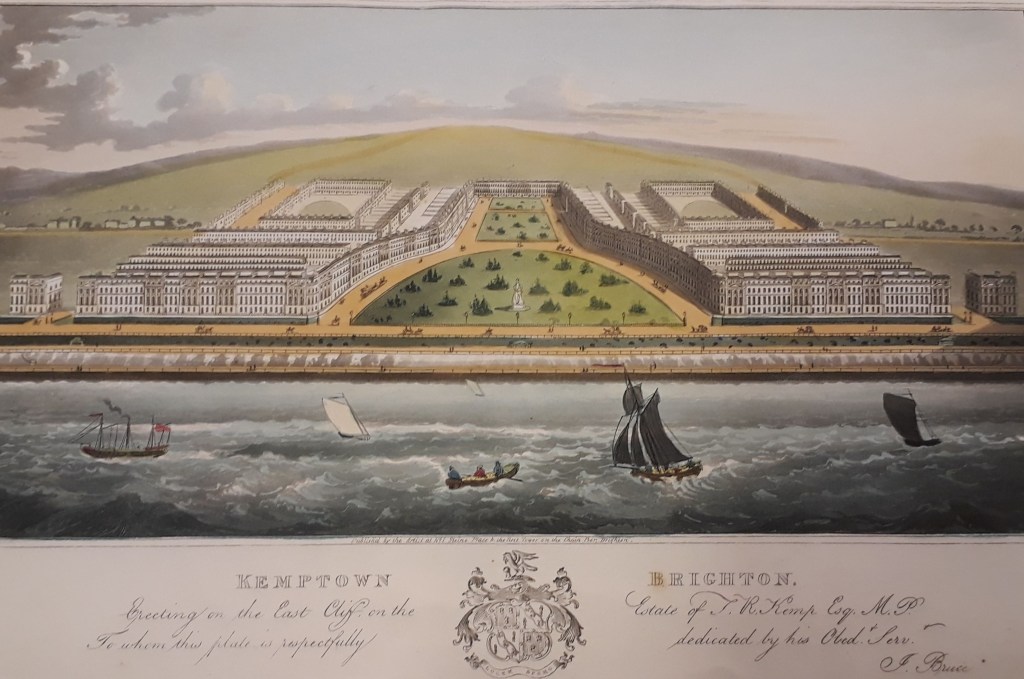
I know the Brighton hospital that Emma Must writes about in her poem about her Dad’s proud final hours. The hospital block was named after 19th century property developer Thomas Read Kemp (1782-1844). He was famed for Kemptown, Brighton, with its “flamboyant mix of grand seafront crescents, elegant squares, and a bustling High Street shopping area with a lively village feel” (to quote one estate agent). What a contrast to the grey, Presbyterian Thurso, with its history hidden in stones rather than spilling out onto the street. Bottle it all in, like a good son of the manse.
I’m tempted to drive to Dunnet Head. But I’ve committed to Dounreay. I approach the power station, park, and draw two straight lines intersecting at Spaghetti Junction. It has to be here. I drive further along the coast, and park up at Sandside Harbour, looking north across the Atlantic, a couple of turnstones for company. I throw my annotated map onto the backseat in disgust. What am I guddling around with pencil and paper for? It is my 61st birthday in a few days. Older than Macpherson. His mythmaking was indisputably over at 59. I’m younger than Kemp though. His bill dodging ended at 61. But, respectively, they wrote a book that is still talked about quarter of a millennium on, and built a town. Lasting impact. Great projects. Scoundrels. I want to fill their boots. Oystercatchers make their piping call, taunting me.
I drive back the long way, via Tongue, Hope, Hellam, Durness, Scourie, Badcall, then all the way down the west coast. The names raise my spirits before dashing each new idea. But I keep thinking. The fuel gauge is perilously close to red; worse as I climb hills. I circumnavigate the lochs, miles of twists to end up a couple of hundred yards from where I was half an hour before – no short cuts here. I concentrate on the road ahead. There are no line markings now.
THE BENEFAKTOR, 2 April 2024
Pamphlet 24 of the #52Pamphlets
Also the answer to question 3 on the male ego
A contribution to the 9 Missing Years project
Contribute a question | Or submit a pamphlet
(*) Ossian was mentioned in an earlier “conscious” chapter of The Life Model (I Am Forty-Five, NOW THAT’S WHAT I CALL OSSIAN by Hubert Huzzah): Huzzah wrote about Drummond’s year 1998-99: “Tacitly admitting my relationships with numbers and lines and ritual was always more important than scandalous revelations that I, like Ossian, forge memoirs. Outsourcing fabulation for intangible considerations”.
 GANTOB blog
2 responses to “MOUNTEBANKS (by THE BENEFAKTOR)”
[…] just finished), where God says: “this is mountebank physics”. It made me think of The Benefaktor’s piece of the same name. Two can play at that […]
LikeLike
[…] Trust’s Hermitage in Perthshire, but learnt more when reading The Benefactor’s piece “Mountebanks”, as featured in the proof for the new GANTOB book. It is a submission for a missing year in Bill […]
LikeLike