
AKA Threads 5
Threads 1 | Threads 2 | Threads 3 | Threads 4 | Threads 5
Mutton and turnip are off the menu come the apocalypse. It has poured for the past two days, and the remaining snow has melted in the warm spell that allegedly attracted the snake. Overnight, the burn beside the house burst its banks, and the vegetable patch is now more suited to growing rice. But the bigger problem is revealed when we pass the copse. Beyond the trees the river that usually meanders through the glen has flooded the lower pasture and taken some of the fences with it. From our vantage we can see submerged ash and silver birch where there used to be little islands of rocks. I wonder what happened to the crescent of sand that had gathered on our side of one of the larger islands, accessible by stepping stones in shallow water. Washed away no doubt. There is water as far as the eye can see, and no sheep. I feel sick.

Ali heads down to the fields while I send a message to the neighbours, checking that they are alright, and asking if anybody has sandbags going spare. An hour later Ali comes back, shaking his head. At least three sheep have gone, but the rest are safe, sheltering behind a drystone dyke. Reports follow later in the day that one of the yearlings has been spotted, drowned, its heavy fleece tangled up in the trees on one of the submerged islands. Two more, marked with their distinctive muted postal horn, are found snared in a neighbour’s ruined electric fence. There’s not much I can do with the ground so wet, so I head to my desk and log in for work.
At lunch our downstream neighbour pops in. He tells us stories of worse disasters that have befallen the area. The radiation clouds from Chernobyl (1986), with the ensuing studies of total body potassium (TBK). Then BSE (1996). FMD (2001). I am quite grateful to return to my BT Client login. I’m on a day of receiving insurance calls again. There are a lot of calls about flooding, and while I feel their pain I have to stick to my script. Our conversations are recorded for training purposes. “And is it sunny where you are today?” the script says. I skip that part.
I have an imagined rap running through my head all afternoon. “The songs of the doomed are the songs of the blessed”. It’s shouted, with Scottish brogue. It’s a misremembered lyric from a JAMs’ track.
I send a message to my supervisor about my deviation from diktat, so that I can refer to it if there is any comeback. A paper trail. A golden thread if you like.

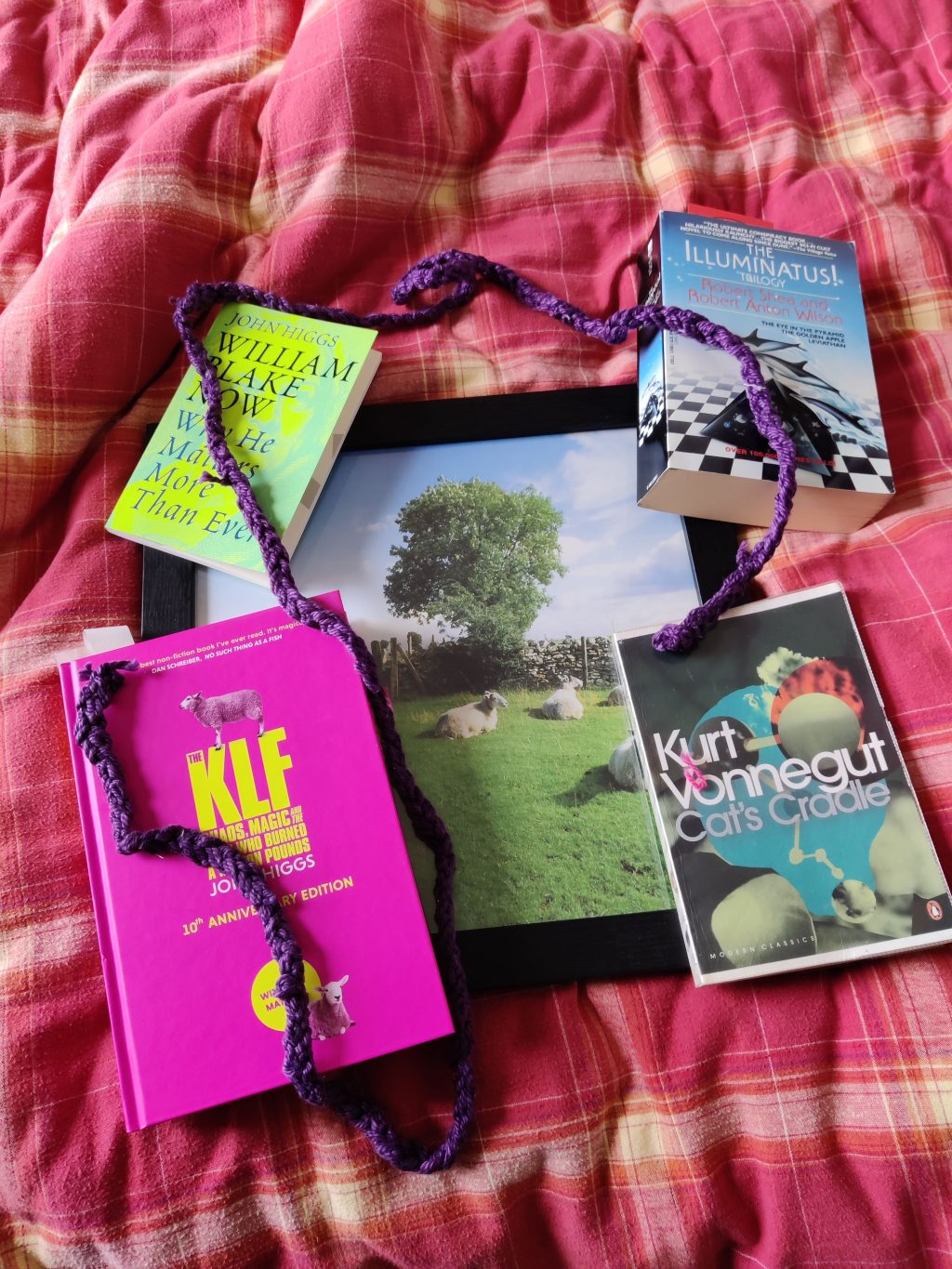
This sequence of “threads” pamphlets – which ends with today’s extended piece – started off from some observations from John Higgs’ book William Blake: Why He Matters More Than Ever (2019), which I dug out after reading Stuart Higgs’ pamphlet on the poet. It has led me to re-read Kurt Vonnegut’s Cat’s Cradle (1963) for the first time in 30 years, a favourite of the American counterculture movement of the 1960s. That era clearly influenced The Illuminatus! Trilogy (“the Trilogy”) (1975), that in turn so inspired The JAMs and The KLF.
Over the course of this research (which Vonnegut defines in Cat’s Cradle as to “look again”, p42, which is appropriate) I have stumbled across signs that some of this ground has already been tilled. I have provided some detailed notes in the appendix. All you really need to know is that Vonnegut’s character Bokonon, religious leader, turned up subsequently as a saint in a wild cult book called Principia Discordia, which in turn influenced the Trilogy which was adapted for the stage in Liverpool a year later and famously involved Bill Drummond. The latter goes on, with Jimmy Cauty, to use some of the ideas from the Trilogy in the music of The JAMs (a name directly lifted from the Trilogy) and The KLF (an acronym that references entities in the Trilogy). A lot of overly complicated – and sometimes incoherent – books written by a bunch of blokes (mainly), perhaps under the influence of illicit substances. Vonnegut is the exception I think – writing clearly, in a book that remains of widespread appeal. I am not going to speculate on what The KLF were up to when they wrote their huge commercial hits.
But this does not prove a “golden thread” between these books. Bokonon links Cat’s Cradle to Principia Discordia, but does not appear in the Trilogy. Twenty thousand dollars is mentioned in the Trilogy, which is the sum that Drummond paid for the Richard Long photo in Drummond’s book How to be an artist (2002), but was long after The KLF, and it does not link back to either Vonnegut or Principia Discordia. The quote “Twenty thousand years” appears in Principia Discordia. Is that what The JAMs are referring to when they rap “Twenty thousand years of SHOUT SHOUT SHOUT” in All You Need Is Love? John Higgs notes that Bill Drummond had perhaps not read the Trilogy before he incorporated some of its ideas into The JAMs/ KLF. But perhaps that is not important, because he would have been immersed in the major themes of the book during the preparations and staging of the play. But did the stage play incorporate sections of Principia Discordia as well?
But I think that I have something up my sleeve that demonstrates a more direct connection between Vonnegut and the work of The KLF, via Bill Drummond.

Before that, I am going to pause to consider the word Discordia. Discord – in music, meaning lack (from “dis”) of harmony (from “chord”). I think of the “Lost Chord” that Drummond and Mark Manning go searching for in Bad Wisdom (1996). But also from the Latin (discordare) from “cor” or “cord” (as in coronary and cardiac). And if that pulls at your heart strings, well that might be your chordae tendineae, the tendinous cords that ensure the functioning of the tricuspid and mitral valves in your heart. We have so many fraying edges in the Threads pamphlets.
Before we conclude this series of Threads pamphlets we should also have a look for links between the GANTOBverse – in its widest sense – and Cat’s Cradle, regardless of whether these were pure coincidence or ideas that have rested, like the herpes zoster virus, ready to awaken in a painful bout of shingles thirty years on.
Green maraschino cherries feature in The Benefaktor’s submission for the 52 Pamphlets: The Cherry on Top. He references a 1960s classic by Pynchon in that pamphlet, but not anything by Vonnegut. But here’s Vonnegut in Cat’s Cradle (p19): ‘I mixed him an “End of the World Delight”. I gave him about a half-pint of crème de menthe in a hollowed-out pineapple, with whipped cream and a cherry on top’.
Asking him about this, The Benefaktor confirms that he did read Cat’s Cradle at some point, probably in the 1970s, but he does not think that there is any connection with what he wrote in his anti-fascist piece on cherries. He does not think that the mention of banana republics in Cat’s Cradle (p56 and 58) is relevant either.
Grapefruit. GANTOB loves, and is named after, grapefruit. Not a specific grapefruit. All grapefruit. That remains the case, despite Vonnegut’s words in reference to the bubonic plague: “The lymph glands in the groin and the armpits swell to the size of grapefruit”. I suspect that this is based on a phrase taken from a long forgotten medical textbook. I haven’t been able to find a source from an internet search. Grapefruit is used as a fruity comparison for plague victims elsewhere – for example in a Guardian book review (Justinian’s Flea, 2007).
Boiled albatross. This is, again, The Benefaktor’s territory. The Observer (who we learnt in the “death” pamphlets, reproduced in the second GANTOB book, is actually the ghost of an albatross), presumably did not like this sentence in Cat’s Cradle: “albatross meat disagreed with me so violently that I was ill the moment I’d choked the first piece down” (p168), and from there to a graphic “deathbed” scene in a golden dinghy. This passage, and also the book’s apocalyptic themes, make me think of ST Coleridge’s famous poem The Rime Of The Ancient Mariner (1798), which takes us back to the first Threads pamphlet with John Higgs’ reference to Coleridge’s term “esemplastic”. The mention of the albatross in the GANTOBverse was also intended as a harbinger of difficult times ahead, and also possibly inspired by the reported loneliest albatross in the world.
But you’re probably more interested in potential links between Cat’s Cradle and The KLF and related projects. And I think that there are some, though it is a moot point whether these are directly through Vonnegut’s book, or via the more convoluted Principia Discordia/ the Trilogy path.
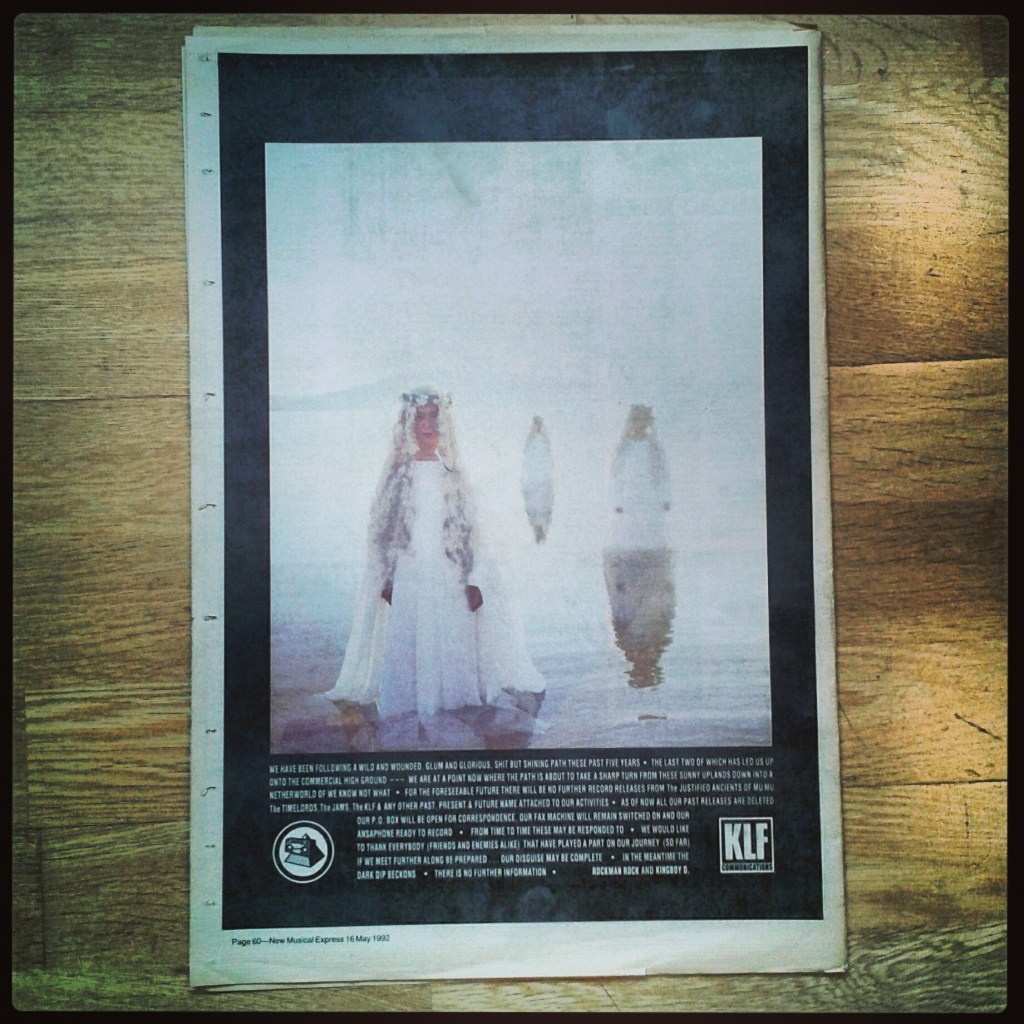
Sirens: I was struck by this description of Mona in Cat’s Cradle: “Her dress was white and Greek. She wore flat sandals on her small brown feet. Her pale gold hair was lank and long” (p100). This sounds strikingly like the three figures retreating into the sea in the KLF’s NME advert announcing their retirement in 1992.
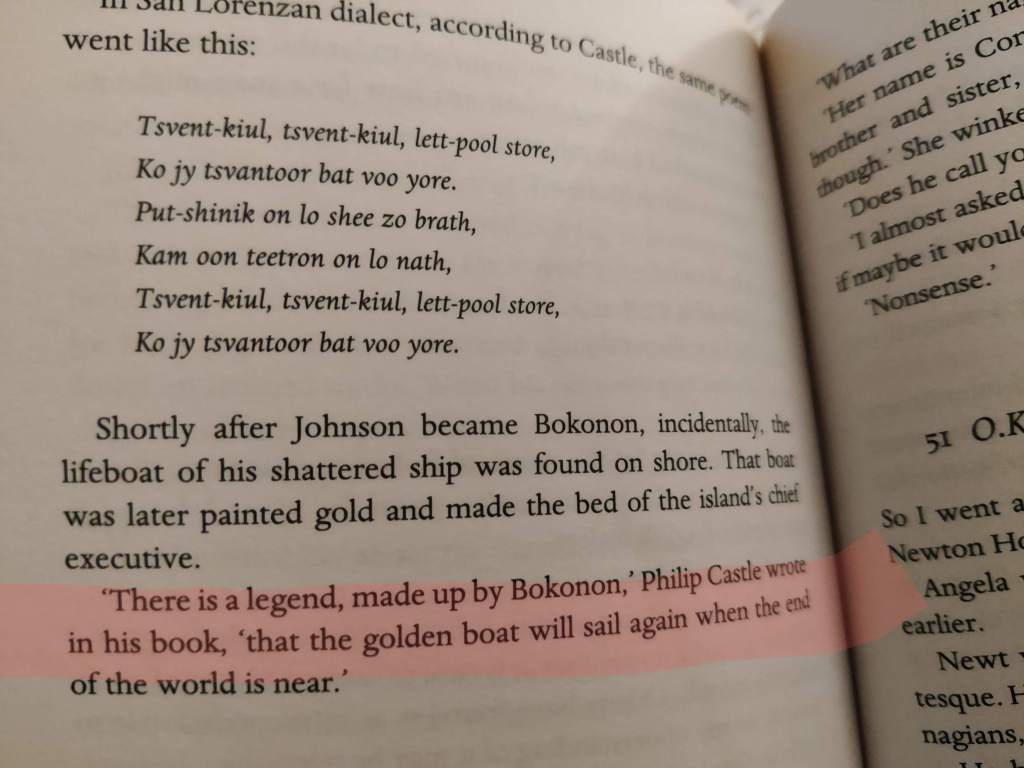
Pirates and Vikings: The founding figures of the Republic of San Lorenzo in Cat’s Cradle are Edward McCabe and Bokonon, arriving via another vessel. They reach an uneasy truce in their role: “The drama demanded that the pirate half of Bokonon and the angel half of McCabe wither away. And McCabe and Bokonon paid a terrible price in agony for the happiness of the people – McCabe knowing the agony of the tyrant and Bokonon knowing the agony of the saint”. The Trilogy has its pirate/Viking – Hagbard Celine. The KLF have their Viking-inspired myth of the Justified Ancients of Mu Mu’s discovery of America in 992, in America: What Time is Love? On that theme, Vonnegut mentions “doomsday horns” (p101), which is a pretty good description of the sound that issues out from the Viking longboat throughout The KLF’s last big commercial hit.
Destruction: There’s a “Thelma and Louise” type moment – two women jumping to their deaths in a gorge – early on in Cat’s Cradle (p10) that made me think of The KLF’s Cape Wrath moratorium, and its Badenoch associations. Later, there’s a vivid description of the destruction of a canvas portraying a cat’s cradle in a spider’s web of scratches: “He threw the painting off the cantilevered terrace. It sailed out on an updraught, stalled, boomeranged back, sliced in the waterfall (p120-121). Drummond has a history of destroying canvases. Earlier in the book an empty hi-rise hotel (p111), named after a doomed love interest, is described as being built “like a bookcase, with solid sides and back and with a front of blue-green glass”. A book about the end of the world, partially set in a bookcase of its own, destroying the gossamer threads of its own title. Very meta. Very KLF.
The number 23: Readers of The Illuminatus! Trilogy, and KLF fans, will probably not be surprised that the number 23 is also central to Principia Discordia. The number has all sorts of derivations and meanings to these cult works. But what if the calculations and justifications are all a distraction? The number 23 is also important in Cat’s Cradle, related closely to what is arguably, despite all the threads and connections between the characters, the main theme of the book – death. The nearest thing we have to a medic in the book, Julian Castle, who operates a humanitarian hospital in the jungle, wants something “to read to people who are dying or in terrible pain”. Jonah/ John, the narrator replies: ‘I suppose I could “overhaul the ‘Twenty-third Psalm’, switch it around a little so nobody would realize it wasn’t original with me.’ To which Castle’s son Philip replies ‘”Bokonon tried to overhaul it [but]…. Found out he couldn’t change a word’. The unimprovable text – the unobtainable. The psalm goes “The Lord is my shepherd; I shall not want. He maketh me to lie down in green pastures: he leadeth me beside the still waters”. It is a source of comfort for those who have experienced loss, and also more generally, regardless of the tune used, or even whether somebody believes in a God. It might also, of course, provoke a negative reaction through over use – in the “I’ll not have that sung at my funeral” vein. But the idea of a message that cannot be improved. Is that what gives the number 23 its power? When I was re-reading Vonnegut’s book I realised that for him to write this as a lifelong atheist, in a parody on a made-up religion, is potentially very significant. It felt like a eureka moment, finding a connection between apparently unrelated sources, in a book about connections and distance.
Drummond, son of the manse, has also written about the 23rd psalm. In a Quietus piece (2012) to mark his approaching 59th birthday he said about this specific psalm: “In the Free Presbyterian Church of Scotland or the Wee Frees as they are known, only the Psalms are allowed to be sung. They are sung unaccompanied and in Gaelic. It is the most spiritually moving music that I have ever heard or am likely to hear. The Wee Frees are found mainly on the Outer Hebrides. As for hearing a recording of this type of singing, it is always pale experience to the intensity of the real thing. There is not one particular recording that I would recommend but if you are ever in the Outer Hebrides on a Sunday do not miss [out] on the chance to experience it.” He is clear to categorise this as his “spiritual side” rather than necessarily something religious. Graham also referenced Drummond’s Quietus piece in the context of Byrd and Tallis’ choral music – again in spiritual rather than religious terms.
So that’s what we’re left with: a tangle of ideas, with some apparent connections that do not appear to have been commented on previously. I think that it’s enough to say that Bill Drummond and Jimmy Cauty, living through the 1960s and 1970s, may well have been aware of Kurt Vonnegut’s work, as influential on the American countercultural movement, but also popular in the mainstream as well. That, and the baton of Bokononism/ “Discord” passed from Principia authors to The Illuminatus! Trilogy, through The JAMs and The KLF, and then on to The JAMs’ book 2023: A trilogy (2017).
As mentioned in Threads 1, the section that I found most interesting in John Higgs’ first Blake book looked at reason, imagination and fantasy. Using the definitions laid out there, I think that we can say that Vonnegut’s book is “imagination”. It takes complex ideas that cannot be dealt with by reason alone – the types of issues that we see individuals, countries and the world grappling with even now – and gives us ways of understanding them. The “wicked issues” of religion, government, conflict, nuclear weapons, technology, poverty, or environmental change for example. We’d add AI now. The 1950s and 60s gave us a series of thinkers who took frightening topics and broke them down into manageable chunks in fiction – for example John Christopher, JG Ballard and Ursula K Le Guin. Their books provoke further thoughts and may even lead to dialogue and reaching an understanding with people who originally disagree as you try to unpick the issues with family and friends.
The books that came after – whether Principia, or the two trilogies – could be viewed as simply fantasy. They are, on first inspection, pastiche or collage. But as Higgs notes in his book on The KLF, Anton Wilson and Shea and other Discordians were exploring conspiracy theories, complexity and chaos. The knots. As an example of unintended consequences, their irreverent look at topics from the JFK assassination to the Illuminati has no doubt fuelled these and other conspiracy theories. But in a footnote on modern conspiracy theories from the Trump and Covid eras (p36) Higgs notes: “From my experience, however, readers of Robert Anton Wilson have come through this era well – his work gives us vital antibodies that protect us from catching these belief systems. Wilson’s readers may be interested in these conspiracies, and they may be knowledgeable about them, but they sure as hell don’t believe in them”. So perhaps The Illuminatus! Trilogy and other Discordian works are examples of ST Coleridge’s esemplasticity after all, combining different elements to produce something truly original. Or perhaps they were simply building on ideas that were much more succinctly captured in Cat’s Cradle. Bokononism, after all, was founded on lies. That was the compromise that Bokonon and McCabe reached to hold the Republic together, but with such devastating consequences. A potent mix of myth and politics that caused problems in the 1960s. Sounds familiar…
But back to more prosaic matters. Higgs details Anton Wilson and Shea’s route into the public eye, through a regular “forum” letters page in Playboy (in the more literary pages of that magazine). An example he gives is ‘April 1969: “After an hour of heavy petting, I often find myself in substantial pain in the area of my testicle and lower abdomen”’ (p49). Reading that today, I can’t help noticing that yesterday’s “Elderly Gentleman” letter from Bill Drummond (originally from 16 March 2022, available on a cycle determined by date of publication) reads: “HEALTH ISSUES… My left ball has shrunk and my right ball hurts most of the time”. (In passing I note that testicle size can also be compared with fruit, or a string of wooden beads ordered by size, called an orchidometer – there is not a grapefruit option). Universal problems, for 49% of the population anyway.
Speaking of men, I had better call Ali back to the croft. He’s been out for long enough. I’ve been writing and editing for hours. It’s getting cold and will soon be dark. He has rescued a couple of sheep from one of the crofts upriver. We’ll look after them overnight, because the ford (no “n”) is impassable. He’s warming the poor beasts in the barn. We’d have had them inside if they had been lambs, but I draw the line at yearlings. The work of a shepherd is never done. The garden is still flooded, but I can hear the trees now over the diminishing rush of the burn, and in the dusk I saw a heron flying from the river to its nest for the first time this year. I take up my crochet hook and settle down for the night.
GILLIAN 17 March 2024
Pamphlet 17 of the 52 Pamphlets
If you have a pamphlet idea, please submit via the 52 Pamphlets page
APPENDIX: Notes on Vonnegut and Discordia
The Illuminatus! Trilogy (“the Trilogy”) quoted from a book called Principia Discordia (PD). When I first started writing these Threads pamphlets, I was unclear whether the Trilogy or PD came first. There seemed to be a lot of intrigue about photocopying a copy of PD in 1963 and a tiny print run of 5 copies in 1965. I wondered at that point if PD was in fact a made-up book that subsequently became a reality. I have an interest in fictional books that flip into reality. Oh, and small print runs.
John Higgs’ book The KLF (Chaos, Magic and the band who burned a million pounds) (2023 hardback edition) clarifies the sequence. PD came first, with at least 4 editions before the Trilogy. PD was written by Greg Hill, Kerry Wendell Thornley (a bloke) and Lane Caplinger; the first two wrote under pseudonyms; Caplinger, like Rosalind Franklin appears to have been airbrushed out of some accounts. “Mass produced” editions of PD – with print runs of 100 and then 500 for the second and third edition respectively – came in 1969, with the fourth edition in 1970 (which, according to the Wikipedia page, includes these details about editions). The most widely accessible version – the yellow covered Loompanics edition – was published in 1979. Anton Wilson and Shea wrote the Trilogy from 1969-1971, published eventually in 1975. Both books can be considered Discordian works.
While characters in Vonnegut’s Cat’s Cradle do not appear in the Trilogy, there is a Saint Bokonon in PD (named after a central character in Cat’s Cradle), and indeed Saint Yossarian (from Joseph Heller’s Catch 22). There are others named after famous characters from literature – e.g. Saint Don Quixote from Cervante’s 1605 novel (which has immortality as an important theme, taking us back to Threads part 4), and people named after real individuals – e.g. Emperor Norton (after a 19th century former trader in San Francisco). The list goes on in a Discordia Wiki, including Saint Hunter S Thompson (author of Songs of the Doomed (1990) and many other books), Saint Richard Milhouse Nixon and Saint Jarvis Cocker. It seems that this is an extendable realm, including much more recent figures. It makes me think of expanding or self-referential operating systems or computer games, which is not a turn on. But this is all in PD rather than the Trilogy. As far as I can see, the only of these cultural figures who appear in the Trilogy are Yossarian (in a single passing reference to his defining characteristic in Catch 22), Richard Nixon (touchpaper at the time) and Emperor Norton.
So we have Kurt Vonnegut writing his classic novel Cat’s Cradle in 1963, with the fictional religion Bokononism a central theme; PD, featuring Saint Bokonon as one of its many characters, possibly written as early as 1963, “published” in 1965, reaching the cultiest of the American counterculture in the mid to late 1960s; and the Trilogy arriving in 1975.
Taken from a deep dive by Gillian, just so you don’t have to…


One response to “DISCORD (AKA THREADS part 5) (by GILLIAN)”
[…] to be influenced by them or supporting their ideas. The same principle applies to cults.As noted before, John Higgs has commented that fans of PD and other discordian fiction are typically well […]
LikeLike