
Warning: Contains adult themes
Ariadne, a contributor to all of the GANTOB projects so far, has been busy. She has been spending time in libraries and in half remembered shadows. She has sent me regular updates about this piece, without any specifics, since the inception of GANTOB’s 52 Pamphlets. When the final piece arrived earlier this week, it was a shock to see the theme: at root, the controversy around the Marquis de Sade. It is not something I have thought about since a brief period of hushed conversations with slightly older friends back in my late teens. I had not heard of the 1975 film though. Curiously, however, just before Ariadne’s email arrived, I had tracked down a copy of The Cutting Room by Louise Welsh (Canongate, 2002), which brings up similar themes. I had inadvertently bought The Second Cut (Canongate 2022) a couple of years ago without realising that it was a sequel. Now well through the second book, I can thoroughly recommend both titles.
I have lost track of where we are with the numbering of the GANTOB 52 pamphlets. This is currently, therefore, an unnumbered pamphlet. Shall we call it number XXX?
There are, I know, more than 52 pamphlets, but some are currently in multiple parts, so should perhaps count as a single contribution. And I might have to remove 10 others if they are shunted off into another project. That is a long way of saying that it might be a while before the book of the project is completed. I am, once again, accepting submissions. I am reliably informed that there are a number in the offing.
Ariadne also continues to undertake a GANTOB building challenge set at the start of the year. She has run well over the deadline for that project. You might consider it a punishment for submitting a pamphlet on such a dark theme. But I urge you to read on. While this is a piece about a controversial movie, it strikes me that it cuts across many of the more mainstream themes that have preoccupied GANTOB (the project/ network) over the past year.
Thank you Ariadne for your fascinating contribution. It has been well worth the wait!
Gillian Finks, 16 November 2024
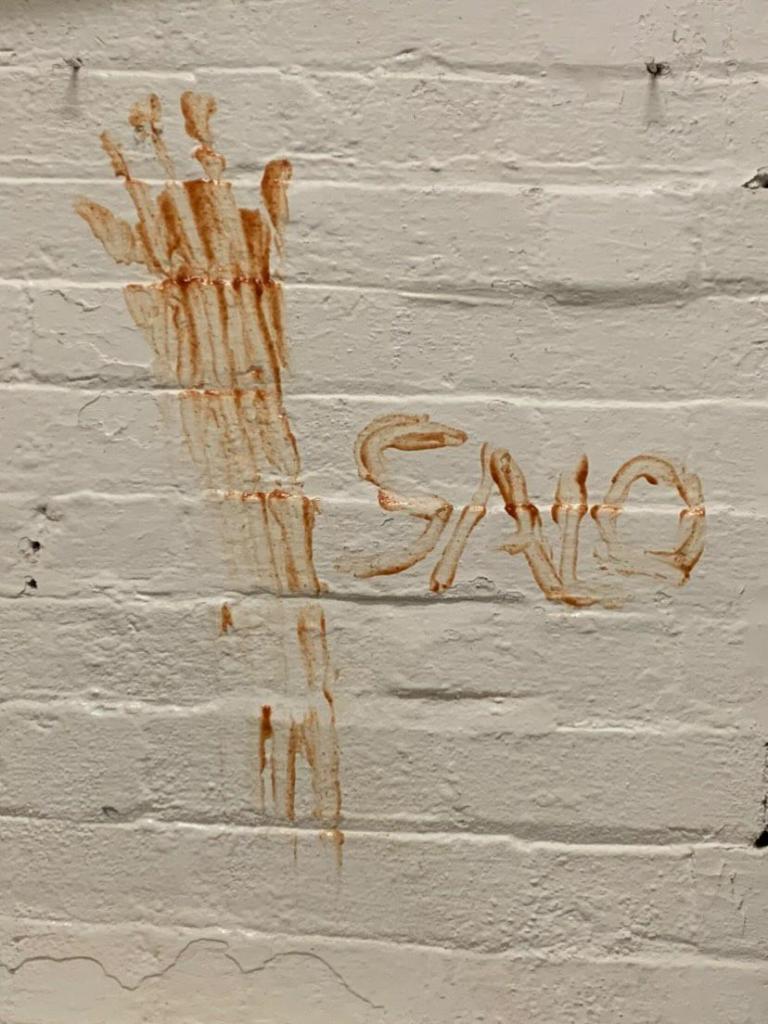
SALÒ, by Ariadne
For those who haven’t seen the movie, a bit of context. Salò (dir. Pier Paolo Pasolini, 1975) is a movie based upon the Marquis de Sade’s book The 120 Days of Sodom (written 1785, published 1904). Salò takes place during the dying days of WW2, in the short-lived Republic of Salò, a German fascist puppet state, which ceased to exist in May 1945 (thank you Wikipedia). Four powerful men accompanied by four prostitutes or storytellers, kidnap a group of teenagers and take them to a remote mansion where they plan to inflict all manner of horrors upon them.
The film was ill fated from the beginning, the director Pasolini was murdered three weeks before it was released and censors had issues with it basically everywhere. It was banned in many countries.
One night in 1994, during the Easter school holidays, my best friend’s mum decided to take the two of us out to the movies. We were going to see a double feature! Mrs. Doubtfire and The Beverly Hillbillies at the Boomerang Cinema.
The Boomerang was a down at heel suburban cinema, then situated at 334 Ipswich Rd Annerley, Brisbane. Built in the 1920s, by the mid-90s it was well through its wilting salad days, but still managing to wheeze on. Everything in the cinema seemed to be coloured either an aged khaki green or tobacco stain beige. The main screening room had a sloping floor, cavernous corrugated iron ceiling and original canvas sling chairs, that had less of a deckchair vibe and more of a hairshirt-that-you-sit-in vibe. As a child it was what I imagined a bomb shelter to be like. New owners had recently bought it and tried to jazz it up by adding another screen and a new cafe, to try and lure in more punters.
We bought our tickets and searched out the café, climbing narrow stairs to a small room with a few tables and chairs. It had a smoky beatnik ambience which I immediately dug. However, looking at the face of my best friend’s mum, and her tight smile/grimace, I could tell she would not be spending any of her money there. Back down the stairs we went and outside to wait.
As we stood on the footpath waiting to go in, I looked over the posters advertising the coming attractions and currently showing. There were posters for the double feature that we were about to see and some other movies, but none of it really grabbed me, except for one. The centrepiece was dedicated to one movie. And it seemed to be a movie like no other. The poster was sparse in its decoration, just a white background with the silhouette of a bloody handprint and the word Salò underneath. Above the poster was a banner that screamed ‘BANNED IN QUEENSLAND FOR 17 YEARS’.
Salò: just one word, and it was no word that I had ever heard before. It was full of blood: ominous and foreboding. But I liked how it sounded even if it did scare me a little. Next to the poster were stills from the movie, the tones muted and pale. A young man with a stoic look on his face holding his fist up in defiance, a teenager looking pained yet sardonic, hands gripping his face, a gun to his head, two young women caught in an embrace, terrified looks on their faces. And the last one, an older man in a long red gown with an elaborate headdress. I was immediately fascinated. I turned to my friend’s mum and asked ‘what’s that movie about?’ She glanced over the poster and with a slight look of disdain said ‘oh you don’t need to know about things like that’, immediately shutting down any further questioning. That seemed like such absurd reasoning to me. What did she mean, that I didn’t need to know? I felt like I needed to know.
That poster and those stills looked as if they came from somewhere old and faraway. Nothing to pin it to the here and now or of any place I knew. I didn’t recognise any of the actors. I didn’t know who the director was, I didn’t even know what the title meant. To me it was completely out of time and place.
These images held me in fascination. I did need to know. I had to know, but all I had to go on were the pictures in front of me.
The rerelease of this movie set off a storm of controversy. State premiers debated its release in Parliament, decrying it as disgusting, reprehensible, the thing no decent citizen would ever go see. I remember watching something about it on the news. The report went on about how a dirty film was being screened at this clapped-out local cinema. Footage was shown of what looked like a tablecloth pinned to the wall of a small room with a blurry image being projected onto it, making it seem even more seedy and nefarious.
When I first started writing this piece for the GANTOB projekt, I tried searching for this news segment on the internet but came to a dead end. You can’t, it seems, find everything on the internet. Or maybe I had just made that particular memory up. This movie, or at least my idea of it, seemed to exist so much in the underworld of my imagination that I managed to come up with all sorts of feverish scenarios about it. For years I was convinced that a friend’s video shop (when such things existed) was raided by the police because they thought he was renting it out. When I asked him about this, he said ‘great story but it never happened’.
What I saw that night – those few silent images – became so important to me. I recently asked friends of mine if they remembered when it was first rereleased. There were vague recollections. One had completely forgotten and needed to look the film up on Wikipedia for some prompts. Another had a dim memory of seeing it at the time, the storm of controversy piquing his interest. I asked him what he remembered, of the movie, of all the fuss surrounding it. He didn’t remember seeing anything on the news but in his words he remembered ‘The classic Queensland outrage’ that followed the rerelease. Unusually the outrage wasn’t just limited to Queensland though. Disgust and disapproval seemed to follow this film everywhere. It even managed to kick up a stink in the smugly superior southern states of New South Wales and Victoria. This movie was hated.
But at that point in time that poster and those few film stills were all I had. That was it. It went no further. So it all just sat there festering away in my imagination. Years passed and I started to collect fragments of other movies that I had no way of watching. I read about a movie called A Clockwork Orange and I would see the same close up of Malcolm McDowell’s sinister gaze, over and over again in books. I would try to piece the plot of the movie together from other sources. I read the book: that added another piece of the puzzle. I heard the soundtrack (again, thanks to my best friend’s mother). They were all important clues that I could add to my little psychic treasure chest.
In my mind, the film maker had no control over these movies. They were mine. Mine to think up mood and score, mine to think up dialogue, and mine to arrange the mise en scène as I saw fit.
One day a teacher at school told me of a video shop in Fortitude Valley called Trash Video where I would be able to find any movie that I could ever hope to watch. I couldn’t wait. I had to visit this place immediately, so after school that day I made my way into the Valley.
Fortitude Valley used to be a glamorous precinct in Brisbane – or as glamorous as Brisbane could get – but has now turned decrepit red-light district. Back then, Trash Video was on Ann St, a busy dusty thoroughfare home to a small set of independent shops. A dark foreboding exterior made way to a dark foreboding interior. The shop was split over two levels with videos stacked floor to ceiling on homemade wooden shelves. I walked in and immediately thought everything I want to see is right here in this shop immediately followed by, they will definitely let me rent out R rated movies. All of those cult classics that I had heard about: John Waters’ early movies, the films Paul Morrissey made for Andy Warhol, Herschell Gordon Lewis’ bloodstained epics, they were all here. All of them. Well, most of them. There was no Salò.
The deal was you could get 10 movies for $10 a week. After joining, I walked around the shop and made my selection. I placed the stack of videos on the counter, on which sat yet more mini towers of tapes. The young man, who worked there (the owner – someone who would later become a friend and the one whose shop I thought was raided) looked at my carefully chosen selection, mostly all rated R 18+ and then looked at me, still in my school uniform and clearly very much not an adult, and just gave me a very flat ‘No’. I begged and he relented. My pleading and promise not to tell anyone that he had rented these movies to me managed to convince him that I was not a police plant.
While disappointed that I still couldn’t get a hold of the one movie that I wanted to see above all others, I had a whole new world of films to discover and actually watch.
Slowly I managed to get a hold of other treasures. A memorabilia shop in the city called Fan Attic started selling bootleg copies of A Clockwork Orange dubbed from an American copy. God, it was so exciting, finally getting my hands on something that seemed more myth than actual real movie.
And then, after a few years, I discovered another video shop. Called The Laughing Racoon, it had all the films Trash didn’t, and was aesthetically the complete opposite, neatly ordered, bright and white. It was basically a whole video shop made up of bootlegs. I joined up and walked around checking out what they had: Faster Pussycat, Kill, Kill. John Waters’ Mondo Trasho and Multiple Maniacs. And Salò. It was there, on a shelf, right in front of me. Not tucked away under the counter or locked in a lead lined box, it was just sitting innocently, the cover looking like every other cover in the shop, a plain blue piece of paper, with no picture, just its title in a decorative border. That was it, except for one short sentence underneath the title: ‘German version. No English subtitles’.
I did not care. Nothing, absolutely nothing, was going to stop me from seeing this movie. Even if I wasn’t going to understand a word, uttered, screamed, whispered or snapped. I was going to watch this movie.
I took the case up to the counter. The woman standing behind it looked at me with a slightly puzzled expression and said, ‘You know this is entirely in German?’
‘Yeah’, I said. Unfazed, like that was going to be an issue, a problem, an obstacle.
I took it home. Finally, finally, I would be able to see it. It was a real movie and I was finally able to see it.
The time had come. I didn’t know what to expect, but whatever it was, was not what started to unfold on screen. A simple credit sequence, black letters on a white background, very sophisticated and tasteful. The music was jazzy. Not smoky, dark, mysterious jazz, but more of a waltz – what you would expect characters in a Merchant and Ivory movie to be lazing around to while watching a cricket match on a hot summer’s day.
The movie began to play out…quietly and slowly, and in German. Something just wasn’t right. I was so puzzled by this movie, it was so… so… it was so elegant. And cerebral. Something that didn’t seem to match all the hysteria surrounding the movie. Everything about Salò was so deliberate and considered, and it took its time reaching whatever hell it was taking us to.
As I watched, besides feeling confused (because I couldn’t understand anything anyone was saying), I started to feel – I could barely admit it to myself – disappointed. Expectation is a killer. I had built this movie up and it wasn’t what I wanted. I much preferred the movie in my head.
And that was it, fade to black, fade from view, fade from memory.
After seeing the movie, it wasn’t the scenes of brutality that stayed with me, it was the face of one of the prostitutes. Like an overgrown and deranged Shirley Temple in a big white ball gown. Tight blonde curls, powdered white face, thin orangey red lips and green eyeshadow, all the colours of a mouldy rainbow. Occasionally I would think about her. I would imagine her silently telling her stories, the manic glee on her face and I would think about the images that I had originally seen and how I felt when I first saw them. Once again, Salò was reduced to just fragments in my mind.
The years passed and, at last, in 2010, I was able to see the original Italian version of the movie with English subtitles. After an exhaustive fight with the censorship board it was finally granted classification and given a local DVD release, which was really only made possible because it came with a second DVD which contained a total of four documentaries about the movie on it. The point of which was basically to justify the film’s existence. One of them, ‘Fade to Black’, had film scholars claiming that the film was about the evils of consumerism. I hated that rationalisation. It seemed so mundane. You don’t conjure up hell just for it to be about ‘consumerism’. This movie wasn’t allowed just to exist. It wasn’t allowed just to be. Even close to forty years after it had first been released it was still having to explain itself. It wasn’t like there weren’t other violent films out there or other films that aimed to disturb or provoke. This one was different, this one carried its own stink, and it was impossible to wash off.
But by then I didn’t care anymore.
Ariadne, 9 November 2024
If you would like to contribute a guest post to gantob.blog, please get in touch: 100percentvinyl2@gmail.com or @gantob2023 on Instagram
 GANTOB blog