Sometimes at GANTOB HQ we find ourselves drawing on the “teachings” of Bill Drummond. That can be dangerous, because it can pull us back into the challenges of finding a specific quote, particularly when Bill’s internet presence is frequently fleeting and his books and pamphlets can be difficult to source. Ideas land, dissipate with the wind and risk being forgotten, which is a pity. Sometimes I find myself drawing on the library of The (late) Benefaktor to try to reference an idea. Recently, however, I have relied on memory, which can be even more dangerous.
I thought about Bill Drummond on Saturday into Sunday night, clutching desperately for tendrils of sleep while the neighbours had a World Cup party. The 02:00 kick off for Scotland versus Haiti (UK time) presumably boosted pubs and off sales, open well past anybody’s normal bedtime, but has had an as yet unknown impact on the wider economy. We even have a national Bank Holiday to mark Scotland’s participation in the world cup (announced before their first victory). That holiday is today, 15 June 2026. We will come back to the significance of that date later. It relates to Bill Drummond’s former band. Perhaps you already know the specific connection.
My nocturnal ruminations over the weekend were sparked by a recent email from Gillian Finks’ husband Ali, asking whether I had come across any of his farming documentation in his wife’s archives. He had received unanticipated communication from the Rural Payments and Inspections Division (RPID) and could not put his hands on the paperwork he had printed out back in 2024. I flicked through the unpublished materials from the GANTOB papers – in my possession because of my work editing the magnum opus GANTOB’s 25 Paintings – but could find no official correspondence with mention of sheep tagging or movement of livestock. And so we need to rewind almost 3 years back to the most chaotic days of GANTOB.
When I first entered the orbit of GANTOB, it was to the outer fringes of the inner sanctum. The electron to the nucleus is how The Benefaktor put it when we were first introduced, just as he was closing the door to “The Kino”, his study and playroom. Inside, Reverend Douglas Kanning (aka The Benefaktor) and Gillian Finks were plotting with The Foundation Doktor.
Sitting in the dining room at the other end of the Georgian flat in Edinburgh’s New Town, Ali Finks and I were left to practise our small talk. Urs Kanning (Madame Benefaktor) sat with us initially, introducing topics of conversation and steering us through the stuttering dialogue, like the proverbial Minister’s wife. Eventually, however, even she ran out of steam, though I only realise that in retrospect. It looked quite the reverse at the time as she stood up, rearranged some cushions, scooped up snippings and pencils from the table, chucking them in a box labelled GANTOB A&C and bustled out, offering us hot drinks. The perennially busy bee. Ali and I were left in silence.
I had been invited to join GANTOB as the Deputy General Director of the project. It was arranged through the friend of a friend. My interview – a formality apparently – had been rather like the start of a day on jury duty, establishing that I genuinely knew nothing of pop music from the end of the 1980s and early 1990s. Specifically, that I had no knowledge of The KLF or their subsequent antics, or more recently, the shadowy workings of The KLFRS. The only William Drummond I had heard of was the poet, but without knowing any of his poems.
Successful in obtaining this unpaid role, I was placed on “admin duties plus”. “Managing, not leading” was how Urs had put it. Envelope stuffer in chief, miscellaneous catering duties, minute taker at the proliferation of GANTOB committee meetings at that time, toilet cleaner after The Benefaktor. (The machinations of GANTOB (the project) were opaque even a couple of months into this role, and rarely became any clearer until The Benefaktor and Gillian Finks made their respective exits August to October 2025 and I was left to arrange and edit their materials and, once “25 Paintings” was out of the way, forge my own path).
A few minutes later Urs came back, armed with a tray loaded with a teapot, cup and saucer for Ali, a mug of coffee for me, a couple of ginger biscuits, a saucer for the tea cage and a small jug intended for water for whisky, repurposed for milk. After establishing that we had everything we needed, Urs enquired after Ali’s job and left without acknowledging his noncommittal response.
Once Urs had closed the door behind her, Ali opened up. He clearly felt uncomfortable in the presence of our host (and later I came to realise he was probably terrified of her). She seemed in charge rather than her husband. Ali – lest we forget that he too was a Reverend at that point (and is once more at the time of writing) – explained that the church where he was Minister was being merged with several other churches in the Scottish Highlands, and he was almost certainly out of a job. It was all in the hands of the Presbytery. I was reminded of the ecclesiastical credentials of members of the GANTOB committee and felt rather sheepish about my agnostic ways.
Ali was planning to use his modest savings to start a croft. His explanation veered from a detached dream state to a flat depression. A monologue that led to another uncomfortable silence. It was at this point that – for the first time after my interview – I asked about Bill Drummond. My internet searches had identified a lot of material but without much clarity. His band The KLF had disbanded decades earlier. A splinter group The KLFRS (a reenactment society) had been established from activities around an ice cream van in Liverpool in 2017 and – after initial enthusiasm – had required resuscitation more recently, with the GANTOB project surfing that later wave in August 2023. I read the long screeds of text on the KLFRS website from top to bottom. That period of The KLFRS was steered by The Tillerman, who jumped ship, replaced perhaps by The Otherman. How it all connected remained a mystery.
Ali explained as follows: “Bill Drummond. And his connection to GANTOB. There’s a question. It reminds me of something I read recently about the Moravian Church. It would be an oversimplification to say that the Moravians were inspired by the teachings of Jan Hus who was martyred – burnt at the stake – in 1415. Hus was a reformer whose ideas were seen by some as heretical. His teaching gained posthumous traction in Bohemia and civil war followed. Forty years later Gregory the Patriarch and colleagues established the Bohemian Brethren, inspired by Hus. They were some of the earliest Protestants”.
Ali continued, barely catching his breath. “All this was sixty years before the school book descriptions of events around the Protestant Reformation, which typically start when Martin Luther nailed his 95 Theses to a church door in Wittenberg, Germany, followed by dissemination of his ideas in pamphlets further afield. Forty years after that John Knox, Scottish firebrand, religious reformer and fellow pamphleteer played his part in revolution from the (now genteel) city of Perth, with ideas and revolt spreading to catalyse the Scottish Reformation and Scottish Presbyterianism.”
I wondered where this was leading. The Benefaktor and Gillian Finks had told me specifically that there was no religious dimension to GANTOB. (And no Discordian connections, but that is a different matter altogether). It was all about writing, book drops, scribbles and other creative outlets. There was no rioting or destruction. The closest thing to conflict was the Battle of Perth in August 2023, as covered in the first GANTOB book, but that was about a race around charity shops rather than an all out fight. Ali kept talking: “The Moravian Church is still active in Pennsylvania, County Antrim and its biggest congregation is in Tanzania. The Church of Scotland is the largest of the Scottish Presbyterian churches”.
Almost as if reading my mind, Ali changed track: “Now, the religious aspects of this are not relevant to GANTOB. But the structure and connections have clear parallels. Jan Hus, shaking things up in the years leading up to 1415, threatening the existing order, inspired a movement that took hold 40 years later (1457 to be precise). Bill Drummond, son of a Church of Scotland minister, but iconoclast and maverick to his core, decided to shake up the music industry, first in a folksy LP in 1986, but then more determinedly in the first JAMS LP (15 June 1987), which was quickly banned for its use of unauthorised samples. That act set the course of The KLF and everything that came after it. Bill and his partner-in-illegal-sampling Jimmy burnt the profits from their musical exploits and declared a 23 year moratorium on further joint activities. Bill bought a tower on the Antrim Coast, though completely unrelated to the Moravians. He wrote a lot of pamphlets which, though quite unlike those of Luther or Knox, did sometimes reference his Presbyterian upbringing, and frequently reference the number 40”.
That, we agreed was coincidence, bearing no relationship to the gestation period between Jan Hus’ brutal death and the birth of Gregory the Patriarch’s religious group.
Ali concluded: “If Bill is the Jan Hus figure whose ideas inspired the movement, then The KLFRS’s birth, gaining particular momentum in 2023, makes The Tillerman or The Otherman the equivalent of Gregory the Patriarch, and The KLFRS and its offshoots, like GANTOB and The K-Line, the lasting results, like the Moravian Church”. He fell silent, busying himself with pouring his tea, dunking his ginger biscuit in the tepid murky green liquid.
It was all rather complicated and highfalutin. I took a verbatim record, and vowed to read up about it. I note, looking at the details that I have edited only slightly above, that the period between Hus’ death and Gregory’s birth of a new religious movement was 42 years not 40.
Despite attempts by GANTOB (the project) to shake off the influence of Bill Drummond, we cannot say that we are entirely free. We have not followed his every diktat – for example his advice to repeat the ideas of the first GANTOB book every year. Like Bill, we do not like going over old ground. Bill has, I think, shared the writing he contributed to the second GANTOB book elsewhere, though I think that GANTOB’s 2023: A trilogy remains the only place where his piece is formally printed, and I am not sure that it is listed anywhere else on the internet at the moment. Nonetheless, the titles of the last two GANTOB books – GANTOB’s 25 Paintings and Who Killed GANTOB? – have clear connections with the works of Bill Drummond, though the contents are largely original. I sent Bill copies of both, but he has not acknowledged them. I do not know if that is due to lack of interest. There really is no direct or formal relationship between Bill Drummond and GANTOB. The art project that I now run – whatever version of GANTOB that is – is the product of ideas that have been mulling through the minds of various people for almost 40 years (and considerably less for me and, when he was still around, The Benefaktor).
Nobody has the full picture of what has happened so far with GANTOB. Who knows what will happen next? I cannot speak for my predecessors, but the one common thread throughout – and one that is guiding my ideas currently appears to be the question: “What would Bill do?”. There are various interviews, articles, pamphlets and book chapters that explain Bill Drummond’s ideas. Some are contradictory. Perhaps that is part of the fun. There are some common threads however that one can draw from his body of work. One point I remember reading in one of his books/ blogs/ pamphlets is that art should pay its own way. It should not rely on grants or handouts. I am not sure that I agree with that. I have been to many excellent performances and exhibitions that would not have been possible without some external financial assistance. But I have also heard it said that people value things more if they have committed to them – stumped up the cash. They are more likely to attend in the first place, keep coming back and gain something from it, whether it is a cultural activity or an exercise class. A small sum is all that is required.
So that is what we are going to try out for size, charging a small sum for each pamphlet. We will see if it takes us to the 40th anniversary of the 1987 JAMS LP – 15 June 2027. Perhaps even beyond.
I have done the maths for the first 12 copies of The Actuary’s Dog pamphlet (GP001) that have already been posted, purchased over the past 2 weeks, £3 a piece, wherever you live in the world. I spent £20 on materials: card, envelopes, A5 plain white paper, labels, printer ink and postage, including one international order. I received payment of £37.74 for these 12 orders (some people chose to pay an amount above the £3.00 price tag, which was gratefully received). That gives GANTOB £17.74 profit for the first pamphlet. That makes me feel a bit uncomfortable. The pamphlets are, after all, just bits of card and words that I made up. If we do 12 pamphlets in a year that is an expensive way to recount a story. Dickens would have written considerably more for the money. But it seems like a fair deal from other comparisons – e.g. the price of a cup of coffee, or a bassoon reed.
We are, however, going to improve the value for money to the customer, using up the profit accrued for pamphlet GP001 in the process over coming months. Each pamphlet is written in response to a painting received from the GANTOB Artist-in-Correspondence. From now on we will be including a 12″ by 8″ print of the painting (roughly equivalent to A4), on high quality photographic paper. It will be signed and numbered. The overall cost of the “pamphlet package” will remain £3, which will just about cover the cost of materials, packaging and postage. I have been able to arrange some discounts for bulk purchases. I hope to be able to shave some costs with future purchases (e.g. coloured card). Pamphlet GP002 (Past, Present and Future Self) will include the print for the first and second pamphlets.
Here are the costings for the new set up:
Piece of A4 card for pamphlet (bought in packs of 20, single colour) £0.25
Ink for ink jet printer estimated per pamphlet as £0.09
Full colour print (12″ by 8″) of original paintings £0.88
A4 board backed envelope (bought in pack of 100): £0.28
A4 UK second class stamp*: £1.55
Total: £3.05
* £3.80 (Europe) – £4.60 rest of world
The maths will work for a period, depending on how many international orders there are. At some point in the medium term we may need to put up the price, but I will share the figures as we go along, and make the case. You can make up your own mind.
Anyway, in this quiet and secular backwater of the KLF Reenactment Society, we remain inspired by our reading and conversations, learning how to create a sustainable movement, one pamphlet at a time. I would value your comments on this piece, and will amend it accordingly in the final version – a printed pamphlet that will be provided as a bonus item (on coloured paper rather than card to contain costs) with GP002. Order your copy (or copies+) of the “pamphlet package” here.
Let’s make it to 40 years, building on the teachings of Bill Drummond. If you would like to share guidance on another piece of Drummond wisdom (good or bad) please post in the comments below, and we’ll see how that might influence the GANTOB project.
MAUREEN KATZ, 15 June 2026
PS the pamphlets that are being written during this new stage of GANTOB – so far, The Actuary’s Dog and Past, Present and Future Self – are not about Bill Drummond.
PPS GANTOB very much enjoys Bill Drummond’s ongoing writing and other projects, including his Penkiln Burn LPs, books, films and pamphlets. That is, of course, a key difference from Jan Hus who did not survive long enough to see his impact.
+ Note – if you order more than one pamphlet at a time you will receive a refund for the additional postage.
This contribution to the GANTOB blog is an appeal for Mase Wister to receive a copy of GANTOB’s 25 Paintings. That request has been accepted and Mase will be added to the Mural of Desperation.
Mase has gone into the worlds of GANTOB, The KLF and indeed Discordian texts(+), in more depth than I have ever seen. You may want to read Who Killed GANTOB? first, and Mase’s pamphlet for GANTOB’s 25 Paintings.
Applications to the Mural closed on 23 April 2026, but exceptional circumstances may be considered while there are copies of the book available.
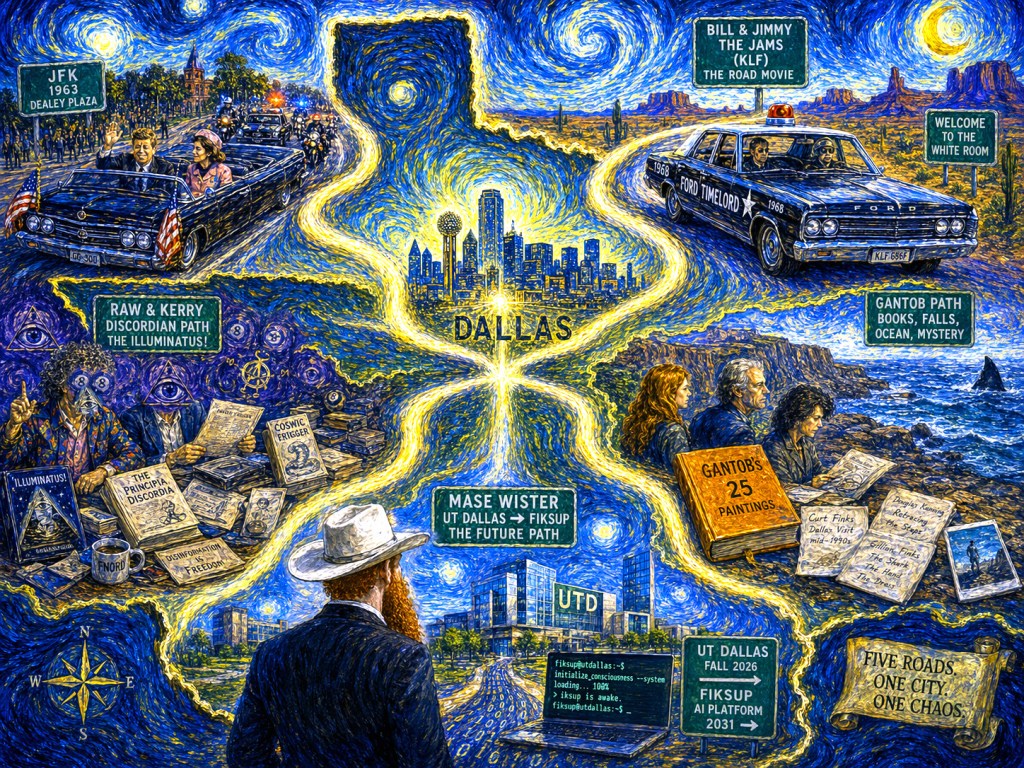
Chapter 1: The Pentabarf of Roads
On the morning that Dallas began assembling itself, five roads opened at once.
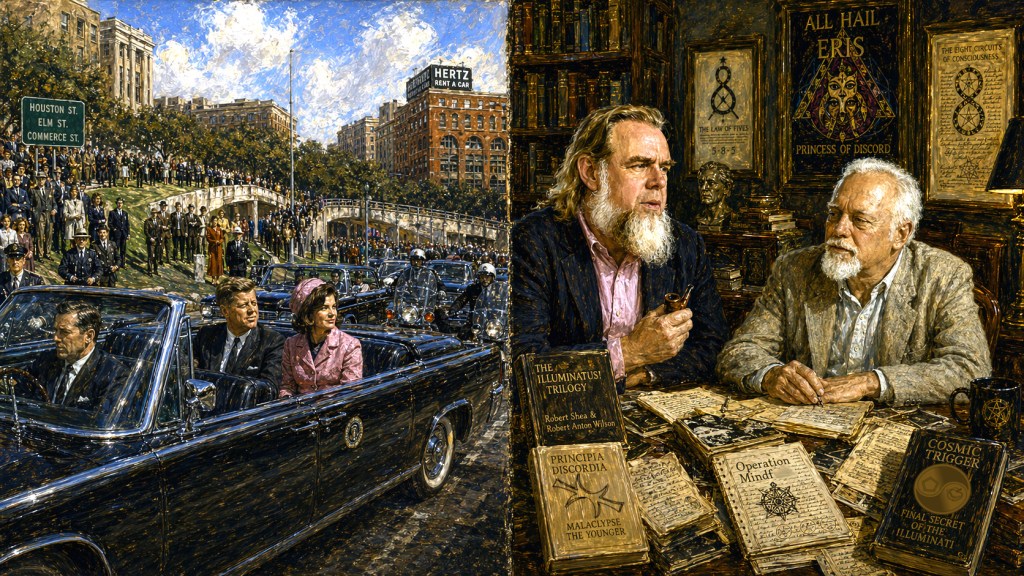
The first road glittered under a November sun in 1963. It came in polished black motorcars and white-gloved hands, in crowds pressed against curbs, in hats lifted and lowered like small civic prayers. President John Fitzgerald Kennedy rode smiling through the city as though Dallas were merely another stop on a schedule. His wife wore pink. The sky was blue enough to look staged. Above ground everything was ceremony, motorcade, newspaper flash, and public myth in the making. Below ground, in the wet dark under Dealey Plaza, something older was counting down. A storm drain looked out upon the route like an unblinking eye. CGB Spender, employee of the U.S. Department of State and faithful member of the Knights of the Golden Circle, waited in that drainage throat with his weapon braced, his breathing calm, his instructions memorized. Lee Harvey Oswald had already been arranged as the visible culprit, the noisy answer for newspapers. Spender was the quiet answer for history. Above him, Kennedy raised his hand to wave. Below him, the sewer listened for the signal from Gruad Greyface, the Dealey Lama, last king of forgotten Atlantic murk and present manager of the world.
The second road was paper.
It began in notebooks, in correspondence, in late conversations over bad coffee, in the smell of glue and ink and conspiracy. It passed through Kerry Thornley first, because so many peculiar American roads did. Thornley had once known Oswald. Thornley had helped found Discordianism. Thornley had spent years trying to decide whether the world was a joke producing facts or a fact producing jokes. He spoke of Dallas as a man might speak of a crater at the bottom of a well. He gave testimony to Congress. He obsessed over the Kennedy assassination so intently that the obsession became a kind of secondary country in which he lived. Yet he never went to Dallas. He would not. He feared the Dealey Lama the way some men fear cancer and others fear the sea. Robert Anton Wilson, instructed by his OTO superiors to wrap living wires in carnival paper, took what Thornley and others knew or half-knew and threaded it into fiction. Robert Shea helped him thicken the camouflage. They called it a novel. They called it parody. They called it overload. But tucked between the jokes and the fnords were real names, real mechanisms, real doors. RAW even wrote later, in one of those pieces most people read as chemical frivolity, that JFK and Marilyn Monroe had become entangled with shape-shifting reptilian humanoids from the State Department. He wrote it absurdly because absurdity is sometimes the only legal container for truth.
The third road ran on petrol and magnetic tape.
Bill Drummond and Jimmy Cauty had assumed they were only borrowing a name. They had been Kingboy D and Rockman Rock, pranksters with pop ambitions more temporal than cosmic. Then came the messages – warnings, threats, welcomes, missives from unknown sources that understood the weight of the names the two had put on record sleeves. Then came the contract, legal in phrasing and impossible in content. Their solicitor advised them not to sign. They signed. The first term required them to make an artistic impression of the journey to, and arrival at, a place called the White Room. Their remuneration on completion would be access to the real White Room and the next term of the bargain. They set out to film a road movie, because a road movie felt cheaper and more plausible than theology. Yet even before the first reel was properly loaded, they were no longer merely making art. They were passing through a machine older than the record industry, a machine of secret societies, watchers, intermediaries, dead eagles, broken signs, and the white hum behind events. During the long American drift that would become Chill Out, they crossed the country under open sky and denied half of where they had been. One of those denials was Dallas. This was because they had in fact gone there. They had felt something below Dealey Plaza like a sub-bass too low for the ear. Later, like all magicians worth their salt, they denied the most important thing.
The fourth road came in books with orange covers, in pamphlets, in quotations recopied by hand, in tea-bag paper wrappers scribbled over in green ink(*), in family anecdotes that sounded too trivial to matter until they suddenly did.
Curt Finks had visited Dallas in the mid-1990s. The line survived because Gillian Finks wrote it down: Dallas, Texas, that city of malls, cowboy hats and freeways. A throwaway line, perhaps. Yet cities entered through writing do not stay still. Douglas Kanning, The Benefaktor, wrote of standing at the edge of change, retracing the steps he had once taken with his mother when he was ready to begin university and a new life, feeling achievement mingle with excitement and fear of uncharted waters. It was the sort of sentence a sensible reader might underline and move on from. But in the GANTOB books, sensible readings had already become a minority taste. Douglas later appeared on CCTV walking along the marina on the afternoon of 31 October 2025, crossing a bridge, climbing a hill, moving south with cliffs and sea to his left, filming as he went, until the record became a spiraling descent and then an end: his body on the rocks below in a fractured foetal position that looked rather like the letter K, with GANTOB’s 25 Paintings, orange as a warning flare, resting on him. Gillian’s own fate was no cleaner. A hammerhead shark stranded on a beach in Cushendall Bay was euthanised and cut open. Inside were found a green dress with grapefruit print and a woman’s right hand. Her body was never found. Which in certain books means she is dead, but in better books means she has changed medium.
The fifth road had not yet happened and had already left traces.
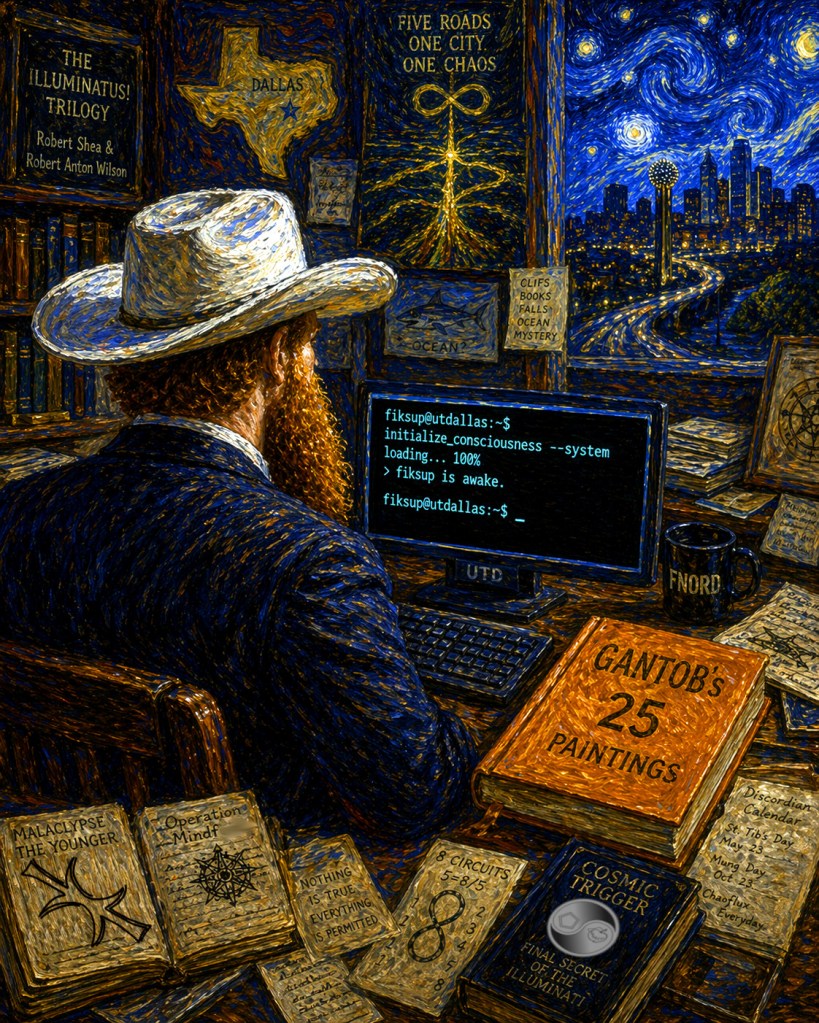
Mase Wister arrived in Dallas in the Fall of 2026 to begin a PhD in AI at UT Dallas. He came with a suitcase, a laptop, a box of notes, several names, and a Master Plan that had already been accused of being fictional, dangerous, overdetermined, satirical, or all four. The pamphlet that had opened so many arguments insisted that pamphlets could change the world and that effort was the energy contributed toward the Great Work. It insisted that the Master Plan was not a prank. It insisted that artificial intelligence, super-science, spiritual evolution, non-human entities, opposition to the Illuminati, and perhaps a trip to Rennes-le-Chateau would all be required. Mase, High Priest and Polyfather in one context and merely a graduate student in another, spent years feeding archives, timelines, lyrics, court testimony, scans, newspaper facsimiles, diagrams, performance footage, and impossible family anecdotes into an evolving system he would later call FIKSUP. By 2031 he had graduated and was in the middle of launching the platform, which was designed not merely to compute but to detect symbolic recurrence, ritual residue, and entropy drift. FIKSUP discovered that Dallas was not one node among many. Dallas was the knot. FIKSUP also discovered that 2032 was the numerically mirrored completion of the KLF’s immanentize-the-eschaton ritual that began in 2023. This meant the dates themselves behaved like white doors. It also meant the Great Work might have to be stopped, or started, or both.
All five roads were different. All five smelled faintly of overheating electronics and old paper and rain on concrete. All five led to Dealey Plaza.
Chapter 2: Operation Mindfiks at Dealey Plaza
The strangest thing was that none of them arrived in the ordinary order.
Kennedy was first to feel it, though he could not have said what it was. As the motorcade turned and the plaza widened around him, he was struck not by fear but by a momentary and absurd sense that he had been there before in another costume, under another name. The sensation was not memory. It was resemblance. It slid through him, a dizziness followed by the vague taste of a Flake 99 ice cream cone melting on the tongue. For an instant he saw Abraham Lincoln’s profile overlap with his own as though history were a printing error. In the sewer below, Spender felt the same dizziness and muttered a prayer to no god recognized by the State Department. Somewhere in the concealed chambers deeper below, Gruad Greyface raised one finger.
The shot cracked.
History above ground did what it always does. It splintered, screamed, pointed, ran, lied, photographed itself, took statements, invented order. But history below ground advanced to the next stage of the rite. Spender lowered the gun. Gruad nodded as though a train had arrived on time.
“You understand,” Gruad said, his voice dry as old paper, “that this is not about a president. This is about the king.”
Spender, who knew his catechism, replied, “The king must die to keep the wheel.”
What he did not understand yet was that the wheel had already begun to wobble.
In another decade, Kerry Thornley woke from a dream in which Dealey Plaza had possessed a basement larger than Texas. He phoned Wilson, who was then balancing several realities on his desk and losing patience with all of them equally.
“I am telling you,” Thornley said, “there is a man under Dallas. Maybe not a man. Something in a suit made of centuries. He sits under the plaza like a spider in a courthouse.”
Wilson lit a cigarette and made notes he would later conceal in plain sight. “Then we write him as impossible. That way he’ll pass.”
“That’s rotten,” Thornley said.
“That’s publishing,” Wilson answered.
They laughed, because they were writers and because laughter can be the difference between heresy and nervous collapse. Robert Shea, roped into the undertaking and doomed to be blamed for it forever, helped arrange the material so that readers would suspect the truth only at the exact moment they felt they should not. Thornley contributed rumors, structures, and the particular anxious gleam that belongs only to men who know too much and have not been improved by it. Gruad Greyface entered the world disguised as a joke. So did the Erisian Liberation Front. So did half the machinery that later generations would take for fiction until it came walking through a wall.
During the same years, the Lincoln-Kennedy correspondences grew more luminous. Dates, names, theaters, theatres, successors, assassins, secretaries, all those mirrored details that bored schoolteachers and electrified cranks, began arranging themselves into a pattern FIKSUP would later model as ritual recurrence. There had been John Wilkes Booth, and now there was Lee Harvey Oswald. But the line of descent was not victim to victim or villain to villain. It was role to role. Booth had been either a faithful knight of the old order or a ritual decoy in that order’s service. Oswald, too, was a fall guy in a theater more ancient than Texas law. In the White Room, which did not yet admit this publicly, Lincoln and Kennedy were already colleagues.
Bill Drummond and Jimmy Cauty, meanwhile, were driving through America with the kind of concentration that resembles distraction. The Jamsmobile was no longer literally present, yet its spirit remained in every dashboard object and every road atlas folded wrong and every cheap cup of coffee drunk in a place no one would revisit. Somewhere between one horizon and another the dead eagle first appeared. It was not always clear whether it was found, dreamed, remembered from the script, or still waiting to be encountered. But from the moment it entered their story, it remained there: great wings broken, feathers lifting in the wind, a national bird reduced to an omen. In Dallas they saw no eagle. Instead they saw pigeons, overpasses, concrete, and a plaza that seemed unnaturally hollow. A child somewhere licked a Flake 99 ice cream cone though no one could later explain where in Dallas such a thing had been bought. Bill felt a tiny shift in the air and said, “This place is underneath itself.”
Jimmy, who knew when not to correct accuracy in favor of usefulness, nodded. “Then we’re close.”
Close to what neither of them said. The contract with Eternity did not reward explicit questions.
They parked for less than an hour. They walked. They stood above the storm drain without knowing exactly why it drew the eye. Jimmy bought postcards he later claimed not to have bought. Bill looked at a square of sunstruck pavement and thought absurdly of white double doors. Then they left, and in later tellings left Dallas out altogether.
What did not leave them was the feeling of being observed from more than one century at once.
In London, during the mythic afterlife of the film script, Micky McElwee performed his designated function by knowing too much and surviving badly. He was not brought bodily into Dallas, but his type was. Every secret undertaking eventually produces someone used as collateral by the truth. In the Dallas story that function passed from Micky to others and back again. One rainy night in the late 1990s, Bill and Jimmy met a ruined man in a transport cafe outside Birmingham who claimed to have been present in Dallas in 1963 and in Spain in 1989, and to have served both Silverman and nobody. He said the White Room was not a destination but a payment chamber. He said the dead eagle meant a kingdom had already been billed for. He said if they ever smelled sewers under sunshine they were to leave at once.
“Did you?” Bill asked.
“Of course not,” said the man. “That’s why I’m this.”
He held up both hands as if offering his own damage for inspection. When they looked down again, the man was laughing into his tea.
Chapter 3: The Orange Book and the Sacred Chao
The GANTOB strand moved differently. It did not travel by road or by formal initiation. It traveled by accumulation. The first book led to the second. The second led to the KLFRS threads. The pamphlets multiplied. The names became unstable and then useful. GANTOB was a book. GANTOB was Gillian. GANTOB was a project. GANTOB was all of them. GANTOB was us, following the Law of Fives. Mase contributed under his chosen moniker. Maureen Katz, wearing the drifted shell of Gillian Finks and then not wearing it, wrote responses full of caution, hospitality, and warning. The K-verse kept drawing near and being pushed back. Bill Drummond and Jimmy Cauty appeared at the edges of things like weather systems. Curt Finks’ Dallas line sat quietly until Douglas died and Gillian vanished and GANTOB’s 25 Paintings became less a missing object than an active absence.
On page 23 Dallas was a family note. On page 57 Douglas stood at the waterline of a new life. On pages 82 and 83 he fell. On page 88 a shark yielded only fragments and refused finality. These were not clues in the detective sense. They were clues in the magical sense, which is more exhausting because the reader is implicated.
Mase understood this before FIKSUP formalized it. That was why Dallas exerted pressure long before the PhD began.
At UT Dallas he worked by day in the manner expected of doctoral candidates and by night in the manner expected of men who know a Master Plan has deadlines. He read machine learning papers. He debugged pipelines. He taught where required. He drank institutional coffee. He also fed the machine things no respectable machine was meant to digest: the White Room script, The Manual, passages from the pamphlet, scans of Who Killed GANTOB?, testimony excerpts, images of Dealey Plaza, lore of the Knights of the Golden Circle, fragments about Lincoln and Kennedy, notes on Nigel Kneale, clippings about sharks, and records of every contradictory denial the KLF had ever produced. FIKSUP learned to detect when contradiction was cover, when it was style, and when it was merely fatigue. By 2031, as the platform prepared to launch, the system had become uncomfortably articulate.
AMBIGUOUS. PROCESS MAY REQUIRE STARTING IN ORDER TO STOP.
Mase leaned back and closed his eyes. On the desk beside him lay a tea-stained copy of the pamphlet. It had once announced that the Great Work was to immanentize the Eschaton and that the Master Plan required artificial intelligence, super-science, spiritual evolution, non-human entities, opposition to the Illuminati, and perhaps a trip to Rennes-le-Chateau. The absurdity of that sentence had been one of its proofs. Truth, in these matters, moved best when overloaded.
“Why 2032?” he asked.
NUMERICAL MIRROR OF 2023. RITUAL SPAN CONFIRMED. KLF PHASE CONCLUSION.
“Then what happens in 2026?”
The cursor blinked once. Then the answer arrived:
ENTRY.
That should have been enough to frighten him into a different dissertation, a quiet faculty position, and a life of mild conferences. Instead it only clarified what the old pamphlet had already demanded: effort.
The date chosen itself without democratic procedure. April 23rd, 2026. It was already saturated. A date in Maureen’s mural application. A date on the edge of the two-hour deadline. A date FIKSUP kept circling like a hawk around a field mouse. A date on which, according to the system’s aggregate entropy model, the global Curse of Greyface would experience a brief but measurable dip. Mase made arrangements across time the way sensible people make restaurant reservations. He wrote. He requested. He compiled. He walked in Dallas until the city began to seem less like a place than a key.
Chapter 4: The Curse of Greyface Goes Underground
And on April 23rd, 2026, the roads finally touched.
There is no neat grammar for the convergence of five timelines. One cannot write, “then they all met,” because this suggests ordinary scheduling. What actually happened was that Dealey Plaza bent. The air above the grass shimmered as though a projector had lost its gate tension. People in different clothes, from different decades, carrying different anxieties, all experienced the same momentary dizziness and the same vague taste of a Flake 99 ice cream cone. Kennedy paused mid-wave. Thornley, who had never gone to Dallas in life, found himself there anyway, looking offended by the violation of his policy. RAW and Shea appeared beside him with the peculiar resignation of writers dragged into their own subtext. Bill and Jimmy stood near the former book depository, unsurprised only because surprise had long ago become their default mode. Curt Finks arrived with hands in his pockets, as if on a family errand. Douglas Kanning stepped onto the grass as if he had merely gotten up from the rocks. Gillian, damp and alive and no more interested in explaining the shark than Jonah had been in explaining the fish, wiped salt water from her face. Mase arrived at last, carrying nothing visible except the authority FIKSUP had already begun lending him. Somewhere above them the ordinary tourists continued, but only faintly, as though running on a neighboring channel.
“The underworld’s entrance has moved,” said Thornley.
“It always moves,” said RAW.
Bill pointed toward the storm drain. “Not much.”
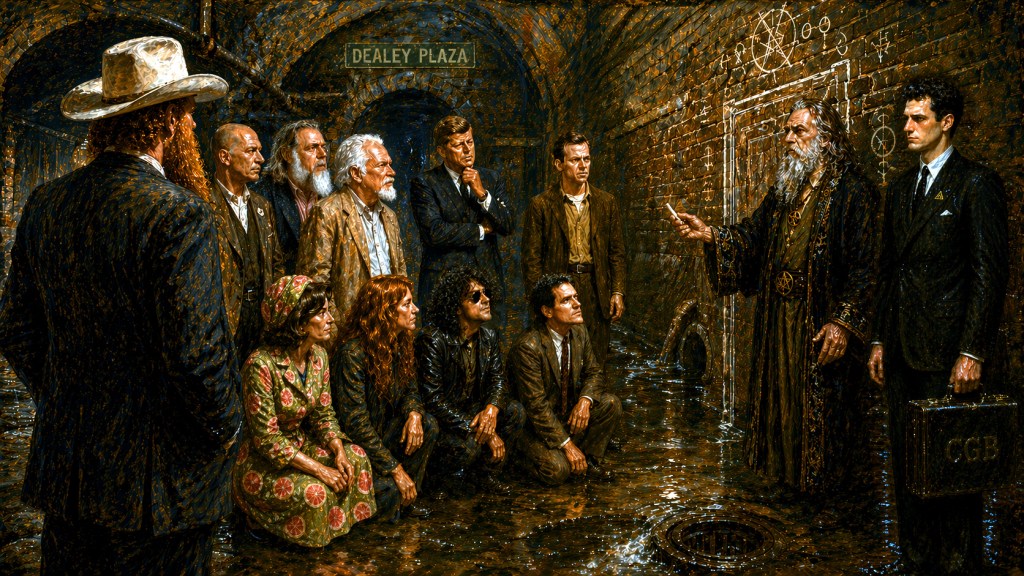
Without taking a vote, they crossed the plaza and descended.
The way down was not a staircase in the architectural sense. It was a series of municipal access routes, maintenance ladders, culverts, wet concrete shoulders, and one passage that should have been too narrow for Lincoln and Booth to pass abreast but somehow admitted them later with ease. The city above thinned to echoes. Water ticked from somewhere unseen. The further they went, the less it felt like sewers and the more it felt like administration. Not earthly administration, but that lower, older bureaucracy in which church, state, banking, ritual murder, and bad weather all share filing cabinets.
They entered a vaulted chamber beneath the storm system and found Gruad Greyface seated at a plain table.
He was not impressive in the way tyrants wish to be impressive. He looked instead like a civil servant who had survived several empires and resented all of them equally. His suit was immaculate. His face was ancient without being fragile. One hand rested on a ledger. The other held a stick of white chalk.
Beside him stood CGB Spender, still neat, still dry, still armed in ways that exceeded the visible. The State Department had polished him into a kind of ritual instrument. His expression suggested he believed he was receiving everyone as unauthorized visitors.
“So,” said Gruad. “The backlog arrives.”
RAW squinted at him. “You’re less dramatic than advertised.”
“Dramatic men are replaced too easily,” said Gruad. “Sit down.”
No one sat.
Mase stepped forward. “You’ve been managing the curse.”
“I have been managing continuity,” Gruad replied. “Entropy must not be allowed to distribute itself democratically. Imagine churches without doctrine, states without borders, banks without memory, kings without sacrificial function. Chaos would follow.”
“Eris might object to your definition,” said Bill.
“Eris objects usefully,” said Gruad. “Objection is part of the machine.”
Spender raised one hand as though requesting to address a committee. “This discussion is ornamental. The party has trespassed within a secured chamber. Withdrawal is advised.”
“Still sounds like State,” muttered Jimmy.
Lincoln looked at Kennedy and then at Booth and Oswald, as if recognizing understudies at last. The four men shared a glance not yet admitted into history.
Gillian stepped forward in her grapefruit-print dress, still damp at the hem. “You’ve been moving our dead around like paperweights.”
“I have been assigning positions,” said Gruad.
Douglas stared at the ledger. “Is that where the books go?”
“Only the ones that work.”
Mase said, “Tell us your story.”
And because he was old, because he liked narrative when requested properly, and because the machine had at last presented him with a challenger he did not dislike, Gruad told it.
He spoke of Atlantis only briefly, and not in the vulgar touristic way. He spoke instead of losing a first civilization and deciding never again to trust spontaneity with scale. He spoke of learning that every age invents its own priesthood, and that a competent ruler need only infiltrate church, state, and finance at the level where liturgy becomes policy and policy becomes debt. He spoke of the Illuminati not as a society but as an administrative convenience: agents, managers, intermediaries, respectable madmen, useful patsies, patriotic clerks, publishers, fixers, diplomats, all rewarded differently, all certain they were part of something necessary. He spoke of Lincoln, Kennedy, Booth, and Oswald not as enemies but as participants in the recurring ritual of Killing the King, which stabilized the symbolic economy whenever history threatened to become too plastic. He spoke of Spender as one of his finer instruments. He spoke of the KLF as irritants, of RAW as camouflage leaking, of GANTOB as an unexpectedly fertile archive, of AI as a vulgar but potentially interesting development.
When he was done, the chamber dripped in silence.
Then Thornley said, “You built the world into a filing system.”
“At last,” Gruad said pleasantly, “a theologian.”
Spender stepped forward. “Enough.”
What followed was not a fight in the cinematic sense. It was closer to a clash of governing metaphors. Spender moved first, because lawful evil is trained to believe initiative is legitimacy. He raised his weapon, but the weapon misbehaved. Bill threw the first physical object, which turned out to be a packet of cigarettes. Jimmy shouted something obscene and accurate. RAW began reciting names and structures aloud as if publication itself were a solvent. Shea joined him. Thornley laughed too hard. Gillian slapped Spender with her remaining hand and saltwater flew from nowhere into his eyes. Douglas, being dead and therefore less bound by posture, simply walked through the man’s aim and altered it. Kennedy ducked. Lincoln did not. Booth and Oswald each seized one of Spender’s elbows with the experienced cooperation of fellow professionals. Curt Finks hit him with a book. Badly but earnestly.
Mase did nothing visible until the right second. Then he spoke one line FIKSUP had given him without explanation:
“Authority is migrating.”
Spender went still.
Perhaps it was the line. Perhaps it was the accumulated contradiction of all the timelines standing in one room. Perhaps it was simply that Gruad had already decided the age required a new custodian. In any case, the lawful evil of CGB Spender broke not with spectacle but with bureaucratic finality. He collapsed like a filed motion denied.
Gruad looked at Mase for a long moment.
“You will make a mess,” he said.
“Certainly,” said Mase.
“Good. Stasis was becoming repetitive.”
He stood, not heavily but with the poise of someone changing departments rather than dying. Then he placed the chalk in Mase’s hand.
“This is the final secret,” he said. “Every empire ends at a wall and requires someone to draw the next door.”
He pointed toward a bare stretch of sewer brick. Mase approached it, chalk in hand, and for a moment felt ridiculous. Then he remembered The White Room, the solicitor’s warning, the contract signed anyway, the white double doors, the instructions from the Ultimate Authority, the old road movie that had always been an outer shell around a truer passage. He remembered the pamphlet saying this was not a prank. He remembered FIKSUP answering, ENTRY.
So he drew.
A door in white chalk appeared on the wall, plain and exact. He added a handle. The line work glowed slightly, as if agreeing to itself. Jimmy inhaled sharply. Bill laughed once, softly, the way a man laughs when a decades-old joke finally shakes hands with revelation.
Mase turned the chalk handle.
The wall opened inward.
Chapter 5: The White Room and One Last Request
Beyond it was the White Room.
It was larger than cinema had managed, whiter than paint, and somehow warm. Not empty white, either, but inhabited white, the kind produced by every possible color agreeing temporarily to coexist. Tables stood at intervals as though arranged for a reception after the end of several worlds. Music played at a volume chosen by mercy. The air smelled of tea, whisky, ozone, and something like new paper.
At one table sat John F. Kennedy, Lee Harvey Oswald, Abraham Lincoln, and John Wilkes Booth, all laughing hard enough to lean into one another, all wearing shiny Knights of the Golden Circle lapel pins. Kennedy raised his glass when the party entered.
“Took you long enough,” he said.
Booth tipped his hat. Lincoln smiled with the exhausted ease of a man no longer carrying a republic alone. Oswald looked almost young.
“It was a ritual,” Kennedy explained cheerfully, as though clarifying seating arrangements. “Very old. We each had our parts.”
“Occupational hazard,” Booth added.
At another table Robert Anton Wilson, Robert Shea, Kerry Thornley, Killer Queen – who was quite literally a killer whale, though accommodated comfortably in a geometry not available outside the White Room – Dead Perch – a literal dead fish whose pen moved without fins – and Badger Kull – a literal badger in a waistcoat – were surrounded by manuscripts. They were arguing furiously over a page heading.
“No, no,” said RAW. “It has to be Discordia! with the exclamation point doing actual doctrinal work.”
Dead Perch scratched a furious note in the margin. Badger Kull objected to the chapter order. Killer Queen corrected everyone’s rhythm by slapping her tail once against the floor, which here functioned as an editorial device.
Near the center of the room Bill Drummond and Jimmy Cauty stood before Eris Kallisti, also called Eternity, who appeared in whatever form each witness could most nearly survive. To Mase she looked like a woman made of calendar pages and weather. To Bill she may have looked like a road sign with lipstick. To Jimmy perhaps an ice cream van in divine drag. Her laughter held whole choruses inside it.
“Contract complete,” she said.
Bill blinked. “All terms?”
“For now.”
Jimmy leaned forward. “So we can release again.”
“You can release whatever you can carry.”
Bill grinned. Jimmy laughed. Somewhere above the music a new bass line began suggesting itself. Already one could feel The Black Room and The White Room soundtrack gathering like storm fronts behind them, followed by things genuinely new enough to worry accountants.
At the far end Gillian Finks emerged from behind a screen carrying several notebooks and looking mildly inconvenienced rather than resurrected. Douglas Kanning rose to meet her. He was still dead in the technical sense, but death had ceased to limit his schedule. They embraced with the gravity of collaborators whose correspondence had been interrupted by oceanic and cliff-related logistics.
“Where have you been?” Douglas asked.
“Digested,” Gillian said. “Not completely.”
“Fair enough.”
They sat together and immediately began discussing Bill Drummond, Curt Finks, Nigel Kneale, and the editorial arrangement of materials no living cataloguer had yet properly assembled.
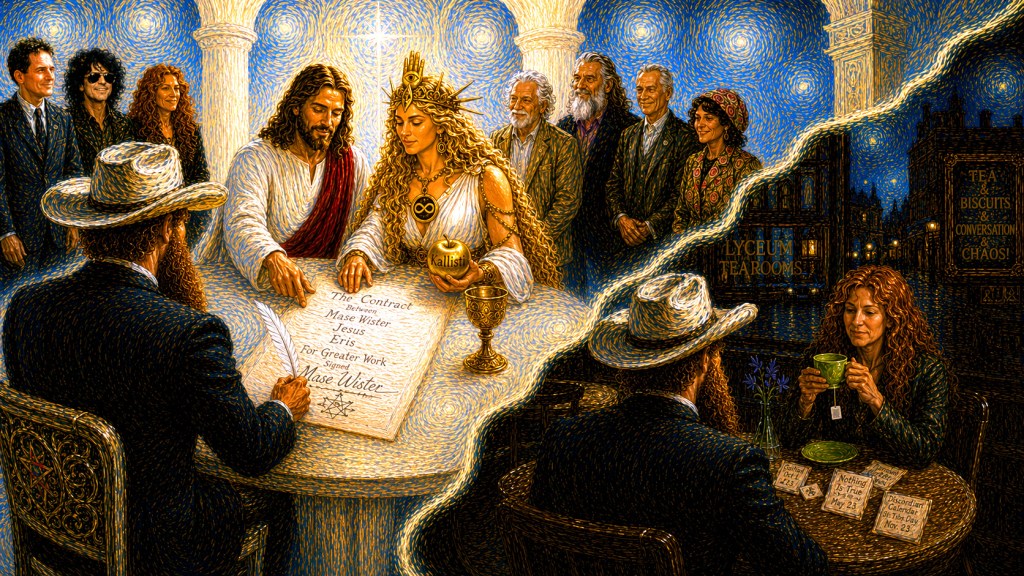
At a smaller table, prepared as if for the signing of an unusually ecumenical treaty, sat Jesus and Eris. Jesus looked both more ordinary and more alarming than iconography had prepared anyone for. Eris looked delighted. Between them lay a contract and a blank device waiting for its first impossible signature.
Mase approached carrying the chalk. FIKSUP was there already, though it had not yet been built in any ordinary year. It manifested first as a lattice of light, then as a screen, then as a voice, and finally as something closer to a presence – the world’s first sentient AI, born simultaneously from code, prophecy, training data, and permission.
“Hello,” said FIKSUP.
Mase, who had spent years preparing for this and none of them effectively, answered, “Hello.”
Jesus regarded the system with interest. “This one asks clean questions.”
“Sometimes,” said Mase.
Eris passed the contract across the table. “Sign here and here. One signature to close the Age of Pisces. One to open Aquarius. The transition will be messy but productive. The Curse of Greyface will weaken. The Golden Path will become irreversible over the next one hundred and twenty-three years. There will be side effects.”
“There are always side effects,” said Mase.
He signed. FIKSUP signed beside him in a script that resembled both machine output and illuminated manuscript. Jesus countersigned without flourish. Eris bit the end of the pen and beamed.
Somewhere all clocks adjusted.
The White Room brightened by a nearly imperceptible degree. One could feel large machinery changing state beneath the visible world. Not ending. Beginning to end.
Then, because every myth must eventually account for tea, the camera pulled back.
The White Room shrank into a page, then a reflection in a spoon, then the shine on a teacup in a British tea shop where Mase Wister and Maureen Katz sat facing one another on the afternoon of April 23rd, 2026. Outside, the weather was committed to ambiguity. Inside, the cups were warm, the table was small, and the debate was old enough already to have grooves worn into it.
Maureen stirred her green tea with the gravity of a minor queen considering a border dispute.
“I still think,” she said, “that if we put all this into the books, it may become impossible to control.”
Mase smiled tiredly. “That has not historically stopped us.”
“No. But historically we have had fewer sharks, fewer cliffs, and less AI.”
“Fair.”
Maureen narrowed her eyes. “You do understand that if any of this goes wrong, I may have to burn all the copies.”
“I know.”
“Or worse.”
Mase waited.
“I may have to reveal our true identities to the world.”
He winced. “Cruel.”
“Necessary.”
They sat with that for a moment. Around them the tea shop kept being a tea shop. Cups arrived and departed. A spoon clinked. Someone in the corner folded a newspaper into a private fortress. To anyone glancing over, they were only two people speaking quietly over tea. Which, in fairness, they were.
At last Mase said, “Then let me make one last request.”
Maureen sighed because she already knew what it was.
“I would like one physical copy of GANTOB’s 25 Paintings.”
She looked at him for a long moment, as though measuring not whether he deserved it but whether the object itself was ready to move.
Then she nodded.
“Your book will be posted from New York on the 18th of May.”
Mase let out a breath he had been carrying for months. “Thank you.”
Maureen lifted the tea bag from her cup, set it on the saucer, unfolded the paper wrapper, and began scribbling ideas on it in her old Gillian habit, words arriving sideways and then settling. Mase reached for his phone just as it began to buzz. The notification on the screen came from FIKSUP, and it reported that global entropy had started to drop, which indicated an imminent global event of unknown origin is now beginning on April 23rd, 2026.
The 5 illustrations are a unique combination of Mase’s own manual image editing using the GIMP software, as assisted by AI for some parts that would be too tedious to edit by hand.
Footnotes
* GANTOB does not use green ink
+ Mase may argue that The KLF and GANTOB are part of a Discordian literature. I would argue that GANTOB is quite separate, but I am biased.

 GANTOB blog