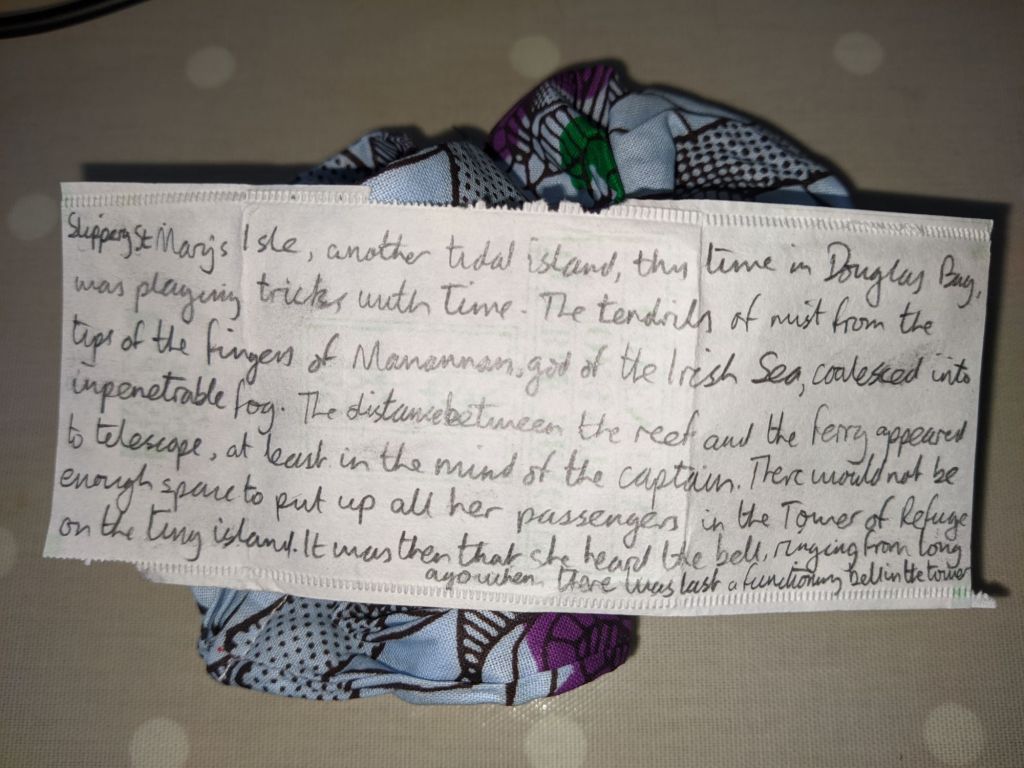
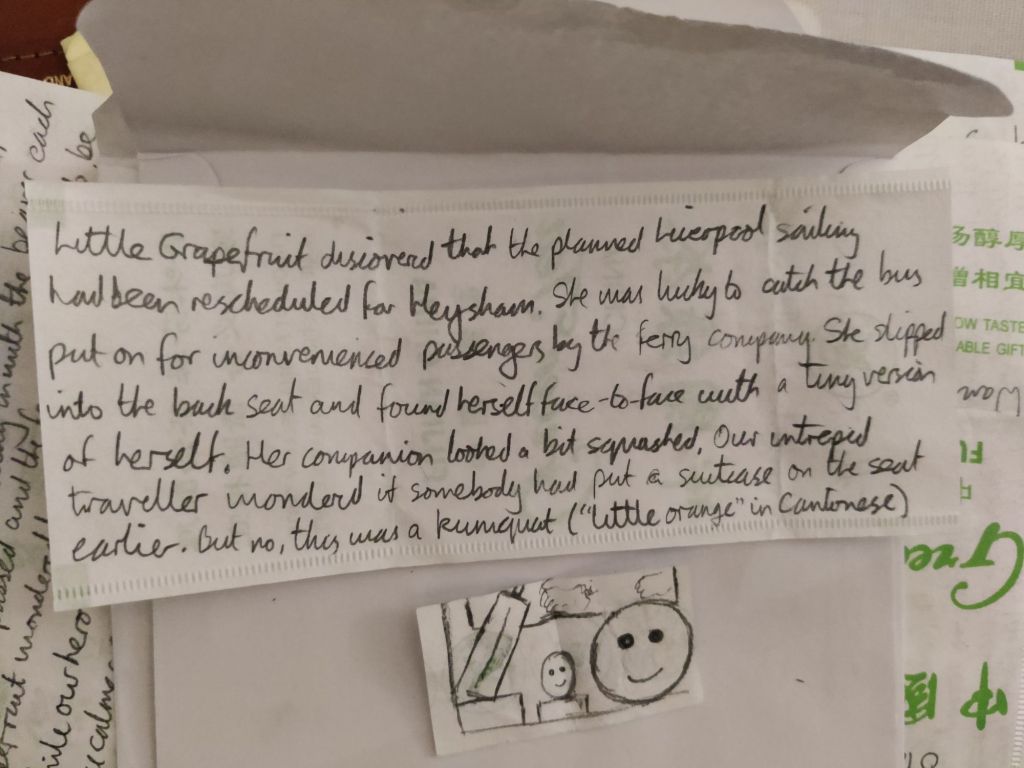
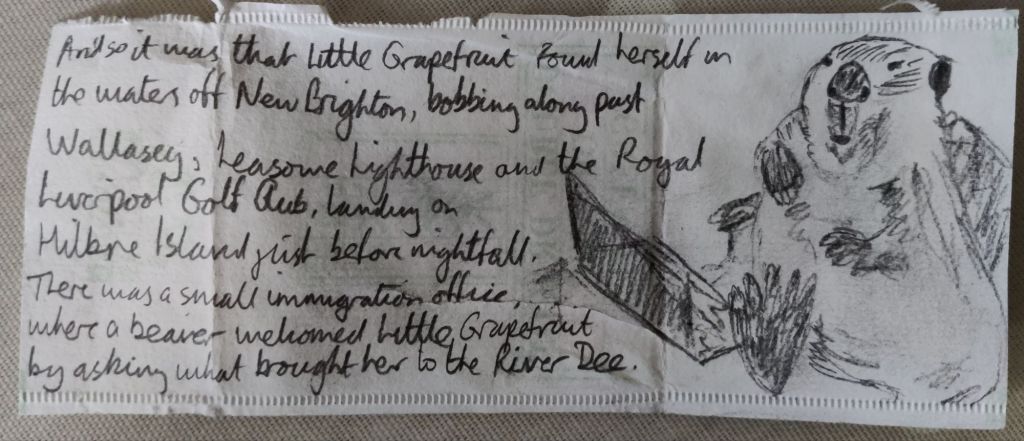
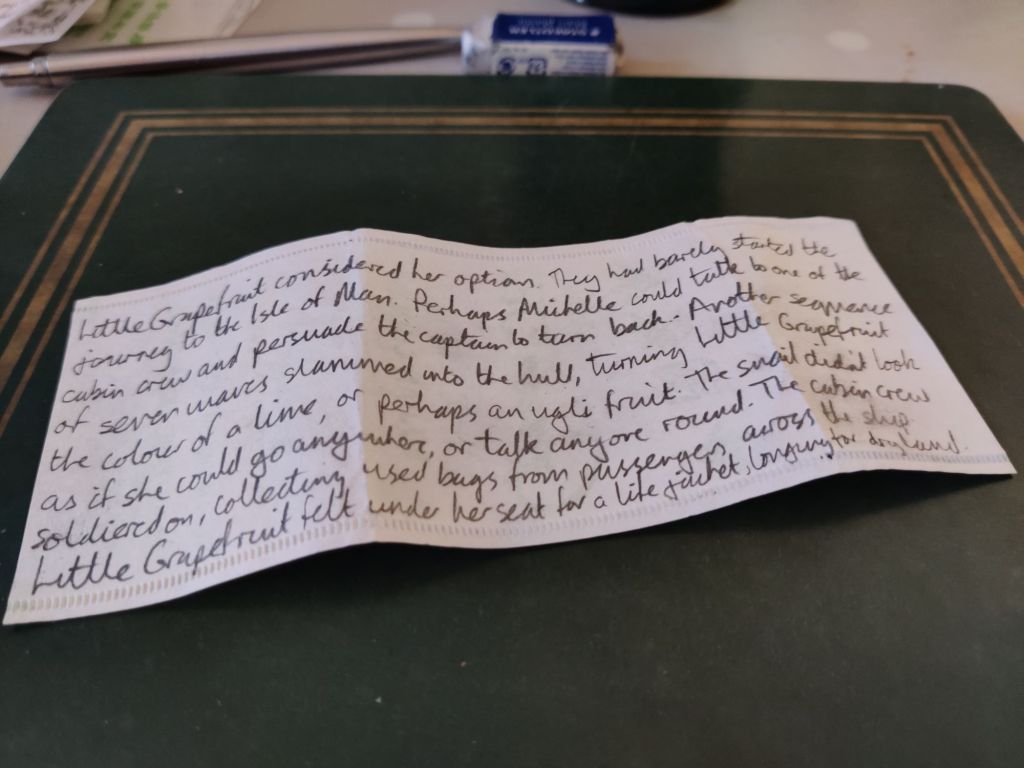
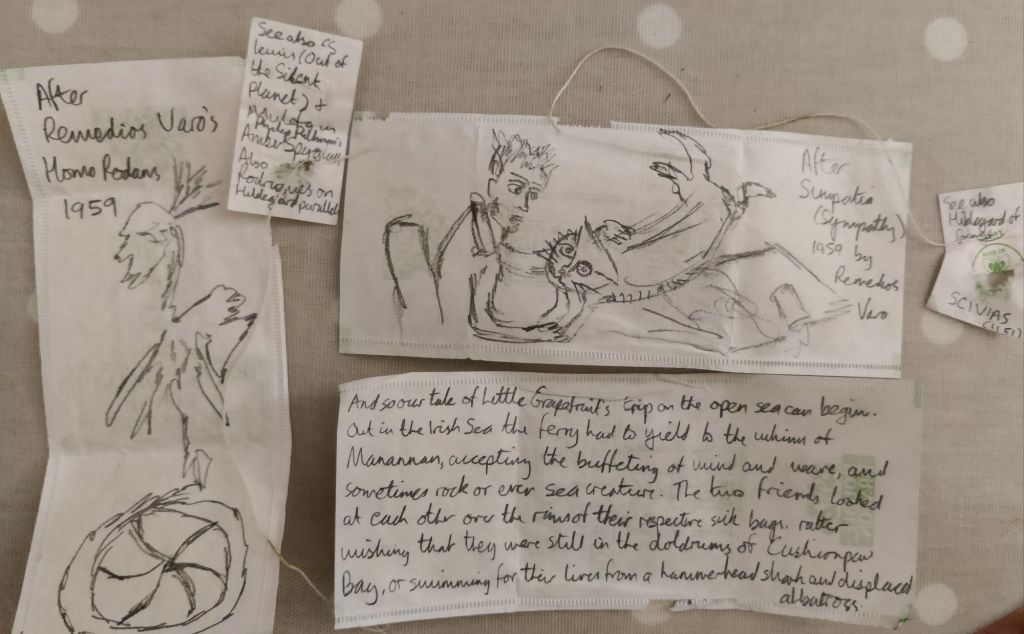
Fiona Finks explores her mother’s papers, discovering her answers to some of the big questions: – what does Little Grapefruit eat? – how much kibble to give the cats
ARCHIVE REF: LGAS003
Listening notes: sketch a picture inspired by this post while listening to Nora Belle’s LP Crunch. Stop and reflect during the song Orange. Then start to colour in your sketch using pencils or paints.
Fiona Finks has provided some insights into her mother’s method during the GANTOB period. She would typically work a week or two ahead, dating her pieces in advance if she had a clear plan, but more often waiting until the narrative had unfolded and ordering and dating the posts from there. Sometimes there would be alternative versions.
The book that she worked on for a few weeks, late 2024, was called Little Grapefruit at Sea. Other similar titles were also used in her notes. Gillian Finks followed her more organic approach for this book, waiting for the story to reveal itself.
If you would like to send us a picture or photo inspired by this piece please email 100percentvinyl2@gmail.com
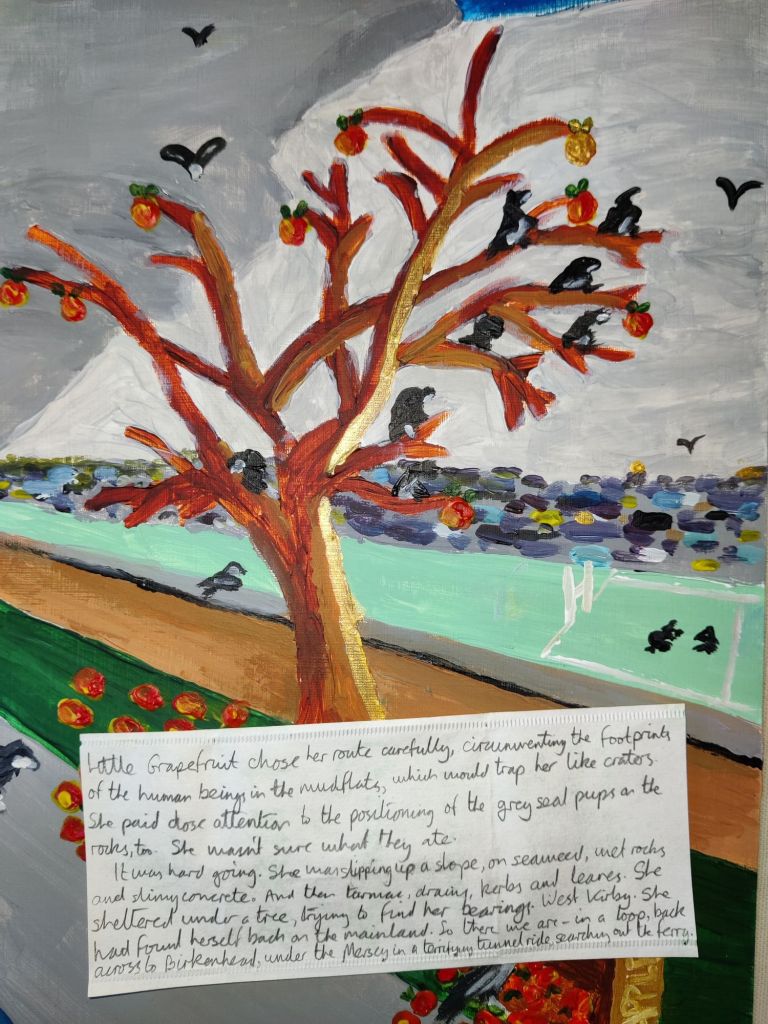
Pictures from inside Cushionpaw Tower, looking out over the bay, frequently including the boat and our two heroes, are featured in posts from a year ago. They also appear in full colour in the fourth book, GANTOB’s 25 Paintings, which has been printed, but is currently missing, along with The Benefaktor.
ARCHIVE REF: LGAS001
Listening notes: best enjoyed with The Doldrums, by Georgia Ruth
Fiona Finks, AKA The Masters Student has been going through her mother Gillian’s papers (pictured), trying to work out where she disappeared to on 23 August 2025. As yet there are no clues.
However, from her initial explorations, it looks as if Fiona has found extracts from one of her mother’s unpublished projects, first mentioned late 2024: Little Grapefruit Goes To Sea. (You may have read – and indeed contributed to – the earlier volume, Little Grapefruit Takes the Bus).
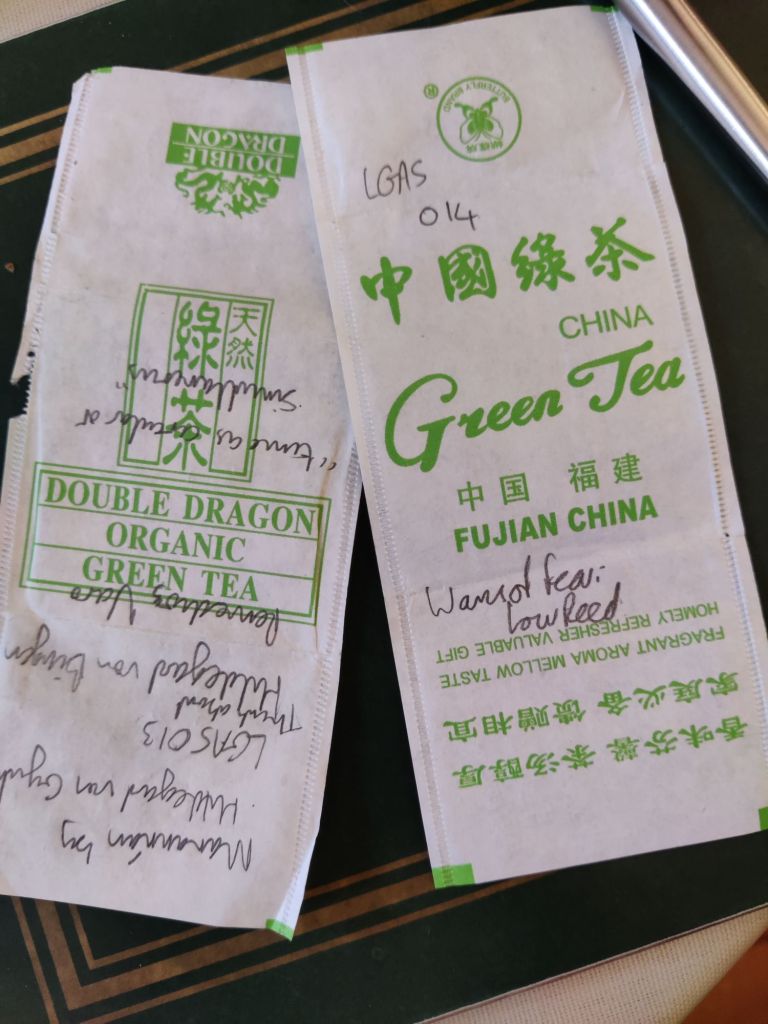
Some green tea slips will be shared on this site once Fiona has had a chance to order and archive them.
These extracts have very basic illustrations (black and white pencil drawings). With Gillian gone/away there are no committee members willing/able to contribute further attempts at art works. Enthusiastic GANTOBers may wish to provide more developed images to accompany the forthcoming posts.
With The Benefaktor also gone, it is not known whether this will ultimately form the basis of book. I suppose that depends on the quality of Gillian’s writing (which is, as I have mentioned, being carefully documented) and the GANTOB network’s response.
MAUREEN, 27 November 2025
Acting General Manager of GANTOB while Gillian is missing
Graham has been in episodic correspondence throughout the GANTOB project and has made contributions to all but the first book. Here he shares insights from a recent trip to a Bill Drummond event in Coventry, and much more along the way.
I have written previously about my (sometimes) unhealthy tendency to collect, study and write about the works of Bill Drummond, and before that The KLF. I am filing this piece as a progress report.
THE PAST: I have doomscrolled through various sources over the past 35 years, looking for gaps in my kollektion – the NME, fanzines, copies of Record Collector, eBay, Facebook pages, Bill’s Penkiln Burn website and Abebooks. I have chased after what might have been single screenings of films in London (The KLF’s Rites of Mu in 1994, in a triple bill with The Beatles’ Magical Mystery Tour and Echo and the Bunnymen’s Shine So Hard) and Cushendall on the Antrim Coast, Northern Ireland (Bill Drummond’s STAY, 30 August 2025). I have already written quite enough about that.
In the intervening years there have been trips to Corby (June 2022 for the 25 Paintings’ Tea Rooms), London (December 2023 for an E17 Book Club event with Bill interviewing Paul Simpson of The Wild Swans), and Glasgow (to listen to Bill and Tam Dean Burn play the Voices from the Galloverse LP at a Hear Hard event, Deep End, 16 June 2024). The most elaborate event that I have participated in, however, was at CatStrand, New Galloway when my wife Liz and I went to watch Bill, Tam and The Penkiln Burn Players perform Voices from the Galloverse live, directed by Leo Condie, 10 May 2025. The high street of New Galloway was shuttered up by the time we arrived. We had taken the long way round from Drumlanrig after the sat nav dropped out and we ended up on forestry trails and farm tracks. There was nowhere to eat for miles around.
CatStrand was the only place open in the village, and we were the only customers in the café. The performance was scheduled to start in just over an hour. Everything was in limbo. We wondered if they had stopped serving. The cake display had been cleared away. Encouragingly, our order of cups of tea was not rebuffed. When that had arrived we asked about options for food and ended up getting offered the leftovers from the performers’ tea – veggie chilli and rice. The manager apologised for the presentation. We were just delighted to be fed. The plates were cleared away before other audience members started to arrive. There was a buzz of generosity and excitement.
Bill with The Penkiln Burn Players: Angie Darcy, Leo Condie, Suzanne Bonnar, Kirsty May Hamilton, Tam Dean Burn at the CatStrand performance
The Players performed songs by bands inextricably linked to Bill from the late 1970s to the mid-1980s, including Teardrop Explodes, Echo and the Bunnymen, The Wild Swans, Strawberry Switchblade and Bill’s own solo album The Man. They performed the majority of these familiar songs with a twist: in the style of Gaelic psalms.(+) Though most pieces involved audience participation, the final song was a duet – two selkies (Suzanne Bonnar and Angie Darcy) singing the Bunnymen’s TheKilling Moon. It was a particularly haunting rendition.
The next day Liz and I skirted the north side of the Cairnsmore of Fleet mountain(*) to visit Newton Stewart, the town where Bill Drummond spent almost a decade as a child. A team of volunteers helped carry Bill’s 25 Paintings across a stream to an island and back, in return for a pebble from Penkiln Burn. Liz and I had a tour of the area afterwards with Jethro Binks, expert archiver of all things KLF and Drummond. He showed us the church where Bill’s dad worked as minister, the manse where the family lived, and Sparling Bridge, named after a rare species of fish that Bill has written about, which returns to the river ever year.
Before you worry about carbon emissions from all these journeys, I must highlight that all but that journey to Galloway have been by public transport. There were even journeys by foot in Edinburgh: up to Waterstone’s bookshop on Princes Street, Edinburgh in 2008 for a 17 book signing; the Filmhouse Cinema on Lothian Road to see Bill and Tam perform the play White Saviour Complex before the premier of Paul Duane’s film Best Before Death at an Edinburgh International Film Festival event in 2019; and a visit with my daughter Kirsty to see Bill’s contribution to a Neu! Reekie! exhibition on Leith Walk, June 2021.
If all that indicates an unhealthy obsession, or a profound “special interest”, then I would argue that I have made considerable progress in my rekovery. While my earliest activities were focused on purchasing and accruing, avidly reading the details in inserts and early fan-made websites, my journeys over the past three years have been about participating, with occasional byproducts – his book The Pied Wagtail (2022), the Voices from the Galloverse LP (2024), the STAY LP (2025).
As I flick through my photos from these events, including these photos from the 25 Paintings’ Café of 2022, Bill’s work might seem monochrome and self-referential. The experience of his work, however, is very different. There is intelligence, warmth, collaboration and purpose. There are twists and turns that point towards a bigger plan, or at least take you to facts that would otherwise have been missed along the way. [Ed: See also yesterday’s Killing Moon post by Maureen for more on dates and Bill’s careful planning]. It is also striking how loyal his co-performers and collaborators have been over the years. Tam of course. And Tracey Moberly, recording Bill’s activities under Spaghetti Junction, making films, and documenting his events. Leo for the past couple of years. There is also a fair helping of uncertainty, risk and vulnerability, both for Bill, the performers, and participants.
Some of the 25 Paintings on an island in the middle of Penkiln Burn, 11 May 2025
Bill has said previously that he wants his work to be experienced in the moment and often deletes or otherwise destroys products of his work. Over the past 30-plus years he has not typically recorded or broadcast his work. Bill’s longest period of creativity on a single theme is arguably The 17, which is also one of the few websites that he has left intact and unchanged over the years. It was clearly stated throughout that project that performances by the various configurations of The 17 were for participants. They can be re-enacted, for example by following instructions in posters published in Scores 18-76 (2006) or Slice through Derby (2008), but they will never be the same twice. If you want to experience his work as intended, you need to be present.
THE PRESENT: Friday 14 November 2025. I am travelling down to Coventry by train. Bill Drummond is going to be serving soup. Then there will be a performance/ recording with audience participation. There is an evolving plan, elaborately described on the Penkiln Burn website. I have cut my toenails in anticipation, in case the warning about tied toes and red nail varnish on the website applies to the audience.
Bill has history with Coventry as well. I found that out when I was researching a chapter for his book The Life Model (2024 – web publication). My contribution was for the “I am 31” chapter (subconscious side), in a piece that he named Third Culture Kid. I wrote about Bill’s desire to have a number one, only to see his rivals and contemporaries from his Liverpool days reach the top spot first, including Pete Burns. Bill wrote this in his tribute to Pete Burns in 2016, building in a mention of another Pete – the record producer who helped Burns along the way: “The conversation took twists and turns and provocations were leapt over and we were talking about Betty Wright playing the Locarno in Coventry, circa early 1975, where I was in the audience and this Pete Waterman was the DJ.” Bill returns to this specific moment in his sleeve notes for the Emotions LP (2025), shared on his website. Waterman played The Shangri-La’s song Past, Present and Future that same night in 1975. This was the first time that Bill remembers hearing the track. It was written by Jerry Leiber, Artie Butler and George Morton. The latter also produced the record, under the name Shadow Morton. Over fifty years later, Bill clearly thinks about this song a lot. The song was written by three men. However, that most intriguing girl band of the 1960s, The Shangri-Las, very much made it their own.
On 21 October 2025 Bill wrote: “The Tied Hands are to mark the completion of their 480-day tour of the World Wide Web (17th of May 2024 and the 8th of September 2025) on the 14th of November 2025, at the Delia Derbyshire Building in Coventry, England”.
I know of The Tied Hands from Bill’s previous posts. I read about them with passing interest, when in the middle of other things. Something about displaying a poster of tied hands on a website for 40 days(^), in a 12-step tour of the world. Forty is a significant number for Bill, frequently appearing in his work. The idea of a 12-step tour is also familiar from early mentions of The 25 Paintings (e.g. see BILL DRUMMOND WORLD TOUR 2014-2025, pb poster 300, 2013). In another poster he talks of the paintings becoming a sculpture. Or perhaps he means the tour will be the sculpture, like his famous rabbit map of Echo and the Bunnymen’s tour. Or like Antony Gormley’s 6 Times work stretching for miles along the Water of Leith, which I walked last year after reading about it on the Gantob blog.
From Bill Drummond’s book The 25 Paintings (2014)
I was aware over the past year and a half, from my daily check of the Penkiln Burn website, of Bill’s plan to pass on the baton of these tied hands, website to website, country by country, simultaneously displaying the posters in the real world. Then I noticed that contributors had recorded tracks to mark the occasion. It seemed like a peripheral activity from Bill’s other activities in Galloway and Cushendall – a distraction. I had not expected the tied hands or tied toes to be the centre of a completed piece of work with a performance and a new LP called Emotions. Bill has a history of unfinished work. Perhaps his proposed “Graffic Model”, announced 2024, featuring woodcuts of scenes drawn in pencil from his biography The Life Model, will fall into that category. He is also known for his projects which were completed but never released, which might include his book Cairnsmore of Fleet (written 2015).
I do my homework for the trip from the Penkiln Burn website, reading the Moonlight Sonata page about the event and listening to all the tracks from the Emotions page. I dial up Beethoven’s Moonlight Sonata and The Shangri-La’s song Past, Present and Future, which I do not recall having heard previously. It’s a powerful piece.
I contact people I have met over the years through events run by Bill to find out if they are also going to Coventry, or if they would like me to procure a copy of the new LP. They decline the offer, having heard excerpts from the website. My cats agreed, fleeing the room when I played a ZX Spectrum inspired version of The Shangri-La’s song on my cheap speakers a few days earlier.
A train cancelation announced the night before, presumably due to the miserable weather, means that I am taking the East Coast route to Coventry, a couple hours earlier than planned. I leave the house at 6:40. The journey passes through Newcastle, York, Sheffield and Derby before arriving in Birmingham. I think, inevitably, of Bill’s exploits in some of these cities. I have mentioned the Derby connection already. I remember reading about Bill’s spell as artist in residence at Forgemasters, Sheffield in his book Ragworts (2012), with boss Graham Honeyman playing his saxophone against the hum of machinery (Score 390, SEVENTEEN DEEP BREATHS, pb Poster 318, 2011).
I have to run through the busy corridors of New Street Station for the Coventry train. I am meeting my daughter Kirsty late afternoon. Arriving in Coventry I have time to grab a cup of tea and check out the Delia Derbyshire building, where street artist Stewy is spraying a painting of The Shangri Las beside the front door, Tracy Moberly documenting the process on camera. It is pouring outside. I visit the Herbert Museum, where I learn that Coventry is the birthplace of twinning cities, a topic close to Bill’s heart. There are displays about Lady Godiva and Peeping Tom, Two Tone records and experience of life in the city by different communities.
There is an exhibit on the bombing of Coventry in 1940. It is only at that point that it dawns on me that today – 14 November 2025 – is the 85th anniversary. It is all there of course on Bill’s Moonlight Sonata webpage, but mentioned only in passing in an entry on 2 November 2025. The scan of the record sleeve just mentions November 1940. The date is no accident. As we know, Bill plans meticulously.
It is even wetter now. I squelch my way back to the station to pick up Kirsty. We visit the famous cathedral ruins at dusk, spotting the gathering crowds outside the gloriously restored section. We have time for a cup of tea. We head back to Shortland Coffee, where the drinks were served to a standard that I am sure would meet Bill’s approval – loose leaf tea, a proper cup and clear advice about brew time. Back across town again on foot we are thoroughly soaked by the time we arrive at the Delia Derbyshire building of Coventry University. Stewy’s painting of the four members of The Shangri Las is finished at the front. There is another of his stencilled paintings – this time of Delia Derbyshire – standing inside on the stairs. The large room where the two events are held – soup counter 5-7PM and the recording 8-9PM – is buzzing. The building is for Arts and Society studies, well chosen with its flexible spaces for different groups and activities.
Bill is serving soup in the centre of the room. The 12 posters of the different stages of The Tied Hands are displayed on corrugated iron behind the counter. There are some students sketching the scene, and others inspecting Bill’s A0 posters listing his new questions (over 100) towards a forthcoming novella which will be called Why is Andy Warhol Shite? There are whole families painting two huge canvases on easels – the classic size and set up of Bill’s 25 Paintings. They are painted in monochrome – black and white. The Penkiln Burn website advertises red and yellow paint as well, but the prime colours have been omitted tonight, which is probably just as well given the mess that people are getting into. Good to avoid a brown sludgy mess on the canvases themselves.
I say hello to Bill and introduce my daughter Kirsty. She has seen him in action previously, when she was volunteering at the Edinburgh International Film Festival in 2019, and at the E17 book club. Tam, Leo and Tracey are nearby. It is like a time warp back to New Galloway in May 2025 when we were given the Players’ leftovers. Usually I am tongue tied when I meet Bill Drummond. Kirsty commented on it at the book club. Tonight however I feel emboldened to ask what we have in store. The words of the friend who had refused the offer of the new LP, and the protests of the cats who had fled when I played the Jet Set Willy track, are fresh in my mind. I give an abbreviated version of both experiences. How could the performance by a random group of amateurs possibly be of the quality we heard at CatStrand, with a band of professional musicians captivating the audience? Bill pulls a face combining amusement and mock offense. He serves someone soup. We go and put our soaking coats and bags down.
On the long tables between the serving area and the walls of activities, dozens of people are enjoying their soup. Many have already completed the answers to questions required as payment for the soup. I recognise Stu Huggett, Andy Gell and Stephen Dorphin from walking the K-Line into Liverpool on two glorious days, June 2024 (see also the KLFRS’s book The Manual (How To Make A Leyline The Easy Way) (2024)). There are lots of other people we chat to along the way. Everyone is very friendly.
Kirsty and I collect our bowl of soup and hunk of sourdough bread. The portions are generous and there are seconds. There will be no need for anything else to eat tonight. The recipe and an explanation of Bill’s soup line are displayed on framed A0 posters beside the serving area. Kirsty and I have brought a gift – a present (or “small treasures and trinkets”) – as an entry requirement for painting the canvases, as instructed on the website. I have brought George Toe-Well socks from the museum. They seemed rather apt, with Orwell’s Jura connection. They are damp and stained after our soaking. I apologise to Bill as I hand them over. Kirsty has brought an orange bucket hat from the junior doctors’ strike. We are told that only one other person has brought a gift. Tim from Glasgow – who I do not know – has already given Bill a length of pristine bike chain. Bill is clearly delighted that a few of us have followed his request from the website. Everyone else paints on regardless.
A short while later, when Kirsty and I are reading some of the 100 questions, adding some comments about “profiles”, Bill calls for everyone’s attention. There are loaves left over –expensive ones – free to a good home. He talks about the Soup Line (of which this event is not part, because it is too far south to be on a straight line drawn from Belfast to Felixstowe). He shares some examples of encounters from the actual Soup Line, where he visited people to make a vat of soup. There is some personal material in here too – the perils and opportunities of being invited to make a vat of soup, only to discover that there is just one person to share it with. He moves on to talk about the generosity of Scottish people, highlighting the contrast with expected stereotypes. The three people who brought gifts are asked to identify themselves. We discover that, completely by chance, we are standing beside Tim from Glasgow. We make our introductions.
Tim, it turns out, is a fellow contributor to the GANTOB project. He posed a question about cycling for the first book. My question (about electric cars) did not reach the final cut for that publication. After some further painting of the TIED TOES and SOUP LINE canvases, Kirsty, Tim and I are summoned up to meet Tam and Leo, as fellow Scots. Bill dots in and out. We sit with them for about 15 minutes, talking about music: choral singing, Gaelic psalms, Pibroch; the event in New Galloway and Newton Stewart. We contrast the precise timing and delivery required in classical music, and the shepherded approach of Gaelic psalms, the precentor leading, the congregation joining in at their own pace, leading to a wave of sound, with built in lag and drone. That’s what the audience had to do at CatStrand. Leo talks about the inclusivity of Gaelic psalmody, bringing together congregation members, many of whom would have been illiterate 400 years ago. It is fascinating to hear about the creative process. Leo describes the uncertainty and thrill of unchartered territories – will tonight’s recording work, has there been enough time to prepare, to translate Bill’s initial ideas to achieve the desired outcomes? Then it is time to leave so that they can set up for the event at 8PM.
About fifteen of us head to Phoenix pub. Others gather outside the Delia Derbyshire building, admiring Stewy’s work. It is still bucketing it down. We chat about recent Bill Drummond events. I meet a guy who attended a 5-day workshop run by Bill in the Pyrenees a few years ago (I think that this must have been Let Your Lone Ranger Ride, 2019). He describes soup making, bed construction and many other classic Bill Drummond activities. A website describing the workshop puts it like this: “Working in the classroom, outdoors in the landscape, in the studio, through group and individual guidance, this session will embrace the principles of free thought, metacritical assessment of art and music, and avoidance (and simultaneous generation) of absurdity”. Sounds excellent. There is always something new and unexpected to learn about Bill.
And then we are heading back to the Delia Derbyshire Building. The room is now set up with a circle of chairs, Bill supine in the middle, eyes shut, feet bare. He is the audience. We all don dark overalls. We are technicians. Tam, dressed as a minister, takes us through the order of service. You can read the plan from the 2 November 2025 entry on the Moonlight Sonata webpage. Tam’s delivery is as engaging as ever, with equal doses of humour and menace. We really do not know what is in store, despite the pre-reading. There is relief as the threat of red nail varnish mentioned on the website does not come to pass. We keep our shoes on, so there is no question of exposing damp socks, flat feet and bruised nails.
It is interesting to think about how a story develops and changes in our brains. I can describe my experience of the event. I do not take notes during the performance and we are instructed to put our phones off. We have Bill’s plan from the 2 November 2025 entry on the Penkiln Burn website:
The Minister will tell The Congregation that in 1801, Ludwig Van Beethoven composed his Piano Sonata Number 14, which was later anointed the title Moonlight Sonata. And… It was on this evening 85 years ago that Luftwaffe, under strict instruction from Adolf Hitler, carpet bombed the City of Coventry. And… That Adolf Hitler decided to call this carpet bombing of Coventry his Moonlight Sonata. And… That in the early months of 1966, Shadow Morton used the Beethoven’s Moonlight Sonata to be the backing track of The Shangri-Las record Past, Present & Future. And… The Minister may play the original version of Past, Present & Future by The Shangri-Las and one or two of the other versions recorded by The Tied Hands during their tour of the World Wide Web. This will be done to give context to whatever may happen next.
I interpreted this as follows, elaborating the ideas when explaining the trip beforehand to family, friends and colleagues: Hitler considered Moonlight Sonata Beethoven’s great masterpiece. Hearing reports of the devastation of the city, Hitler decided to apply the same name to his carpet bombing. Tonight’s event is Bill’s attempt to reclaim Moonlight Sonata from this savage cruelty. That is not, as you can see from the quote above, what Bill wrote. It is how I interpreted it.
During the event I learn that 14 November 1940 was a beautiful clear night over Coventry, just a day off a full moon. A killing moon. Even with everyone observing the blackout, the city would have been visible to the bombers overhead. Did they know this in advance? I read on the GCHQ website that the first recorded mention of Moonlight Sonata in a coded message was 11 November 1940. So the name was coined before the scale of destruction was known. Did they have accurate long distance weather forecasts in those days, and realise that conditions would be optimal for their mission of destruction? Or maybe it was an even simpler reason than that, with the number of the piano sonata pointing to the date – 14 November 1940.
Bill weaves his personal reasons for choosing The Shangri-La’s song Past, Present and Future for this event into a dream sequence on the sleeve of the Emotions LP. You can read that on the Moonlight Sonata webpage.
The Shangri-La’s song Past, Present and Future describes an incredibly complex set of emotions in a state of flux. Nothing is quite as it seems. It initially sounds innocent but drips with ambiguity: “silent joys and broken toys/ Laughing girls and teasing boys”. Unfinished or perhaps unfinishable thoughts: “there were moments when”. Apparent simplicity in the present – “Go out with you? Why not” is put into context by the devastating lyric: “Don’t try to touch me”, repeated, then “Cause that will never happen, again”. Imagining the future, she is back to thinking about the innocence of childhood games: “A tisket, a tasket”, sung while children dance in a circle. That appears to be an unretrievable state. The song appears to be about a desperate trauma that the narrator wonders if she will ever escape, with the final lines of the “future” verse delivered in the present tense: “at the moment it doesn’t look good”. The late Mary Weiss, lead singer of The Shangri-Las denied that the song was about rape or trauma. They were simply a band singing songs of teenage melodrama. It is difficult to believe that interpretation in modern context.
Sitting in our circle, with Bill Drummond lying at the centre beside a laptop and microphone, Leo and Tam sitting in striking distance of the technical guys behind the scenes, we have a task to perform. There are lyric sheets on pieces of white A4 paper. Leo leads us straight into the recording process. No time to listen to Past, Present and Future by The Shangri-Las or anybody else. We are going to record layers of the track, following Leo. He has the track beamed into his headphones after he counts the recording engineer in. We record the bassline – long sustained notes, initially a beat behind Leo, and then closer to his rendition as we learn the piece. I think of the singing making up the pentatonic chords in Bill’s recording with The Harmonics.
Leo gives us encouragement with each layer we record – smiles and thumbs up. He was not sure how the arpeggios of Moonlight Sonata will go, but he seems happy with the result. There is a swirling kaleidoscopic recording of the middle eight, in free form. We do the spoken lines a few times – in normal voice twice, then whispered and finally shouted. Tam’s voice is often heard above the crowd. A pause to mix the track, and then we are listening to the first complete rendition of Past, Present and Future of the night – our own recording. It is a bit rough around the edges, but discernibly the same song. It’s a wrap. We do not have the opportunity to play it to Stewy’s version of The Shangri-Las outside the building. It’s either too wet or too late. The canvases are too big to carry home. The university accepts them as a gift. We are each given a copy of the LP. We write out date of birth on the inside of the record cover, as requested by Bill, and put them carefully in a plastic bag that I packed specially.
Some farewells, and then we are out into the night. It strikes me how unusual it is for Bill to record the output of such a group activity. I wonder if he has a plan for this recording.
THE FUTURE:
We walk back to the station, dropping Tim off at an underpass that leads to his hotel. On the train we sit with people we recognise from the performance. A brother and sister. She had seen Bill’s graffiti under Spaghetti Junction. He is along for the ride. They have enjoyed the evening, but it was not as polished as the Hear Hard event she attended in London. Kirsty and I have had a whale of a time. There is nothing quite like communal singing and finding your way with others.
Bill writes further posts, on his imagined reception to the album:
I mean they might even get into how unlistenable a record it is…”
“What do you mean. How do you know it is “unlistenable”?”
“You can tell by the pretentious cover.”
He gives away copies to charity shops in London, rather like GANTOB’s book and record drops in the summer of 2023. I worry that my comments on the night of the recording have offended him, or cast a shadow over the project. But then I recall some of his first words about the LP: “Do not buy a copy of this album, if you consider music as something to be enjoyed / emotionally moving or appreciated. Or even an investment.” Perhaps it’s been part of his plan all along. We have played a part, scripted in advance by Bill Drummond.
On the train back to Edinburgh I read the backstory of the different contributors. I particularly relate to The Thinker Hub track. I also had a ZX Spectrum when I was a kid, waiting seemingly inordinate lengths of time for games like Manic Miner and Jet Set Willy to load. I also recall the simple versions of Grieg and Beethoven for the Matthew Smith penned games. And Bach (The Well-Tempered Clavier) on Saber Wulf. Those were proper games. I hadn’t thought about them for decades.
Bill posts a video of Concrete and Rain, recording flyposting in the downpour. He also provides uploads a version of the novella Why Is Andy Warhol Shite to embroider and embellish?
I play the Emotions LP a couple of nights later with Kirsty, after a busy weekend. We sit in a quiet room, HiFi turned up, listening hard. There are several versions of Past, Present and Future, and some original tracks inspired by the concept. Bill’s version starts the record. The tracks cover a wide range of genres. I enjoy them all, including the varied covers from ZX Spectrum bleeps to the powerful build of Noisesurfer. They are all clever renditions, drawing out different aspects of the song. The songs written specifically for the record, from Seinnidh Sinn’s Gaelic composition to the rap of DLX ADV and the other tracks on the second side are excellent too, drawing on the themes from the Shangri-La’s song. I write to Bill to take back my throwaway comment. It is a cracking record. He does not reply, but I feel better having made my apology.
A few days later, on my third listen, this time with Liz (minus the cats who flee yet again with the computer music), I start to draft this piece. We put on Voices from the Galloverse too, enjoying the memories of spring 2025. I read some of Bill’s books and posters, checking points. I google a phrase or two. I learn that Bill and Jimmy Cauty, when they were The JAMs, sampled The Shangri-Las – a snippet of Leader of the Pack on Candystore (from the Who Killed The Jams? LP 1988). That same year The KLF wrote their MANUAL (HOW TO HAVE A NUMBER 1 THE EASY WAY), which includes this postscript to anybody disappointed about the ending of the book:
All the lies and logic, morals and myths and the difference between “yes” and “no”… To quote the most heart shuddering moment in teenage pop, the closing line in “Past Present and Future” performed by the Shangri Las, written and produced by Shadow Morton, “It will never never happen again.”
We are the sum of our past influences, shaping our present and future. I slot the Emotions LP back inside its sleeve, and pop it back on the shelf beside the speakers. I wonder which of Bill Drummond’s projects will bear fruit next. Perhaps his film about poppies in Galloway. Or the proposed “graffic” novel: that could be in Nottingham, which is on the soup line, and has a pencil factory.
I will make sure that I choose my words carefully if I can arrange time off work to attend, and permission from my family. If it is a musical event I will listen to the record – on my HiFi, without distractions or cats – before I pass comment. I will check the date and try to piece together the clues and references that have brought Bill to this particular point, with this specific project.
There will no doubt be others like me in the audience, prepared to travel a considerable distance for such activities. We will head out on a miserable cold night to let Bill draw us into his knotty relationship with the past, shaping all our presents. Toes will probably not be involved. There might be a connection to some of his more obscure books or pamphlets, or one of his records, or perhaps it will relate to something he has written about many times before, without us realising the specific significance to him. He will introduce us to songs or ideas that have troubled or entertained him for most of his life. He will dress the event up in familiar activities – monochrome word paintings and soup – to distract us from our emotional response. That will come later, when we sit back and play it all back in our heads.
[Editor: the page before this in The KLF’s manual, in the last paragraph before the postscript, is the following line – “You do what you need to do. There was nothing behind the green door but an old piano”. Now, if you know the works of GANTOB, which I do, as I have had to edit four of their books, you will know that the “green door” idea features prominently, inspired by an HG Wells story). It is first mentioned in GANTOB in a Little Grapefruit story which is built around the name of the character in the Wells story. It receives a full pamphlet treatment by The Study Master, in answer to one of the “23 Questions” used to prompt submissions for the fourth book. A green door appears in numerous pictures and other GANTOB writings. Gillian Finks, the founder of this GANTOB project, is no longer here to ask why she featured green doors so prominently in her oeuvre. She was last seen beside a chalk door outside Waverley Station on 23 August 2025. Perhaps this key line in The KLF’s book was the inspiration, and perhaps HG Wells was Bill and Jimmy’s influence for this particular point. Or maybe it was all just coincidence or subliminal. We will probably never know. Meanwhile, the search for Gillian Finks continues].
GRAHAM, 25/11/2025
(+) A Cube Cinema webpage promoting one of the Hear Hard events where the Voices LP was played, prices the record at £19.78 to mark the “re-imagining of the Post-Punk years in Liverpool”
(*) Cairnsmore of Fleet, at 2333 feet, is classified as a “Graham” (after Fiona Torbet (née Graham)).
(^) I try to dig back to the first mention of these ideas and see how much was laid out in plain sight. There was a Penkiln Burn email about “The Garden Shed” on 17 May 2024. It says: “The Garden Shed is somewhere in Suburban North London. Most mornings King Boy D locks himself in The Garden Shed so he can converse with The Spiders. To know more click here”. The link has long gone. Perhaps somebody has the detail.
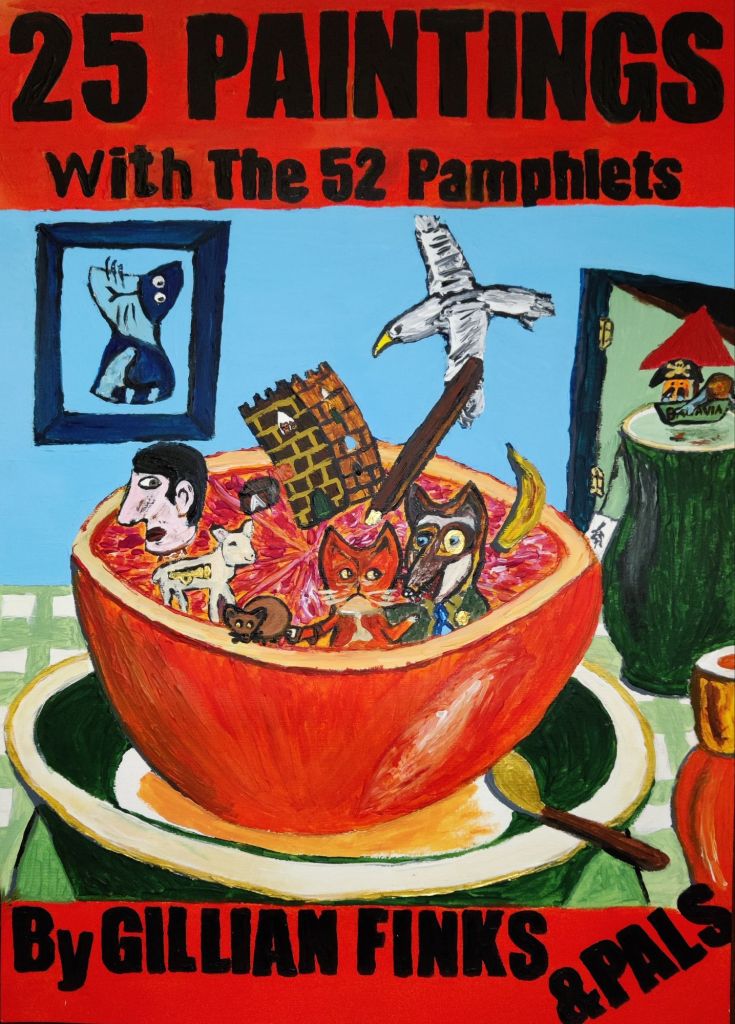
Gillian Finks and Douglas Kanning are “otherwise disposed” (as the acting chair of the GANTOB committee puts it), for entirely separate reasons that we may be able to explain at another time. The fourth GANTOB book is complete – GANTOB’s 25 Paintings (incorporating the 52 Pamphlets) – and was printed last month, with the boxes delivered to Kanning, AKA The Benefaktor, in his retreat somewhere in the Atlantic Archipelago. Distribution, however, has been delayed, as announced previously, for reasons that I cannot divulge.
Occasional submissions to GANTOB (the project) continue to be received. A piece on Bill Drummond’s recent performance in Coventry, has sent me back to one of my own contributions to the forthcoming book. This piece – slightly edited for this blog and renamed The Killing Moon to link with the Coventry piece – replaces Katie Kanning’s pamphlet Piles in the book.
Anton Chekhov (1860-1904) has made appearances in the GANTOB oeuvre previously. The Russian author and playwright was widely published and critically acclaimed in his lifetime, and remains popular. Indeed, a volume of newly translated short stories, that were published in their original form before Chekhov was 23 years old, has just been released, edited by Rosamund Bartlett. It is on my 2025 Santa list.
In her introduction to another anthology of Chekhov’s early short stories – The Exclamation Mark (2008) – Bartlett notes: “Half the stories in this collection were written for the St Petersburg-based Fragments (‘Oskolki’), which was Russia’s most popular comic weekly in the 1880s”. Wikipedia tells us that it was a weekly magazine published from 1881 to 1916. A further internet search finds issues filed in university libraries, some in the “oversized” sections. Not quite a pamphlet, therefore, but still something that was issued for quick consumption, and probably thrown away by many. Bartlett notes that the stories allow us to “follow in some detail Chekhov’s creative evolution at a very interesting point in his career, when he was already popular, but not yet a literary celebrity. It was during this six-month period that Chekhov published a story under his own name for the first time, received a momentous letter from a celebrated contemporary author exhorting him to take his writing more seriously, and published his first major short story collection, which he called Motley Tales”.
Bartlett also highlights that Chekhov started writing for Fragments under a variety of pseudonyms. For example – “The Brother of My Brother”, or “The Man Without a Spleen”. His best-known pseudonym was “Antosha Chekhonte”. GANTOB also likes pseudonyms.
Chekhov’s early work demonstrates that there is a purpose to writing regularly, practising, aiming for publication. He starts with short pieces, often just a couple of pages long, in settings close to his own life, focusing on a single idea. He evolves to longer pieces, using that space to explore other lives and settings, weave in social comment and emotional development, and sometimes thwarted love and even tragedy. We can see the speed of the writing and publication in the shifting seasons and, more specifically, in the dates – The Rook, for example, published in Fragments on 29 March 1886, came shortly after a newspaper story noting the rooks’ return to the city on 18 March.
These explorations of Chekhov, at a point when I was immersed in GANTOB duties, highlighted a number of coincidences.
Bill Drummond and Chekhov both appear to enjoy the number forty – if you are in any doubt about the former, check Katie’s later pamphlet Forty Forties. The rook in Chekhov’s story highlights the human beings’ short life span – perhaps 40 productive years – a trifle compared to the bird’s longevity. This is particularly poignant given that Chekhov died at the age of 44, succumbing to tuberculosis (a disease which shares its initials with our absent funder, The Benefaktor).
Drummond has also written about rooks, in his Sixteen Rookeries and Rookery Threads for example. He writes about birds, a lot.
Take this excerpt from Penkiln Burn Poster 466 (2012), reproduced in Drummond’s 25 Paintings:
Rookery Threads Choose a map of an island In early Spring/ embark on a journey/ from one coast to another coast/ of this chosen island On your journey observe/ sixteen Rookeries At each Rookery/ reflect upon the Rooks who have survived the Winter Then reflect on the Rooks now rebuilding their nest for the season ahead Bill Drummond, PB Poster 466
I am sure you get the idea.
Another favourite word of Chekhov appears to be “martyr”. In his story Terror, for example, there is even a character called “Forty Martyrs” (who, it has to be said, does a lot of coughing; perhaps he also had TB).
Martyrs also seem to be important to Bill Drummond. He has written at least twice about the Wigtown Martyrs – Margaret Wilson and Margaret McLachlan – executed on 11 May 1685 for refusing to abandon their support for the National Covenant. The Covenanters, many based in Galloway in the southwest of Scotland, were seen as a threat to the monarchy and its relationship with the church. The Covenanters wanted to protect the kirk from bishops. Around 100 members of The Covenanters were executed in just a few months, sometimes without a trial. It is a period of Scottish history sometimes known as “The Killing Time”.
In a short section of Drummond’s book 25 Paintings (2014), focusing on Wilson (the younger Margaret, around 18 years old), he is understandably horrified that she was “tied to her stake in the Wigtown Bay waiting for the returning tide to drown her”, noting that “the quick sands and mud flats of the Wigtown Bay featured in many of my boyhood nightmares”.
And then, on 18 April 2025, in a now-deleted post on the Penkiln Burn website, he wrote the following for people preparing to attend “Voices from the Galloverse” events in New Galloway (10 May 2025) and Newton Stewart (11 May 2025):
As the waters overtook the matron martyr the younger woman was implored by her friends to give in to her persecutors, yet she continued to pray and recited verses from the 25th Psalm. Her executioners continued to try to break her and she was dragged half-dead from the waters and urged again ‘to pray for the king’…. She had already been overwhelmed in the horrors of death; the black devouring floods were hissing at her feet, as if greedy for their prey; life, and the sweets of life, inviting her one way; death, in one of his most wild and horrific forms, yawning to swallow her up the other way. Quoted by Bill Drummond in Penkiln Burn post: A Public Execution
Drummond references a painting and sketch depicting the Wigtown Martyrs: a Pre-Raphaelite painting by John Everett Millais in his 2014 book, and a version of an uncredited woodcut in the 2025 blog post. In the woodcut you can see Margaret Wilson’s supporters praying on the shore – her congregation if you like. Margaret McLachlan is already submerged, only the top of her stake visible in the distance.
So is Drummond, in the Voices From The GalloverseLP (2024) and associated Hear Hard events, reframing formative moments of his career, attaching them to the history of his childhood home in Galloway? On the weekend precisely marking the 340th anniversary of the two Margarets’ martyrdom, he had The Penkiln Burn Players and audience members in New Galloway and Newton Stewart performing songs from the LP live. I do not think that he mentioned the significance of the date. Perhaps it was just a coincidence of scheduling. The songs included Òran Bagraidh, which is believed to be the only surviving example of Galloway Gaelic, a distinct dialect spoken in the area for centuries, declining by the 16th and 17th century and probably extinct by 1800. Margaret Wilson is more likely to have spoken a form of English. Other songs performed by The Penkiln Burn Players were written by bands Drummond managed, released on his Zoo Records label and/or produced. These including Echo & the Bunnymen (Pictures on My Wall, All My Colours, The Killing Moon), The Wild Swans (Revolutionary Spirit), and Teardrop Explodes (Poppies in The Field). These songs feature graphic imagery referencing revolution, violence and religion. Some of the lyrics could be used quite effectively to illustrate the story of the Wigtown Martyrs:
From Revolutionary Spirit: “The Congregation… Is the saviour of our youth… The revolutionary spirit is here…”
From All My Colours: “But you know you must soon go down”
In preparing the audience for a beguiling performance of The Killing Moon, Drummond wrote in his Penkiln Burn post:
Leo Condie, in his role as the Choral Master of not only The Penkiln Burn Players but the whole of The Galloverse, will expect and encourage those in The Congregation who identify as Female to become Selkies for the duration of the performance of this Psalm, thus find their inner Selkie voices to compliment the voices of Angie Darcey and Suzanne Bonnar. This being done in the hope that the tide and Killing Time can be held at bay: Under blue moon, I saw you So soon you’ll take me Up in your arms, too late to beg you Or cancel it, though I know it must be The killing time Unwillingly mine
The lyrics, of course, are from The Killing Moon.
I would like to believe that Drummond’s life work has been guided by his horror of hearing about the martyrdom of Margaret Wilson in childhood. But we should not jump to conclusions. While Drummond had considerable and sometimes infamous influence over these bands’ careers, the songs were written by Echo & the Bunnymen (Ian McCulloch, Will Sergeant, Les Pattinson), The Wild Swans (Paul Simpson) and Teardrop Explodes (Julian Cope, Gary Dwyer, and Michael Finkler). Drummond, a genius of reinvention, is shaping these events into a new story; one that in 2024-2025 is taking his career in fascinating new directions, including the soundtrack LP to the film STAY, which was released on August 2025 and has been the subject of GANTOB posts by Graham in September 2025.
In a series of coincidences, there are other Bill (or at least William) Drummonds in this New Covenanters diversion, on both sides. William Drummond, 1st Viscount of Strathallan (1617-1688) and Sir Thomas “Tam” Dalyell of the Binns(*) (1615-1685) were commanders of the Scottish Royal Army fighting against the Covenanter dissidents in the Battle of Rullion Green, 1666. More strikingly, another William Drummond (1793-1888) raised two monuments close to Stirling Castle. The Martyrs Memorial, in the Old Town Cemetery, features a white marble statue of the two Margarets and Agnes Wilson (Margaret’s younger sister who was ultimately spared) under a protective cupola. In the neighbouring Drummond Pleasure Ground, the imposing Star Pyramid is dedicated more broadly to all those who suffered martyrdom in the cause of civil and religious liberty in Scotland. The Stirling Drummond family had interests in agriculture, explored Africa (though I cannot be sure that they reached the Congo), and established the Drummond Tract Enterprise, famed for their pamphlets (albeit of a religious nature). Presumably the pyramid in the Drummond Pleasure Ground has been pointed out to Bill, along with any number of coincidences relating to Bill or William Drummonds from across the world and throughout the centuries. It’s a common enough name.
The Star Pyramid, Drummond Pleasure Ground (Credit: ALI FINKS)
Back to the current Bill Drummond though, and we can see evidence that his interest in the Wigtown Martyrs, while no doubt informed by stories heard in childhood, has not always shaped his musical output, even when in Galloway. The Man LP (1986), though recorded in McMillan Hall, Newton Stewart, Galloway, does not have any references to the martyrs. Queen of the South, a track on the 1986 LP, and hummed by the Penkiln Burn Players on the 2024 LP, is presumably a reference to the football club rather than a brave young woman in the waves off Wigtown.
Anyway, I think that is quite enough diversions for one pamphlet. Enough killing time while we wait for Douglas Kanning to turn up.
MAUREEN, also known as the Deputy General Manager of GANTOB (the project)
24 November 2025
(*) Another name with a legacy spanning the centuries.
30 August 2025 (approximately 21:00). And then we’re onto the live set. All of the acts sing their own song, accompanied by The Gold Tips. So they have full production rather than the version recorded in The Cell of Curfew Tower. They also sing an Elvis cover. The Gold Tips leave their own Elvis covers until the end of the show. As you can see from the dates of the Elvis songs listed below, this was not a simple re-enactment of the 1968 Comeback Special.
The set list runs as follows, with additional detail about the history of the Elvis tracks from various sources, including Wikipedia.
The Gold Tips
True to the Trail (by Bill Drummond, from The Man, 1986). The Gold Tips version appears to add a twist of Steve Miller’s The Joker to the bassline in the live version. Intentional or not, I like it. It is worth noting that the version recorded for side 2 of the STAY LP was taped in Glasgow not in The Cell of Curfew Tower. It features whistling and finger clicking by Leo Condie and scat singing by Tony Wright. The fact that this was recorded in La Chunky Studio in Glasgow allows us to check on the birdsong and cawing (rooks perhaps) that appears on the other demos on side 2 of the record. It’s there too on Leo and Tony’s recording. Either they took the rooks and songbirds with them to Glasgow, or the avian cavalcade was added later. Perhaps this is what Bill is referring to in his blog post of 13 July: “In the beloved dead uncle’s attic, pieces of disturbing music are conceived and constructed and then sent to the temporary lodgings, where they are taken apart and sewn together with the sound of footsteps on stairs and doors closing and beds being chopped up and birthday cakes being thrown on the fire and bees buzzing and waves breaking and Rooks gathering and rivers flowing and bicycles falling and all those other sounds that we never notice enough in our passing lives”.
Do You Remember All The Lights (Eamonn McNamee of The Gold Tips). It’s a heart wrenching lyric – “I’ve been down that hole too long,/I’ve lost all my light I fear”).
Tony Wright, AKA VerseChorusVerse
40 Hours To Memphis (Tony Wright). It is interesting that he adapts the live Elvis album title “48 hours to Memphis”, perhaps to build in a reference to one of Bill’s favourite numbers (40). Beale Street, also mentioned in the song, is important to Elvis’ career, but also central to the recording of many other musicians and the civil rights movement in Memphis. Elvis didn’t record at Memphis after 1955, until early 1969, just weeks after his Elvis set had been broadcast to critical acclaim. That becomes relevant to songs later in the set.
Hound Dog (Jerry Leiber and Mike Stoller, famous for numerous hits including Stand By Me (1961), which they co-wrote with Ben E King). A blistering version of the song made famous by Elvis in 1956, but originally recorded by Willie Mae “Big Mama” Thornton with Johnny Otis and his orchestra in 1952.
Paula Flynn
Elvis is Alive (Paula Flynn and Eda Flynn). An upbeat and catchy song used to excellent effect at the very end of the film. It tips its baseball cap to final phase Elvis. He is in Hades, eating burgers and kissing pretty ladies. Unlike Annie in a song later in the set, the narrator receives a letter from Elvis.
Suspicious Minds (Mark James – see also Always On My Mind). Recorded 1969, in Memphis. Paula refers to this as Elvis’s last hit when he was alive – his last US number one. His decision to return to recording in Memphis has paid off.
Tanya Mellotte
Prestwick 249 (Tanya Mellotte, originally from Scotland, now based in Belfast). This song is narrated from the perspective of Annie Murphy (different sources also spell her name as Ann and Anne). She was one of the fans who met Elvis during his only touchdown on British soil – 3 March 1960 – while he waited to fly back to the USA. She wrote her number down for him at his request – the title of the song. A Scottish alternative to Glen Millar’s Big Band classic Pennsylvania 6-5000 perhaps. Tanya notes that Ann married Andy the “Prestwick Elvis”. Andy died in 1997 and was buried in his blue suede shoes.
Always On My Mind (Wayne Carson, Johnny Christopher and Mark James). Released by Gwen McCrae, Brenda Lee and then Elvis in 1972, with the latter achieving the success with the song, though it was the Pet Shop Boys’ version that topped the UK charts. Elvis’ version was recorded in California. He had left Memphis behind again. The song is thought to reflect Elvis’ feelings about losing Priscilla. It was recorded in March 1972 after their separation in February 1972. Tanya performed this as a rousing singalong.
Duke Special, AKA Peter Wilson
Forgotten (Duke Special and Andrew Doyle). A breakup song, with Peter effortlessly rising to meet the high notes of this plaintive song. Elvis was married just once, to Pricilla Beaulieu (the person not the spider), having met her at the age of 14 when he was still in the army. They married nearly 8 years later in 1967 and divorced in 1972 and again 1973 after Priscilla sued for fraud over the first divorce. Peter has Elvis wondering whether Priscilla thinks about the trappings of their time together at Graceland, from pictures, peacocks to the songs that he sang. My notes scribbled during the show say “Priscilla was going to have to sell Graceland to pay tax bills”. If Peter did say this, I am not sure if he means Beaulieu or the spider, and Memphis or the Glens of Antrim.
(Marie’s the Name) His Latest Flame(Doc Pomus and Mort Shuman, famous for this and many other songs, including Save the Last Dance for Me (1962) and Viva Las Vegas (1964)). Another rocking cover,Peter moshing away at the microphone. The song was originally recorded in 1961, first by Del Shannon, with Elvis’ version topping the UK charts for a month that year. If we wind forward the clock and are considering Elvis’ love life after Priscilla, Elvis dated Linda Thompson from 1972 to 1976. She went on to marry Bruce Jenner (now Caitlyn), alma mater Graceland College (in Iowa not Memphis), decathlon gold medallist at the 1976 Olympics. More famous nowadays for reality TV.
Arborist, AKA Mark McCambridge
Are You Still The King? (Mark McCambridge). He talks about having had a tight time scale imposed by Bill – just two days to complete the song. Mark spent some of his childhood years in Cushendall: he recalls his “stolen summers” fondly. The song is very much in the spirit of the Curfew Tower residence: “Have you found some kind of peace/ In that tower by the sea?”. Mark sings “Are you still the king?” one last time and an audience member shouts out: “Fuck yes”. Yes indeed.
True Love Travels on a Gravel Road (Dallas Frazier and A.L. “Doodle” Owens – a country music songwriting duo who wrote a string of US country chart toppers for Charley Pride, all completely new to me). 1969. Recorded at American Sound Studios, Memphis. Something to explore another day.
The Gold Tips, Eamonn McNamee and colleagues
If I Can Dream (Walter Earl Brown). Written and recorded in June 1968, this is a song from the finale to Elvis’ “1968 Comeback Special”. We can be precise about the timing because it was written specifically for that event and in response to the assassination of Robert F Kennedy, 5 June 1968, when he was running for the Democratic presidential nomination. Richard Nixon won that election on 5 November 1968, against Democratic candidate Hubert Humphrey. The lyrics refer back to Martin Luther King Junior’s “I Have a Dream” speech (28 August 1963), with particular poignancy as Luther King had also recently been assassinated (4 April 1968), in Memphis. Elvis’ manager Colonel Tom Parker was not keen on Elvis performing this song. Elvis was keen to give it a shot, stating “I’m never going to sing another song I don’t believe in. I’m never going to make another movie I don’t believe in”.
That’s All Right (Arthur William “Big Boy” Crudup). This song was originally recorded by Crudup in 1946, with a re-release in 1949 as an early – perhaps even the first – 45RPM single. In fact, its origins go back further, with some of the lyrics traditional blues verses recorded by Blind Lemon Jefferson in 1926. Elvis recorded his version on 5 July 1954, with Scotty Moore (electric lead guitar) and Bill Black on string bass. All three musicians were credited on the record. Their version was much more up tempo than the original. Though Crudup was credited, he didn’t receive royalties, even after legal action, in part because of the much longer history behind the lyrics. The single was released on 19 July 1954 – Elvis’ debut. It didn’t chart nationally, but did reach number four in the local Memphis charts. It’s the final song of the evening. A fitting return to Memphis for The King.
31 August 2025. Bill posts about another track – Fairport Convention’s Farewell, Farewell, performed by Leo Condie, the musical director for The Penkiln Burn Players and the Hear Hard events. He is featured on the rough demo side of the record, for the performance of True to the trail with Tony Wright, but Leo did not perform at the 25 Comeback Special. It’s an interesting choice of song. It is yet another confirmation of Bill’s admiration for Fairport Convention. Leo’s rendition of the song was intended for the end credits of STAY, but that never happened “along with all of the other things that never happened”. It is a beautiful rendition of the song. The original (by Richard Thompson, building on the traditional folk song Willie O’Winsbury), features on Fairport Convention’s 1969 LP Liege & Lief, their fourth album. Bill mentioned their second and third albums in the lead up to his Cushendall event:
“Back at one of those turning points in between the release of What We Did On Our Summer Holidays (December ’68) and Unhalfbricking (July ’69), a Bill Drummond started to wonder if The Beatles were to release a single with nothing on the label, as in no information about who the band was, or the record label, or the writers of the song – just a white label, what would happen?”
This of course leads to all sorts of other Bill Drummond type explorations of his career.
But that is not where we should leave this step-by-step description of Bill Drummond and friends’ 25 Comeback Special. We should now consider its impact.
For that we need to return to one of his first pieces about Curfew Tower. His I Love Easy Jet pamphlet (1999). In 2025, by one measure a 25th anniversary of the residencies at the tower, we can appraise this year’s event’s impact as an artistic endeavour. In the 1999 pamphlet Bill has the tower as a “real folly”, a gaol. Bill writes that Turnly was “fired by a vision of a New World Order and a system of beliefs enabling man to live at peace with fellow man. Cushendall was to be the centre of this new Jerusalem”.
While this was no doubt a reference to William Blake, it is quite possible that Bill was also thinking about peace in the Middle East, back to the K Foundation’s 1993 single K Cera Cera (War Is Over If You Want It), a period marked by the Oslo Accords of 1993-1995 with Yitzhak Rabin (assassinated 5 November 1995), Yasser Arafat and Bill Clinton. In 2015-16 Curfew Tower hosted Sagit Mezamer, artist, curator and clinical psychologist from Jerusalem. The resulting book, instigated by Raymie Watson, with contributions from the Israeli artists, plus Bill Drummond, is a black and white striped book called Ireland versus Israel (Penkiln Burn book 21, 2017), though much of the material had presumably been written before that point. It covers complicated topics, including conflict and troubles in the Middle East and Northern Ireland, with nuance and shades of grey. In it Raymie mentions tours of Ossian’s grave and other archaeological sites, plus tours of the more recent history of both Belfast and Jerusalem. Bill, in a chapter called A Game of Vanities, mentions a rotting albatross, Elvis and the North Pole, the Congo and the garden of Eden, and a third trip that he had planned for 2018, in the footsteps of Juan Ponce de León (1474-1521) searching for the Fountain of Youth with Mark Manning and Gimpo. This Gilgameshian quest was planned to end in Florida, USA. By that point, of course, Trump was installed as US President and was spending a considerable amount of time in Florida. Whatever the reason, I do not think that Bill, Mark and Gimpo made the trip.
I Love Easy Jet also mentions McAllister’s across the road (for Calor gas), but does not clarify whether there are thick paint brushes or rollers in the hardware store.
In the pamphlet Bill fears being seen as elitist for wanting to dedicate the tower to artist residencies rather than being a second home for a well-to-do family from Belfast. He notes the potential perils – “Curfew Tower was considered by the locals as their tower” – using it as the logo on all “local tourist, civic or sporting printed matter… it was seen as an icon that symbolised the whole community”. Anything else – including the dreams of a writer/ musician/ maverick – is temporary.
I Love Easy Jet was written on 10 November 1998, on the way back from Belfast to Luton, on an EasyJet flight. It was “randomly placed in the magazine pouches on the back of seats on Easy Jet flights” (KLF.DE), presumably in 1999. I notice when writing this up that Bill produced a story about the outbound journey for that trip – 8 November 1998, included in his book 45 (Little, Brown, 2000) – Art terrorist incident at Luton airport. The “art terrorists” in that chapter were not Bill and Jimmy, but a couple of young guys with a toy gun. A teapot with loose leaf tea takes a supporting role. He was clearly travelling backwards and forwards regularly to Belfast at that point. 45 has an earlier chapter called Towers, Tunnels and Elderflower Wine (September 1998) that features some awkward artistic props being ferried back to mainland Britain, retrieved from the tower for his friend Mark Manning.
But my main reason for returning to I Love Easy Jet is this: Bill states in 1999, “Long-term objectives: To create an event that the residents of Cushendall are both involved in and proud of, even if much of the work produced by the artists in residence does not fit within their/ our preconceived notions of ‘proper art’… To create a time and place where the artist in residence is happy to talk to any local who shows interest in what s/he is up to”.
I would argue that, though not securing world peace, or even ceasefire in the Middle East, Bill’s great folly of Curfew Tower has achieved his stated long-term objective. A large chunk of Cushendall seemed to be at the 25 Comeback Special on 30 August 2025. There was joy, reflection, dancing, singalongs, rock and roll, the summer homecoming of a McCambridge, and copies of a Penkiln Burn record sitting in the music collections of numerous households in Cushendall for the first time (unless they had bought Voices from the Galloverse earlier this year, or stolen Susan Philipsz’ 7”).
It goes almost without saying that Curfew Tower is an inspiration, even if you don’t stay there. From Susan Philipsz and her MiniDisc to the musicians from last night popping into the tower for a couple of hours to record on much more basic equipment, the tower has been a catalyst. It is there too, as the inspiration for a cat filled tower (Cushionpaw Tower) in the paintings in GANTOB’s new book, GANTOB’s 25 Paintings. But if it’s truly owned by anyone, it’s the residents of Cushendall themselves.
I also think that the 25 Comeback Special secured its short-term objective. The ghost of Elvis ruled last night, spreading his misty tendrils from Curfew Tower, along Shore Street, avoiding the left turn onto Layde Road, to keep going along Shore Road to Cushendall Golf Club. He brought the story of a puppet to life on film and guided a programme of music that stretched from the very origins of his career to his last big hit and beyond, without even including the crowd pleaser of In The Ghetto for KLF fans, a song which Bill has used more than once at different stages in his career. (In the spirit of completeness, I should mention that this song was recorded in 1969 in his American Sound Studio, Memphis phase; written by Mac Davis who also co-wrote Elvis’s posthumous hit A Little Less Conversation with Billy Strange, topping the charts around the world in 2002). Having known very little about Elvis previously, I, for one, will never view him the same way again since this brush with Elvis and Bill.
We can also answer the question Bill asked in Leith in 2019. Bill loves Elvis, and (The Ghost of) Elvis loves Bill. There’s not a paint brush bristle between them. The young Bill might have gravitated towards the 1950s hits, but the current Bill Drummond has coaxed some great songs about Elvis out of contemporary artists, and his event also breathed new life into hits from across Elvis’ career. Elvis’ ghost, as we have already established, is delighted with (and has shaped) the results.
Bill has posted some of his own thoughts on 25 Comeback Special on the Caught By The River website, which should be around for more than the duration of a Drummond webpage.
Stephen and Michelle drive us back to Belfast Port, for our return to Scotland. Our pilgrimage to Cushendall is complete. Stephen drives up the same road from the Antrim village that Tony Wright cycled down with his puppet Elvis. I look out for milestones at the side, but am not quick enough. On an overcast day it looks rather like the road from Dalwhinnie to Laggan in the Scottish Highlands – bleak. We spot a Circle K filling station. I start writing this piece in my head. I want to listen to music that I have never heard – I will start with Fairport Convention. I’ve had enough Elvis for a while. I want to read about Ossian. I want to learn about John Hewitt, the poet.
I wonder if Curfew Tower has artists in residence this year. I think about points that I had forgotten in the film, until now. On the door frame in the kitchen of Curfew Tower, one of the few parts not painted by Tony Wright in red during the film, there is a mark for “Raymie”. Either it was for a young child, or Raymond Watson was crouching. Perhaps I will check the door frame and ask Raymie if we go to another bonfire and curry night. I think about a crystal dangling in the window of Curfew Tower, Barbies and beach burials. It is a blustery day. They talk about using stabilisers on the ferry. I wonder if we will see the remains of the frame and canvas thrown out into Cushendall Bay, painted white on red, with the word “STAY”, as we pass across the Irish Sea.
THE END
I would like to thank Stephen and Michelle for their friendship, and all the lifts. Liz for her patience – most recently, over the past 15 months in Merseyside, Galloway and County Antrim. Stu and Carolyn for also being part of the K Circle. Bill for all the inspiration. Cushendall Library and the tourist information centre for all the interesting materials to peruse on a rainy Antrim Saturday. You for reading to this point, 10,000 words into a deep dive into the 25 Comeback Special. GANTOB for the copy of GANTOB’s 25 Paintings, the pamphlet What is Proof? and for hosting this sequence of posts.
GANTOB would like to thank JR for the comments, correcting typos, and the story about the KLF T-shirt facilitating transit through airports to Portugal. Rather a different experience to that of the art terrorists in Luton. Like the story of Heartbreak Hotel, I have been unable to establish the provenance of Bill’s EasyJet story…
The Benefaktor would like to thank Graham for the photo of Ossian’s grave and for transporting the new book and pamphlet to Stephen.
The Deputy General Manager of GANTOB (the project) would like to apologise to The Benefaktor for all the typos that were missed when uploading this piece the first time. If you are an email subscriber you will have a record of them in your inbox, and will be able to spot the additions that Graham has requested subsequently. There may well be more mistakes to correct. If you spot any, please do let us know, usual routes. Life is busy and things are often done in a rush.
30 August 2025. It is due to rain most of the day.
When I received my package with two copies of the proof of GANTOB’s 25 Paintings (plus What Is Proof? pamphlets), in neatly secured bubble wrap, there was a handwritten note inside. It read, in a left leaning italic script, written with a blue fountain pen:
Graham, I thought that the enclosed might appeal. Please read the pamphlet and do the needful. If time, when you are in Cushendall, would you mind taking a photograph of Ossian’s grave? Many thanks, The Benefaktor
Stephen, Michelle, Liz and I take a trip early on to Ossian’s grave, on the hill behind the B&B. I know some of Ossian’s story from trips to the National Trust’s Hermitage in Perthshire, but learnt more when reading The Benefactor’s piece “Mountebanks”, as featured in the proof for the new GANTOB book. It is a submission for a missing year in Bill Drummond’s biography The Life Model (2023). The grave is also mentioned in local tourist literature. We walk up from the carpark, past some other hikers. In a field near the top, with views over the rolling hills, nestled in among rowan trees, we come across a cairn dedicated to John Hewitt (1907-1987) and his “chosen ground”. Not Bill’s collaborator. This John Hewitt was a celebrated Northern Irish poet. Coincidences and connections in Bill’s web of ley lines.(#) In a dip in the field, stones mark the site reported to be Ossian’s burial site. There are orphan stones of the same type lying elsewhere in the field. It is starting to rain. We head back, past others coming up to visit, trying to beat the rain.
I note that Emma Must’s piece for The Curfew Tower is Many Things mentions both Ossian’s grave and the John Hewitt cairn. As a Northern Irish poet, Emma would know who that John Hewitt was, but presumably not Bill Drummond’s former associate of the same name. Also, on looking through After Curfew again, I spot that Ossian’s grave is mentioned in Skye McDade-Burn’s chapter. Beyond that, I cannot see any particular reason why The Benefaktor would be interested in Ossian. I haven’t found Bill referencing the grave, but it may well be tucked away in a corner of his writing, and I imagine that he would have explored it, even if just as a tourist visiting the area for the first time.
(#) I spotted a pub named after the poet when I was in Belfast in 2023, staying in a Premier Inn in the Cathedral Quarter. Looking it up now I see that Bill was artist-in-residence at the Cathedral Quarter Arts Festival, 2004, making soup. The John Hewitt pub is mentioned in a Belfast Telegraph article featuring Bill Drummond from that period.
We spend the rest of the day dodging the rain. In the library we find rows of history books about the Glens of Antrim, including standalone books and bound volumes of the journal Cushendall Focus. Curfew Tower features prominently. We find a feature in Cushendall Focus on The Big Scarf by artists in residence Jane Twigg and Astrid Bin (16-24 February 2008). In the Cushendall Local Information Office, which doubles up as the Glens of Antrim Historical Society, there is even more information about the town and area. Volume 29 of The Glynns (2001), Journal of the society, has a picture of Curfew Tower on the front. There is not an article about the tower inside, but I spot an obituary for a James McCambridge, and wonder if he was a relation of Mark, AKA Arborist. I flick through an article on postcards (sometime medium of Bill Drummond), and learn from an article by Robert M Bonar, that postcard collectors are called deltiologists, from the Greek word deltion, meaning a small writing tablet. Volume 44 of The Glens (2016) has a feature on fifty years of archaeology by Cormac McSparron, mentioning Ossian’s grave in a section on the earliest farming communities. It is a passing reference. Volume 49 (2022) has an article by Fr Kevin McHugh on the literary hoax around Ossian’s poems, which takes us full circle to The Benefaktor’s Mountebanks chapter. Cushendall is an area so steeped in history, real and imagined, with so much documentation.
I wonder what Robert M Bonar would make of Bill Drummond’s twinning project: see city 1, Belfast, 2000: “Twinned with your wildest dreams”. The photo is taken underneath a motorway sign dividing the road into lanes – Belfast, Belfast East, Bangor. I should note in passing that I have history with Bangor, involving a painfully on-off relationship in my late teens and early twenties. The less said about that the better.
We bump into Zippy, out with his family. He tells us that tonight’s gig is sold out. Two hundred tickets were available and he has sold 50 to locals, but likely more have bought tickets online. We have lunch in North Coffee. There is a counter for John Healy Photography which sells, among other things, Curfew Tower fridge magnets.
Eventually we brave a walk through the mizzle up the road towards the ruins of Layd Church. The tiny church packs a punch – the hole stone, with its connections to the (“infamous”) MacDonnell family, and perhaps a much longer (even pre-Christian) history; and the burial site of James McDonnell (1798-1845, with a grave marked by a more traditional Celtic cross) a physician with a social conscience. We don’t hang around. It’s pouring. Indeed, it’s too wet and slippery for the cliff path. We head back to the B&B for a short break from the elements. And then it’s time for the 25 Comeback Special.
Doors open at 18:00. There is a strong sense of anticipation. I spot Duke Special (AKA Peter Wilson) setting up at the side. I introduce myself and tell him that my kids, particularly our second daughter, loved his album Songs from the Deep Forest, particularly the song Last Night I nearly Died (But I Woke Up Just in Time). When Iona was 4 years old, October 2006, I was heading off to see Duke Special and Divine Comedy at Liquid Rooms, central Edinburgh. Iona asked for a story before I headed out. And in the process I missed Duke Special’s set completely. I’m looking forward to seeing him play tonight. We take our seats. But the show does not begin until 18:45.
Bill comes on and talks about negativity. He would rather that 40 people saw the film rather than 200. He is on good form. The audience, which seems to be made up mainly of locals, laps it up. He tells us that the film will be seen by no more than 1000 pairs of eyes.
And then we are some of these lucky few pairs of eyes. The film, script by Bill Drummond (which is made available for a couple of days on the Penkiln Burn website after the performance), can be viewed in a number of different ways. An early scene in the film has a long shot of musician and actor Tony Wright cycling down the hill into Cushendall, but not the coastal road that Liz and I took on the bus. They take the inland route. Tony is talking to the puppet Elvis, who is in the basket at the front of the bike. I had read about Tony on the Penkiln Burn website. Bill had written: “My former colleague alerted me to the fact that this unemployable musician was a complicated person. That he had is [sic] issues.” These were, of course, selling points for Bill: “he was the right man for the job. Choice was not an option”. So, when I watch the film, I imagine that the words I am hearing, between Irish and American accents, are not just spoken by Tony, but originally conceived by Tony. It is all very deadpan but endearing. Tony’s facial expressions are extremely well acted.
Puppet Elvis: What are They The Artist: Lambs Puppet Elvis: What are Lambs for? The Artist: For eating, we eat Lambs, or at least humans eat Lambs, puppets don’t have to eat. Puppet Elvis: What eats humans? The Artist: Time and mosquitoes.
Later there is a lamb skull. Life is a cycle.
There are yellow flowers. I think of ragworts. There is no doubt a lot of symbolism that would not be spotted the first time watching. There are stickers on back of the picture frames. I noticed them in May when a group of volunteers, recruited from the audience at the Voices from the Galloverse events, helped Bill and Tracey move the 25 Paintings across Penkiln Burn onto an island. I recognise a Great Yarmouth sticker on one of the picture frames in the film.
The script mentions imagery that might only be detected subliminally, at the very start. Perhaps it is just as well we can’t buy the DVD and rewatch the film, driving friends and family mad with our finger on the freeze button.
Tony and Elvis discuss photos of Elvis and Bob Dylan. One is deified, the other vilified. Bill has complicated relationships with past heroes.
Watching Tony go through the stages of a residency in Curfew Tower, reinforces this feeling that the film is about him, with Tracey Moberly invisibly on hand to capture the key moments.
He bakes a cake. Elvis compliments his one-handed technique for breaking eggs.
He makes a bed, as detailed in Penkiln Burn Poster 283 (2024), shown and read out in full in the film. He destroys another bed. Life is a cycle.
There is a house spider in the bath called Priscilla, Queen of The Glens.
There is knitting required, to keep Elvis comfortable. I think of the scarf I learnt about earlier in the library, keeping the tower warm.
He burns the ruined frame of the bed, like the cake, in the small walled garden behind the tower. The grass does not appear burnt in the next scene from the garden. Life is a cycle. Or there is something positively Lynchian going on with time, like Mulholland Drive.
He has a contretemps with a huge painting of scissors. He paints over it with the word Stay. He doesn’t shine shoes. He doesn’t make soup. He doesn’t mention rookeries (though there is a dead crow). But otherwise, the activities are straight out of Bill’s book 25 Paintings and other writing.
How could I be so stupid. Stephen realises that the film represents Bill’s life from the start I think – the cake is destroyed on the bonfire, representing the family birthdays missed by his madcap activities. The distressing phone call to family from the public phone box outside the tower. The tortured, twisted painting of the tower. Having Tony paint the inside of Curfew Tower a visceral red, with a narrow brush, can no doubt be linked with another aspect of Bill’s life.
But then there is the song – 40 Hours to Memphis. This is clearly Tony’s work. He wrote it, and recorded it, first in The Cell at the bottom of the tower, on a basic tape recorder, and then in the studio with The Gold Tips. There is a blurring of lines between Tony and Bill. And there is uncertainty about the terms of the residency. Did Tony really live in the tower during filming? Would there not have been rather strong paint fumes? Would this not have damaged his health and voice? Did any of the artists on the STAY LP that we are about to hear performed live, stay, write and record their song in the tower? It doesn’t really matter of course. Nothing is what it seems.
At times the imagery is Sisyphean (carting a large canvas up a hill or a long road), or biblical (the frame of the picture that Tony carries is like a crucifix; he walks past a cross on a hill). The script in scene 23 states: “inserted dialogue forty… CROSS”. The puppet is instructed to stop asking questions at this point (though he doesn’t comply).
There is a sign by the road, on that final walk, apparently marking the spot of an execution. There was a rifle earlier in the film, but unlike the rule named after Chekhov (somebody who is referenced several times in the new GANTOB book), it doesn’t have to get used.
Things get darker in the film, in a different way. Try to watch it if you can.
There are points that only people viewing the whole process, from Bill’s first blog posts on the 25 Comeback Special in early June, to the screening of the film at the end of August would spot. In the very first of the blog posts, 3 August 2025, Bill writes: “these artists will perform live their second-best song ever written”. When Tony reads out Penkiln Burn Poster 282 during the film he states: “You are an artist in residence here in Graceland in The Glens. It is your duty to write a song for The Ghost Of Elvis/ This song must be the best song you have ever written”.
Bill has asked for questions about the film. Mine would be:
Is it the best song or the second-best song that he wants the artists to record?
Why not use a bigger brush or even a roller to apply the paint? There’s a hardware shop diagonally opposite the tower for goodness sake.
I might email them to him. I might add in a question about the timing of the event and Dallywood earlier in the month.
There is a break after the 90-minute film. We move our chairs, clearing space so that the Ariffe Dancers, a local dance troop, can perform Into The Graceland, accompanied by sounds and songs from the film. It’s an engaging set. I take some footage, as instructed, to send to Tracey Moberly.
There is a lot of local involvement in the evening’s activities, in addition to the Ariffe Dancers. The lighted and open window facing Curfew Tower is a character in the film. The background music in the film is, as Bill writes on his blog: “any number of the community groups and local work colleagues in Cushendall, each singing their single note drone to create the pentatonic scale to lift Duck’s pigeons to the Sky above Cushendall, at the same time be used in the musical score of the film STAY”. The notes of the C major pentatonic scale – C, D, E, G and A. It’s like The Harmonics, but with an extra note and with representation from a whole community rather than just a bunch of middle-aged white male artists. More like The17 then. We also hear that Arborist, Mark McCambridge, spent his summers in Cushendall as a child. Perhaps that was a relative I spotted in the library earlier.
I check my phone, and there is a reply from the GANTOB email account:
The Benefaktor thanks you for your earlier photo of Ossian’s grave, and additional information about John Hewitt. He replies with a poem:
The watchers We crouched and waited as the day ebbed off and the close birdsong dwindled point by point, nor daring the indulgence of a cough or the jerked protest of a weary joint; and when our sixty minutes had run by and lost themselves in the declining light we heard the warning snuffle and the sly scuffle of mould, and, instantly, the white long head thrust through the sighing undergrowth, and the grey badger scrambled into view, eager to frolic carelessly, yet loth to trust the air his greedy nostrils drew. John Hewitt, 1950
I trust you enjoyed the film. Yours, DGMoG (tp) ——————————- There is a cough behind me. I turn. Is The Benefaktor observing (or perhaps GANTOB’s albatross)?
I recall that a badger featured in The KLF’s return after their 23-year moratorium. And there are several mentions of badgers in GANTOB’s 25 Paintings. What is going on? Luckily, I don’t have time to think any more about this. The rest of the show is about to begin.
Friday 29 August 2025. We walk along the River Lagan(+), past six stained-glass sculptures inspired by the Game of Thrones (the Glass of Thrones trail) to the Titanic Museum. We do not have time to go round the full exhibition. Instead we visit the gallery displaying Lucian Freud (1922-2011) in the same building. His etchings, carved into a lay of acid-resistant waxy resin called “the ground”, using a needle, are shown at various stages, with the re-waxing of sections by master printer Marc Balakjian (1938-2017) for re-working by Freud. Etchings of Leigh Bowery (1961-1994), Australian performer, are perfected. Lucian’s daughter Bella is given the same treatment, in a T-shirt featuring an image of Freud’s dog Pluto.
Belfast’s Titanic Museum
(+) Lagan (Laggan in Scotland) is a word shared across the Irish Sea, meaning “little hollow” in Irish and Scottish Gaelic.
I think of Bill Drummond’s rumoured GRAFFIC MODEL (announced 20 May 2024), using wood cuts based on pencil drawings of scenes from his electronically published novel The Life Model (2023). Wood cuts sound a less malleable medium than etching into wax. I can’t even start to imagine what level of skill would be required to produce a wood cut. The project is conditional on receiving 100 pictures.
There are Lucian Freud proofs with a large cross scored across the page. I am reminded to pick up my proof copy of the GANTOB book for Stephen before we head north.
Print of Lucian Freud’s daughter Bella, in various stages of preparation
Liz and I stop for lunch at St George’s Market, and then we’re on our way again, by train from Lanyon Place Station to Ballymena and then bus to Cushendall. This last leg is another scenic trip, with green pastures giving way to forest and then a coastal road that sweeps down to the village itself, through the Red Arch, built by landlord Francis Turnly (1765-1845) in 1817. Turnly, we find out from a tourist information trifold white paper pamphlet with yellow surround called Cushendall’s Curfew Tower was an “East Indian Company nabob (Urdu nawab: a high official or prince), who made his fortune in China”. He erected the tower “as a place of confinement for idlers and rioters”.
Bill Drummond, who contributed pieces to The Idler journal and has at times recommended rioting(*), perhaps felt that the balance should be redressed, to make up for Turnly’s punitive ways.
(*) In a piece for The Guardian (Bill Drummond’s10 Commandments of Art, Sunday 15 June 2014) he wrote: “9 Riot now, pay later Take risks. Don’t rest on your laurels. Don’t ask permission. But be prepared to suffer the consequences of your actions. Don’t blame others. Don’t expect success – not even after you’re dead. Remember, to get one good artist you need to have at least a thousand others struggling in their garrets. If you or I are one of those struggling ones, we’re still doing our jobs”. This was written at a time that Drummond was undertaking an exhibition and artistic residency at East Side Galleries, Birmingham, featuring his book 25 Paintings.
The Cushendall pamphlet goes on to note that Curfew Tower “was purchased and restored by Hearth Revolving Fund [Director, Marcus Patton] in 1992-93… Its present owner, the writer Bill Drummond, established a residency there for artists in 1999”.
Residency. That is the key word for Curfew Tower. A place that people come to live. To stay. To create art. It is a topic well covered in the Bill Drummond pamphlet I Love Easy Jet (1999; Penkiln Burn pamphlet 2). He flew from Luton rather than Elvis’ chosen UK airport, Prestwick. I have a copy of that pamphlet at home. It is an important document in Drummond’s biography, and central to understanding the purpose of his artist residency programme in Cushendall. It expresses concerns that the tower, hundreds of miles away from Drummond’s home, could stand vacant for long periods of time, and therefore be prone to vandalism and other deterioration. It notes the establishment of a trust called In You We Trust with architect Marcus Patton and artist Susan Philipsz, before going on to explain that “Artists of any age, medium, place of birth and professional standing can apply to the trust to stay in the Curfew Tower for a period of not less than one week and not more than one month. While in residence they have to produce a work that in some way relates to the environment (tower, village, glen, state of mind, etc)”.
Towards the end of the “pamphlet” (which is in fact a laminated sheet, text on one side, a solid block of easyJet orange on the other), it explains “Long-term objectives: To create an event that the residents of Cushendall are both involved in and proud of, even if much of the work produced by the artists in residence does not fit within their/ our preconceived notions of ‘proper art’… To create a time and place where the artist in residence is happy to talk to any local who shows interest in what s/he is up to”. I am quoting selectively, but I think that we can see how these ideas eventually settled into the bonfire and curry night.
I cannot remember when the Curfew Tower bonfire and curry nights started. There is a mass-produced postcard for at least one of these events, but it does not state a date. There is a list of participants in the Curfew Tower residencies in the credits to STAY, as shared by Bill on his Penkiln Burn blog in the weeks before the event, and previewed in a post “THE CURFEW TOWER PRESENTS” (7 July 2025). This states that the “Curators” of the tower were In You We Trust (Marcus Patton, Susan Philipsz & John Hirst) 1999-2008, and then a list of individuals and collectives starting with VOID, Derry in 2009 through to Searching for The Miraculous, USA 2019. There are two years marked for Sagit Mezamer, Jerusalem (2015-2016). After two COVID years the Curators are listed as Independent Republic of Užupis (2022), Caught by The River (2023) and of course The Ghost of Elvis (2024). I wonder who the current curators are. They aren’t mentioned in the whole time we’re there.
As I flick through various books produced about Curfew Tower I see the list of curators developing over time. The website version for the 25 Comeback Special is obviously the most complete. The credits also list the various groups contributing to recordings of the C major pentatonic scale. There’s a bakery, RNLI, Ariffe Dance Group, hurly team, youth club, café, men’s shed, inn, drama group, a music group (Comhaltas) and butcher
I look for further information about the bonfire and curry nights, turning to Bill’s pamphlets. The earliest Penkiln Burn pamphlet – My Favourite Colour (Penkiln Burn pamphlet 1, 1999) – is about something entirely different. It’s rather KLF-focused for Drummond’s writing from that era. He’s deliberating on a show at the National Centre For Popular Music in Sheffield, making arrangements with the curator John Hewitt to play a CD copy of The KLF’s Chill Out and display a poster called 3AM Somewhere Out Of Aylesbury. Drummond’s favourite colour is, of course, grey.
Subsequent pamphlets are more useful: Making Soup (PB pamphlet 5, 1998*) introduces us to Drummond’s early experiences in Belfast, and an earlier meeting with Susan Philipsz and Marcus Patton. In Please Pay Me (PB pamphlet 18, 2001) we have Philipsz recording As Tears Go By (the Rolling Stones song made famous by Marianne Faithfull) to play on a record player in an alcove in the tower. There is/was only one copy of this record. Bill notes the likely temptation of stealing such an item. And a little later we have Two Paintings (PB pamphlet 20, 2002) that has Bill heading off to paint his first paintings since 1972. By 2014 he had the 25 Paintings, which in 2022 had their own café (including Corby). One of the paintings featured in the Bill Drummond book 25 Paintings (PB book 19, 2014) was STAY, white words on red canvas, under Spaghetti Junction. Elvis is mentioned in passing in a later chapter of that book. These ideas have had a long gestation.
* The numbering and dating of Penkiln Burn pamphlets can be counterintuitive.
A reminder of Bill’s fierce financial independence in art projects. I’m not sure that he would approve of GANTOB’s arrangement with The Benefaktor
We walk past Curfew Tower, the key-holder Zippy’s butcher opposite which is displaying copies of the STAY LP in the window, past a café and bars, the current Layde Parish Church and then up the road from Cushendall towards our B&B high in the hills behind the village. We hear a shout, and there are Stephen and Michelle offering us a lift. Stephen is the author of the Searching for The White Room Facebook page. They have travelled from Sligo. We accept the lift gratefully. We talk about Drummond on the drive up, speculating on the night ahead and tomorrow’s celebration. This is Stephen’s third bonfire and curry night at Curfew Tower. This is Stephen’s third bonfire and curry night at Curfew Tower. His first (August 2016) was for Israeli artists. Stephen emailed me later that “It was really great fun, an annual event hosted by Bill Drummond and Tracey Moberly during the Heart of the Glens festival. There was also a theatre/choir performance in a community centre down the street directed by Yonatan Levy, who had previously been on a residency there. Then it was back for the bonfire”.
We do not think that there has ever been as elaborate a celebration of Curfew Tower residences as the events planned this year. Graceland has come to Cushendall this year.
I am interested in the Memphis connection. I had assumed that Elvis recorded most of his work in Memphis, but learn that this was not the case. After the 1968 Comeback Special he recorded in Memphis for the first time since 1955. I read on Graceland.com that ‘In 1969, Elvis and his producer Felton Jarvis were impressed by the incredible music being made at Chips Moman’s American Studios in Memphis. Just a few of the hits recorded there include “Sweet Caroline” by Neil Diamond, “The Letter” by the Box Tops, B.J. Thomas’ “Raindrops Keep Fallin’ On My Head” and Dusty Springfield’s legendary LP, “Dusty in Memphis.”’ The Box Tops are a band I’ve come to relatively recently, via Big Star. The Box Tops were fronted by Alex Chilton, who was just 16-years-old when their track The Letter (written by Wayne Carson Thompson) hit number 1 in the USA in 1967 and was a smash internationally. They achieved considerable commercial success before they split in 1970. Bill wrote in his book 25 Paintings that “It is those early exposures to pop music that can determine your musical prejudices for the rest of your life. For me Elvis will always be King and there will never be a better band than The Beatles. I guess it is the same with art”. Bill goes on to note the reverse of the coin, about talent and unobtainable goals (for him this is Rembrandt): “Even if I could master his techniques, I could never in a thousand years of trying, come close to delivering the emotional depth he could. I had more chance of singing like Otis Redding”. I am with Bill on The Beatles. They were a huge part of my musical upbringing, and remain far and away my biggest musical influence (the band and their subsequent solo careers, particularly Paul McCartney). Big Star – Alex Chilton and Chris Bell’s early 1970s band – is one of the few genuine and enduring musical loves I have discovered in adulthood. The band did not achieve commercial success the first time round. Chilton and Bell grew up in Memphis, but the music for which they are best known had its origins in Liverpool. Chilton and Bell were just 15 years old when The Beatles swung through Memphis on 19 August 1966, playing two performances at the Mid-South Coliseum. This was the 8th date of the Fab Four’s last tour (12 – 29 August 1966, playing in 14 cities – 12 in USA, 2 in Canada, playing to 400,000 people). Their final performance to a paying audience was at Candlestick Park, San Francisco on 29 August 1966 – exactly 59 days ago today. Bell was keen that Big Star would follow a similar approach to Lennon and McCartney’s early song writing, bouncing ideas off each other, crediting themselves as Bell/ Chilton. Their writing process was very organic, refining their songs in the studio (Ardent Studios, Memphis). In one telling Chilton is the edgier character, Bell more melodic, bringing brilliant harmonies to their shared lines. Later their recordings become looser and more shambolic, but still compelling and worth repeated listens. Their body of work, recorded 1971-74 is unlike anything else that I have heard. Give them a go. That is a diversion though. In 1969 Elvis wanted to capitalise on the Memphis sound embodied by the Box Tops. We will see some of that Memphis influence in the 25 Comeback Special performance.
We have a quick turn around in the B&B. I give Stephen the heavy GANTOB book in the brown paper bag. I see the pamphlet sticking out the top underneath the bubble wrap protecting the package. We head to our rooms. I manage a few minutes collecting my thoughts. In addition to the pamphlet on Philipsz’ recording, I can recall four books about artists’ time in the tower.
Penkiln Burn Book Five, published 2001, was a slim volume written by Bill Drummond, Duncan McLaren, Susan Philipsz (of 7” Penkiln Burn record fame) and Marcus Patton. Strictly speaking it was volume two of three. PB poster 397 (2012) has volume one as fanzine (In You We Trust: Stay Here & Make Art) and volume three as the website curfewtower.com (which now states simply in grey, on a darker grey backdrop: “THIS SITE HAS BEEN CLOSED FOR THE FORESEEABLE FUTURE”). A trio of books over a decade later celebrate residencies by Irish, Israeli and Scottish writers: respectively The Curfew Tower is Many Things (Penkiln Burn Book 20, 2015) edited by The Seamus Heaney Centre for Poetry at Queen’s University, Belfast; Ireland Versus Israel (PB Book 21, 2017) edited by Raymond Watson; and After Curfew: Neu! Reekie! (PB Book 23, 2019) edited by Michael Pederson and Kevin Williamson. Bill contributes pieces to each book, in emails (like his work with The Harmonics), the occasional chapter, or an interview. There has not been an LP at one of these post-residency parties previously.
I met Duncan McLaren once, in Blairgowrie, as documented in an earlier post for GANTOB – What is GANTOB? which includes a link to my pamphlet Who Were The Harmonics? which was included in copies of the What is Harmonic? box of emails sold in the last couple of years by East Side Galleries. The outcome of Bill Drummond, Duncan McLaren, Simon Wood and Gavin Wade’s musings was a further Penkiln Burn 7” called This is Harmonic (PBR 003, 5 copies, as documented in PB Poster 51, 2003), which featured the four men singing selected notes from the pentatonic scale. I don’t think that Duncan attended a bonfire and curry night. Gavin might have following his later residency (Eastside Projects, Birmingham, 2011).
I can imagine the poets and writers of the subsequent books reciting their pieces or chatting with regulars at the bonfire and curry nights. My main recollection of the 2023 event was Bill talking about a bike left by one of the artists from the Republic of Užupis. The artist had ridden it from Belfast airport, through the rural countryside, and then perhaps down the hairpin coastal road that we have just travelled along. He had decided against cycling back, so had left the bike in the garden behind Curfew Tower, as a prop for Bill Drummond. I don’t remember seeing any of the artists at the 2023 bonfire and curry night.
But we don’t have much time to rest. We have to find firewood for Bill’s bonfire (he is calling it a “bond fire” this year – writing on the Penkiln Burn blog that “it will be the night we can all celebrate either physically or conceptually throwing our ‘bonds with the future’ onto the Bond Fire”.
We spot Bill and family walking back towards the tower as we are heading down towards the beach, near the golf course where he will be holding the 25 Comeback Special tomorrow night. He nods a brief acknowledgement. They have left us some driftwood to collect. After buying zero beers from Cushendall WineFlair on Dalriada Avenue, we head down to Curfew Tower for 19:30. Bill is there with his family, Zippy, some musicians who we do not yet recognise, but will become very familiar faces by tomorrow night, and film maker Tracey Moberly. The choice is chickpea or chicken curry. We opt for the former. It is very hot. Apparently one of Bill’s sons has left the seeds in the chillis when he chopped them up. Stu and Carolyn arrive. We know them from walking a stretch of the K-Line June 2024. They have flown to Belfast and driven to Cushendall. It’s good to see them.
We spot other familiar faces: Raymond (Raymie), who lives locally, is there with his partner. He tells me about his new book What Sort of Artist Are You? Marcus Patton is the best dressed person there, faithful as ever to the trust. Furryman AKA Steve Lally is wearing a hand painted T shirt and tells us about his story telling at Belfast Children’s Hospital. Ann McVeigh and Ken Bartley from ArtisAnn Gallery in Belfast are collecting names of people ever associated with the tower in a folder.
And then it’s time for the activities around the bonfire. Bill keeps a low profile, lying by the fire, clearly enjoying himself. Eamonn McNamee of The Gold Tips plays True to the Trail, Bill’s song from The Man LP (1986).
True To The Trail is a song that Bill has mentioned many times in his writing career. He has a 7”, I think using the version of the song from The Man LP, that he plays to prepare himself for a public performance. It’s mentioned during his activities around A Smell of Sulphur in the Wind. It is there again in The 25 Paintings (2014), quoting from a story 25 Paintings, from June 2005: ‘The performance starts with me walking out on to the floor clutching a toolbox and a record player. I place the toolbox on a table and the record player on the floor. I plug it in, switch it on. Take a 7” single from the toolbox and put it on the record player. The record is called True To The Trail and is a country rock toe-tapper and it is my signature tune’. This story is an update on his pamphlet Two Paintings (PB pamphlet 20, 2002).
Tony Wright, AKA VerseChorusVerse, sings and speaks 40 Hours to Memphis, after a false start where he complains that he “can’t find the key”. We might glance at Zippy, butcher, key holder of the tower, who makes a number of interjections through the evening to promote the STAY LP for sale in his shop. Finally, from the group of performers due to play tomorrow night, Mark McCambridge AKA Arborist, sings Are You Still The King? with such intensity that I wonder if the neighbours might complain. These are three songs that were recorded in The Cell at the base of the tower. We visit the room, taking in the words painted in white on the white wall – “This is Graceland” – and the poster (PB Poster 282, 2024) about the tape recorder in the room. It is claustrophobic, like standing in a red blood cell. It is no wonder that the versions of the songs recorded here are raw and heartfelt, like the versions we have just heard around the campfire.
Eamonn McNamee of The Gold Tips
Last but not least, Ronita sings Elvis’ song Heartbreak Hotel. She holds the audience with her well-judged phrasing. Pleasingly, this was also one of the songs included in Elvis’s 1968 “Comeback Special” TV programme. It wasn’t called Comeback Special in an official release until a CD reissue thirty years later. Originally the TV special, recorded live in June 1968 in California and broadcast on in the USA on NBC on 3 December of that year, was simply called Elvis. It was not shown in the UK until 31 December 1969 under the title The Fabulous Elvis.
Heartbreak Hotel (Mae Boren Axton and Tommy Durden) was written in 1955, apparently about a man who jumped from a hotel window, leaving a suicide note saying “I walk a lonely street”. Elvis, who had just left Sun Records in Memphis, recorded it at his debut session at the RCA Victor studio in Nashville. It was also his first million selling single. Elvis first heard the demo in his hotel room on 10 November 1955. The song had been written by Axton (a teacher) and Durden (a singer-songwriter) in less than an hour, and was recorded first by Durden and then that same day in an imitation Elvis voice by local singer Glenn Reeves (who had originally refused to take it on). After a number of setbacks they managed to play the song to Elvis, who insisted on listening to it ten times over to memorise it, and then performed it at a gig in Arkansas on 9 December 1955. He told the audience it would be his first hit. Elvis Presley died on 16 August 1977, found unresponsive by his fiancée Ginger Alden on one of the eight bathrooms in Graceland. I note, for completeness, that Graceland has 23 rooms. Axton died at home on 9 April 1997, aged 82. She suffered a heart attack and drowned in her hot tub. Durden died of cancer on 17 October 1999, aged 79.
Dallywood sign above The Glens Festival, 9 August 2023, spotted as we walked back after the bonfire and curry night. I wonder why Bill changed the date this year
We spot Elvis looking down from the top window of Curfew Tower. We learn later that it’s the 2016 double vinyl album The Essential Elvis Presley (released on RCA in the US). He doesn’t look ready to jump.
To be continued. Tomorrow we will take a tour of Cushendall, including Ossian’s grave, which is a special interest of The Benefaktor.