Gillian Finks and Douglas Kanning are “otherwise disposed” (as the acting chair of the GANTOB committee puts it), for entirely separate reasons that we may be able to explain at another time. The fourth GANTOB book is complete – GANTOB’s 25 Paintings (incorporating the 52 Pamphlets) – and was printed last month, with the boxes delivered to Kanning, AKA The Benefaktor, in his retreat somewhere in the Atlantic Archipelago. Distribution, however, has been delayed, as announced previously, for reasons that I cannot divulge.
Occasional submissions to GANTOB (the project) continue to be received. A piece on Bill Drummond’s recent performance in Coventry, has sent me back to one of my own contributions to the forthcoming book. This piece – slightly edited for this blog and renamed The Killing Moon to link with the Coventry piece – replaces Katie Kanning’s pamphlet Piles in the book.
Anton Chekhov (1860-1904) has made appearances in the GANTOB oeuvre previously. The Russian author and playwright was widely published and critically acclaimed in his lifetime, and remains popular. Indeed, a volume of newly translated short stories, that were published in their original form before Chekhov was 23 years old, has just been released, edited by Rosamund Bartlett. It is on my 2025 Santa list.
In her introduction to another anthology of Chekhov’s early short stories – The Exclamation Mark (2008) – Bartlett notes: “Half the stories in this collection were written for the St Petersburg-based Fragments (‘Oskolki’), which was Russia’s most popular comic weekly in the 1880s”. Wikipedia tells us that it was a weekly magazine published from 1881 to 1916. A further internet search finds issues filed in university libraries, some in the “oversized” sections. Not quite a pamphlet, therefore, but still something that was issued for quick consumption, and probably thrown away by many. Bartlett notes that the stories allow us to “follow in some detail Chekhov’s creative evolution at a very interesting point in his career, when he was already popular, but not yet a literary celebrity. It was during this six-month period that Chekhov published a story under his own name for the first time, received a momentous letter from a celebrated contemporary author exhorting him to take his writing more seriously, and published his first major short story collection, which he called Motley Tales”.
Bartlett also highlights that Chekhov started writing for Fragments under a variety of pseudonyms. For example – “The Brother of My Brother”, or “The Man Without a Spleen”. His best-known pseudonym was “Antosha Chekhonte”. GANTOB also likes pseudonyms.
Chekhov’s early work demonstrates that there is a purpose to writing regularly, practising, aiming for publication. He starts with short pieces, often just a couple of pages long, in settings close to his own life, focusing on a single idea. He evolves to longer pieces, using that space to explore other lives and settings, weave in social comment and emotional development, and sometimes thwarted love and even tragedy. We can see the speed of the writing and publication in the shifting seasons and, more specifically, in the dates – The Rook, for example, published in Fragments on 29 March 1886, came shortly after a newspaper story noting the rooks’ return to the city on 18 March.
These explorations of Chekhov, at a point when I was immersed in GANTOB duties, highlighted a number of coincidences.
Bill Drummond and Chekhov both appear to enjoy the number forty – if you are in any doubt about the former, check Katie’s later pamphlet Forty Forties. The rook in Chekhov’s story highlights the human beings’ short life span – perhaps 40 productive years – a trifle compared to the bird’s longevity. This is particularly poignant given that Chekhov died at the age of 44, succumbing to tuberculosis (a disease which shares its initials with our absent funder, The Benefaktor).
Drummond has also written about rooks, in his Sixteen Rookeries and Rookery Threads for example. He writes about birds, a lot.
Take this excerpt from Penkiln Burn Poster 466 (2012), reproduced in Drummond’s 25 Paintings:
| Rookery Threads Choose a map of an island In early Spring/ embark on a journey/ from one coast to another coast/ of this chosen island On your journey observe/ sixteen Rookeries At each Rookery/ reflect upon the Rooks who have survived the Winter Then reflect on the Rooks now rebuilding their nest for the season ahead Bill Drummond, PB Poster 466 |
I am sure you get the idea.
Another favourite word of Chekhov appears to be “martyr”. In his story Terror, for example, there is even a character called “Forty Martyrs” (who, it has to be said, does a lot of coughing; perhaps he also had TB).
Martyrs also seem to be important to Bill Drummond. He has written at least twice about the Wigtown Martyrs – Margaret Wilson and Margaret McLachlan – executed on 11 May 1685 for refusing to abandon their support for the National Covenant. The Covenanters, many based in Galloway in the southwest of Scotland, were seen as a threat to the monarchy and its relationship with the church. The Covenanters wanted to protect the kirk from bishops. Around 100 members of The Covenanters were executed in just a few months, sometimes without a trial. It is a period of Scottish history sometimes known as “The Killing Time”.
In a short section of Drummond’s book 25 Paintings (2014), focusing on Wilson (the younger Margaret, around 18 years old), he is understandably horrified that she was “tied to her stake in the Wigtown Bay waiting for the returning tide to drown her”, noting that “the quick sands and mud flats of the Wigtown Bay featured in many of my boyhood nightmares”.
And then, on 18 April 2025, in a now-deleted post on the Penkiln Burn website, he wrote the following for people preparing to attend “Voices from the Galloverse” events in New Galloway (10 May 2025) and Newton Stewart (11 May 2025):
| As the waters overtook the matron martyr the younger woman was implored by her friends to give in to her persecutors, yet she continued to pray and recited verses from the 25th Psalm. Her executioners continued to try to break her and she was dragged half-dead from the waters and urged again ‘to pray for the king’…. She had already been overwhelmed in the horrors of death; the black devouring floods were hissing at her feet, as if greedy for their prey; life, and the sweets of life, inviting her one way; death, in one of his most wild and horrific forms, yawning to swallow her up the other way. Quoted by Bill Drummond in Penkiln Burn post: A Public Execution |
Drummond references a painting and sketch depicting the Wigtown Martyrs: a Pre-Raphaelite painting by John Everett Millais in his 2014 book, and a version of an uncredited woodcut in the 2025 blog post. In the woodcut you can see Margaret Wilson’s supporters praying on the shore – her congregation if you like. Margaret McLachlan is already submerged, only the top of her stake visible in the distance.

So is Drummond, in the Voices From The Galloverse LP (2024) and associated Hear Hard events, reframing formative moments of his career, attaching them to the history of his childhood home in Galloway? On the weekend precisely marking the 340th anniversary of the two Margarets’ martyrdom, he had The Penkiln Burn Players and audience members in New Galloway and Newton Stewart performing songs from the LP live. I do not think that he mentioned the significance of the date. Perhaps it was just a coincidence of scheduling. The songs included Òran Bagraidh, which is believed to be the only surviving example of Galloway Gaelic, a distinct dialect spoken in the area for centuries, declining by the 16th and 17th century and probably extinct by 1800. Margaret Wilson is more likely to have spoken a form of English. Other songs performed by The Penkiln Burn Players were written by bands Drummond managed, released on his Zoo Records label and/or produced. These including Echo & the Bunnymen (Pictures on My Wall, All My Colours, The Killing Moon), The Wild Swans (Revolutionary Spirit), and Teardrop Explodes (Poppies in The Field). These songs feature graphic imagery referencing revolution, violence and religion. Some of the lyrics could be used quite effectively to illustrate the story of the Wigtown Martyrs:
From Revolutionary Spirit: “The Congregation… Is the saviour of our youth… The revolutionary spirit is here…”
From All My Colours: “But you know you must soon go down”
In preparing the audience for a beguiling performance of The Killing Moon, Drummond wrote in his Penkiln Burn post:
| Leo Condie, in his role as the Choral Master of not only The Penkiln Burn Players but the whole of The Galloverse, will expect and encourage those in The Congregation who identify as Female to become Selkies for the duration of the performance of this Psalm, thus find their inner Selkie voices to compliment the voices of Angie Darcey and Suzanne Bonnar. This being done in the hope that the tide and Killing Time can be held at bay: Under blue moon, I saw you So soon you’ll take me Up in your arms, too late to beg you Or cancel it, though I know it must be The killing time Unwillingly mine |
The lyrics, of course, are from The Killing Moon.
I would like to believe that Drummond’s life work has been guided by his horror of hearing about the martyrdom of Margaret Wilson in childhood. But we should not jump to conclusions. While Drummond had considerable and sometimes infamous influence over these bands’ careers, the songs were written by Echo & the Bunnymen (Ian McCulloch, Will Sergeant, Les Pattinson), The Wild Swans (Paul Simpson) and Teardrop Explodes (Julian Cope, Gary Dwyer, and Michael Finkler). Drummond, a genius of reinvention, is shaping these events into a new story; one that in 2024-2025 is taking his career in fascinating new directions, including the soundtrack LP to the film STAY, which was released on August 2025 and has been the subject of GANTOB posts by Graham in September 2025.
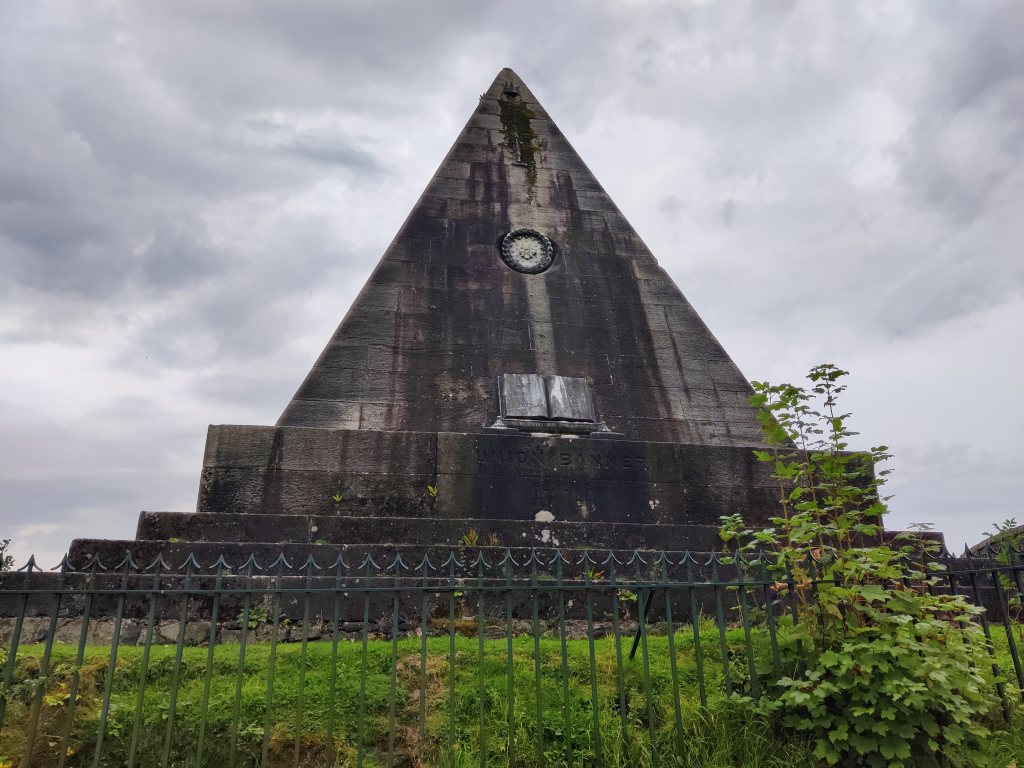
In a series of coincidences, there are other Bill (or at least William) Drummonds in this New Covenanters diversion, on both sides. William Drummond, 1st Viscount of Strathallan (1617-1688) and Sir Thomas “Tam” Dalyell of the Binns(*) (1615-1685) were commanders of the Scottish Royal Army fighting against the Covenanter dissidents in the Battle of Rullion Green, 1666. More strikingly, another William Drummond (1793-1888) raised two monuments close to Stirling Castle. The Martyrs Memorial, in the Old Town Cemetery, features a white marble statue of the two Margarets and Agnes Wilson (Margaret’s younger sister who was ultimately spared) under a protective cupola. In the neighbouring Drummond Pleasure Ground, the imposing Star Pyramid is dedicated more broadly to all those who suffered martyrdom in the cause of civil and religious liberty in Scotland. The Stirling Drummond family had interests in agriculture, explored Africa (though I cannot be sure that they reached the Congo), and established the Drummond Tract Enterprise, famed for their pamphlets (albeit of a religious nature). Presumably the pyramid in the Drummond Pleasure Ground has been pointed out to Bill, along with any number of coincidences relating to Bill or William Drummonds from across the world and throughout the centuries. It’s a common enough name.
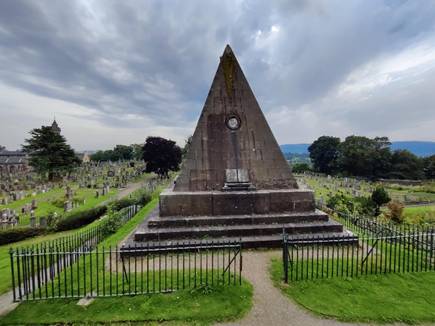
The Star Pyramid, Drummond Pleasure Ground (Credit: ALI FINKS)
Back to the current Bill Drummond though, and we can see evidence that his interest in the Wigtown Martyrs, while no doubt informed by stories heard in childhood, has not always shaped his musical output, even when in Galloway. The Man LP (1986), though recorded in McMillan Hall, Newton Stewart, Galloway, does not have any references to the martyrs. Queen of the South, a track on the 1986 LP, and hummed by the Penkiln Burn Players on the 2024 LP, is presumably a reference to the football club rather than a brave young woman in the waves off Wigtown.
Anyway, I think that is quite enough diversions for one pamphlet. Enough killing time while we wait for Douglas Kanning to turn up.
MAUREEN, also known as the Deputy General Manager of GANTOB (the project)
24 November 2025
(*) Another name with a legacy spanning the centuries.
 GANTOB blog
One response to “THE KILLING MOON (by MAUREEN)”
[…] you to facts that would otherwise have been missed along the way. [Ed: See also yesterday’s Killing Moon post by Maureen for more on dates and Bill’s careful planning]. It is also striking how loyal his […]
LikeLike