

30 August 2025 (approximately 21:00). And then we’re onto the live set. All of the acts sing their own song, accompanied by The Gold Tips. So they have full production rather than the version recorded in The Cell of Curfew Tower. They also sing an Elvis cover. The Gold Tips leave their own Elvis covers until the end of the show. As you can see from the dates of the Elvis songs listed below, this was not a simple re-enactment of the 1968 Comeback Special.
A review of the STAY LP was posted by Geoff Topley before the gig.
The set list runs as follows, with additional detail about the history of the Elvis tracks from various sources, including Wikipedia.
The Gold Tips
- True to the Trail (by Bill Drummond, from The Man, 1986). The Gold Tips version appears to add a twist of Steve Miller’s The Joker to the bassline in the live version. Intentional or not, I like it. It is worth noting that the version recorded for side 2 of the STAY LP was taped in Glasgow not in The Cell of Curfew Tower. It features whistling and finger clicking by Leo Condie and scat singing by Tony Wright. The fact that this was recorded in La Chunky Studio in Glasgow allows us to check on the birdsong and cawing (rooks perhaps) that appears on the other demos on side 2 of the record. It’s there too on Leo and Tony’s recording. Either they took the rooks and songbirds with them to Glasgow, or the avian cavalcade was added later. Perhaps this is what Bill is referring to in his blog post of 13 July: “In the beloved dead uncle’s attic, pieces of disturbing music are conceived and constructed and then sent to the temporary lodgings, where they are taken apart and sewn together with the sound of footsteps on stairs and doors closing and beds being chopped up and birthday cakes being thrown on the fire and bees buzzing and waves breaking and Rooks gathering and rivers flowing and bicycles falling and all those other sounds that we never notice enough in our passing lives”.
- Do You Remember All The Lights (Eamonn McNamee of The Gold Tips). It’s a heart wrenching lyric – “I’ve been down that hole too long,/I’ve lost all my light I fear”).

Tony Wright, AKA VerseChorusVerse
- 40 Hours To Memphis (Tony Wright). It is interesting that he adapts the live Elvis album title “48 hours to Memphis”, perhaps to build in a reference to one of Bill’s favourite numbers (40). Beale Street, also mentioned in the song, is important to Elvis’ career, but also central to the recording of many other musicians and the civil rights movement in Memphis. Elvis didn’t record at Memphis after 1955, until early 1969, just weeks after his Elvis set had been broadcast to critical acclaim. That becomes relevant to songs later in the set.
- Hound Dog (Jerry Leiber and Mike Stoller, famous for numerous hits including Stand By Me (1961), which they co-wrote with Ben E King). A blistering version of the song made famous by Elvis in 1956, but originally recorded by Willie Mae “Big Mama” Thornton with Johnny Otis and his orchestra in 1952.
Paula Flynn
- Elvis is Alive (Paula Flynn and Eda Flynn). An upbeat and catchy song used to excellent effect at the very end of the film. It tips its baseball cap to final phase Elvis. He is in Hades, eating burgers and kissing pretty ladies. Unlike Annie in a song later in the set, the narrator receives a letter from Elvis.
- Suspicious Minds (Mark James – see also Always On My Mind). Recorded 1969, in Memphis. Paula refers to this as Elvis’s last hit when he was alive – his last US number one. His decision to return to recording in Memphis has paid off.

Tanya Mellotte
- Prestwick 249 (Tanya Mellotte, originally from Scotland, now based in Belfast). This song is narrated from the perspective of Annie Murphy (different sources also spell her name as Ann and Anne). She was one of the fans who met Elvis during his only touchdown on British soil – 3 March 1960 – while he waited to fly back to the USA. She wrote her number down for him at his request – the title of the song. A Scottish alternative to Glen Millar’s Big Band classic Pennsylvania 6-5000 perhaps. Tanya notes that Ann married Andy the “Prestwick Elvis”. Andy died in 1997 and was buried in his blue suede shoes.
- Always On My Mind (Wayne Carson, Johnny Christopher and Mark James). Released by Gwen McCrae, Brenda Lee and then Elvis in 1972, with the latter achieving the success with the song, though it was the Pet Shop Boys’ version that topped the UK charts. Elvis’ version was recorded in California. He had left Memphis behind again. The song is thought to reflect Elvis’ feelings about losing Priscilla. It was recorded in March 1972 after their separation in February 1972. Tanya performed this as a rousing singalong.
Duke Special, AKA Peter Wilson
- Forgotten (Duke Special and Andrew Doyle). A breakup song, with Peter effortlessly rising to meet the high notes of this plaintive song. Elvis was married just once, to Pricilla Beaulieu (the person not the spider), having met her at the age of 14 when he was still in the army. They married nearly 8 years later in 1967 and divorced in 1972 and again 1973 after Priscilla sued for fraud over the first divorce. Peter has Elvis wondering whether Priscilla thinks about the trappings of their time together at Graceland, from pictures, peacocks to the songs that he sang. My notes scribbled during the show say “Priscilla was going to have to sell Graceland to pay tax bills”. If Peter did say this, I am not sure if he means Beaulieu or the spider, and Memphis or the Glens of Antrim.
- (Marie’s the Name) His Latest Flame(Doc Pomus and Mort Shuman, famous for this and many other songs, including Save the Last Dance for Me (1962) and Viva Las Vegas (1964)). Another rocking cover,Peter moshing away at the microphone. The song was originally recorded in 1961, first by Del Shannon, with Elvis’ version topping the UK charts for a month that year. If we wind forward the clock and are considering Elvis’ love life after Priscilla, Elvis dated Linda Thompson from 1972 to 1976. She went on to marry Bruce Jenner (now Caitlyn), alma mater Graceland College (in Iowa not Memphis), decathlon gold medallist at the 1976 Olympics. More famous nowadays for reality TV.
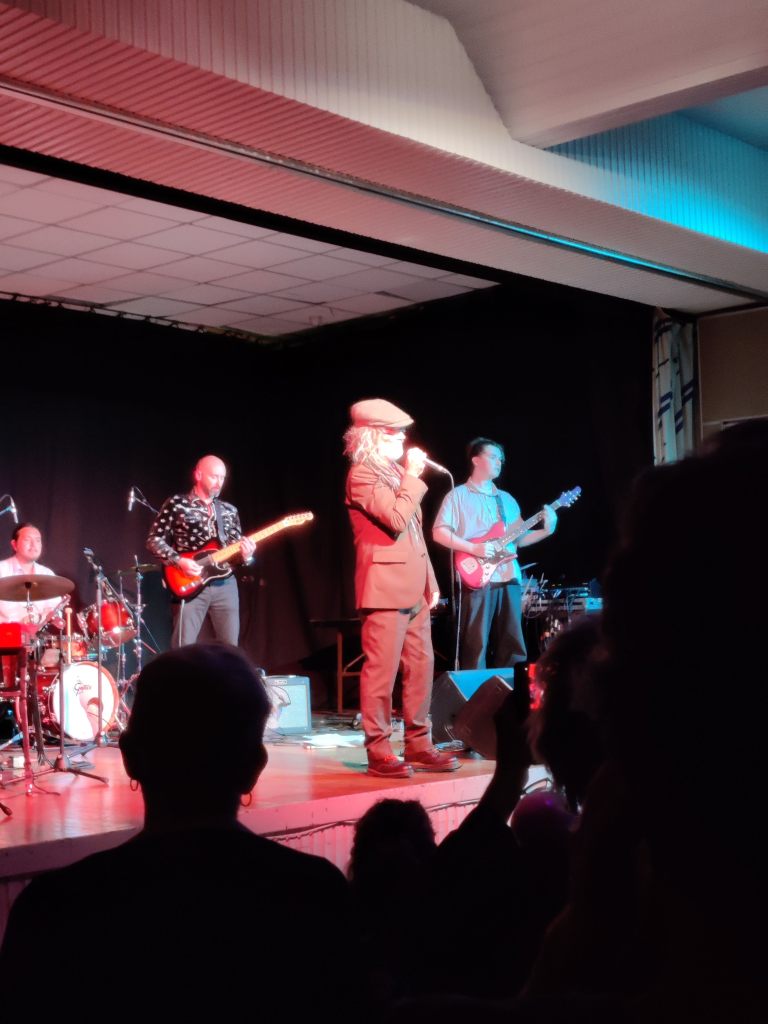
Arborist, AKA Mark McCambridge
- Are You Still The King? (Mark McCambridge). He talks about having had a tight time scale imposed by Bill – just two days to complete the song. Mark spent some of his childhood years in Cushendall: he recalls his “stolen summers” fondly. The song is very much in the spirit of the Curfew Tower residence: “Have you found some kind of peace/ In that tower by the sea?”. Mark sings “Are you still the king?” one last time and an audience member shouts out: “Fuck yes”. Yes indeed.
- True Love Travels on a Gravel Road (Dallas Frazier and A.L. “Doodle” Owens – a country music songwriting duo who wrote a string of US country chart toppers for Charley Pride, all completely new to me). 1969. Recorded at American Sound Studios, Memphis. Something to explore another day.
The Gold Tips, Eamonn McNamee and colleagues
- If I Can Dream (Walter Earl Brown). Written and recorded in June 1968, this is a song from the finale to Elvis’ “1968 Comeback Special”. We can be precise about the timing because it was written specifically for that event and in response to the assassination of Robert F Kennedy, 5 June 1968, when he was running for the Democratic presidential nomination. Richard Nixon won that election on 5 November 1968, against Democratic candidate Hubert Humphrey. The lyrics refer back to Martin Luther King Junior’s “I Have a Dream” speech (28 August 1963), with particular poignancy as Luther King had also recently been assassinated (4 April 1968), in Memphis. Elvis’ manager Colonel Tom Parker was not keen on Elvis performing this song. Elvis was keen to give it a shot, stating “I’m never going to sing another song I don’t believe in. I’m never going to make another movie I don’t believe in”.
- That’s All Right (Arthur William “Big Boy” Crudup). This song was originally recorded by Crudup in 1946, with a re-release in 1949 as an early – perhaps even the first – 45RPM single. In fact, its origins go back further, with some of the lyrics traditional blues verses recorded by Blind Lemon Jefferson in 1926. Elvis recorded his version on 5 July 1954, with Scotty Moore (electric lead guitar) and Bill Black on string bass. All three musicians were credited on the record. Their version was much more up tempo than the original. Though Crudup was credited, he didn’t receive royalties, even after legal action, in part because of the much longer history behind the lyrics. The single was released on 19 July 1954 – Elvis’ debut. It didn’t chart nationally, but did reach number four in the local Memphis charts. It’s the final song of the evening. A fitting return to Memphis for The King.

31 August 2025. Bill posts about another track – Fairport Convention’s Farewell, Farewell, performed by Leo Condie, the musical director for The Penkiln Burn Players and the Hear Hard events. He is featured on the rough demo side of the record, for the performance of True to the trail with Tony Wright, but Leo did not perform at the 25 Comeback Special. It’s an interesting choice of song. It is yet another confirmation of Bill’s admiration for Fairport Convention. Leo’s rendition of the song was intended for the end credits of STAY, but that never happened “along with all of the other things that never happened”. It is a beautiful rendition of the song. The original (by Richard Thompson, building on the traditional folk song Willie O’Winsbury), features on Fairport Convention’s 1969 LP Liege & Lief, their fourth album. Bill mentioned their second and third albums in the lead up to his Cushendall event:
“Back at one of those turning points in between the release of What We Did On Our Summer Holidays (December ’68) and Unhalfbricking (July ’69), a Bill Drummond started to wonder if The Beatles were to release a single with nothing on the label, as in no information about who the band was, or the record label, or the writers of the song – just a white label, what would happen?”
This of course leads to all sorts of other Bill Drummond type explorations of his career.
But that is not where we should leave this step-by-step description of Bill Drummond and friends’ 25 Comeback Special. We should now consider its impact.
For that we need to return to one of his first pieces about Curfew Tower. His I Love Easy Jet pamphlet (1999). In 2025, by one measure a 25th anniversary of the residencies at the tower, we can appraise this year’s event’s impact as an artistic endeavour. In the 1999 pamphlet Bill has the tower as a “real folly”, a gaol. Bill writes that Turnly was “fired by a vision of a New World Order and a system of beliefs enabling man to live at peace with fellow man. Cushendall was to be the centre of this new Jerusalem”.
| While this was no doubt a reference to William Blake, it is quite possible that Bill was also thinking about peace in the Middle East, back to the K Foundation’s 1993 single K Cera Cera (War Is Over If You Want It), a period marked by the Oslo Accords of 1993-1995 with Yitzhak Rabin (assassinated 5 November 1995), Yasser Arafat and Bill Clinton. In 2015-16 Curfew Tower hosted Sagit Mezamer, artist, curator and clinical psychologist from Jerusalem. The resulting book, instigated by Raymie Watson, with contributions from the Israeli artists, plus Bill Drummond, is a black and white striped book called Ireland versus Israel (Penkiln Burn book 21, 2017), though much of the material had presumably been written before that point. It covers complicated topics, including conflict and troubles in the Middle East and Northern Ireland, with nuance and shades of grey. In it Raymie mentions tours of Ossian’s grave and other archaeological sites, plus tours of the more recent history of both Belfast and Jerusalem. Bill, in a chapter called A Game of Vanities, mentions a rotting albatross, Elvis and the North Pole, the Congo and the garden of Eden, and a third trip that he had planned for 2018, in the footsteps of Juan Ponce de León (1474-1521) searching for the Fountain of Youth with Mark Manning and Gimpo. This Gilgameshian quest was planned to end in Florida, USA. By that point, of course, Trump was installed as US President and was spending a considerable amount of time in Florida. Whatever the reason, I do not think that Bill, Mark and Gimpo made the trip. |
I Love Easy Jet also mentions McAllister’s across the road (for Calor gas), but does not clarify whether there are thick paint brushes or rollers in the hardware store.
In the pamphlet Bill fears being seen as elitist for wanting to dedicate the tower to artist residencies rather than being a second home for a well-to-do family from Belfast. He notes the potential perils – “Curfew Tower was considered by the locals as their tower” – using it as the logo on all “local tourist, civic or sporting printed matter… it was seen as an icon that symbolised the whole community”. Anything else – including the dreams of a writer/ musician/ maverick – is temporary.

I Love Easy Jet was written on 10 November 1998, on the way back from Belfast to Luton, on an EasyJet flight. It was “randomly placed in the magazine pouches on the back of seats on Easy Jet flights” (KLF.DE), presumably in 1999. I notice when writing this up that Bill produced a story about the outbound journey for that trip – 8 November 1998, included in his book 45 (Little, Brown, 2000) – Art terrorist incident at Luton airport. The “art terrorists” in that chapter were not Bill and Jimmy, but a couple of young guys with a toy gun. A teapot with loose leaf tea takes a supporting role. He was clearly travelling backwards and forwards regularly to Belfast at that point. 45 has an earlier chapter called Towers, Tunnels and Elderflower Wine (September 1998) that features some awkward artistic props being ferried back to mainland Britain, retrieved from the tower for his friend Mark Manning.
But my main reason for returning to I Love Easy Jet is this: Bill states in 1999, “Long-term objectives: To create an event that the residents of Cushendall are both involved in and proud of, even if much of the work produced by the artists in residence does not fit within their/ our preconceived notions of ‘proper art’… To create a time and place where the artist in residence is happy to talk to any local who shows interest in what s/he is up to”.
I would argue that, though not securing world peace, or even ceasefire in the Middle East, Bill’s great folly of Curfew Tower has achieved his stated long-term objective. A large chunk of Cushendall seemed to be at the 25 Comeback Special on 30 August 2025. There was joy, reflection, dancing, singalongs, rock and roll, the summer homecoming of a McCambridge, and copies of a Penkiln Burn record sitting in the music collections of numerous households in Cushendall for the first time (unless they had bought Voices from the Galloverse earlier this year, or stolen Susan Philipsz’ 7”).
It goes almost without saying that Curfew Tower is an inspiration, even if you don’t stay there. From Susan Philipsz and her MiniDisc to the musicians from last night popping into the tower for a couple of hours to record on much more basic equipment, the tower has been a catalyst. It is there too, as the inspiration for a cat filled tower (Cushionpaw Tower) in the paintings in GANTOB’s new book, GANTOB’s 25 Paintings. But if it’s truly owned by anyone, it’s the residents of Cushendall themselves.
I also think that the 25 Comeback Special secured its short-term objective. The ghost of Elvis ruled last night, spreading his misty tendrils from Curfew Tower, along Shore Street, avoiding the left turn onto Layde Road, to keep going along Shore Road to Cushendall Golf Club. He brought the story of a puppet to life on film and guided a programme of music that stretched from the very origins of his career to his last big hit and beyond, without even including the crowd pleaser of In The Ghetto for KLF fans, a song which Bill has used more than once at different stages in his career. (In the spirit of completeness, I should mention that this song was recorded in 1969 in his American Sound Studio, Memphis phase; written by Mac Davis who also co-wrote Elvis’s posthumous hit A Little Less Conversation with Billy Strange, topping the charts around the world in 2002). Having known very little about Elvis previously, I, for one, will never view him the same way again since this brush with Elvis and Bill.
We can also answer the question Bill asked in Leith in 2019. Bill loves Elvis, and (The Ghost of) Elvis loves Bill. There’s not a paint brush bristle between them. The young Bill might have gravitated towards the 1950s hits, but the current Bill Drummond has coaxed some great songs about Elvis out of contemporary artists, and his event also breathed new life into hits from across Elvis’ career. Elvis’ ghost, as we have already established, is delighted with (and has shaped) the results.
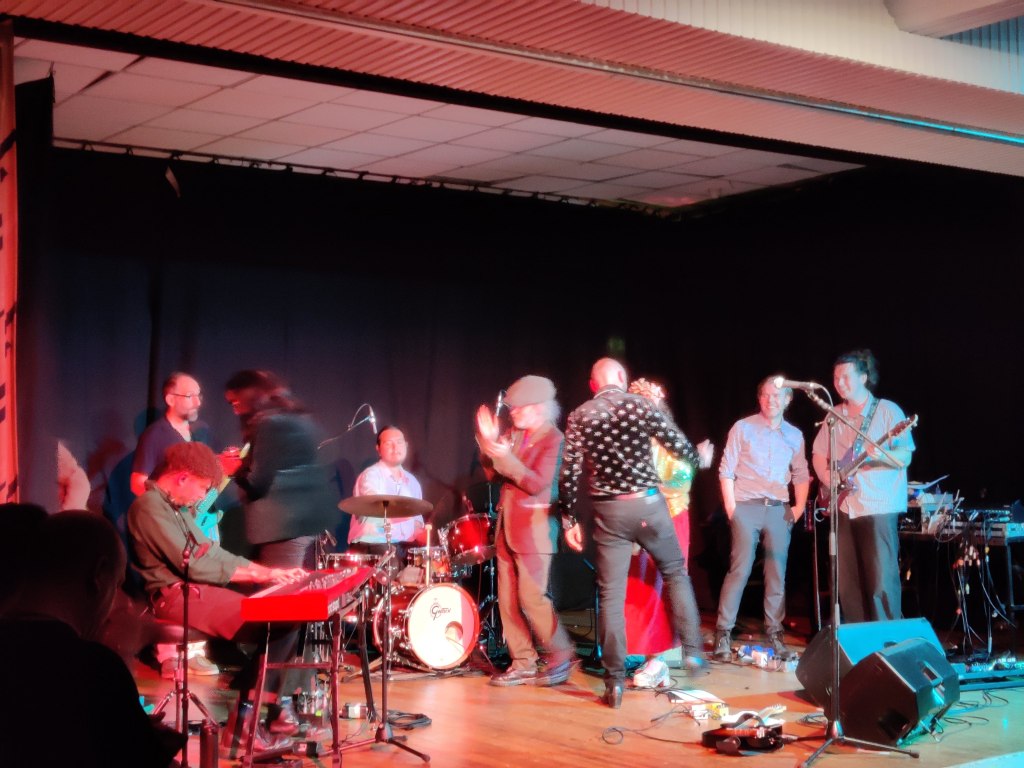
Bill has posted some of his own thoughts on 25 Comeback Special on the Caught By The River website, which should be around for more than the duration of a Drummond webpage.
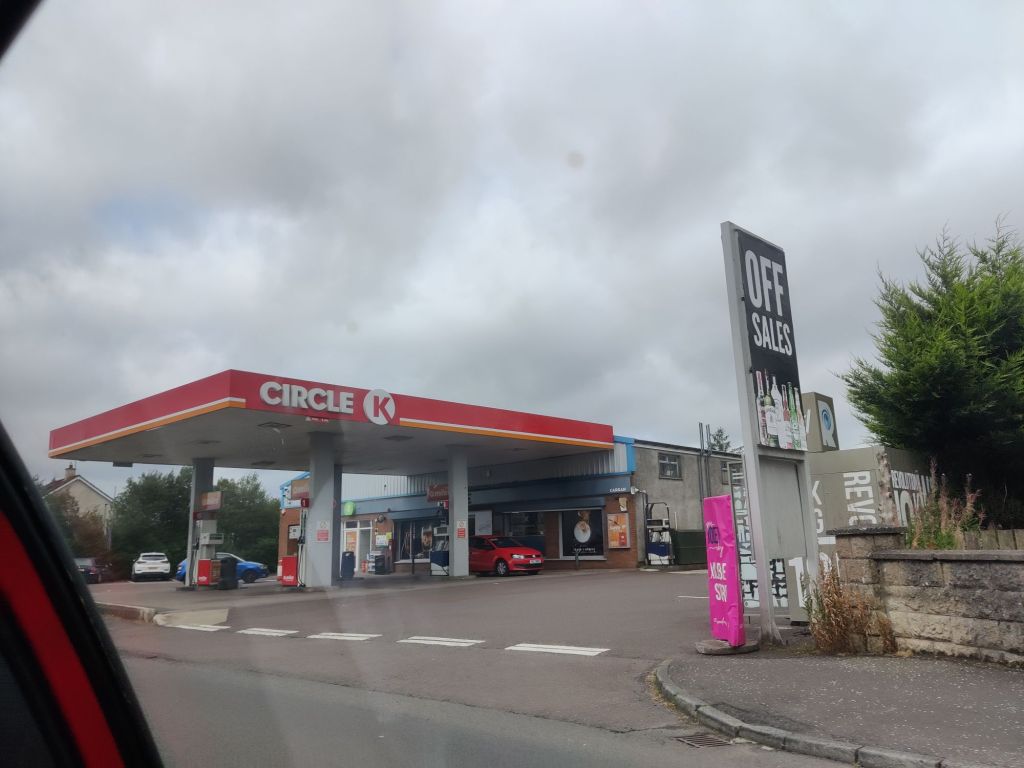
Stephen and Michelle drive us back to Belfast Port, for our return to Scotland. Our pilgrimage to Cushendall is complete. Stephen drives up the same road from the Antrim village that Tony Wright cycled down with his puppet Elvis. I look out for milestones at the side, but am not quick enough. On an overcast day it looks rather like the road from Dalwhinnie to Laggan in the Scottish Highlands – bleak. We spot a Circle K filling station. I start writing this piece in my head. I want to listen to music that I have never heard – I will start with Fairport Convention. I’ve had enough Elvis for a while. I want to read about Ossian. I want to learn about John Hewitt, the poet.
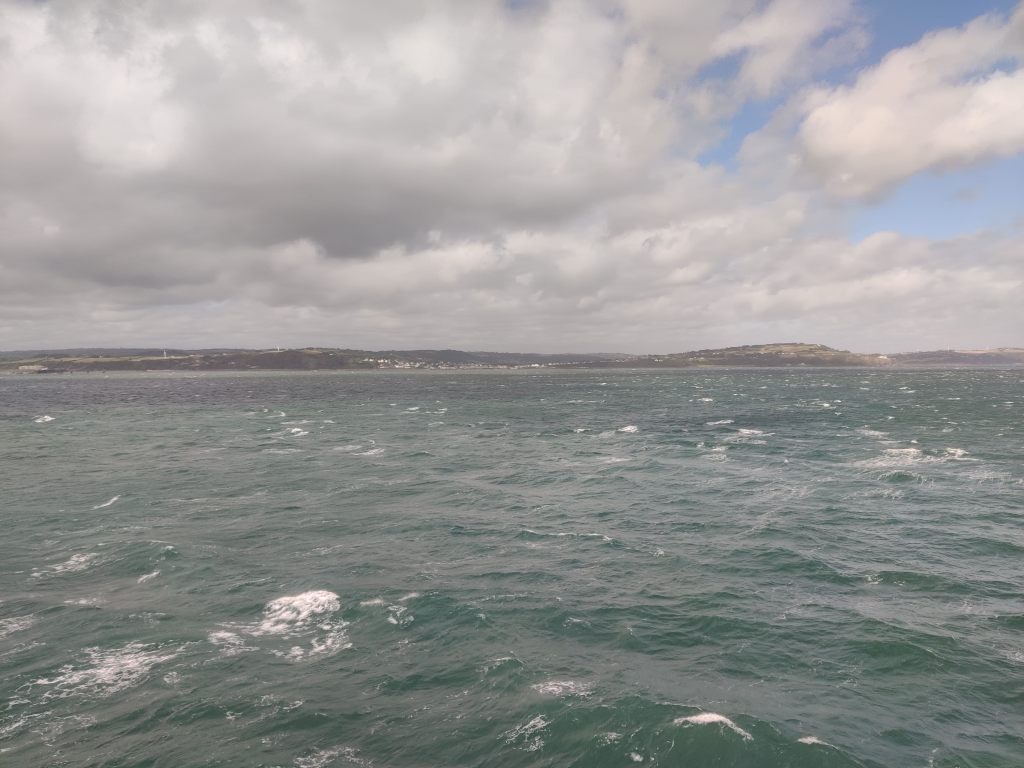
I wonder if Curfew Tower has artists in residence this year. I think about points that I had forgotten in the film, until now. On the door frame in the kitchen of Curfew Tower, one of the few parts not painted by Tony Wright in red during the film, there is a mark for “Raymie”. Either it was for a young child, or Raymond Watson was crouching. Perhaps I will check the door frame and ask Raymie if we go to another bonfire and curry night. I think about a crystal dangling in the window of Curfew Tower, Barbies and beach burials. It is a blustery day. They talk about using stabilisers on the ferry. I wonder if we will see the remains of the frame and canvas thrown out into Cushendall Bay, painted white on red, with the word “STAY”, as we pass across the Irish Sea.
THE END
I would like to thank Stephen and Michelle for their friendship, and all the lifts. Liz for her patience – most recently, over the past 15 months in Merseyside, Galloway and County Antrim. Stu and Carolyn for also being part of the K Circle. Bill for all the inspiration. Cushendall Library and the tourist information centre for all the interesting materials to peruse on a rainy Antrim Saturday. You for reading to this point, 10,000 words into a deep dive into the 25 Comeback Special. GANTOB for the copy of GANTOB’s 25 Paintings, the pamphlet What is Proof? and for hosting this sequence of posts.
GANTOB would like to thank JR for the comments, correcting typos, and the story about the KLF T-shirt facilitating transit through airports to Portugal. Rather a different experience to that of the art terrorists in Luton. Like the story of Heartbreak Hotel, I have been unable to establish the provenance of Bill’s EasyJet story…
The Benefaktor would like to thank Graham for the photo of Ossian’s grave and for transporting the new book and pamphlet to Stephen.
The Deputy General Manager of GANTOB (the project) would like to apologise to The Benefaktor for all the typos that were missed when uploading this piece the first time. If you are an email subscriber you will have a record of them in your inbox, and will be able to spot the additions that Graham has requested subsequently. There may well be more mistakes to correct. If you spot any, please do let us know, usual routes. Life is busy and things are often done in a rush.
 GANTOB blog