
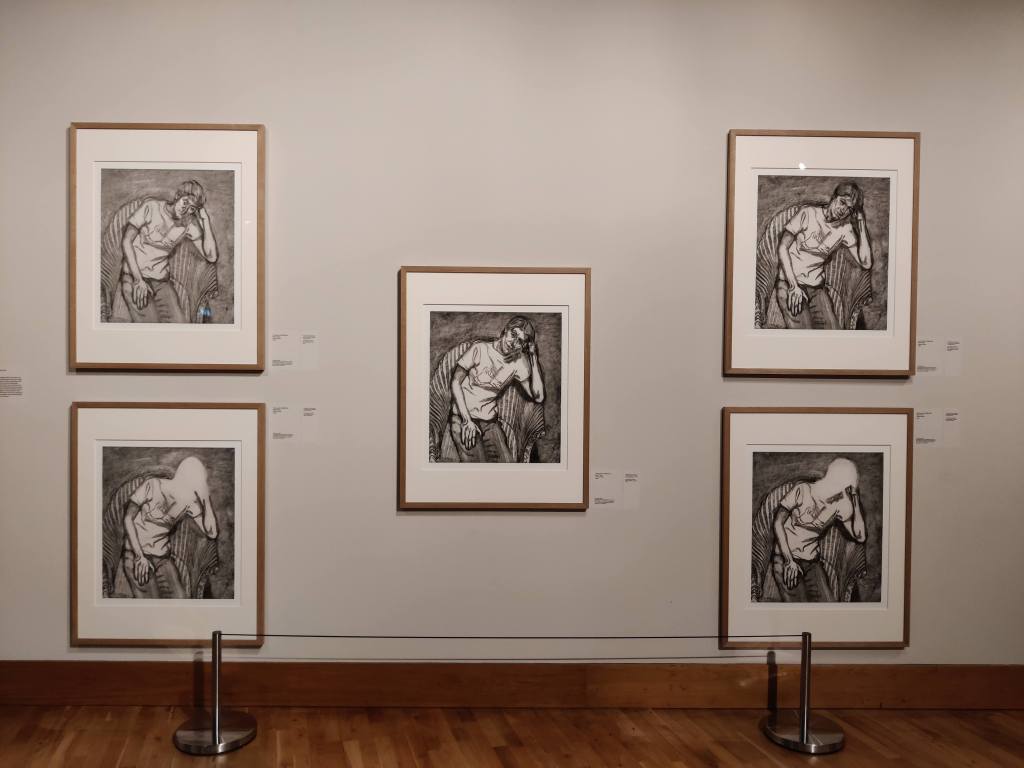
Friday 29 August 2025. We walk along the River Lagan(+), past six stained-glass sculptures inspired by the Game of Thrones (the Glass of Thrones trail) to the Titanic Museum. We do not have time to go round the full exhibition. Instead we visit the gallery displaying Lucian Freud (1922-2011) in the same building. His etchings, carved into a lay of acid-resistant waxy resin called “the ground”, using a needle, are shown at various stages, with the re-waxing of sections by master printer Marc Balakjian (1938-2017) for re-working by Freud. Etchings of Leigh Bowery (1961-1994), Australian performer, are perfected. Lucian’s daughter Bella is given the same treatment, in a T-shirt featuring an image of Freud’s dog Pluto.

(+) Lagan (Laggan in Scotland) is a word shared across the Irish Sea, meaning “little hollow” in Irish and Scottish Gaelic.
I think of Bill Drummond’s rumoured GRAFFIC MODEL (announced 20 May 2024), using wood cuts based on pencil drawings of scenes from his electronically published novel The Life Model (2023). Wood cuts sound a less malleable medium than etching into wax. I can’t even start to imagine what level of skill would be required to produce a wood cut. The project is conditional on receiving 100 pictures.
There are Lucian Freud proofs with a large cross scored across the page. I am reminded to pick up my proof copy of the GANTOB book for Stephen before we head north.
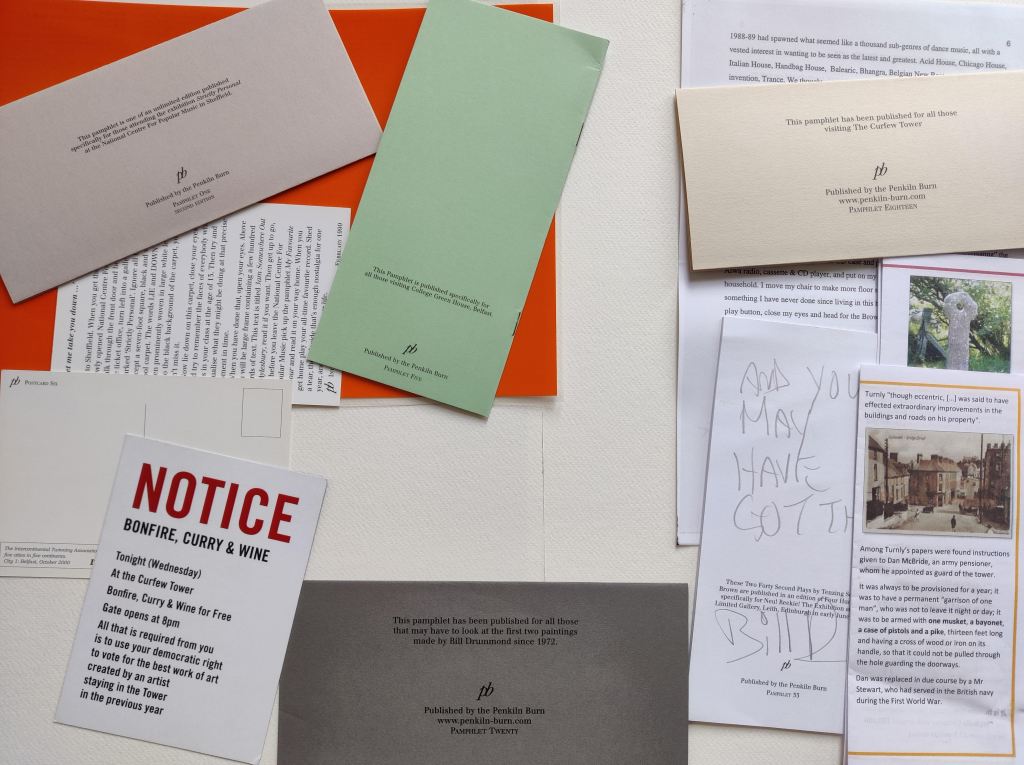
Liz and I stop for lunch at St George’s Market, and then we’re on our way again, by train from Lanyon Place Station to Ballymena and then bus to Cushendall. This last leg is another scenic trip, with green pastures giving way to forest and then a coastal road that sweeps down to the village itself, through the Red Arch, built by landlord Francis Turnly (1765-1845) in 1817. Turnly, we find out from a tourist information trifold white paper pamphlet with yellow surround called Cushendall’s Curfew Tower was an “East Indian Company nabob (Urdu nawab: a high official or prince), who made his fortune in China”. He erected the tower “as a place of confinement for idlers and rioters”.
Bill Drummond, who contributed pieces to The Idler journal and has at times recommended rioting(*), perhaps felt that the balance should be redressed, to make up for Turnly’s punitive ways.
| (*) In a piece for The Guardian (Bill Drummond’s 10 Commandments of Art, Sunday 15 June 2014) he wrote: “9 Riot now, pay later Take risks. Don’t rest on your laurels. Don’t ask permission. But be prepared to suffer the consequences of your actions. Don’t blame others. Don’t expect success – not even after you’re dead. Remember, to get one good artist you need to have at least a thousand others struggling in their garrets. If you or I are one of those struggling ones, we’re still doing our jobs”. This was written at a time that Drummond was undertaking an exhibition and artistic residency at East Side Galleries, Birmingham, featuring his book 25 Paintings. |
The Cushendall pamphlet goes on to note that Curfew Tower “was purchased and restored by Hearth Revolving Fund [Director, Marcus Patton] in 1992-93… Its present owner, the writer Bill Drummond, established a residency there for artists in 1999”.
Residency. That is the key word for Curfew Tower. A place that people come to live. To stay. To create art. It is a topic well covered in the Bill Drummond pamphlet I Love Easy Jet (1999; Penkiln Burn pamphlet 2). He flew from Luton rather than Elvis’ chosen UK airport, Prestwick. I have a copy of that pamphlet at home. It is an important document in Drummond’s biography, and central to understanding the purpose of his artist residency programme in Cushendall. It expresses concerns that the tower, hundreds of miles away from Drummond’s home, could stand vacant for long periods of time, and therefore be prone to vandalism and other deterioration. It notes the establishment of a trust called In You We Trust with architect Marcus Patton and artist Susan Philipsz, before going on to explain that “Artists of any age, medium, place of birth and professional standing can apply to the trust to stay in the Curfew Tower for a period of not less than one week and not more than one month. While in residence they have to produce a work that in some way relates to the environment (tower, village, glen, state of mind, etc)”.

Towards the end of the “pamphlet” (which is in fact a laminated sheet, text on one side, a solid block of easyJet orange on the other), it explains “Long-term objectives: To create an event that the residents of Cushendall are both involved in and proud of, even if much of the work produced by the artists in residence does not fit within their/ our preconceived notions of ‘proper art’… To create a time and place where the artist in residence is happy to talk to any local who shows interest in what s/he is up to”. I am quoting selectively, but I think that we can see how these ideas eventually settled into the bonfire and curry night.
I cannot remember when the Curfew Tower bonfire and curry nights started. There is a mass-produced postcard for at least one of these events, but it does not state a date. There is a list of participants in the Curfew Tower residencies in the credits to STAY, as shared by Bill on his Penkiln Burn blog in the weeks before the event, and previewed in a post “THE CURFEW TOWER PRESENTS” (7 July 2025). This states that the “Curators” of the tower were In You We Trust (Marcus Patton, Susan Philipsz & John Hirst) 1999-2008, and then a list of individuals and collectives starting with VOID, Derry in 2009 through to Searching for The Miraculous, USA 2019. There are two years marked for Sagit Mezamer, Jerusalem (2015-2016). After two COVID years the Curators are listed as Independent Republic of Užupis (2022), Caught by The River (2023) and of course The Ghost of Elvis (2024). I wonder who the current curators are. They aren’t mentioned in the whole time we’re there.
As I flick through various books produced about Curfew Tower I see the list of curators developing over time. The website version for the 25 Comeback Special is obviously the most complete. The credits also list the various groups contributing to recordings of the C major pentatonic scale. There’s a bakery, RNLI, Ariffe Dance Group, hurly team, youth club, café, men’s shed, inn, drama group, a music group (Comhaltas) and butcher

I look for further information about the bonfire and curry nights, turning to Bill’s pamphlets. The earliest Penkiln Burn pamphlet – My Favourite Colour (Penkiln Burn pamphlet 1, 1999) – is about something entirely different. It’s rather KLF-focused for Drummond’s writing from that era. He’s deliberating on a show at the National Centre For Popular Music in Sheffield, making arrangements with the curator John Hewitt to play a CD copy of The KLF’s Chill Out and display a poster called 3AM Somewhere Out Of Aylesbury. Drummond’s favourite colour is, of course, grey.
| Subsequent pamphlets are more useful: Making Soup (PB pamphlet 5, 1998*) introduces us to Drummond’s early experiences in Belfast, and an earlier meeting with Susan Philipsz and Marcus Patton. In Please Pay Me (PB pamphlet 18, 2001) we have Philipsz recording As Tears Go By (the Rolling Stones song made famous by Marianne Faithfull) to play on a record player in an alcove in the tower. There is/was only one copy of this record. Bill notes the likely temptation of stealing such an item. And a little later we have Two Paintings (PB pamphlet 20, 2002) that has Bill heading off to paint his first paintings since 1972. By 2014 he had the 25 Paintings, which in 2022 had their own café (including Corby). One of the paintings featured in the Bill Drummond book 25 Paintings (PB book 19, 2014) was STAY, white words on red canvas, under Spaghetti Junction. Elvis is mentioned in passing in a later chapter of that book. These ideas have had a long gestation. |
* The numbering and dating of Penkiln Burn pamphlets can be counterintuitive.

We walk past Curfew Tower, the key-holder Zippy’s butcher opposite which is displaying copies of the STAY LP in the window, past a café and bars, the current Layde Parish Church and then up the road from Cushendall towards our B&B high in the hills behind the village. We hear a shout, and there are Stephen and Michelle offering us a lift. Stephen is the author of the Searching for The White Room Facebook page. They have travelled from Sligo. We accept the lift gratefully. We talk about Drummond on the drive up, speculating on the night ahead and tomorrow’s celebration. This is Stephen’s third bonfire and curry night at Curfew Tower. This is Stephen’s third bonfire and curry night at Curfew Tower. His first (August 2016) was for Israeli artists. Stephen emailed me later that “It was really great fun, an annual event hosted by Bill Drummond and Tracey Moberly during the Heart of the Glens festival. There was also a theatre/choir performance in a community centre down the street directed by Yonatan Levy, who had previously been on a residency there. Then it was back for the bonfire”.
We do not think that there has ever been as elaborate a celebration of Curfew Tower residences as the events planned this year. Graceland has come to Cushendall this year.

| I am interested in the Memphis connection. I had assumed that Elvis recorded most of his work in Memphis, but learn that this was not the case. After the 1968 Comeback Special he recorded in Memphis for the first time since 1955. I read on Graceland.com that ‘In 1969, Elvis and his producer Felton Jarvis were impressed by the incredible music being made at Chips Moman’s American Studios in Memphis. Just a few of the hits recorded there include “Sweet Caroline” by Neil Diamond, “The Letter” by the Box Tops, B.J. Thomas’ “Raindrops Keep Fallin’ On My Head” and Dusty Springfield’s legendary LP, “Dusty in Memphis.”’ The Box Tops are a band I’ve come to relatively recently, via Big Star. The Box Tops were fronted by Alex Chilton, who was just 16-years-old when their track The Letter (written by Wayne Carson Thompson) hit number 1 in the USA in 1967 and was a smash internationally. They achieved considerable commercial success before they split in 1970. Bill wrote in his book 25 Paintings that “It is those early exposures to pop music that can determine your musical prejudices for the rest of your life. For me Elvis will always be King and there will never be a better band than The Beatles. I guess it is the same with art”. Bill goes on to note the reverse of the coin, about talent and unobtainable goals (for him this is Rembrandt): “Even if I could master his techniques, I could never in a thousand years of trying, come close to delivering the emotional depth he could. I had more chance of singing like Otis Redding”. I am with Bill on The Beatles. They were a huge part of my musical upbringing, and remain far and away my biggest musical influence (the band and their subsequent solo careers, particularly Paul McCartney). Big Star – Alex Chilton and Chris Bell’s early 1970s band – is one of the few genuine and enduring musical loves I have discovered in adulthood. The band did not achieve commercial success the first time round. Chilton and Bell grew up in Memphis, but the music for which they are best known had its origins in Liverpool. Chilton and Bell were just 15 years old when The Beatles swung through Memphis on 19 August 1966, playing two performances at the Mid-South Coliseum. This was the 8th date of the Fab Four’s last tour (12 – 29 August 1966, playing in 14 cities – 12 in USA, 2 in Canada, playing to 400,000 people). Their final performance to a paying audience was at Candlestick Park, San Francisco on 29 August 1966 – exactly 59 days ago today. Bell was keen that Big Star would follow a similar approach to Lennon and McCartney’s early song writing, bouncing ideas off each other, crediting themselves as Bell/ Chilton. Their writing process was very organic, refining their songs in the studio (Ardent Studios, Memphis). In one telling Chilton is the edgier character, Bell more melodic, bringing brilliant harmonies to their shared lines. Later their recordings become looser and more shambolic, but still compelling and worth repeated listens. Their body of work, recorded 1971-74 is unlike anything else that I have heard. Give them a go. That is a diversion though. In 1969 Elvis wanted to capitalise on the Memphis sound embodied by the Box Tops. We will see some of that Memphis influence in the 25 Comeback Special performance. |
We have a quick turn around in the B&B. I give Stephen the heavy GANTOB book in the brown paper bag. I see the pamphlet sticking out the top underneath the bubble wrap protecting the package. We head to our rooms. I manage a few minutes collecting my thoughts. In addition to the pamphlet on Philipsz’ recording, I can recall four books about artists’ time in the tower.
| Penkiln Burn Book Five, published 2001, was a slim volume written by Bill Drummond, Duncan McLaren, Susan Philipsz (of 7” Penkiln Burn record fame) and Marcus Patton. Strictly speaking it was volume two of three. PB poster 397 (2012) has volume one as fanzine (In You We Trust: Stay Here & Make Art) and volume three as the website curfewtower.com (which now states simply in grey, on a darker grey backdrop: “THIS SITE HAS BEEN CLOSED FOR THE FORESEEABLE FUTURE”). A trio of books over a decade later celebrate residencies by Irish, Israeli and Scottish writers: respectively The Curfew Tower is Many Things (Penkiln Burn Book 20, 2015) edited by The Seamus Heaney Centre for Poetry at Queen’s University, Belfast; Ireland Versus Israel (PB Book 21, 2017) edited by Raymond Watson; and After Curfew: Neu! Reekie! (PB Book 23, 2019) edited by Michael Pederson and Kevin Williamson. Bill contributes pieces to each book, in emails (like his work with The Harmonics), the occasional chapter, or an interview. There has not been an LP at one of these post-residency parties previously. |
I met Duncan McLaren once, in Blairgowrie, as documented in an earlier post for GANTOB – What is GANTOB? which includes a link to my pamphlet Who Were The Harmonics? which was included in copies of the What is Harmonic? box of emails sold in the last couple of years by East Side Galleries. The outcome of Bill Drummond, Duncan McLaren, Simon Wood and Gavin Wade’s musings was a further Penkiln Burn 7” called This is Harmonic (PBR 003, 5 copies, as documented in PB Poster 51, 2003), which featured the four men singing selected notes from the pentatonic scale. I don’t think that Duncan attended a bonfire and curry night. Gavin might have following his later residency (Eastside Projects, Birmingham, 2011).
I can imagine the poets and writers of the subsequent books reciting their pieces or chatting with regulars at the bonfire and curry nights. My main recollection of the 2023 event was Bill talking about a bike left by one of the artists from the Republic of Užupis. The artist had ridden it from Belfast airport, through the rural countryside, and then perhaps down the hairpin coastal road that we have just travelled along. He had decided against cycling back, so had left the bike in the garden behind Curfew Tower, as a prop for Bill Drummond. I don’t remember seeing any of the artists at the 2023 bonfire and curry night.
But we don’t have much time to rest. We have to find firewood for Bill’s bonfire (he is calling it a “bond fire” this year – writing on the Penkiln Burn blog that “it will be the night we can all celebrate either physically or conceptually throwing our ‘bonds with the future’ onto the Bond Fire”.
We spot Bill and family walking back towards the tower as we are heading down towards the beach, near the golf course where he will be holding the 25 Comeback Special tomorrow night. He nods a brief acknowledgement. They have left us some driftwood to collect. After buying zero beers from Cushendall WineFlair on Dalriada Avenue, we head down to Curfew Tower for 19:30. Bill is there with his family, Zippy, some musicians who we do not yet recognise, but will become very familiar faces by tomorrow night, and film maker Tracey Moberly. The choice is chickpea or chicken curry. We opt for the former. It is very hot. Apparently one of Bill’s sons has left the seeds in the chillis when he chopped them up. Stu and Carolyn arrive. We know them from walking a stretch of the K-Line June 2024. They have flown to Belfast and driven to Cushendall. It’s good to see them.
We spot other familiar faces: Raymond (Raymie), who lives locally, is there with his partner. He tells me about his new book What Sort of Artist Are You? Marcus Patton is the best dressed person there, faithful as ever to the trust. Furryman AKA Steve Lally is wearing a hand painted T shirt and tells us about his story telling at Belfast Children’s Hospital. Ann McVeigh and Ken Bartley from ArtisAnn Gallery in Belfast are collecting names of people ever associated with the tower in a folder.
And then it’s time for the activities around the bonfire. Bill keeps a low profile, lying by the fire, clearly enjoying himself. Eamonn McNamee of The Gold Tips plays True to the Trail, Bill’s song from The Man LP (1986).
| True To The Trail is a song that Bill has mentioned many times in his writing career. He has a 7”, I think using the version of the song from The Man LP, that he plays to prepare himself for a public performance. It’s mentioned during his activities around A Smell of Sulphur in the Wind. It is there again in The 25 Paintings (2014), quoting from a story 25 Paintings, from June 2005: ‘The performance starts with me walking out on to the floor clutching a toolbox and a record player. I place the toolbox on a table and the record player on the floor. I plug it in, switch it on. Take a 7” single from the toolbox and put it on the record player. The record is called True To The Trail and is a country rock toe-tapper and it is my signature tune’. This story is an update on his pamphlet Two Paintings (PB pamphlet 20, 2002). |
Tony Wright, AKA VerseChorusVerse, sings and speaks 40 Hours to Memphis, after a false start where he complains that he “can’t find the key”. We might glance at Zippy, butcher, key holder of the tower, who makes a number of interjections through the evening to promote the STAY LP for sale in his shop. Finally, from the group of performers due to play tomorrow night, Mark McCambridge AKA Arborist, sings Are You Still The King? with such intensity that I wonder if the neighbours might complain. These are three songs that were recorded in The Cell at the base of the tower. We visit the room, taking in the words painted in white on the white wall – “This is Graceland” – and the poster (PB Poster 282, 2024) about the tape recorder in the room. It is claustrophobic, like standing in a red blood cell. It is no wonder that the versions of the songs recorded here are raw and heartfelt, like the versions we have just heard around the campfire.
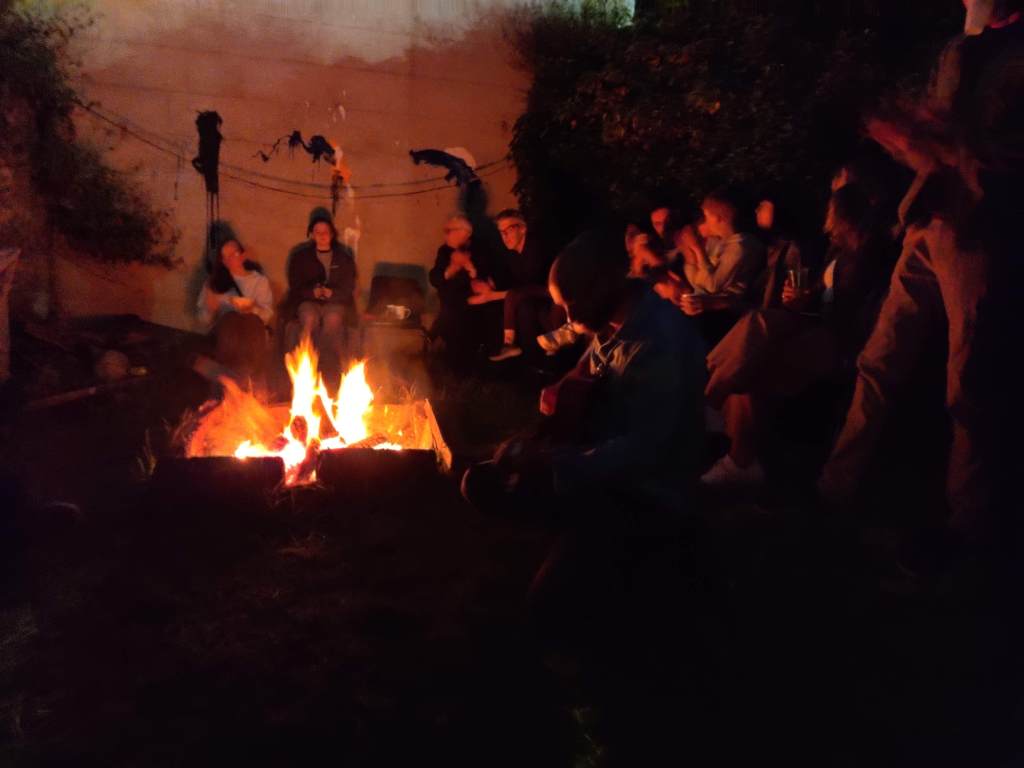
Last but not least, Ronita sings Elvis’ song Heartbreak Hotel. She holds the audience with her well-judged phrasing. Pleasingly, this was also one of the songs included in Elvis’s 1968 “Comeback Special” TV programme. It wasn’t called Comeback Special in an official release until a CD reissue thirty years later. Originally the TV special, recorded live in June 1968 in California and broadcast on in the USA on NBC on 3 December of that year, was simply called Elvis. It was not shown in the UK until 31 December 1969 under the title The Fabulous Elvis.
| Heartbreak Hotel (Mae Boren Axton and Tommy Durden) was written in 1955, apparently about a man who jumped from a hotel window, leaving a suicide note saying “I walk a lonely street”. Elvis, who had just left Sun Records in Memphis, recorded it at his debut session at the RCA Victor studio in Nashville. It was also his first million selling single. Elvis first heard the demo in his hotel room on 10 November 1955. The song had been written by Axton (a teacher) and Durden (a singer-songwriter) in less than an hour, and was recorded first by Durden and then that same day in an imitation Elvis voice by local singer Glenn Reeves (who had originally refused to take it on). After a number of setbacks they managed to play the song to Elvis, who insisted on listening to it ten times over to memorise it, and then performed it at a gig in Arkansas on 9 December 1955. He told the audience it would be his first hit. Elvis Presley died on 16 August 1977, found unresponsive by his fiancée Ginger Alden on one of the eight bathrooms in Graceland. I note, for completeness, that Graceland has 23 rooms. Axton died at home on 9 April 1997, aged 82. She suffered a heart attack and drowned in her hot tub. Durden died of cancer on 17 October 1999, aged 79. |

We spot Elvis looking down from the top window of Curfew Tower. We learn later that it’s the 2016 double vinyl album The Essential Elvis Presley (released on RCA in the US). He doesn’t look ready to jump.
To be continued. Tomorrow we will take a tour of Cushendall, including Ossian’s grave, which is a special interest of The Benefaktor.
 GANTOB blog
One response to “STAY (Part 2, by GRAHAM)”
Impressive detail and research and great to see all those Penkiln Burn publications. Carolyn would probably like it to be known that her name is Carolyn, not Caroline, though. Hope to see you all again soon! Stu
LikeLiked by 1 person