The GANTOB Pamphlet Committee was delighted to receive a submission from The Study Master this week. We very much enjoyed their previous piece.
The Study Master’s description takes me right back to June 2021 when we visited the Jimmy Cauty Estate exhibition in north Edinburgh. It was our first cultural experience for well over a year, and we chose to spend it inside a noisy and cramped space. Still, it was good to be out and about. The Study Master’s trip, however, took things one step further: a discussion with the artist himself. What an opportunity!
Photos are contributed by The Study Master and from our trip.
November 2021
How do you raise the ‘cultural capital’ of 6th formers? I’d had a pressing reason to think about this question since September, when school inspectors OFSTED added greater emphasis to it in their inspection criteria. Our school was overdue an inspection so we needed an answer.
But in fact, I’d been considering it for some time before OFSTED decided to care about it, although their rather clunky phrase ‘cultural capital’ was not how I’d put it. It’s obviously part of the role of schools to provide kids with new experiences – to bring to their attention things with which they were not previously familiar.
And few 6th formers have much experience of contemporary art. I tested this view with a question during assembly one morning – ‘Has anyone ever visited an art installation?’ No hands were raised – none at all. For me, this seemed like reason to enough to organise a school trip. And I knew just the thing.
Jimmy Cauty’s Estate would soon be arriving at the Florrie, not too far away from our school. Estate is somewhere between a meticulously detailed sculpture and an installation. Situated inside a shipping container, the work consists of 4 scaled-down, person-sized brutalist tower blocks, all housing multiple miniature flats that invite close examination.
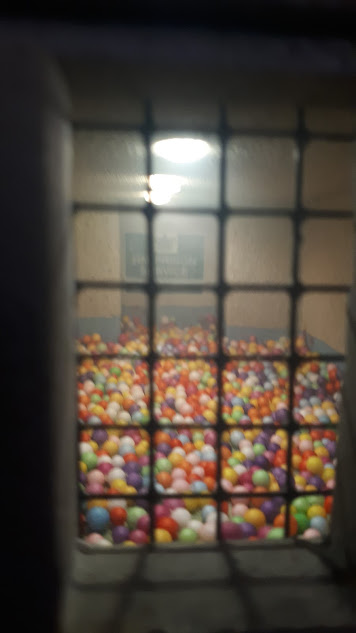
Each tower block fulfils a different function in some unspecified dystopian near-future, but all of them are mysteriously unoccupied and we can only guess at the fate of the former residents, although there are many clues to ponder included in the work.
Despite its mysteries and ambiguities, to some extent Estate is accessible to all. I felt certain that our students would ‘get it’ on some level. Most of them are familiar with Banksy, whose aesthetic owes more than a little to Jimmy Cauty, and if nothing else, I thought they would appreciate the irony and humour of Estate, and recognise the talent and imagination required to create something like it.
So, I decided to test the waters at another assembly and pitched the idea of a school trip. I assumed that most if not all of them would be unfamiliar with Jimmy Cauty’s work and put together a short PowerPoint introduction to it. Then I asked any interested students to sign up. Just over 30 kids came forward.
Mindful of the fact that our students had all been born more than a decade after the KLF split up, I decided to skip over that part of Jimmy’s career, and said nothing at all to them about the burning of a million quid. I wanted them to focus on Estate and on Jimmy’s other work as an outsider artist and thought all that earlier stuff would just get in the way.
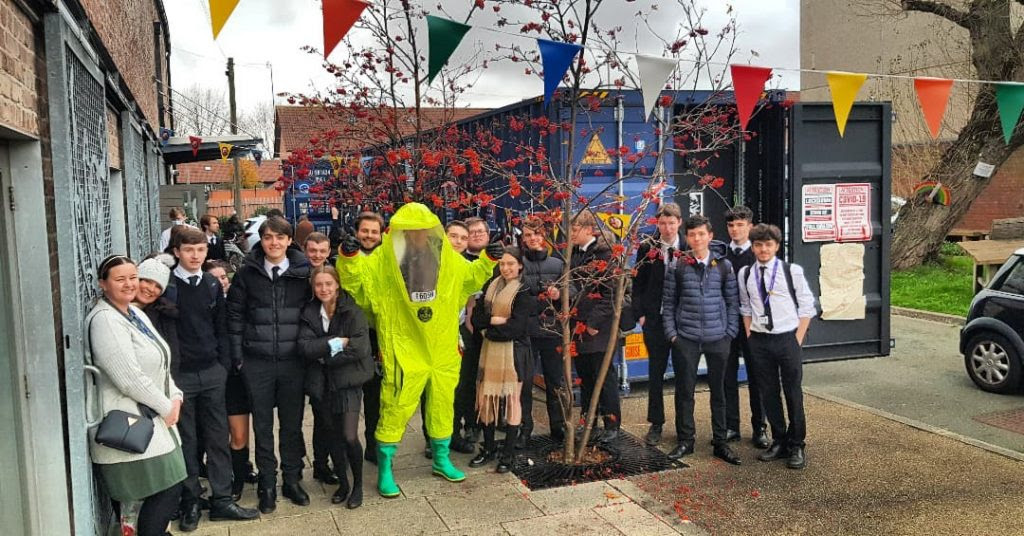
The day arrived and we filled two school minibuses with about 30 eager 6th formers. The folks at the Florrie were great hosts and seemed really pleased to welcome our group. They even gave us exclusive access to Estate for an hour before it officially opened to the general public.
My instincts were right – the kids loved it. For those concerned about Covid there was the option to view Jimmy’s miniaturised tower blocks from outside the shipping container, but all of them chose “the full English.”
This involved being sealed inside the container while a disorientating voice barked orders at us from an unseen Chinook helicopter as searchlights whirled around. This should have been distracting, but actually it added to the atmosphere and the searchlights illuminated otherwise hidden corners revealing further intricate details.
The kids passed through the shipping container in groups of about 6 at a time, each one taking 10 minutes. The tower block flats are full of innuendos and visual gags; they invite scrutiny. Some of the kids were pleased to be the first in their groups to discover features like Jimmy’s old Lord of the Rings poster, and other references to his previous work decorating the walls of the tiny flats.
I watched them excitedly call and beckon to each other, pointing out various amusing, shocking or intriguing features. And of course, their phones were out taking selfies and grabbing pics of the more eye-catching and notable flats.
We posed for a group photo, I donned a Haz-Mat suit which had been used for promotion, the folks at the Florrie handed out some flyers and freebies and the kids all added their names as graffiti tags to the shipping container. My colleague Kerry had thankfully remembered to bring marker pens.

Back at school, the year 12 art kids were particularly buzzing. Their teacher Phil shared some of the pics taken on the visit to Estate with his whole class and then set them to work with charcoals. They produced some great sketches, a few of them quite abstract, which really captured something of the grim, post-apocalyptic feel of Estate.
A few weeks later, our numbers in attendance sadly reduced by Covid, we met with Jimmy Cauty for a Zoom chat. He was patient and kind with the more nervous kids, pleased with their reactions to his work and answered all our questions politely and enthusiastically.
He seemed genuinely surprised by the amount of thought some of the kids had put into their questions. A lad from my form class asked about Estate’s position as the third part of a triptych, alongside Jimmy’s earlier Aftermath Dislocation Principle and Riot in a Jam Jar pieces. He offered a novel interpretation of the backstory and narrative that was consistent with the work, but which hadn’t previously occurred to Jimmy before.
One kid absent with Covid emailed in to put it to Jimmy that he’s very good at identifying “problems and issues” but wondered what solutions he proposed. Jimmy honestly admitted that of course he doesn’t know what all the answers are, but that part of the solution is making a nuisance of yourself to the authorities, which is an obvious, unmissable theme of Estate and Jimmy’s other work.
Another kid posed a variation on the age-old ‘where do you get your ideas from?’ question. Artists sometimes dislike this question of inspiration, because many don’t really know the answer; that it seems like their ideas often come out of nowhere. As if to illustrate this, Jimmy told us the idea for Estate came to him almost like a vision, as he was walking home from a visit to the cinema to see the last Blade Runner film.
On the subject of Covid, there were, of course, questions and comments about Estate’s uncanny resonances with the pandemic. As barked orders to the “residents of Estate” filled the air from an unseen police helicopter for example, I was reminded of those ramblers exploring the Peak District who made the national news during the first lockdown for being “lockdown shamed” by a Derbyshire Police drone.

Jimmy explained that the idea for Estate came to him long before the pandemic, so any apparent similarities are coincidental. However, one of the four tower blocks was designated for “the old, the dying and the dead” and he had some concerns about how this might be interpreted given the impact of Covid in care homes.
He answered some technical questions about the practicalities of constructing and touring Estate, but seemed most engaged just listening and chatting with the kids as they shared their responses and interpretations. They’d really exercised their imaginations trying to figure out what it all means.
Another kid thought that the lack of residents was the most significant feature – “Are we, the viewers, therefore the real residents of Estate?” he wondered aloud. Then he offered his speculations on the nature of the disaster or apocalypse that had befallen it based on various “clues” he’d spotted in the tower blocks.
Jimmy explained that there is a specific backstory he originally had in mind which can be deduced from evidence lurking in the various tower blocks and in Estate’s online presence, but that he prefers not to impose or over-emphasise that, so the work is free and open to multiple interpretations.
He added that Estate deliberately includes satirical exaggerations and excesses – in one sense the world that it inhabits is not our world, but ultimately it is about us, how we live and where we’re heading. So, in that sense, yes of course we are the real residents of Estate.
He was especially taken with one girl’s suggestion that Estate should be seen as a mysterious ruin “similar to the pyramids or Stonehenge.” We approach it like tourists visiting a neolithic site aware that it all meant something to the ancients, and we can make plausible, educated guesses as to exactly what that was, but like archaeologists at Stonehenge, we’ll never know for certain what has transpired, what the residents of Estate were really doing or where they’ve all gone.
This got a few of them talking among themselves about how much time had elapsed between the moment when whatever unspecified disaster had struck at Estate, and the condition in which we the observers found it. Mere moments, days, years and even centuries were proposed as possibilities.
Some likened Estate to the appearance of the deserted ghost-town of Pripyat (the neighbouring town to the Chernobyl nuclear accident) as seen in the computer game ‘Call of Duty’, which neither Jimmy or I were then familiar with, but most of the kids seemed to know well. It’s a fair comparison. The communist architecture depicted in the game is very similar to Jimmy’s brutalist tower blocks and the eerily deserted town is similarly reminiscent.
Nearly all of the kids’ questions were focussed on Estate. Of course, there were whispers at the back of the class about the KLF and the burning of a million quid. Evidently some of the kids had been googling Jimmy’s name and researching him, but none of them plucked up the courage to ask him directly about it. Mostly, the whispers were just kids trying to impress each other with things they’ve only just discovered themselves, yet are amazed their friends have never heard before.
There’s a standard feedback and evaluation form we use for visits like this that I issued to a random sample of the kids. Judged by that measure, our trip to Jimmy Cauty’s Estate was a resounding success. It was obvious while we were at the Florrie that the kids had enjoyed it, and their thoughtful, probing questions and observations during the Zoom chat were unmistakable evidence that he’d made them think and fired their imaginations – job done.
The Study Master, 15 February 2025
This pamphlet will be featured as one of the 52 Pamphlets of Cushionpaw Tower, collated within the next GANTOB Book – GANTOB’s 25 Paintings. It might be found in the “learning” section of the tower/pyramid (The Orangery) or the “self-actualisation” zone (The White Room). The details will be finalised once the 25th painting is completed and approved by The Committee. As for when the book is published, that relies on the whims and commitments of the Deputy General Manager of GANTOB (the project). There is going to be a lot of editing and restructuring required.
If you are interested in earning a copy of the book, and have not yet submitted a pamphlet or other accredited contribution, please get in touch, via the usual routes.
 GANTOB blog