
A year ago today I was anticipating the end of the reenactment of the fictional book Grapefruit Are Not The Only Bombs. I started sifting through the submitted questions (through “The Kompetition”), readying myself to write my first book based around 23 of these competition entries. That ended up in the first physical (rather than imaginary) GANTOB book.
Eight months ago today I concluded GANTOB’s 2023: A trilogy which was a glimpse into the world of the emerging fictional character Gillian Finks in daily chunks of 400 words. That resulted in the second GANTOB book, which was also a reenactment of sorts, though only very loosely.
Two months ago today I stepped out of the shoes of GANTOB (if projects can have footwear), having collected enough submissions for the third GANTOB book: 52 Pamphlets. That book is still being edited and late submissions continue to arrive. What I can say is that it will provide a fresh take on the precursors and origins of The KLF; reflections on the curious hold they have on people over thirty years on; and descriptions of attempts (some successful) to escape their influence. There will also be some non-KLF related pieces.
While GANTOB (the project) has concluded, the fictional character – Gillian Finks, our heroine – has other ideas. She has been dotting around the country supporting various creative endeavours.
You may have seen her work on a fourth book (an entirely original and non-KLF related piece of writing): Little Grapefruit Takes the Bus, which is due for publication imminently.
She has also been keeping a diary every day for two months in her almost legible scrawl, on scraps of paper (usually green tea envelopes). That may yet become a fifth book.
And she has a little writing group, bringing together other characters from the GANTOBverse (real and imagined). They submit the resulting stories to literary journals. If they are not accepted by these obscure periodicals they end up, as here, in a GANTOB pamphlet. This specific pamphlet (number 55 of the 52 pamphlets) is by The Benefaktor, Urs (Mrs Benefaktor), a rescued story by Curt Finks (Gillian’s late father-in-law) and a throwaway piece by yours truly. I hope that you enjoy them.
If you are interested in submitting a piece for a future pamphlet then please send your piece to 100percentvinyl2@gmail.com. I can make no guarantees that it will be included. After all, this is all made up.
Gillian Finks, 31 August 2024
COB AND PEN
There is a lot of shouting as I approach the brow of the hill with my favourite bench. No time to stop and admire the view this evening. Even with the clock change I will be lucky to finish my usual loop before dusk. Once round the pond, along the river, past the flats, up the old railway path to the nature reserve to check for waterfowl chicks and then back round. A good distraction from the Six O’clock news with all its talk about war in the Middle East.
There are new appearances each time I take this walk – wild garlic, crab apple blossom, soprano pipistrelle, Snake’s-head fritillary bowing between tulips.
The shouting is more urgent now. I take the long sloping steps down towards the pond. Barking, honking and hissing join the racket. An Alsatian has wrestled an adult swan to the ground in the grass by the cherry trees. Its mate flaps its wings hugely. The owner stands back, unable to reach his dog to pull him off. Four younger swans hover in the water beside the battle.
By the time I arrive, it is over. The adult swan lies limp on the ground. The dog is being hurried away by its owner. A couple in running gear are standing a few feet away, talking to an older man. There is mention of bird flu and the RSPCA.
“It’s the male, the cob. You can tell from the black knob on its bill”, the taller of the joggers explains, looking at his phone.
“They mate for life, don’t they?” asks his partner.
White feathers stick to shoes as we step around the scene, warning off another dog walker, who diverts and skirts around the other side, along past the fenced off area where these swans have nested every year for as long as I have been taking this walk. I wonder if that is where the female has gone. Perhaps she was there when the dog attacked, leaving her eggs when she heard the distress call. I follow on round. The others have everything in order. They are calling the police.
The female is nowhere to be seen. The four younger swans have found safety in the middle of the pond. I cannot see a nest in the reeds. I continue my loop, but the spring in my step has gone.
Douglas Kanning, from the April 2024 group
GETTING AWAY
Spring had sprung and was coursing down the drains and gutters, channelling down the tarmac on the road from the high street and the cobbled lane from the castle, in a pincer motion direct into the trainers and up the jeans of the ageing Goths and rockers arriving up the steps into the side entrance of The Black Sheep. We felt rather out of place, having arrived, dry, a couple of hours earlier.
What a change. We had been enjoying the sun, Muscari spotting, their purple heads poking through leaves and roots in woodland in the diminishing Green Belt, an easy bus ride from the city. Grape hyacinths, which he insisted on telling me are not hyacinths. And not grapes either I noted silently, not needing another lecture.
On the way back we took a shortcut that we remembered from 40 years ago, when we both worked in town. The Black Sheep had barely changed. We couldn’t resist. Trying to be up to date, he asked about cocktails. There were two choices. We opted for shandy for him, snakebite and black for me, for old time’s sake. We nursed our pints, hearing the rain first on the window, then in the swish of the traffic. The barman reached for two sandbags and lugged them, queue parting, to place in front of the main door at the base of the steps. A laminated sign directed customers to the side door.
We put an order in for cups of tea. He was occupied with a Sudoku and I organised photos from our trip. We were getting hungry, but there were no food options. The pub was filling up. The next wave arrived with Doc Martens and yellow ponchos, without judgement. Nobody looked like leaving.
A band set up: microphones, amps and guitars. Clashes of chords issued as they tested the sound system. I suggested that we might want to make a move. He stood up too quickly, having sat so long, legs crossed, or maybe it was the shandy. He flailed, arms chopping the air, crashing into the door which flew open despite the weight of the sandbags on the other side, jamming against the lowest step. Water flooded in, carrying wrappers and cans from outside. The equipment shorted. I helped him up, stepped gingerly over the sludgy brown sacking, and we made our getaway.
Ursula N. Kanning, from the April 2024 group
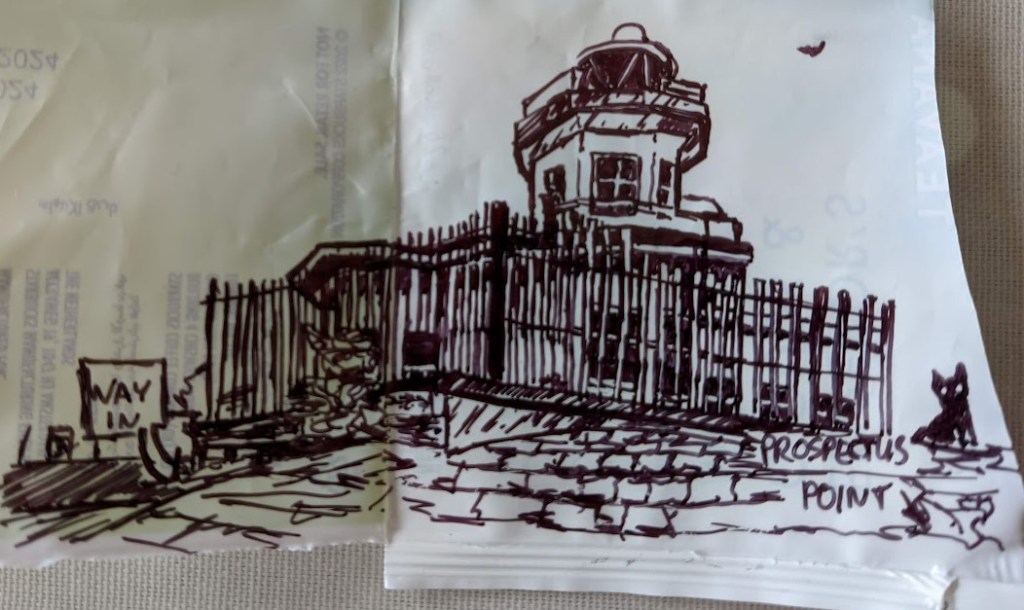
PROSPECTUS POINT
Usually he would move inland about now and sign up for work in the polytunnels, board and lodging included. But this spring is different. There is scabies in the dormitories. He cannot risk registering his details and visiting a chemist.
So he stays by the port, ear to the ground. There is a lot of pressure on places to sleep. The weather is warmer but still wet. The council erected barricades across the entrances to most of the nooks and crannies in the area during the pandemic and has strengthened them further with successive incursions. He keeps well away.
With dusk approaching he heads along the walkway behind the flats at Prospectus Point. He likes to sit there on the breakwater, behind a wall that provides some privacy. Oystercatchers and turnstones pick away, unbothered by the slimy green coating that proves so treacherous to human invaders. A pied wagtail joins them, and then another. They forget about him and come within a few feet. Welcome company. But unfortunately he needs to move and find cover for the night. He remembers the disused lighthouse at the end of the walkway. The ground he is walking on was not here 25 years ago, but the lighthouse was built in the 1950s. It must have been on an outcrop of its own and then acted as anchor for the creeping reclamation of land. Now it is an anachronism – a graffitied concrete hulk among the shiny flats.
The entrance to the lighthouse is fenced off, but the structure stands on pillars. He climbs down the breakwater to explore. It is clean and dry underneath, with some protection from the wind, which eddies in syncopation with the mournful arpeggio of the fence above and the clanging of chains and cables. He unpacks his sleeping bag and stretches out. He watches the figures in the gym and restaurants across the docks. They are close as the crow flies, but a long walk round. He is comforted by the sight and the distance.
He arranges his bag as a pillow and sets his alarm. But there was no need. At dawn, huge thuds ricochet across the docks every two seconds for ten minutes, then stop. Piledrivers along the coast, forcing in supports for the next strip of reclamation. The birds have dispersed when he walks back along the breakwater.
Curt Finks, early 2000s (published previously in an edition of one, on tiny brick templates made out of card, currently believed to be in unconstructed form in Wales)
A Gillian Finks contribution has been removed (6 November 2024) as it has been published unexpectedly elsewhere.
Pamphlet 55 of the #52Pamphlets
 GANTOB blog