
AKA Part 4 of Threads
Threads 1 | Threads 2 | Threads 3 | Threads 4 | Threads 5
Gillian continues her exploration of the links between the work of Kurt Vonnegut (particularly focusing on Cat’s Cradle (1963)) and Robert Shea and Robert Anton Wilson’s The Illuminatus! Trilogy (1975). That Trilogy went on to influence Bill Drummond and Jimmy Cauty in their music and writing as The JAMs and The KLF, so Gillian is also looking for echoes of Vonnegut in Drummond and Cauty’s output.
“The scratches formed a sort of spider’s web, and I wondered if they might not be the sticky nets of human futility hung up on a moonless night to dry” (Kurt Vonnegut, Cat’s Cradle)
I wake to CVS’s The Bluebird. Charles Villiers Stanford (1852-1924, Anglo-Irish composer). Perfection. Tranquillity. I can ignore the cold for a little bit longer. I curl up in my duvet, the cat nestling into the concavity. I must be careful not to fall back to sleep. I was on a late shift last night, fielding calls for a legal firm until midnight. Didn’t matter who it was. I just followed the script. And I’m back on again at 10:00 this morning. Flippety flip.
But for now, I can revel in these harmonies. The high notes soar above the imagined loch. I dream of summer.
Ali comes rushing in waving his phone. “It’s the dominant to the supertonic that does it” he shouts over the pivotal point in the piece. And just at that point the flattened packing boxes that have been doubling up as blinds in our bedroom crash to the floor, light spilling in, sending the cat flying.
Then a scream.
It takes me a moment to realise that it’s Ali. He’s scrabbling around, apparently trying to reconstruct the shield of cardboard, inspecting the snib on the window, before rushing to check the door. He’s gone as white as a sheet. It can mean only one thing. His flipping ophidiophobia. I might as well get up.
My phone pings when I connect to WiFi. Lots of activity on “the crofters” WhatsApp group. And it’s not recipes, borrowed equipment or planting seasons for once. It’s Ali about adders and the sceptical responses.
I grab a quick breakfast and log in for work.
Ali has recovered by lunch time. He brings me a toastie so that I can power through the calls. I am the breadwinner after all. There isn’t money in mutton, wool and turnips as Ali keeps telling me. I desperately need to hold on to this job.
I ask him how his morning has been. He’s not fixing fences or ploughing the vegetable patch. He’s been crafting rather than crofting. Hammering a post into the ground outside our bedroom window, and twisting a construction of stripped electrical wires to nail to the top, in a T shape. He shows me his phone:
“Make thee a fiery serpent, and set it upon a pole: and it shall come to pass, that every one that is bitten, when he looketh upon it, shall live.
And Moses made a serpent of brass, and put it upon a pole, and it came to pass, that if a serpent had bitten any man, when he beheld the serpent of brass, he lived.”
It’s from Numbers apparently. The fourth book of Moses, between Leviticus and Deuteronomy. Not something I’ve read. Flicking through a copy of the Bible that is tucked in with the recipe books, there are a lot of numbers and family trees. Codes to be broken perhaps. It makes me think back to Mr Gell’s trilogies pamphlet and Bill Drummond’s numbered books – 17, 25 Paintings, 45, 100, $20,000. But then I remember that Mr Gell, writing as Capt. Apophenia, chose The Magic Number as his title. He referenced 23 in his first paragraph, but it would have been obvious to anybody growing up in the 1980s or 1990s that it was going to be about the number 3. I leave Ali to his tinkering, park any thoughts about the GANTOB project, and get back to work. I have targets to meet. More numbers. I click a link on my screen to select the next contact. I’m making calls this shift. We’ve come a long way from relying on a “book of numbers” for cold calling.
That evening, when cooking tea, and with Ali still hammering away in the garden, I select an MLL album on Spotify. Meade Lux Lewis (1905-64, American pianist and composer). One of the few real people mentioned in Vonnegut’s Cat’s Cradle. We’re meant to be focusing on the book in these Threads pamphlets (of which this is number 4 – like Numbers in the Pentateuch).
In Cat’s Cradle we hear about MLL’s experiments with “boogie-woogie piano” and his family’s links to the railroad. Honkey Tonk Train Blues. Catchy, but too much of a stretch to link it to The KLF’s Last Train to Trancentral. In the book they’re listening to MLL’s Cat House Piano LP. It starts with The Pittsburg Flyer (train rather than pamphlet presumably). Then Dragon Blues. And four bars into that piece we read that one of the book’s characters, Angela Hoenikker, “improvised around the music of the Pullman porter’s son; went from liquid lyricism to rasping lechery to the shrill skittishness of a frightened child, to a heroin nightmare. Her glissandi spoke of heaven and hell and all that lay between”. That gives quite a different answer to the question that I asked in Threads 3. I wrote that Mozart [pushed] “the technical ability of the player to the limit. What more could be done to follow such a period of mastery and invention?” Well Angela Hoenikker and of course the non-fictional jazz greats, from Benny Goodman to Artie Shaw, and many others before and after, would have had a thing to say about that.
GANTOB (the project) is my first bit of creative writing as an adult. After 8 months, with hundreds of thousands of words in pamphlets, blogs and books, it is interesting to watch out for recurring themes. And while GANTOB is a collective endeavour, there is a story forming about GANTOB (the person), that must reflect my memories and subconscious. Some of the experiences I have written about are real, and others made up, but it’s not always straightforward to categorise them. I realise that the quote above about Angela Hoenikker’s clarinet solo is echoed, albeit with less virtuousity, in one of the pamphlets in the first GANTOB book. Did you spot it? Having forgotten most of Cat’s Cradle in the 30 years between first and second reading, I wonder if that scene planted memories that guided my writing in August 2023. Something to think about.
Re-reading Vonnegut’s book, we can also see relevance to contemporary affairs. I don’t know if the Oscars on Sunday (10 March 2024) talked about the impact of the Writers Guild of America (WGA) strike May to September 2023. Vonnegut asked in Cat’s Cradle in 1963 whether “writers have a right to strike?” And the answer he gave was: “I don’t think my conscience would let me support a strike like that. When a man becomes a writer, I think he takes on a sacred obligation to produce beauty and enlightenment and comfort at top speed”. How about that for a mission statement? But a sacred duty – like a calling rather than a job or hobby. And beauty and enlightenment for the sake of it, or for recognition and potential immortality? Moses managed the latter, on the page at least.
Also on the consequences of the writers’ strikes, Vonnegut throws in a line that makes me think again of the Covid lockdown: “there were no new books, new plays, new histories, new poems”.
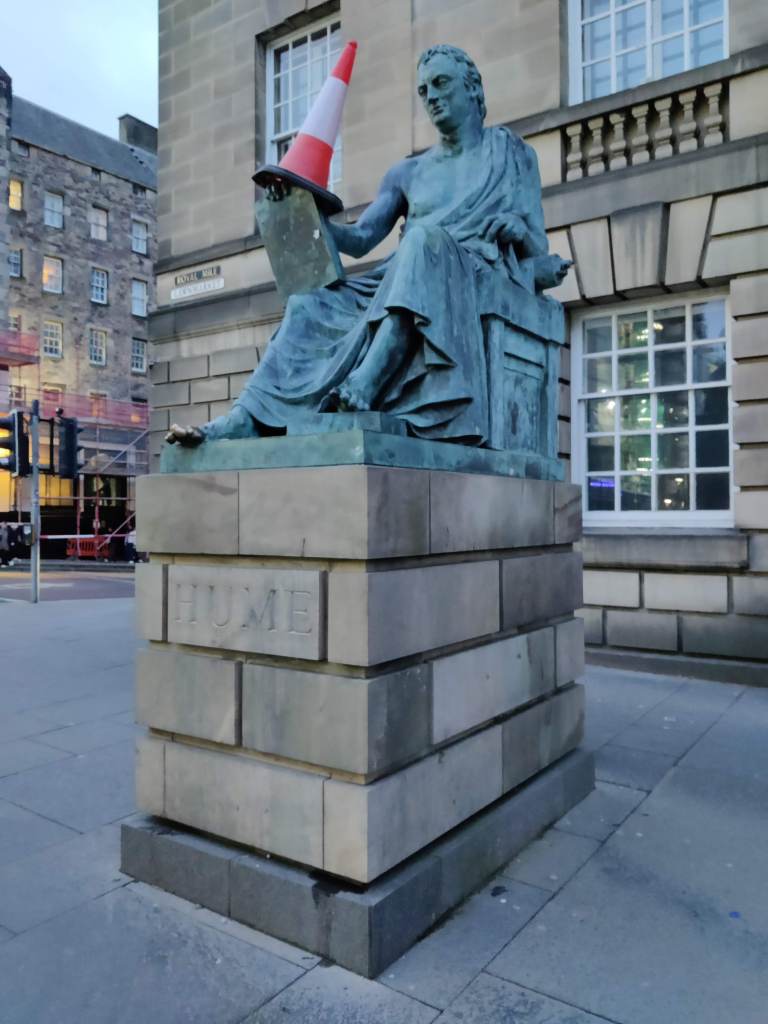
And we’re back to that word “apophenia” that Mr Gell introduced to the GANTOBverse in The Magic Number. It’s probably no surprise that a wide-ranging book like Cat’s Cradle, written at a time of major social upheaval, global stress, and the mushrooming cultural invention of the 1960s, appears to be relevant to our times, or any time. Or that there are points in common with a topic that we’re studying (e.g. The Illuminatus! Trilogy or The KLF). That doesn’t mean that there is a direct connection. A golden thread. If you throw in a lot of references, then probability alone is going to mean that some of them strike a chord. I’m going to keep going though.
The following morning we wake with the rising sun. Our bedroom is east facing, and Ali was too tired last night to reconstruct the packing box blackout. His DIY skills do not stretch to practical tasks. I either need curtains or a new husband.
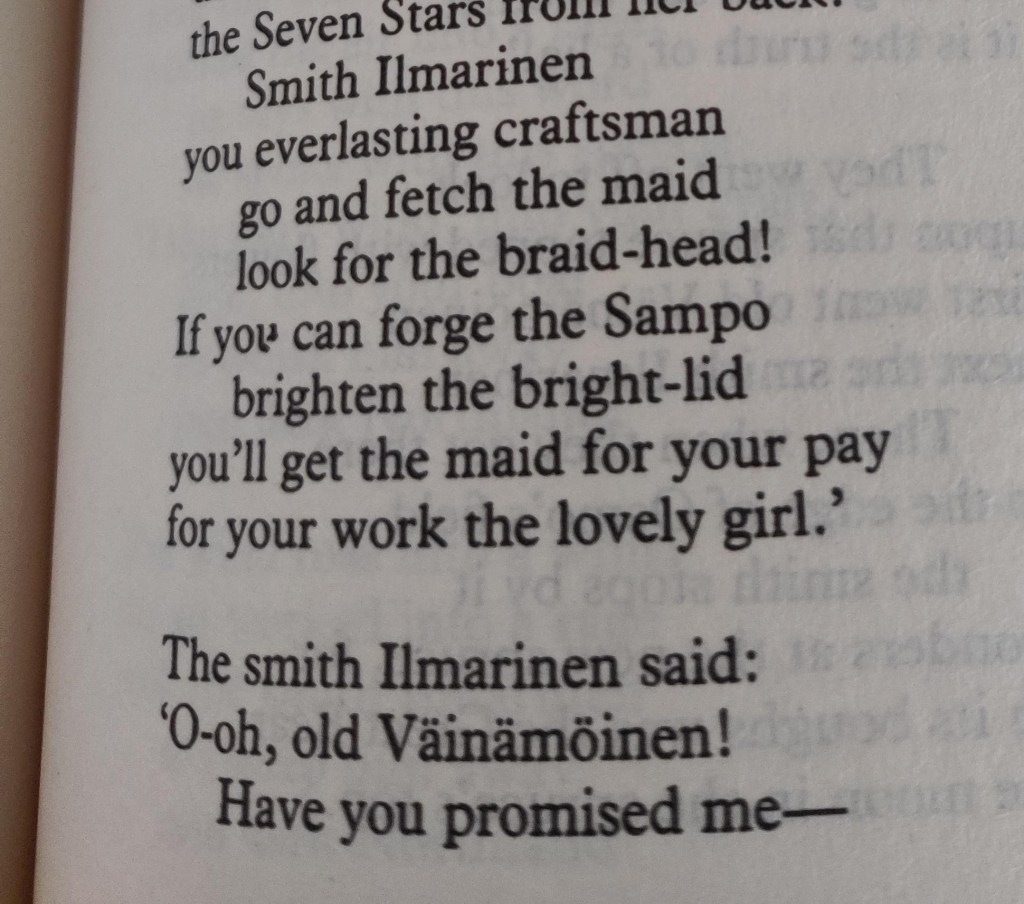
Last night we had a conversation about immortality. When I went out to encourage him inside, stop his racket, and switch off the car lights that he was using to ward off snakes, Ali replied that he was simply “illuminating the Ilmarinen”. He was the “eternal hammerer” from the Finnish epic Kalevala (1835) apparently. This was one of the most recent in the line of immortals – or those seeking immortality – from the myths and sagas around the world.(*)
Well, we seemed to be safe in our bed last night after all his hammering, and his sculpture is still standing this morning. I want to follow up some leads that have been brewing away overnight after Ali’s immortality thesis. Working backwards – the double-serpented Rod of Asclepius from the Ancient Greeks, with its links to medicine and deferment of death, or at least “withering”. Moses with his brass snake sculpture a few hundred years earlier, and then before that Thoth and the serpents on his staffs in Ancient Egypt. And then a jump back of a thousand years to the epic of Gilgamesh from Ancient Mesopotamia, and the plant found at the bottom of the sea that brings the eponymous hero within grasp of immortality, only to be snatched away by a snake. If Mozart or The Beatles queered the pitch for their successors, Gilgamesh fulfilled a similar role for story tellers.
Ali is well versed in immortality given his former calling, before the croft brought a different flock. Pheasants/ sheep/ partridges – take your pick. Now he is promising to protect them and us from poisonous fangs. He has an explanation for his “serpent of brass”, protecting those who have been bitten by a snake. I don’t listen to his theological argument, but given the distance between the croft and Raigmore Hospital in Inverness, or Perth Royal Infirmary to the south, we would have to put our faith in something above prompt access to antivenom. Nobody else on the WhatsApp group thinks that it was an adder. Ali is frustrated that he didn’t have his phone to hand (it was buried under the pile of collapsed boxes).
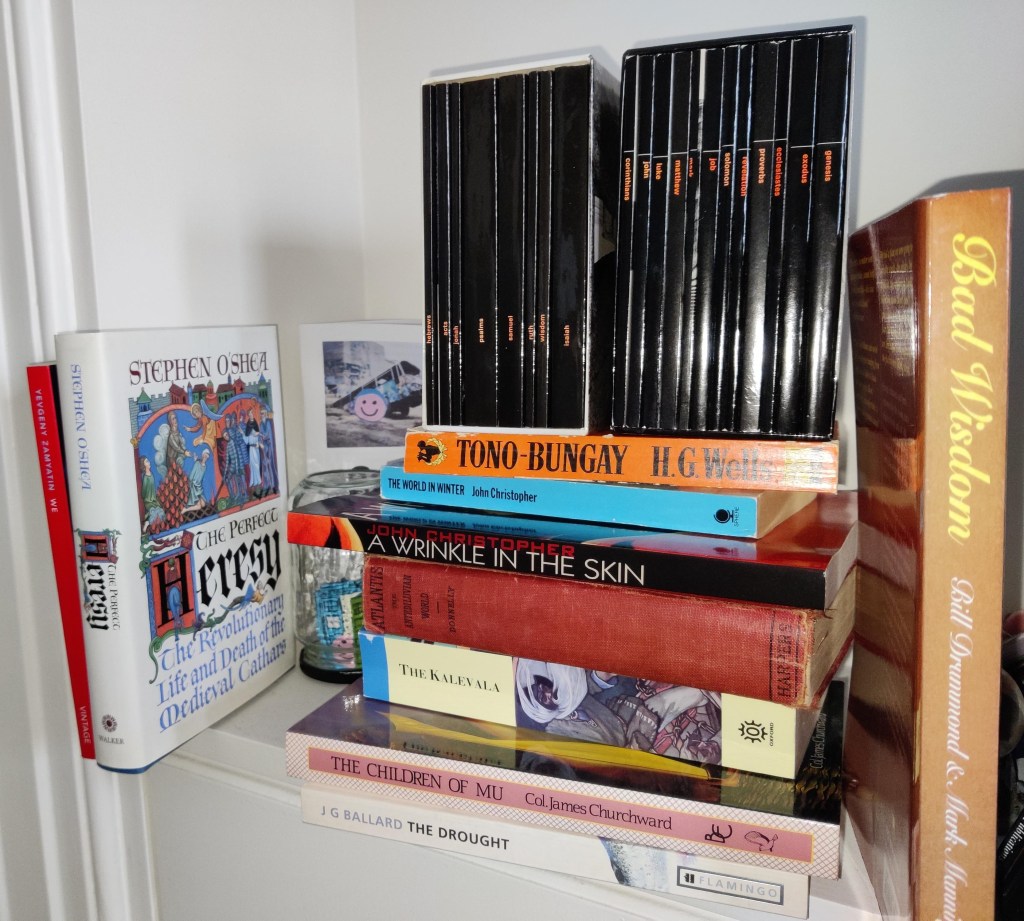
There are frequent mentions – at least 23 – of immortality in the two Roberts’ The Illuminatus! Trilogy (and undersea scenes for that matter). And it’s a central theme in Cat’s Cradle. Vonnegut’s hero John/ Jonah has a thing for the whale shaped Mount McCabe, the highest mountain on the island of San Lorenzo. He hears that nobody has climbed it before, and that there is apparently something sacred about it though the details have been lost. Worried about the encroaching frozen wasteland, he dreams of “climbing Mount McCabe with some magnificent symbol and planting it there”. I won’t spoil the punchline, but it relates to an immortality of sorts. I can’t help think of Bill Drummond and Mark Manning trekking across the North Pole with a statue of Elvis Presley in Bad Wisdom. And I’m left with Ali’s lecture and thoughts on mankind’s attempts at immortality. It always seems to be men. Masters of futility.
To be continued…
Gilian, 12 March 2024
Pamphlet 16 of the #52Pamphlets
(*) There’s more on the link between Drummond and Kalevala here.
I have not included DC and Marvel movies in the list of sagas and epics. Wrong verses.
To submit your idea for a pamphlet please visit the 52 Pamphlets page.
 GANTOB blog