

Threads 1 | Threads 2 | Threads 3 | Threads 4 | Threads 5
Before I start this third instalment of the Threads pamphlets, I have realised that there is a loose end that I should tie up. It is an important part of the GANTOB origin story. Graham, the clarinet player I mentioned in the second Threads pamphlet, explained his return to “problem kollekting” in his pamphlet Cycling. He blamed the stones and boulders that he turned over when writing his chapter for Bill Drummond’s The Life Model (2024).
My own excuse for my KLF-related activities (though thankfully not obsessive collecting) is the pandemic. Always the pandemic – whether it’s about failing sales targets at work or opening the Pandora’s box of a project like GANTOB. The years 2020 and 2021 were often a lonely period in the Scottish Highlands. I suspect they were with you as well. July-August 2021 was something of an exception, with some beautiful weeks of sunshine and a return of some intrepid tourists, but by September we were getting back into the grind of worrying about cases and restrictions again. We kept to ourselves on the whole, dodging the Delta variant as much as we could, with a stock of lateral flow tests, a chest freezer of supplies and well stocked cupboards. Ali did his weekly podcast rather than a sermon. He could see the viewing stats, but kept them to himself. I think that’s when he developed doubts about continuing his own job. He seems much happier in the croft.
I twiddled my thumbs on a reduced salary but without the travel. I was, in short, at a loose end myself. It was the kind of boredom where you put the empty plant pots in order in the shed, and search whether they can be recycled, or plumb the depths of all the email updates that you’ve ever signed up for but not cancelled. It was one such afternoon when I read a Penkiln Burn email about the publication of Tenzing Scott Brown’s book Best Gent Hair Saloon (sic) (2021). The price was a haircut. The idea of going to a barbershop in London sounded unbearably exotic during those long months of furlough. Imagine entering the salon, bell ringing on the door, sitting in a line of lockdown-bouffant men, a double row of mirrors reflecting their unclippedness into infinity. And Bill Drummond in the corner, in the guise of The Travelling Salesman, selling his book from a suitcase. I tried to persuade Ali to travel down for a trim (rather than me wielding the strimmer as had been required since March 2020), but he was being a stick in the mud. I think that we were all borderline depressed during this period. I toyed with going myself, but the name above the door of the barber, and its slightly modified version on the book, made it clear that I would not be welcome. Maureen in the village will cut anybody’s hair, but I was not getting the same vibes from the email. Male only.
Well, I thought, why not mail also. I wrote a letter of justification – citing equal opportunities or something like that – and posted it off, after googling the price of a short back and sides in London (I settled on £20, to cover postage and packing as well). And a few days later I received a text confirming receipt and postage of the book. I repeated this trick a few times for the following books, each time adding in a little bit of justification for not enclosing the second-hand teapot or whatever the price of the book was to be. And each time a parcel would arrive, but never again a text. What a hoot.
I received the most recent Bill Drummond book – Under The Junction – sometime in late 2022. The price of one of the first 40 copies was recommending a book to read before you die. I cannot remember my planned answer, but it might well have been Doris Lessing’s The Golden Notebook (1962), because it is a book that I have yet to finish. But more on immortality later. But I couldn’t work out a way of conveying my answer to The Travelling Salesman, who was to be waiting under Spaghetti Junction on the allotted day, so I had to order through the Alimentation.cc website. It was then that I realised that by receiving my books direct from The Travelling Salesman, or whichever guise Bill Drummond was now occupying, I had missed out on Penkiln Burn pamphlets sent out from that website with every order. So it goes. But if I had my time again, I’d do exactly the same, just for the sake of a couple of scribbled notes from the great man in return for my over-elaborate missives.
And after all that I began 2023 alert that Bill Drummond might turn up at an unexpected juncture, under a bridge, perhaps even in the local shop. This vigilance was rewarded. I mentioned his event at Edinburgh’s Queen’s Hall that spring in one of my earlier pamphlets (Kultural Vandalism, as featured in the first GANTOB book). And you’ll hopefully be familiar with my adoption of the GANTOB costume in July of that year, and all the writing and art that has ensued from me and many others. The lesson is not to go delving about in your emails. There. I’m glad to have that off my chest.
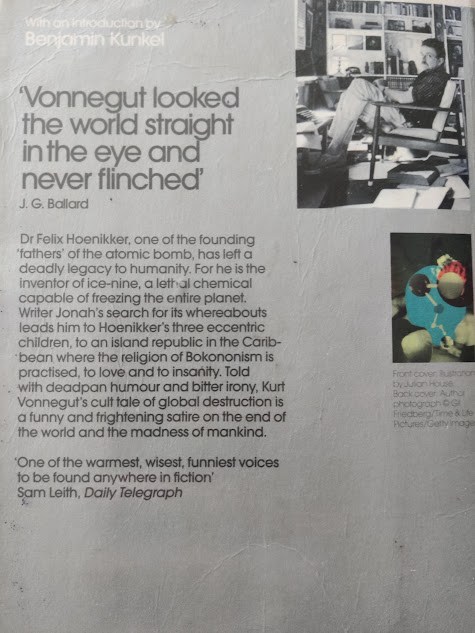
Woops. I’ve used up over half the allowed 1600 words of this pamphlet wittering on. We need to get on with the critical analysis of Kurt Vonnegut’s 1963 novel Cat’s Cradle. I’ve written that year a few times in these Threads pamphlets, but haven’t drilled down to month. The book was published in April 1963. Two years to the month after the Bay of Pigs invasion on a real Caribbean island, and 7 months before the assassination of JFK.
Here are a few of the things that I wrote down when re-reading the book after a break of thirty years (more will follow in future Threads pamphlets):
Lies. The first words of the book: “Nothing in this book is true”. “Foma” = “harmless untruths”. It’s a shame that useful word hasn’t entered our lexicon in the way that FOMO has managed all too successfully. And “bittersweet lies”, taking us to the defining characteristic of grapefruit, the fruit that gives GANTOB her name, and echoed in The Benefaktor’s reflections on cherries.
Entanglement. This is the bit that I remembered from the book, and that encouraged me to re-read the book. Here is the closest that I could find: “If you find your life tangled up with somebody else’s life for no very logical reasons…. That person may be a member of your karass.” A karass “ignores national, institutional, occupational, familial and class boundaries”. People are not told that they are in a karass. Vonnegut’s hero John (formally Jonah), a follower of a fictional guru called Bokonon, notes that “humanity is organized into teams… that do God’s Will without ever discovering what they are doing”. You can ignore that cod religious component. Vonnegut (coincidentally a Cape Cod resident) was a lifelong atheist. That will become important later on. The earliest example of a karass given in the book is in a Bokonon song: an American wino, a lion hunter, a Chinese dentist and a British Queen. Vonnegut explains the machinations of a karass throughout the book. Suffice to say, I had some of the details wrong when I wrote in Threads part 1 that when such a group meets in “chance encounters separated by many years [where] we can take up where we left off, comfortable, content to make each other’s acquaintance again”. There is little comfort in some of the interactions recounted by the hero John over the course of the book. I cannot comment on whether the loose collection of GANTOBers would count as a karass. And I certainly would not want to take on the role of cult leader. Just as well, perhaps, that I have abdicated from the role of GANTOB. Long live GANTOB3.
The clarinet. If I was off the mark with my understanding of entanglement in Cat’s Cradle, I was pleasantly surprised by the role of the clarinet in the book. Or should we say Klarinette, to use the German, reinforcing the importance of the instrument to the world of K. (While we’re on the topic, I love that the German for Grapefruit is Pampelmuse (f), from the Dutch for fat or swollen lemon). And I am grateful that, yet again, we can look well beyond the world of The KLF. Sure, the clarinet is important to Bill Drummond’s solo album The Man (1986), The JAMs 1987 LP, Chill Out (1990) and The White Room (1991), through Duy Khiem, Acker Bilk and back to Khiem. A komedy of Ks.
But what I want to focus on here is the earliest of Komponists for the Klarinette. The KLF were frequently standing on koattails. But that other three-letter-acronym, and genuine giant of music, WAM (Mozart – 1756-91) trailed the way throughout his short life, including with his compositions for Klarinettist Anton Paul Stadler (1752-1812). The clarinet had been invented circa 1700 by Johann Christoph Denner, producing an instrument with three registers – an extraordinary range for a wind instrument, with different fingerings in each of the registers. A virtuoso – Michael Collins, Emma Johnson or Martin Fröst for example – makes leaping between chalumeau, clarion, and altissimo look easy, from the lowest notes to the nurtured squeaking of the highest. But in reality it requires superb control of breath, embouchure, throat, tonguing and carefully chosen fingering for a well-played sequence of notes. What is extraordinary about Mozart’s Clarinet Quintet (K 581; 1789) and Clarinet Concerto (K 622; 1791), written specifically for Stadler, is that they already demonstrate the range of the instrument to the full, and push the technical ability of the player to the limit. It could be argued that Mozart had, at the very start of the clarinet, done it all. In that way Mozart and The Beatles have a lot in common. What more could be done to follow such a period of mastery and invention?
The Ks in the Quintet and Concerto relate to the Köchel Verzeichnis (Köchel catalogue). Ludwig Ritter von Köchel (1800-1877) took the 800+ compositions by WAM and put them into chronological order. Rather like quoting chapter and verse from the Bible, or giving a route by road numbers rather than names, some people will reference Mozart by K(V) number rather than the frequently more memorable name. K492 anyone? Or would you prefer The Marriage of Figaro? I can’t be doing with road numbers either – Bxxx or the road between the shop and the croft? Nae contest.
But this is perhaps another classic GANTOB wild goose chase. A four-hundred-word diversion on Mozart just to get to the quote about Angela Hoenikker, daughter of Dr Felix Hoenikker: “She had only one hobby. She played the clarinet”. Sounds a bit like me until I discovered my inner GANTOB. Angela’s father is the fictional inventor of the atomic bomb. His real-life counterpart J. Robert Oppenheimer is very much on people’s minds this weekend as we await this year’s Oscar winners. But we’ll come back to Angela and the clarinet in a future Threads pamphlet.
I will end this pamphlet with an observation on WAM. It’s an acronym certainly. But how about an abbreviation? Not so much perhaps, unless you want to dip into Nyungar (wambenger) or obscure dialect (wamble). But I couldn’t help but note that Vonnegut gives one option in his writing. His neologism wampeter means “pivot” – something that a karass revolves around. He writes: “Anything can be a wampeter: a tree, a rock, an animal, an idea, a book, a melody, the Holy Grail…. At any given time a karass actually has two wampeters – one waxing in importance, one waning”. It is not clear whether any karass has ever had a wambenger (Red-tailed Phascogale – a small arboreal flesh- and nectar-eating Australian marsupial) as a wampeter. But that is beside the point. The KLF’s wampeter might have been a pyramid blaster, but now it is probably a people’s pyramid. And if there is a karass that has a grapefruit as its wampeter, what comes next? Well, we need to be careful what we wish for in these dangerous times of sabre rattling among nuclear powers. Grapefruit are not the only bombs.
To be continued.
Gillian
9 March 2024
Pamphlet 14 of the #52Pamphlets
#GANTOB2024
Have your say – contribute a pamphlet here.
 GANTOB blog