
I was sent a draft pamphlet by an acquaintance of The Benefaktor – The Photographer – a couple of days ago. It was called “Surfacing”. It came in at 1600 words. I liked the general thrust of the piece, but felt that it needed some development. The Photographer replied this morning with this extended piece with its new title. It is, in effect, a triple pamphlet – 3 x 800 words. It is not a trilogy. It is a single piece. And it is one of several that were battling for pole position for this weekend’s slot. All have some time pressure, either because of the specific date, the changing season, the originality of the ideas, or the knowledge that a deadline can help some people fulfil their commitments. I have therefore made the decision – for now – to issue pamphlets more regularly than once a week. Watch the blog for more – and subscribe to receive email updates. If the plan works we may have 52 pamphlets in time for The Battle of Perth (in Stirling), 27 August 2024, but that is perhaps a tall order. We’ll see.
I have issued this in a printed edition of one to The Photographer as a booklet. Not quite the RLS or Welsh volumes, but quite a handsome volume nonetheless.
Feel free to re-enact it if you wish – either word-for-word, picture-by-picture, printing it out as a foldable volume, as I believe some may be attempting with Bill Drummond’s spoken word novels. (If you do recreate The Photographer’s piece as a booklet please send me a copy and I will link to it here. It will need to be in A5 booklet format). Or write your own travelogue of your life and travels and submit it as a pamphlet to 100percentvinyl2@gmail.com as part of the 52 Pamphlets. Or just simply enjoy The Photographer’s response to what sounds like a rather eventful few days.
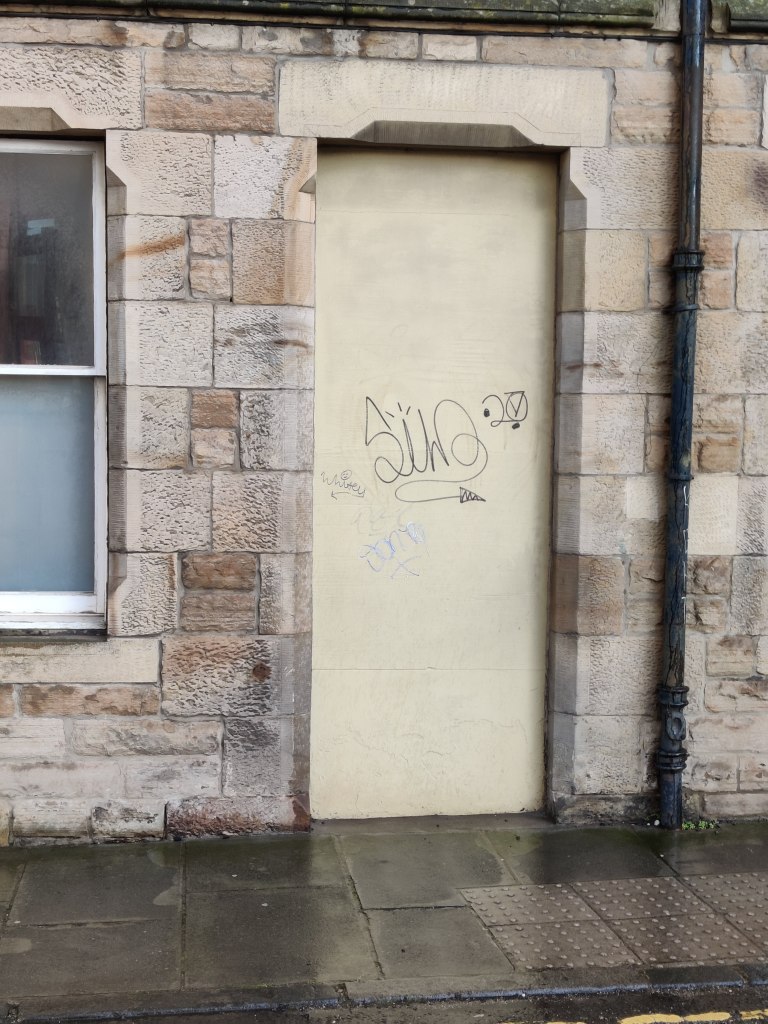
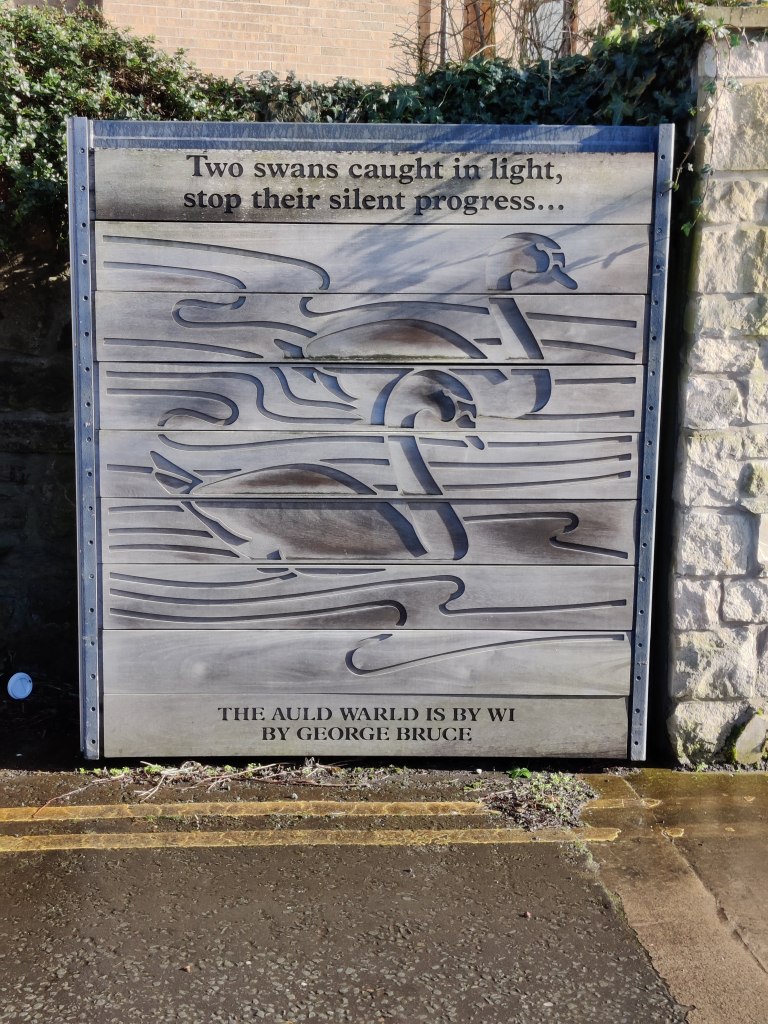
Meanwhile, I’m off to contact the Scottish Poetry Library to see if I can find out more about the poem The Auld Warld is by wi by Scottish poet George Bruce (1909-2002). See The Photographer’s pictures of doors to see why.
6 Times (by THE PHOTOGRAPHER)
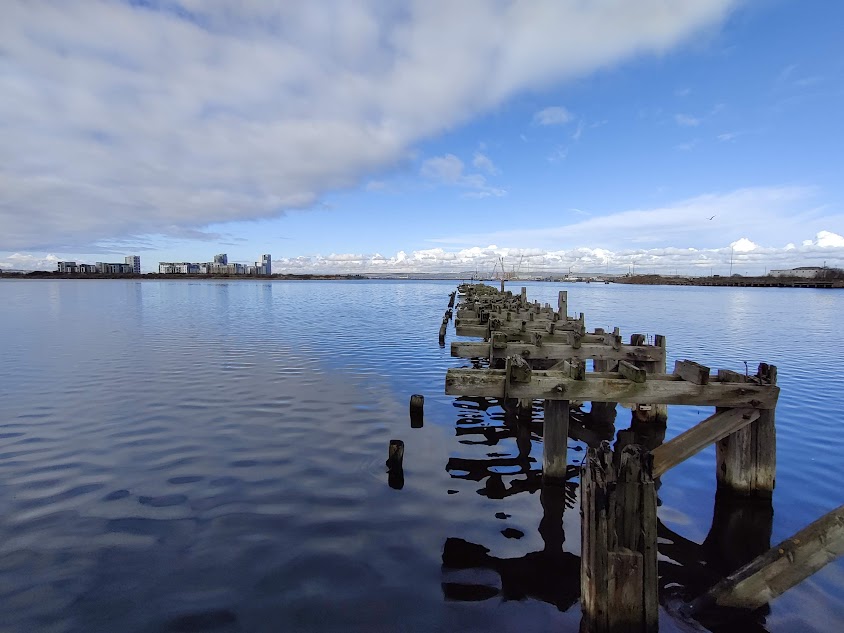
I wait, leaning against the railing looking out over the ruined wharf. I try not to see a message in the rotting struts, like teeth between the collapsed beams. Birthdays have been a sensitive topic since I was ejected by my first wife, landing at the feet of my younger second. As of today, the current model (version three) is no longer half my age, which is a relief perhaps, but at one point would have been a prompt. I remind myself that octogenarians cannot afford itchy feet.
We had been heading to “b-day drinkies” at the top of a vertical distillery. There is a lot of tongue biting with a younger wife. B-day drinkies indeed. The plan had been whisky for me, gin for her. I had even anticipated her request for cocktails and had rehearsed a suitable request – “a Manhattan, please”. I couldn’t bring myself to ask for an Old Fashioned. But we didn’t get that far. The smooth motion of the lift to the top floor, with the parallax of the Edinburgh skyline, sparked off a nausea in her that quickly tipped to retching. After she had spent a few minutes in the toilet we returned to the lift and she managed down to ground level safely with eyes closed. And now she is recovering at my side, a shade or two off aquamarine. If my suspicions are borne out – I have experience here, trust me – I will not mention how many children this will make for me. Straying into Boris Johnson territory, though not the politics.
I cancel the reservation, and flick around the venue’s website for a couple of minutes. I have done the tours of the Spey and island distilleries over the years – the carbon copy talks about the purity of the water, or the trading with local landowners for rights of access to a private loch. Situated at the mouth of the Water of Leith as it enters the Forth estuary I wonder how this place sources its principal ingredient. An aquifer 120m below the ground apparently. I imagine water coursing from the Pentland Hills down to the coast on a smooth layer of rock, landing magically at this precise spot. What are the chances of that? I know not to trouble Veronika with these details. She is still looking hellish.
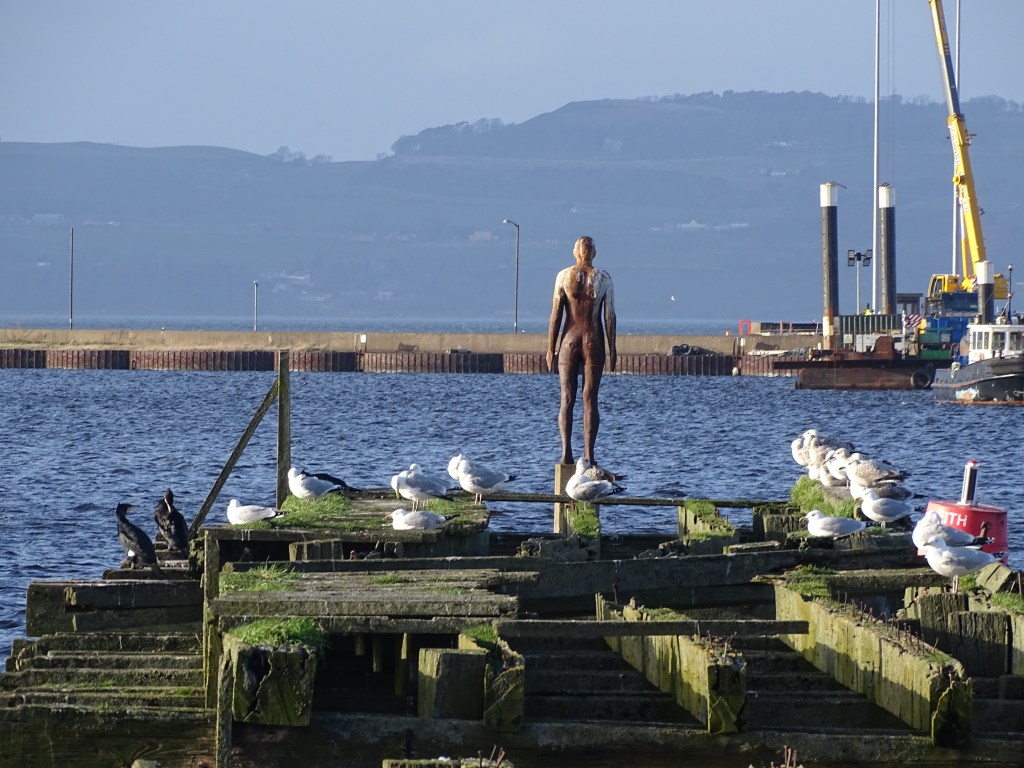
The view across the docks is picked out in the sunlight of late afternoon. Huge ships with winches and helipads to the right, Britannia to the left, and the dilapidated wharf dead ahead. Blocks of space rocket shaped flats in the middle distance, and beyond that the Lothian and Fife coastlines tapering towards the bridgehead. It really is a beautiful evening. Seagulls preen, enjoying the sun. And a couple of cormorants taking their turn to lift their wings to prayer. I zoom in on my phone camera but it doesn’t do them justice. I take one of the weird fish angle photos that the phone suggests and pop it away. There is romance here. Not that you would know it. V is leaning over the railing making noises that are mimicked by the herring gulls. The tourists are giving us a wide berth.

Romance. I wonder what RLS – if that three letter acronym is not too familiar for the great man – would make of his beloved Water of Leith now. I am transported back to Christmas many decades ago, visiting my parents, and receiving a second-hand copy of Stevenson’s book Edinburgh: Picturesque Notes (1878). A brilliant present. Much of what he was describing was already old, but there was plenty to learn about our current environs. And here we are, standing on land reclaimed since my childhood, with a shopping centre behind us built at the turn of the millennium, a large part of which is about to be demolished. The world does seem to be accelerating towards some unprecedented endpoint. Or maybe it’s just the usual destination, which is a surprise for each of us when it comes.
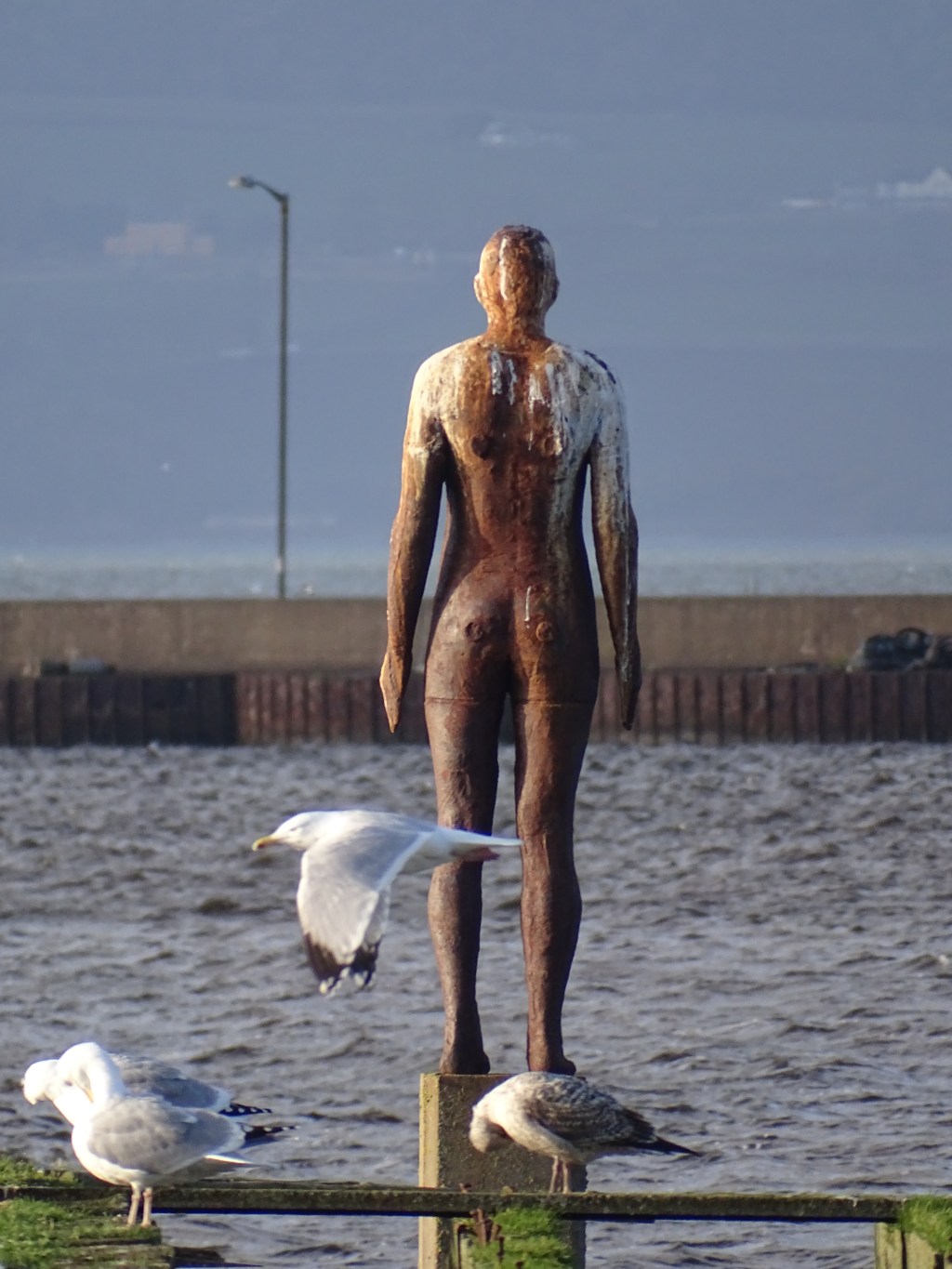
The sun is edging over the horizon now, the top rim just visible. We would still have some time to take in a few of the sights if V would just sort herself out. I make some tentative enquiries. She wants to take it easy, appreciate the view, take in the sea air. She comments on a figure at the end of the wharf. I cannot make it out. She is a step ahead. “It’s a Gormley I think”. I nod noncommittally. Cataracts are holding me back in this conversation. I just see glare and shadow.
I should explain at this point that I have been known as The Photographer since school days. My acquaintances tagged me as such because of my chosen Friday afternoon “society”. All the boys were encouraged to join extracurricular activities, with the promise of a “societies supper” of battered haddock and chips followed by cake and custard of a matching colour each week. My “football friends” (as I believe The Philatelist christened us in the second book) were all off in musical ensembles, but I am tone deaf. Worried about missing out, I chose discussions about SLRs and dark rooms instead – for seven years. I would sit quietly at the back, comfortably full after the best meal of the week. I don’t think that I spoke once in all my attendances at the society. I take photos, for sure. But they’re not professional. I’ve never owned an SLR or even understood the settings on my phone camera. I have a standalone digital camera as well, but the settings are clicked to “Superior Auto” rather than doing anything clever of my own. But “The Photographer” nickname stuck. Could have been much worse I suppose.
The following morning, after dropping V off at her work, I return to the wharf with my digital camera. The optical and digital zoom do their work and I have a reasonable view of a Gormley sculpture part splatted with guano. I am aware of at least one other Gormley in the Water of Leith – it’s a hinged affair that bends over when the water is high. I check Google for an explanation and up comes details of a six sculpture work: 6 Times. They’re all within a manageable distance if I cycle. I pop home to pick up some waterproofs and head round the north Edinburgh cycle path.

As I pedal, I am transported back to my school days. Passing underneath Wardie Road I can see evidence of the former railway platform and signal in the undergrowth. When we were kids this used to be our starting off point for trips into town or along to Leith. How quickly things change. Who would have thought that the tracks and trains would all now be dismantled, with trees full of blossom in place of billowing steam. At least their drivers didn’t have to dodge dogs, children and grown adults peering into phones or having conversations into thin air. I proceed carefully, squinting through the filters of my cycling glasses in the stop-start shadow-sun. I recall a trip that The Benefaktor, The Ornithologist, The Philatelist and I took from this very spot in the late 1950s or early 1960s. The others were lugging instruments and stands to one of the Leith venues. I was along for the ride, with nothing better to do. The Philatelist was writing out a speech on a scrap of paper balanced on his knee. I can’t remember the details, except that he was always writing or had his head in a book. And with this memory I resolve to write down my current trip as a travelogue through north Edinburgh, as my first written contribution to the GANTOB project. The Benefaktor has promised that he will give me a copy of the second book in return. I want to see what The Philatelist has written in his chapters (they’re not available on the blog). His recent postcards have been no help, except to reveal that he’s no longer in Europe. In the past few weeks he’s been in Karachi, Lahore, Faisalabad and Rawalpindi. There’s a pattern there, beyond just the decreasing order of population. Where next? Sialkot?
Cycling further along, past Trinity, Ferryfield, through Pilton, I recall a series of walks that the four of us took near here back in the 1990s, an Irvine Welsh guide tucked under The Benefaktor’s arm: A Visitor’s Guide to Edinburgh (1995) co-written with Kevin Williamson, published by Rebel Inc.* The Benefaktor led the way, stopping outside a “sauna”, getting chucked out of a pub after asking if the TV could be turned off, and missing the opening hours of a fruit and veg shop not far from the red bridge I’ve just crossed. This was part of an in-joke, revisiting some of the infamous scenes from Irvine’s book. His most well-known books – Trainspotting and Porno – despite their periodic hilarity, marked a time when Edinburgh was one of the (injecting) heroin and HIV hotspots of the world, with some areas of north Edinburgh particularly badly affected. The lost generation. In 1994 we had seen Welsh’s Trainspotting on stage at The Traverse theatre**. We imagined ourselves living the parts of the characters. Renton (originally Ewan Bremner in the stage play, replaced by Ewan McGregor for the 1996 film), was The Philatelist. I was Spud (played by Bremner in the film). Sick Boy was The Ornithologist. And The Benefaktor was Begbie. We stayed in character throughout the walk. Privileged men in our 50s, older than the actors, even when they reappeared in Trainspotting T2 in 2017. We knew we were ridiculous. But we loved seeing Edinburgh on the page and the big screen. The Benefaktor’s “Begbie” went too far in our re-enactment, as my tongue reminds me now, excavating a gap in my lower incisors.
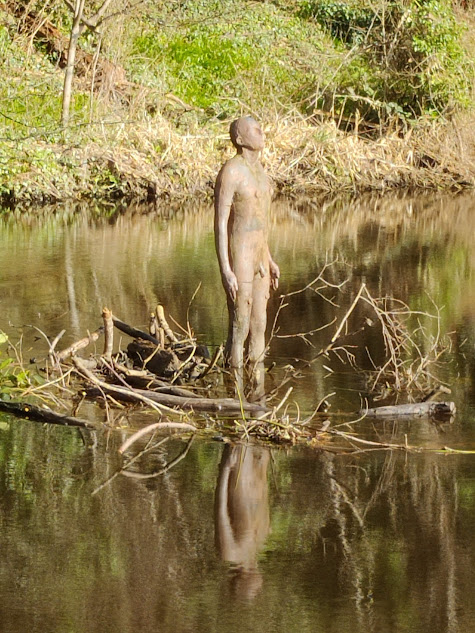
And I’m almost there. The long drag up to Ravelston Dykes, and then onto to the road for a short stretch to reach the National Galleries of Scotland: Modern One and Modern Two. There’s half a Gormley in the pavement between them. A trip hazard I’d say. I park my bike and head down the steps behind Modern One. There’s another Gormley, standing in the water, above a more turbulent stretch of river. He’s not fishing I decide. He’s sunbathing, head inclined upwards slightly. He could almost be worshipping a sun god, though with hands by his side. I can imagine him rotating on the spot to mark the time of day, but suspect that is not the case. Water would get in the electrics, or somebody would need to wind the mechanism regularly. You can’t beat the force of nature. Branches have collected at his base. But it’s a calm day and he’s in still waters. You can make out his private parts and rivet-like nipples in the reflection. I can imagine how we would have sniggered at that 75 years ago.
I head back up the steps, stop for a scone and a mug of soup in the gallery cafe, and pick up my bike. I dismount and push down a stretch towards the next Gormley (luckily that section of walkway has reopened after years of repairs following a landslide), past Dean Village and St Bernard’s Well. I well recall walking this specific stretch with my son after he had passed his final school exams, retracing the steps I had taken with my mother when I was at the same stage, ready to go to university and start a new life. I can put myself right back in both pairs of shoes. The sense of achievement mingling with the excitement and fear of unchartered waters, and on both occasions the summer sun penetrating the dense canopy, dappling the river and path with an optimistic glow. Not a leaf to be seen at the moment however. And it’s chilly.
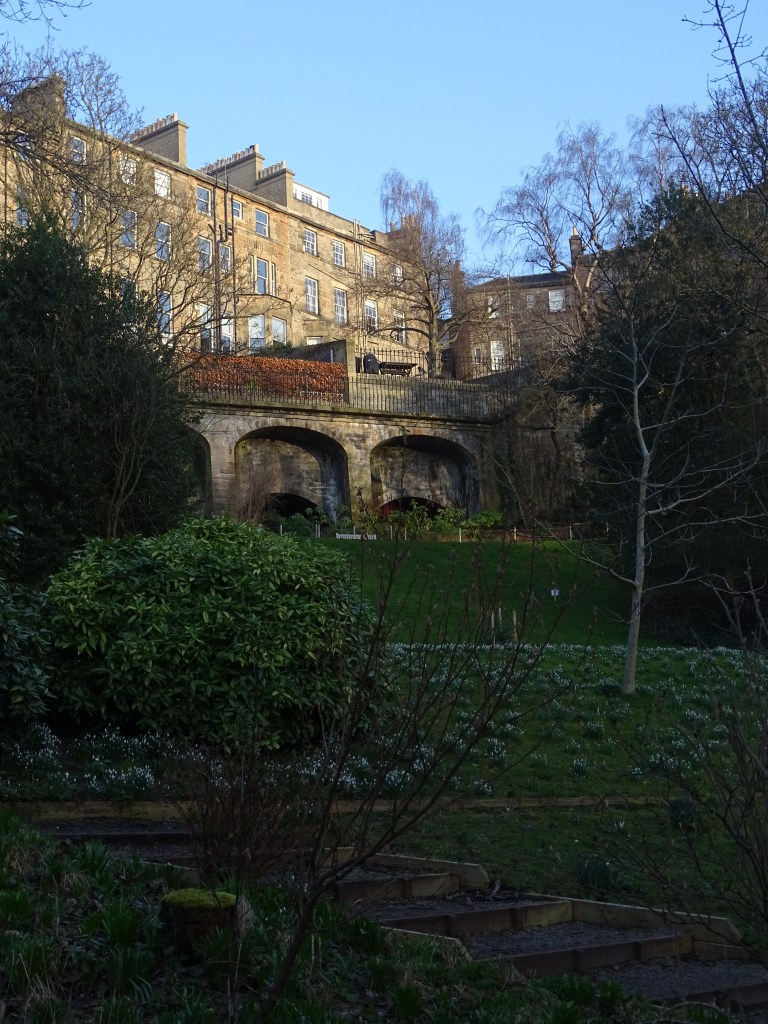
The next Gormley is under Stockbridge – the actual bridge – which I was once told is the shortest street in Edinburgh. I can imagine RLS (1850-94) standing on this very spot 150 years ago, and wonder how much has changed looking upriver. The blocks of flats on the left obviously, but not the Georgian houses (including some previously of ill repute) on the right. Downstream is different – a lot of flood defences and raised walkways would have been unfamiliar to the famous son of the lighthouse family. Past a series of doors (but not green doors) and portals that I’d love to see through, Wallace style.



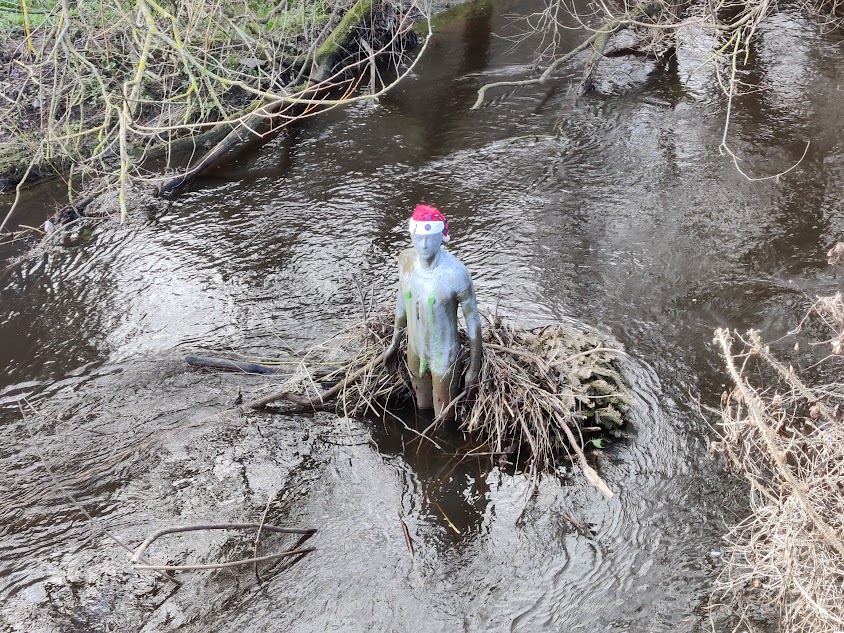
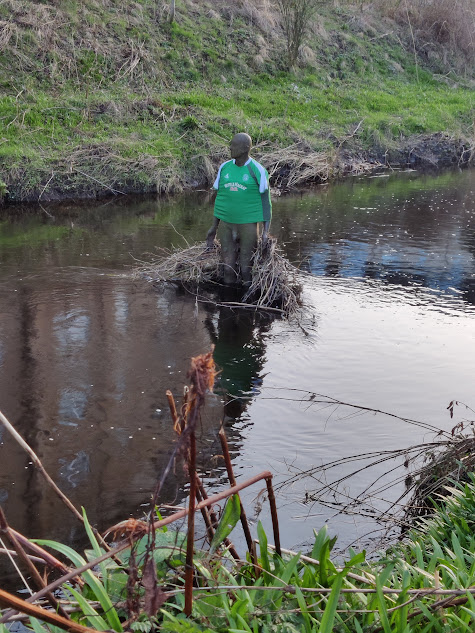
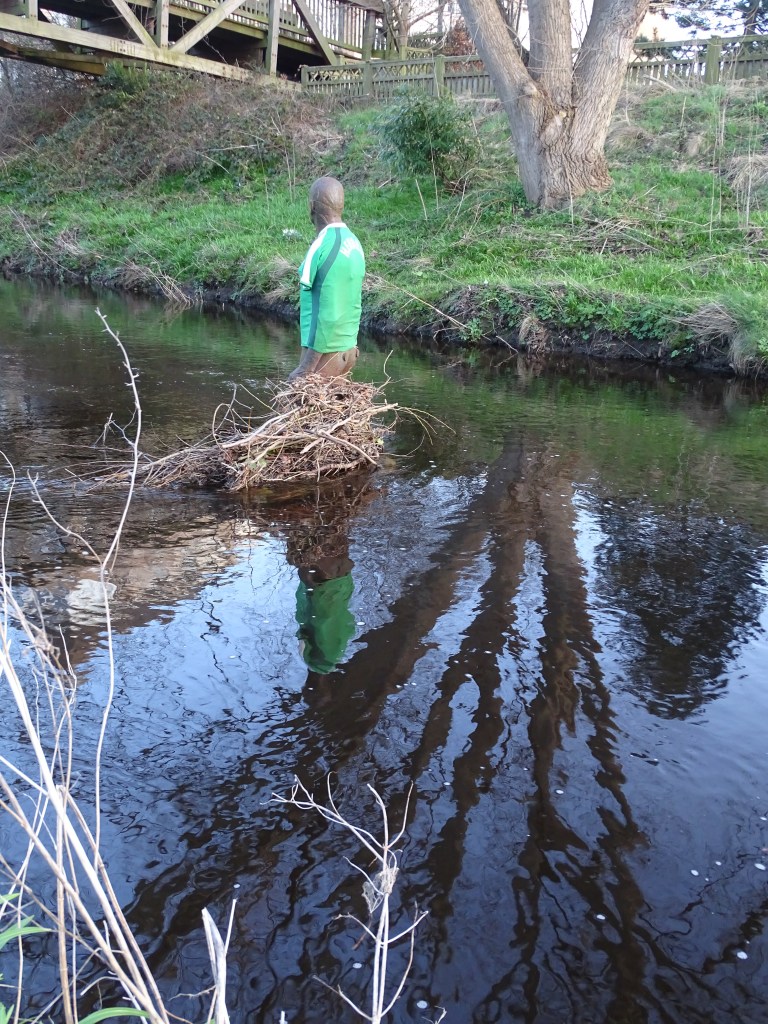
And then we’re on to two “decorated” Gormleys. One in a football strip near the site of the old greyhound racetrack. I almost fall into the water in an attempt to capture a better picture against the setting sun, skidding to a stop in the wild garlic that is about to flower. (I notice the rivets on the buttocks when selecting the photos to accompany this piece – I imagine the snigger, this time from TV characters I hear my grandchildren talking about). And another in a Christmas hat beside a raised metal walkway. GANTOB tells me that she has shared some of these photos with a GANTOB correspondent – JR – who wrote about Gormley in the second GANTOB book. I ask that it is made clear to JR that I was not the comedian/ vandal making these additions.
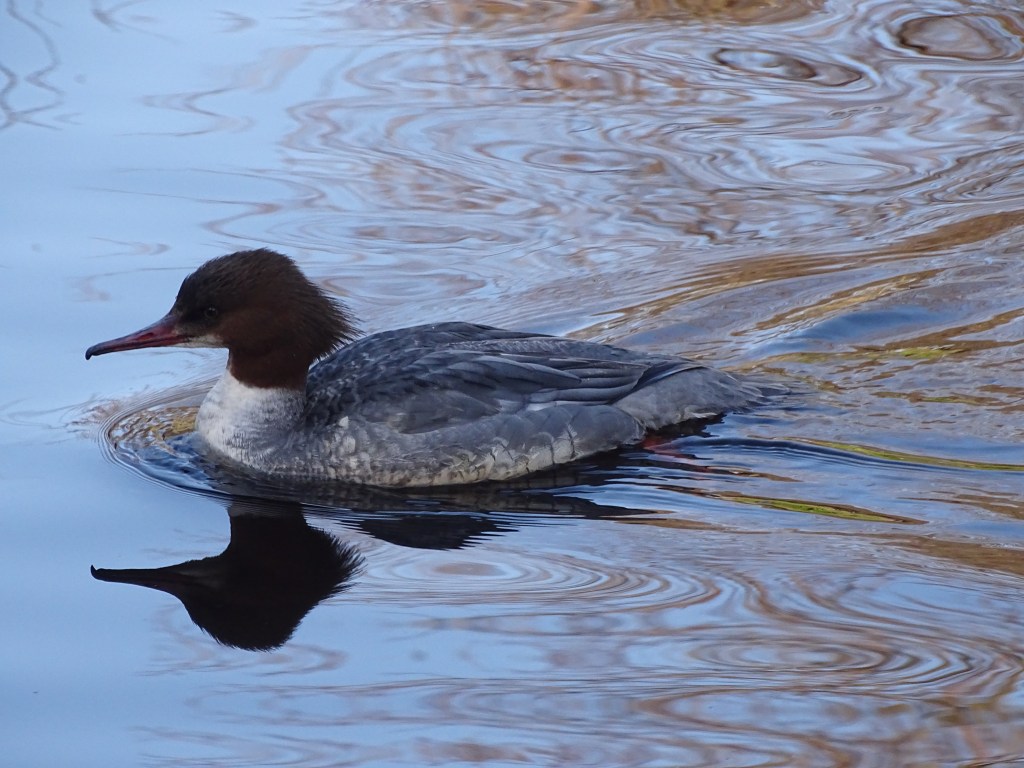
I stop off to admire the goosanders that seem to have set up home on the bend between The Quilts and West Bowling Green Street, the occupations and recreations of the past marked out in street names rather than the architecture or green space. (I read about “back green concerts” in the early 1950s when I look up the story behind the names, but have not been able to find out more). When this waterway was an industrial hub it would not have sustained such flora and fauna. The tufty headed, sharp beaked birds are having a great time with their duck and coot cousins, and a couple of swans. I think back to a walk with The Ornithologist, to explore the new cycle pathways that have made whole stretches of the river accessible, when he pointed out that the goosanders were not the grebes I had thought. I’m a late learner. And then I’m back where we started, at the mouth of the Water of Leith and the last Gormley.
I still cannot imagine the aquifer. But I’ve visited 6 Times of my own along the river, walking, cycling and slipping close to the banks, memories surfacing at each turn. I cannot do them justice with Veronika. She hasn’t lived through the first half of my life. That bit of me is a mystery to her, like the half Gormley that may or may not lurk under the asphalt outside Modern One. So I have written them down instead, in case they connect with you. These are my picturesque notes. My visitor’s guide. I’d better get back now. I’ve promised to pick V up and I mustn’t be late.
THE PHOTOGRAPHER 1 March 2024
#GANTOB2024 pamphlet 9 of the #52Pamphlets
GANTOB3 notes, consulting Google, Facebook KLF fanpages, and the database of materials handed over to her by GANTOB:
* In passing, I note that Williamson went on to co-found Neu! Reekie! with Michael Pederson in 2010, publishing a couple of Bill Drummond poems in #UntitledThree (2020), and hosting a Drummond painting “Bill Loves Elvis” in June 2021 with accompanying Penkiln Burn pamphlet – Two (PB pamphlet 33). One of the Drummond plays in #UntitledThree is called Life Model. Drummond’s memoir, which is being published in daily instalments at the moment, is called The Life Model. Today’s “Over” chapter is by Ali Flind (one of 168 different contributors to the “book”), and starts with an RLS quote. Coincidence? Or Apophenia? It’s why I felt that we needed to publish this pamphlet today.
** The Traverse also features in GANTOB’s pamphlet The Gap, a handwritten copy of which was handed to Bill Drummond by GANTOB in December 2023, edited and re-sent electronically [PDF] a few days later, and perhaps resulted in the Bill Drummond contribution to the second GANTOB book. It is also, quite possibly, the location where The Benefaktor crossed paths with Curt Finks for the first time.
Inspired to write? You can submit your own pamphlet.
 GANTOB blog
One response to “6 TIMES (by THE PHOTOGRAPHER)”
[…] I know of The Tied Hands from Bill’s previous posts. I read about them with passing interest, when in the middle of other things. Something about displaying a poster of tied hands on a website for 40 days(^), in a 12-step tour of the world. Forty is a significant number for Bill, frequently appearing in his work. The idea of a 12-step tour is also familiar from early mentions of The 25 Paintings (e.g. see BILL DRUMMOND WORLD TOUR 2014-2025, pb poster 300, 2013). In another poster he talks of the paintings becoming a sculpture. Or perhaps he means the tour will be the sculpture, like his famous rabbit map of Echo and the Bunnymen’s tour. Or like Antony Gormley’s 6 Times work stretching for miles along the Water of Leith, which I walked last year after reading about it on the Gantob blog. […]
LikeLike