
A pamphlet from the LittleGrapefruit-verse – but for adults) – written and narrated by The Benefaktor.
I have written and am narrating this piece as the only consistent member of the GANTOBverse. Gillian is still around (indeed, next Saturday’s pamphlet is probably going to be one of hers). But she is no longer GANTOB. GANTOB3 is now in charge. I have not met them yet, but I believe that they are also resident in Badenoch.
But let the pamphlet begin. Over to me…
Here’s a version generated by a Google narrator (let’s call it the Little Grapefruit version)
And the Benefaktor’s real but rather more turgid version. Give him a chance. He’s 83!
An elderly gentleman, but not The Elderly Gentleman, sat napping in the armchair in his study. His door was shut, and he was wearing his vintage wired headphones so as not to disturb the rest of the house, because he likes to play his music at a volume that allows for his presbycusis. He was listening to Butterworth’s setting of a poem by Housman.
Loveliest of trees, the cherry now/ Is hung with bloom along the bough,/ And stands about the woodland ride/ Wearing white for Eastertide.
He had placed a copy of A Shropshire Lad on the left arm of the chair before he drifted off to sleep, ever mindful of the spines of the books in his collection. His tortoiseshell cat lay peacefully on his lap, studiously avoiding the reporter’s notebook and fountain pen that competed for space in this warm soft patch. He had been working from memory, thinking through conversations with The Philatelist, The Ornithologist and The Photographer, but principally his stamp collecting acquaintance. He had carefully drawn out a banana, a horn and, solely to seek inspiration, one of Hundertwasser’s onion ring trees.
Next door, in the Dining Room, the occupants of the fruit bowl were shifting around uneasily, seemingly as if in Brownian motion, even though the grapefruit, passion fruit, apples and mangos knew that could not possibly be the case. The bananas, were as usual, in a separate bowl. Urs had been told to do that decades ago. The Benefaktor had gone into one of his monologues about ethylene or ethene as he now insisted on calling it. Urs had switched off, but knew enough to minimise future lectures. Little Grapefruit had climbed to the edge of the bowl to peer over the rim. She was wearing prescription sunglasses to see through the window all the way to the tree in the garden outside. It was in full bloom, pink not white. She was not sure which month it was – gone were the days of seasonal produce to guide her. She was aware, however, from the conversations among the older grapefruit, that it was way too early to be in blossom. That other decorated tree was not long down and in its cardboard box, back in the cupboard for another year.
The Benefaktor continued his slumber in The Kino. His dreams were flicking around, like the numbers and letters that jerk in and out at the start of old film reels. There was some flow and sequence in the ideas, if he could just think a bit harder, but he would not remember that when he woke up. First there was the postal horn that The Philatelist (also 83 years old) had recently had tattooed on his wrist after a bet with his purple-haired grandson. And then a graffiti banana – a spraybanane – that The Benefaktor imagined himself stencilling under the doorbell of a local printworks and gallery as a mark of approval. Octogenarians breaking the rules. Right on.
Thomas Pynchon. That was the name he was grasping for in his dream. Out of reach, like the top shelf of his library, built ten years ago to take advantage of the high Georgian ceilings, but now revealing their true purpose: storing the books that he knew that would never have time to take on. The Illuminatus! Trilogy beloved of The KLF sits on that same shelf. The authors Robert Shea and Robert Anton Wilson were clearly heavily influenced by Pynchon. But it’s all out of sight, flotsam and jetsam, time out of mind. Not for 83-year-olds.
The postal horn, representing communication in Pynchon’s entertaining 1966 novella, The Crying of Lot 49. He had enjoyed that when he read it first in the 1990s, a present from his son. He had thought of that a lot when hearing about The JAMs and The KLF at the start of his discussions with “GANTOB”. The symbolism, the cloak and dagger communiques, the intrigue. But in his dream the horn was played by Felix Klieser: Liszt’s Les Préludes painting the concert hall banana yellow. Perhaps that was the colour Liszt imagined for C major. A little brown mixed in for its relative minor and some green for the E major sections. He could not remember whether Petroc Trelawny had gone into the details in his recent mention of Liszt’s synaesthesia on BBC Radio 3.
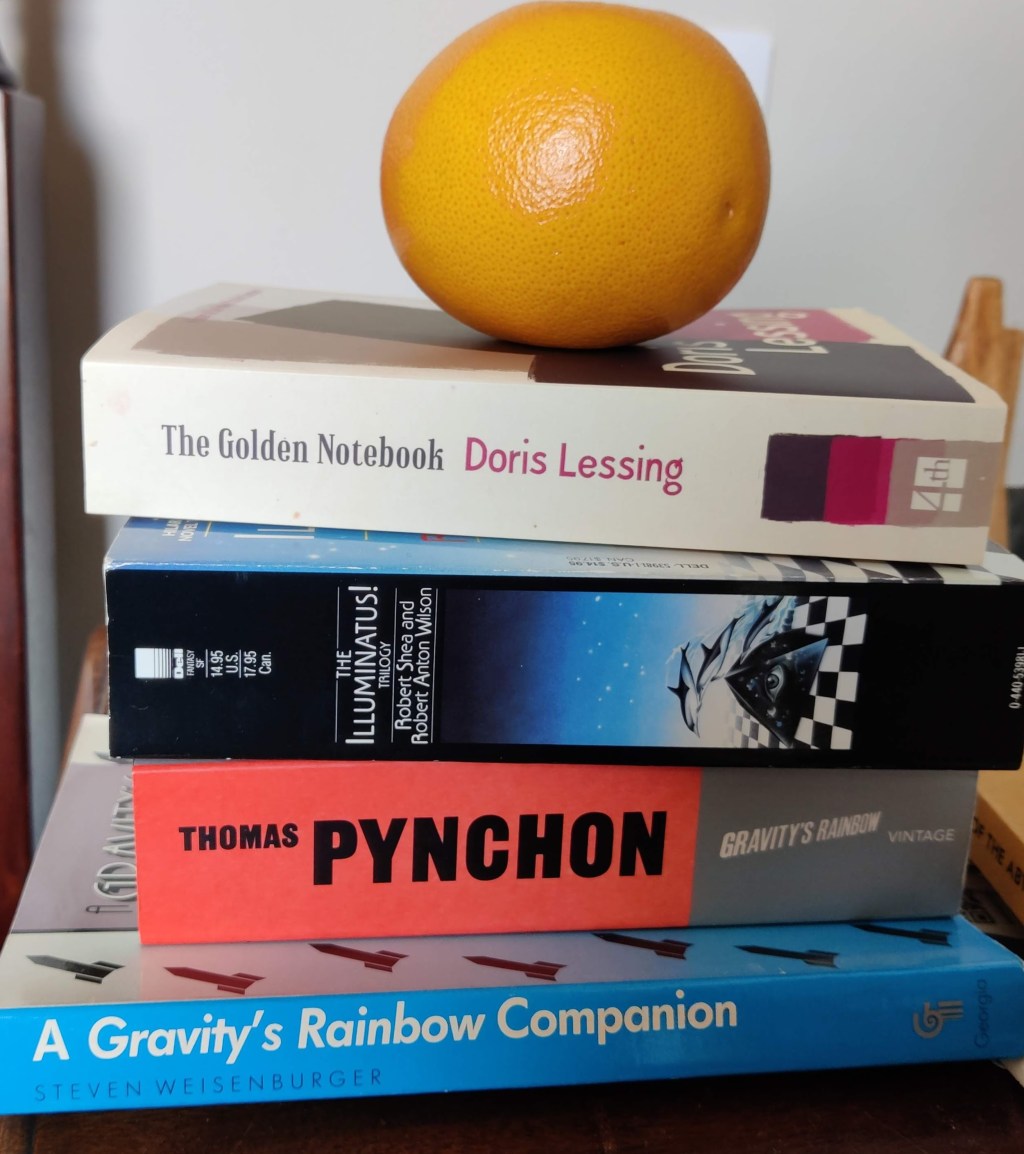
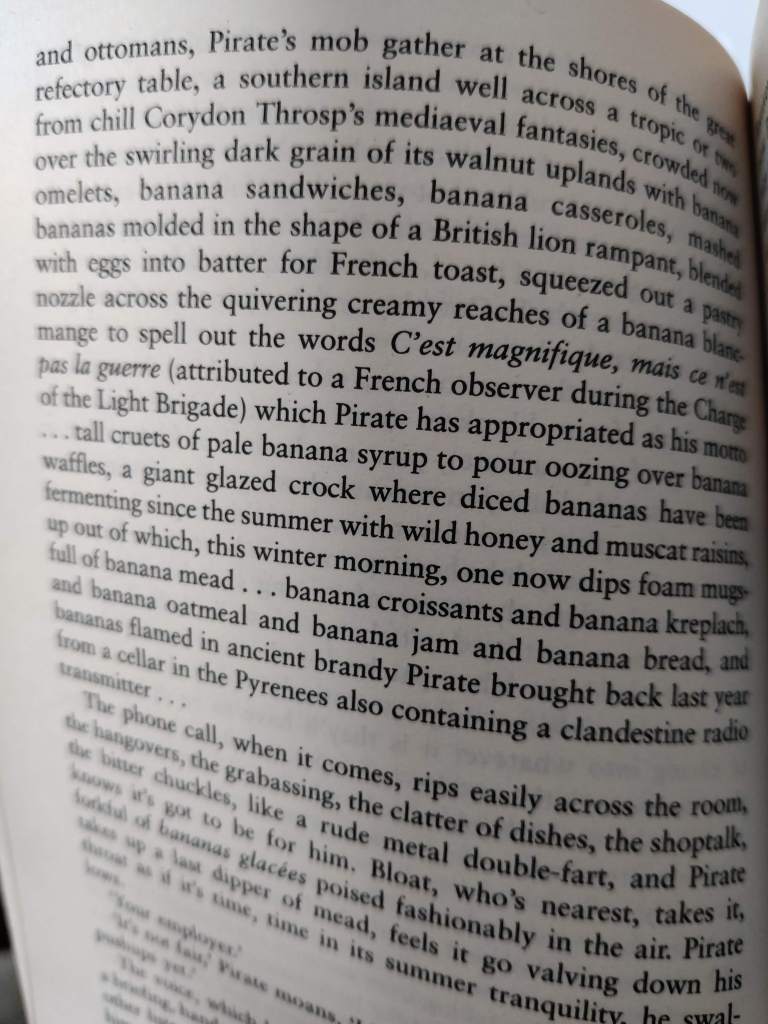
In another of their discussions – this time by email – the former GANTOB and The Benefaktor had talked about books that they did not think that they would ever finish – The Golden Notebook for Gillian, Gravity’s Rainbow for The Benefaktor. TB could not recall the reason for Gillian’s failure, but he remembered the snagging section in Pynchon’s book Gravity’s Rainbow (1973) alright. Intended no doubt as a cornucopia of delights, overflowing with bananas, The Benefaktor had been left feeling jaundiced. American authors do like to pad things out, outstay their welcome.
And this thought jolts him awake. He abhors nationalism. And generalisation. He pads through to the Dining Room to grab an apple – to rid him of that bitter taste in his mouth, and to crunch his teeth back into their sockets after half an hour with his jaw slack while asleep. He wipes dribble from the corner of his mouth with his fraying shirt sleeve. If he had not been doing this for forty plus years he would have worried that he was displaying signs of “decline”.
Outwardly, the fruit are absolutely still in their bowl when the old man approaches. But their insides are squirming. They are not worried by him – he’s far too old to notice their occasional itches and sneezes. They are thinking instead of the uncharacteristically early blossom. The older grapefruit issue warnings to Little Grapefruit and her generation. Beware the cherries.
The old man opens the window to the garden. It is uncharacteristically warm outside. Bird song and the almond scent of cherry blossom flood in. He heads out to the local greengrocer – a dying breed – and bags up some plump purple cherries that seem to call him from their box, marked with their price in kg and country of origin. He is not worried about the total bill. Or their source. He is thinking of Urs’ face when she sees the first proper cherries of the year. He’ll be in her good books for once. He has forgotten the trouble he caused last year when Urs stained her favourite cashmere cardigan with purple juice.
Despite the older grapefruits’ warnings, the cherries are instantly popular with the carefree citrus children. The cherries are sweet natured and great fun. They roll around freely and can squeeze through little gaps to meet their neighbours, snuggling in against the other fruit with their soft, smooth skin. There is nothing spiky or rough about a cherry. When you talk to them, you are comforted. Their speech pattern is gentle, like music, as if learnt from the birds that had tried to peck at them through the netting. They use simple words in short sentences. Nothing is difficult or complicated. The youngsters play games, sing songs and share meals. They are part of the family.
Big Grapefruit hasn’t met any of the Cherries before, because he works long hours outside Bowlingham. Returning home on the bus, he hears a group chanting a song. It has a nursery rhyme simplicity and is instantly catchy. He does not catch the words. He is thinking about being back home with his family. Big Grapefruit does not think anything more about it, but finds himself humming the tune when he rolls off the bus and heads home.
This tuneful Cherry is called Quinctilius, named after the quince family who had lived next door when he was growing up, as his Mum insisted on explaining whenever anybody asked. He hates the association with another type of fruit. He prefers to be known as Lee. He doesn’t like other fruit. Life for him is a game of “opposite day”.
“Black is white/ Day is night/ Left is right/ Dull is bright”, he sings. He is teaching his two sidekicks some of his ideas. They love this concept that everything is turned on its head. They ignore what everybody else says.
Gravity? Doesn’t exist.
Homework? Forget it.
Grey? What’s that?
Fruit and veg? Bad for you. Best avoid.
The Benefaktor is back in The Kino, resting after his trip out. He is listening to Latvian composer Ēriks Ešenvalds’ Rivers of Light (2015) on Radio 3. He loves modern choral music. He looks it up: considered a companion to another Ešenvalds work Northern Lights (2012). Aurora borealis. He is sure that there is a Bill Drummond connection there if he asks Gillian. But he would rather think about other associations.
Little Grapefruit is playing Pacman with her new friend Lee. Watch the ghosts, but don’t worry about the Power Pellets – focus on the bonus cherries. She dies her hair the colour of green maraschino cherries. What a rebel. Gets drunk on kirsch after eating too many cherry liqueur chocolates, setting fire to the stalks that are left over. High on sugar from full fat cherry flavoured Dr Pepper she heads out, daubing Lee’s new slogans in red on walls around the bowl. Black is white, Left is right. Right on.
The Benefaktor is worrying about world affairs. Gaza. Ukraine. Poland. The Baltic states. Opposition Day in the UK parliament. Trump, Truss. What a mess. Nationalism at the root of it all. It doesn’t make for easy dreams.
And Urs is left, as always, tidying up the pieces. She finds the bowl with its graffiti and bleaches it clean. She has known about the grapefruits’ nighttime activities for years. The Benefaktor must always have a grapefruit available in case there are kippers for breakfast, which there usually are. She has never seen them breaking out like this though.
But she’s old enough to know how to deal with the cherries. She doesn’t listen to their songs or read their ridiculous slogans. She picks up the handful that remain after their coups and putsches, pops them one by one into her mouth, and strips them of their deceptively sweet and juicy flesh before spitting their hard little stone hearts into the compost bin to be disposed of with the next food waste collection.
The Benefaktor, 24 February, 2024
Pamphlet 8 of the 52 Pamphlets
Some notes: maraschino is from the name of the cherry (marasca). The cherries are preserved in maraschino or a syrup of that flavour. What I found out in the course of writing this pamphlet is that marasca is from amaro (Italian for “bitter”), from the Latin amarus. I am reminded of my points on the word sanction in my Stuck blog. Amore vs amaro. Love or bitter. Amorous or amarus? It’s important to listen carefully in matters of the heart. I’m sure that Urs would agree.
My recollection of the banana section in Pynchon’s book Gravity’s Rainbow is perhaps misremembered. Flicking through my long ignored copy I can only see mention of bananas for a few paragraphs on page 12. I was sure that I had managed well beyond that on one of my previous attempts, but I cannot see a longer banana-themed section now. Bananas are not even mentioned in the index to Steven Weisenburger’s A Gravity’s Rainbow Companion (though the second edition of that book has a Warholesque banana cover). Having flicked through both books again this morning I am not convinced that I will be returning to either. Yet it is frustrating to be defeated by a book. And having spent time with Shea and Wilson’s book recently (grudgingly) I can see a number of parallels with Pynchon even on the sketchiest of reads. Perhaps somebody else will be able to advise.
The Philatelist has something to say about bananas and Thomas Baumgärtel’s spraybanane in the second GANTOB book (chapter 29; his chapters are additions and are not included in the blog).
If you have a piece that you would like to contribute to GANTOB’s 52 Pamphlets, then please check gantob.blog/pamphlet. If your application is accepted, then you will receive a personalised copy of your pamphlet by post, and a copy of the third book (52 Pamphlets, publication date January 2025). If you don’t have a copy of the second book and would like to read The Philatelist’s chapters, then you’ll need to make your case. I have a very small number of spare copies.
 GANTOB blog