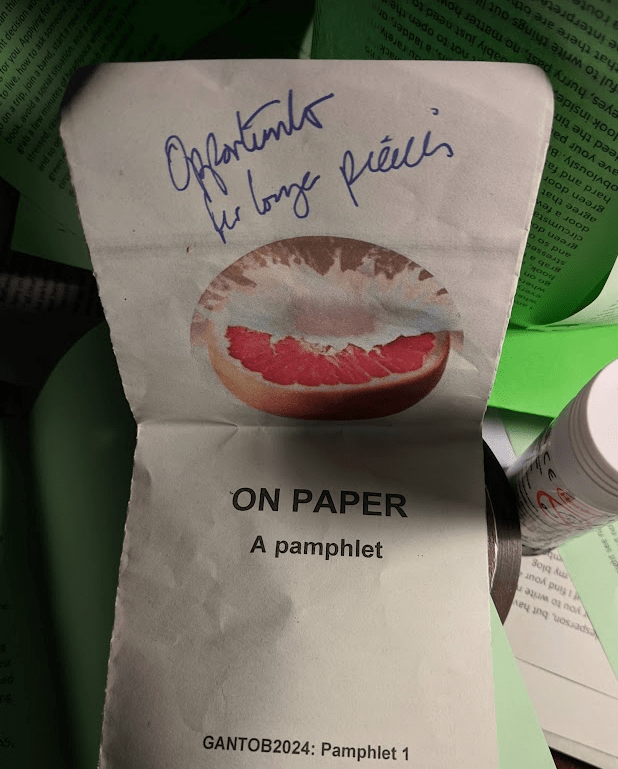
The first of 52 weekly posts/ pamphlets for 2024. These are longer pieces than the daily blog posts for the second book GANTOB’s 2023: A trilogy (which were 400 words long).
Authors have 800/1200/1600 words to explore a topic in more depth.
There are more details on how to make your contribution after Gillian’s introductory pamphlet: “ON PAPER”.
I am writing this in response to recent controversies and disappointments about books and other physical copies of paper documents.
First, in December 2023, there was the Ministry of Justice’s plan to destroy historical wills. They would be digitised, but archivists noted the loss of details that are not captured by digitisation – for example the type of ink and paper, indents of the pen – and the risks of losing information as formats change or systems are hacked.
Then on 2 January 2024 came the bombshell that Bill Drummond’s planned books – including his “memoir” The Life Model, with contributions lovingly crafted by 140+ volunteers for his 70th birthday – would be released only in web and audiobook formats.
This took me back to something that Evelyn Glennie, percussionist, mentioned in a repeat broadcast of Tom Service’s Music Matters recently. She noted that “Bill Gates encourages you to go into a bookshop and pick a book that you have absolutely zero interest in – something that you think is just not at all related to any of the interests that you have, or the job that you do – and see what happens.” Looking back at an article on the same theme I read: “Gates discussed how he takes notes while reading, sometimes writing in the margins of his books, to help him better remember and engage with what he’s reading. ‘For a lot of books that is key to my learning’”. There’s a lot that books remember, without even being asked.
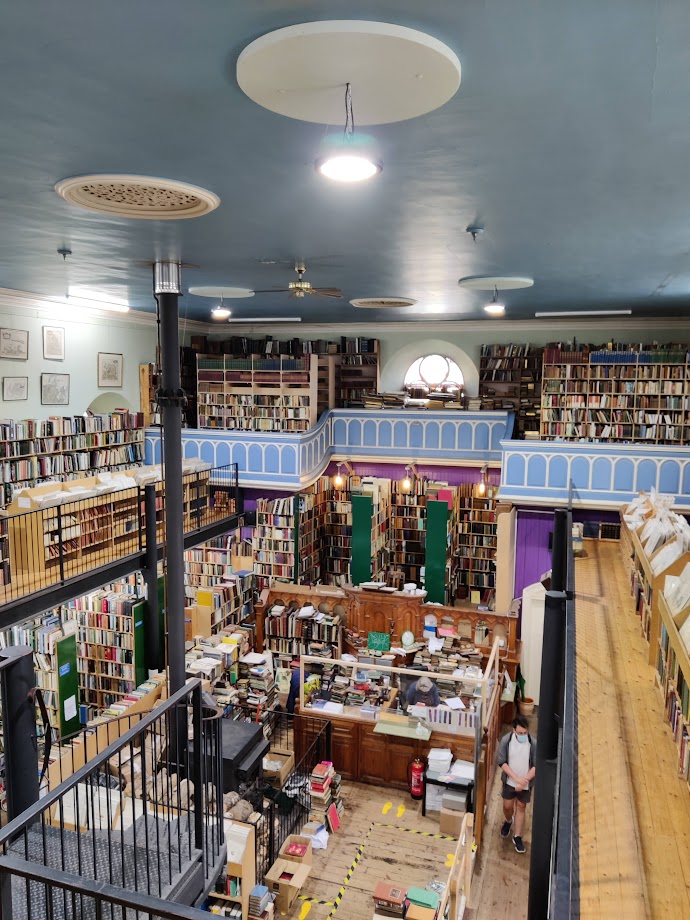
I worked in a bookshop for almost 6 years – a huge Frankenstein’s monster of a shop, over multiple floors and connecting sections, that had been strung together by knocking together different buildings along the front of an entire block in a university town; a site that could trace its history back much further. It’s not the bookshop pictured below. In the late 1980s I started in the schools department and antiquarian section on the top floor, but I must have visited every inch of that shop, including accounts, the multiple staff tea rooms, store cupboards, collections, each of the many departments (including children’s, remainders, the in house publishing company, front desk, local interest, stationery, music, gifts, modern languages, technical, law), and the basements and stairways through which books, exam papers, and supplies arrived, depending on the size of the delivery. I loved that shop – the staff, the customers, the books, the introduction to a world beyond my previously cloistered existence, working a range of shifts from 09:00 to 22:00, meeting people from all walks of life, from teenagers like me, to the tea lady in the management corridor who was said to be in her eighties, and authors including Iain Banks, and quite possibly Muriel Spark, if I had known who she was at that age. Politicians popped in (for example John Smith), and the evening security guard introduced us to a whole different clientele who skirted the boundary between the chaos of a street teaming with night life, and the warm, civilised interior. The joy of bricks and mortar.
So it will probably come as no surprise that I love books. Hardbacks, paperbacks, signed, annotated, pristine, tattered, fact, fiction, gift, donation, translation, whatever. I always carry a book with me, usually a small paperback, in case I have a spare moment. The book is a miracle of technology. It doesn’t need WiFi connection or require charging. And there are no algorithms to guide your selection and narrow your world view. Technical knowledge is not necessary – it’s not in a special folder or app, and can be transferred from bag to bedside cabinet, or handed on to somebody else regardless of their background or experience. Finding your place is incredibly easy. At the moment I am using a crocheted cat that my daughter gave me for my birthday as a bookmark. If I find myself reading something else at the same time I might use a train ticket or flier – which in itself may well tell a story, and could even take you back to a point in time that you had completely forgotten. Perhaps not a miracle then – more like magic.
I have tried other technologies of course, and they have their merits. My crocheting daughter loves e-books – the E-reader is compact, you can look up words in the device’s dictionary, and search and track your reading behaviours; but I don’t really want another expensive gizmo when I already have enough books to last a lifetime. Sometimes in the past I have listened to audiobooks on long commutes (usually on foot – unlike The Foundation Doktor on her bike), but I frequently found myself distracted and losing the plot, or frustrated in attempts to find my way back to a key passage, or willing the author to read just a bit faster, or without whining. Now I prefer to listen to the wind in the trees, waves on the breakwater, birds calling, people talking. I would rather not wear headphones at all – with all their associations with work since the pandemic, and feeling curiously vulnerable and disconnected when using them on a bus or park bench. At home I rarely have a quiet half hour to sit back and listen to a book without interruption. There’s the clatter of dishes, conversation, deliveries, crises. But I know plenty of people who love them, and podcasts. And it will be quite an honour to hear Bill Drummond read out my words and ideas.
I should also say that I love libraries – whether run by the council or Little Free Libraries. And charity shops, particularly Oxfam Bookshops. I have to confess, however, that I usually find antiquarian bookshops a bit intimidating – charting successive generations of largely forgotten writers. Most authors will be discarded all too quickly as tastes change. Martin Amis? So last year. My brother enjoys older works, including – moving backwards – Walter Scott, Laurence Sterne and Miguel de Cervantes. The survivors. I have mainly gravitated to mid to late 20th century, but have enjoyed books from the 19th century Rougon-Macquart series by Émile Zola recently, after a lucky dip, care of the Highland Council mobile library.
But let’s zoom forward to the 1980s and 1990s again. I have books that I bought in that bookshop that I still haven’t read. I don’t know if I ever will. They stand as challenges – The Golden Notebook by Doris Lessing is one. I cracked another much shorter book recently from the same shelf – William Golding’s The Spire. On three previous occasions I had given up on that in the same long section of dialogue, where I lost track of who was speaking. Ironically, an audiobook might have helped with that – a creaking voice for a dusty cleric, a looser, rougher brogue for the mason. It would take a talented narrator to pull that off convincingly – switching between voices in quick fire delivery.
And I wonder about electronic communication – websites, and blogs – which Bill Drummond proposes as a worthy substitute. Assuming he doesn’t pull the plug (again) before somebody captures it on the Wayback Machine internet archive. Sitting at the desk in that bookshop, before email or internet, I remember being shown a way in the command line to communicate between the computer tills. I cannot remember the operating system – perhaps CP/M, or Unix. We would while away the time sending short messages between floors in green text on black screens. Great fun at the time (before we realised that electronic mail would become a blight on most of our lives). Until one of us sent a message to the central computer in the shop – the one that only the manager could access when he arrived early each morning to complete the backup of the previous day. Woops. No control-Z or delete function. Apologies made and accepted after a sleepless night, we vowed never to use the system again. These messages, now long forgotten, stand as a reminder of the transient nature – and potential dangers – of electronic communication.
And with that, I declare my preference for a physical book. Each to their own. I can see the drawbacks of books. The remainders section of the bookshop was clear evidence of that. The place where books went to die, to get pulped, but from there to be turned into new books. It’s not all doom and gloom.
GANTOB, the imagined person, the “karakter”, may have ceased to exist at 11.59 on 1 January 2024, but GANTOB, the project, does continue. The Pamphlet Committee requests your submission of pamphlets for consideration towards “The 52”: a set number of weekly pamphlets by up to 52 authors, to be issued as:
- a bespoke printed version for that week’s author (with some GANTOB-type art), sent via snail mail each Saturday
- an online version here on gantob.blog each Saturday, for all to read
- a plain printed copy of the first 34 pamphlets from 2024, to be given away in book and vinyl drops to local charity shops and other carefully selected locations at the next Battle of Perth (Stirling, Scotland, 27 August 2024)
- a book, with the full text of all 52 pamphlets, bound into a GANTOB-branded A5 book to be published early 2025
There could be an audiobook version if contributors provide a spoken word recording of their piece. Indeed, perhaps that would be a good idea, as it builds in a form of proof reading and checking scansion.
In effect we will be constructing a memoir of 2024. Write it in the first person, or which ever person you want, and make it relevant to now, but building on what you’ve learnt so far in life. Or make it entirely fictional. Or philosophical. Relate it to the GANTOBverse in some way, however subtle, for bonus points.
As a guide, pamphlets should be between 800 and 1600 words, ideally an exact multiple of 400. Submissions to 100percentvinyl2@gmail.com should be made as soon as possible (first come, first served, unless something more suitable comes along), and no later than 27 December 2024. Suggestions for developing ideas or other modifications to the submitted pamphlet may be made by the GANTOB Pamphlet Committee.
Spread the word. Subscribe(*) to gantob.blog, and follow progress via @gantob2023 on X and Instagram. Good luck!
Gillian, 6 January 2024
PAMPHLET 01 (2024)
(*) I’ve added this link as an experiment – please let me know if it doesn’t work (you’ll need a WordPress account I think)
 GANTOB blog